community · environment · health

Healing Honey And The Beekeeping Craze : NPR

I’m far from home right now, and feeling it. I could use a touch of home…and for some reason honey seems very homey to me. Especially when it’s made at home! Don’t laugh, urban bee-keeping is becoming a big thing, as part of the local-vore, grow-your-own-food movement.

Beekeeping classes from Medina, Ohio, to the suburbs of Washington, D.C., and New York are seeing an unexpected shift in enrollment. Numbers are way up as thousands of novices take up the hobby. And who are these new beekeepers? Increasingly, they’re women.

“The surge has really been with younger, urban women,” explains longtime instructor Kim Flottum, who teaches beekeeping in Medina.

Flottum estimates that there are about 100,000 backyard beekeepers across the United States. Exact numbers are hard to pin down. But subscriptions to the publication Bee Culture are on the rise. And when Flottum published a how-to book — An Absolute Beginner’s Guide to Keeping Bees in Your Yard and Garden — 60,000 people snapped up copies. The book is aimed at making the hobby easier and using more lightweight equipment.

more via Healing Honey And The Beekeeping Craze : NPR.

anthropology · architecture · community · creativity · culture · design · environment · happiness

The Most Colorful Cities In The World

Living in the Pacific Northwest I can definitely appreciate the idea of adding more color to one’s life! Interestingly, it tends to be warmer climates that have the more colorful buildings, although Denmark and Finland has some of the most colorful interiors (and now exteriors) I’ve seen. Color has an amazing effect on human mental health and mood. People often talk about getting back into nature to see all the colors. Now, the colors can come to you (unless you live in a community with a rule against bright colors).

Urban life doesn’t have to be bleak and gray — in fact, many of the world’s cities pride themselves upon the bright palettes used to liven up their architecture. From the garish blue-walled buildings of Jodhpur, India, to the gentler pastels of Charleston, S.C., these cities are far from monotonous.

Charleston, SC
Charleston, SC
Nyhavn, Denmark
Buenos Aires, Argentina

More of The Most Colorful Cities In The World: Pics, Videos, Links, News.

anthropology · behavior · community · disease · education · environment · health · mental health · Social

How the places we live could heal us | Grist

This is an interesting follow-up/add-on to the RadioLab “Cities” episode I blogged about a couple of weeks ago. The Healing Cities Working Group of planners and health professionals in Vancouver, BC is working to create healthy environments in urban areas, particularly focusing on food and food sources.

It’s possible to interest public officials in the health impact of the built environment because Canada has nationalized health care.

“When you have a public health care system like we have in Canada, we all collectively pay the end-of-pipe costs,” said Holland. “So anything we have in our society that makes us unhealthy, we end up paying for it.” Of course, that’s true in the United States as well, but there is much less transparency and awareness of those costs because of the way our system is set up.

In Canada, Holland hopes to be able to involve doctors and public health authorities in the fight against sprawl and for more walkable and transit-oriented neighborhoods. Among the Healing Cities Working Group’s many planned initiatives is a partnership with health officials to advocate for more health-enhancing infrastructure and development at the local level.

via How the places we live make us sick, and how they could heal us instead | Grist.

Other studies have found that greener neighborhoods also decrease stress and make people more likely to walk or bike places. Where you live, what have you found works best for you personally to motivate you to get you outside, moving, and buying less insta-food?

community · culture · education · family · learning · play · school · Social · technology

HASTAC, Superman, and the school fair

The Education system in the U.S. has reached a pretty low low right now. This is currently being displayed on the big screen in the documentary “Waiting For Superman.” Film-maker Davis Guggenheim “follows a handful of promising kids through a system that inhibits, rather than encourages, academic growth, and undertakes an exhaustive review of public education, surveying ‘drop-out factories’ and ‘academic sinkholes’.” (IMDB)

So, what do we do about it?

Lots of things.

One idea is HASTAC, or Humanities, Arts, Science, and Advanced Technology Collaboratory. Pronounced “haystack”, it is “a network of individuals and institutions inspired by the possibilities that new technologies offer us for shaping how we learn, teach, communicate, create, and organize our local and global communities.” They’re the group behind Reimagining Learning (DMLcompetition.net), and other scholarly workshops.

Cathy DavidsonDuke University Co-founder, HASTAC; Co-PI, HASTAC, writes:

Traditional education too often forgets its precious social condition of face-to-face interaction and takes its collective opportunity for granted. If your classroom can be replaced by a computer screen, maybe it should be.

We are using lessons from collaborative open web development and peer-to-peer learning and assessment to storm the academy at the first international Drumbeat Festival in Barcelona, Nov 3-5. Surrounded by pioneering open source web developers and experimenters in online peer-to-peer learning, we are using methods of the open web to look back and at shake up traditional learning institutions. Were looking at four key areas that need storming: collaboration, syllabus building, assessment, and publishing (including peer review). Our chief idea is that face-to-face learning should not be taken as a given in education but as an affordance, as an opportunity not a default. How does thinking about the unique opportunity to learn together change the components of traditional learning?

more via We’re Storming the Academy! A Provocation and a Promise | HASTAC.

Teachers are already spending their own money to provide supplies for a fuller education experience.

“Vicky Halm spends a $1,000 a year out of her own pocket to equip her Brooklyn classroom. She buys star stickers to help motivate her students, but she also spends a great deal on basic supplies — such as pencils and paper.
A whopping 97% of teachers frequently dip into their own pockets to purchase necessary classroom supplies, according to a national survey conducted by Kelton Research. Last year, teachers spent more than $350 on average from their own income on school supplies and instructional materials, according to the National School Supply and Equipment Association” (CNNMoney)

There are lots of opportunities for students to gain hands-on learning outside of the classroom too. Zoos and Universities often have family or kid-only programs to try out.

“Children and parents hummed through wax paper-covered combs while jazz singer Jeni Fleming sang the “Science Saturday” version of “Hound Dog,” everyone rocking out to their newly learned blues chord progression. And so — with tingling lips and a room full of smiles — the second season of Science Saturdays came to a close. Over 900 children from Bozeman, communities as far away as Helena, Stevensville and Glasgow; and the Crow Indian Reservation have participated in Science Saturdays since MSU started offering the program in the fall of 2008, said Suzi Taylor, outreach director for MSU’s Extended University. (MSU News)

Parents can also organize these events. A blogger on GeekDad describes his son’s school fair:

For our school fete we blacked out a classroom with curtains and asked for donations from people to enter the “Corner of Curiosity.” It was amazing what people came up with. There was a delightful Plasma Ball near the entrance which was a favorite of the younger children, and a beautifully faded yellow newspaper from 1938 headlining concerns about Hitler’s leadership in Germany. One parent produced a display of the “history of mobile” phones and others had insect collections.

One student produced what has to be the most curious of collections – a collection of animal scats. A local community member supplied a whale vertebrae (and a kangaroo vertebrae for comparison). But, the real value was being able to present a fund raising activity for the school that was also educational. (GeekDad)

Any small measure, from buying markers to throwing a curiosity fair, helps enrich kids’ learning and keeps them wanting more. Even just a little bit of time each week adds up quickly.
Mental · psychology

Design*Sponge best of: Offices

Grace Bonney at Design*Sponge is creating a design book, but as a business owner also appreciates the need for your own creative/productive space. Hence, two blog posts (and hopefully book sections) dedicated to creating spaces that are good for productivity and innovation:

…there are over 20 amazing offices in this final group, ranging from simple, minimalist desks to colorful offices that will wake you up with bright paint and hot pink piping. Visit here for Part One.

[image above: i love the matisse print above d*s editors (and horne owners) ryan and alissa’s beautiful home office in philadelphia]

[image above: i love all the green (and the cute paris print!) in julie murphy’s home (founder of jack and lulu)]

more at DesignSponge » Blog Archive » sneak peek best of: offices part two.

architecture · creativity · Mental · psychology

Rx Art For Hospitals: Just What The Curator Ordered : NPR

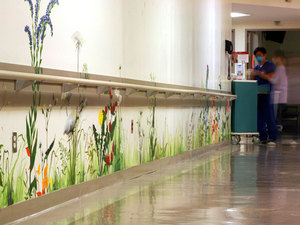
Being able to relax during medical treatments makes treatments more effective, as well as making better patients. Diane Brown is working to add a little art and light to a scary place: hospitals.

“While hospitals have become more physically welcoming in recent years, with new buildings designed by famous architects and lobbies filled with art, those changes rarely find their way to some of the hospital’s most difficult spaces — the rooms filled with machinery where treatment actually happens.

Diane Brown is trying to change that. She’s the founder of Rx Art, a nonprofit group dedicated to bringing art into the examination room and giving patients a way to escape their bodies’ sickness through their minds’ imagination.”

more via Rx Art For Hospitals: Just What The Curator Ordered : NPR.

Mental · Nature

The importance of healthy sound

I posted this on my other blog, Art of Science, because it concerns the science behind pretty sounds, but it’s also important from an environmental enrichment perspective – in fact that’s what Julian Treasure does for a living – so I wanted to also post it here:

From Art of Science

Listen to Julian Treasure’s TED talk about sound. [And really listen! Close your other computer screens, turn off the email “ping”s and listen.]

Treasure says our increasingly noisy world is gnawing away at our mental health — even costing lives. He lays out an 8-step plan to soften this sonic assault (starting with those cheap earbuds) and restore our relationship with sound.

Julian Treasure is the chair of Sound Agency, “a firm that advises worldwide businesses — offices, retailers, hotels — on how to use sound. He asks us to pay attention to the sounds that surround us. How do they make us feel: productive, stressed, energized, acquisitive?

Treasure is the author of the book Sound Business and keeps a blog by the same name that ruminates on aural matters (and offers a nice day-by-day writeup of TEDGlobal 2009). In the early 1980s, Treasure was the drummer for the Fall-influenced band Transmitters.” (Source: TED)

Nature · Social

PARKing Day in Seattle

Speaking of public creativity, yesterday Seattle held its third annual PARK(ing) Day demonstration. Despite the drizzly weather, several groups such as the Trust for Public Land, Piper Creek Nursery, Hazard Factory, and others* came out to raise awareness about open space and promote public space and parks.

From the website:

PARK(ing) Day is an annual, worldwide event that inspires city dwellers everywhere to transform metered parking spots into temporary parks for the public good.

It’s happening already in Australia, Japan, Korea, and for the first time ever, in China! Rebar is up bright and early for the first major PARK(ing) Day installation in Paris. And hundreds of you are preparing to please the public with your own PARKs across Europe, America and beyond.

More at parkingday.org.

Seattle held their event outside the Seattle Art Museum (SAM) downtown. One of the representatives from the Public Land Trust told me how the rotten economy has led people to hold more events outside in public places, from business picnics to yoga classes, raising awareness of all the public space Seattle has to offer and why it’s important to maintain these and add more. Hopefully people won’t forget that once the weather turns bad, or the economy turns good.

Here are some of the pictures I took at the Seattle event:

Park(ing) Day, SAM, Seattle WA 2010
PARKing Day outside the SAM, Seattle WA
Parking Day Seattle 2010 line-up
an arts+crafts table and lounge area were set up for visitors to PARKing Day
Parking Day Seattle 2010 Mark a Park
The Trust for Public Land set up a map for people to mark parks that they liked, could use a little love, or places they wanted parks.
Parking Day Seattle 2010 Bear feet
Bear feet drawn by a little girl visiting the event
PARKing Day activity, Rusty Oliver, Seattle 2010
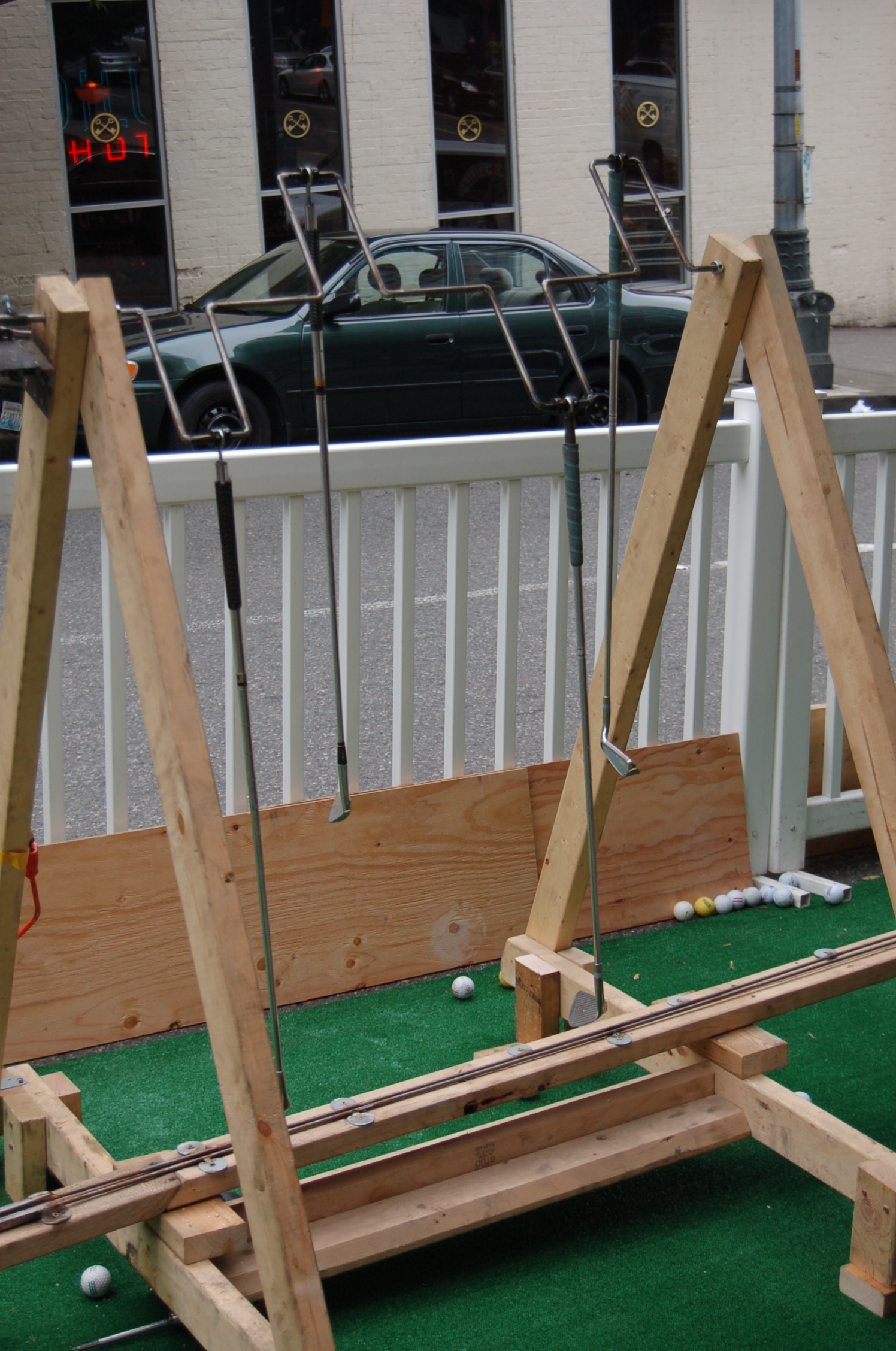
Rusty Oliver, artist behind the Hazard Factory, devoted his PARKing space to this portable mini-golf obstacle he built.

Hopefully the weather next year will be nicer and bring out more participants.

*If I missed any organizers, please leave their names in the comments and I’ll update this post. Thanks!