behavior · brain · environment · health · mental health · neuroscience

Your brain on oceans, now part of a study

Fishing in the Maldives
The ocean has a significant, presumably positive, effect on the brain. Image via Wikipedia

Several researchers have looked at the effects of nature on the brain, but usually look at wooded environments. But how does the ocean effect us? Some argue a lot.

One researcher, Wallace J. Nichols, is looking at the effect that the ocean has on our brains.

If the ocean has a direct, neurological impact on our brains, an awareness of this connection will change the way we treat it—and the policy implications could be profound. That’s the hope, at least, that motivated “neuro-conservationist” and turtle specialist Wallace J. Nichols to invite a group of neuroscientists, marine scientists, journalists and artists to start a conversation about our emotional connection with the sea.

Nichols thinks that our grey matter is actually uniquely tuned into the Big Blue. “When we think of the ocean—or hear the ocean, or see the ocean, or get in the ocean, even taste and smell the ocean, or all of those things at once,” Nichols said in an OnEarth interview, “we feel something different than before that happened. For most people, it’s generally good. It often makes us more open or contemplative. For many people, it reduces stress.”

Nichols aims to tap into this emotional response to oceans—what he calls the Blue Mind—to help build support for responsible stewardship of the world’s marine ecosystems.

more via This Is Your Brain on Oceans

I like the term “neuro-conservationist,” but I’m not sure what it means exactly, even after reading this article. But anecdotally I agree the ocean has a definite effect on the brain.

What information or experiences are already out there that involve the ocean.

behavior · children · education · mental health

Reading, Writing, Empathy: The Rise of ‘Social Emotional Learning’ | GOOD

Creative Curriculum: CDCs provide tools to con...
Learning how to empathize improves the entire learning process. Image by familymwr via Flickr

How does empathy and social learning improve the learning experience at schools? A lot, apparently! And some research is finding that actively teaching empathy and social understanding can be taught in a public school setting, with great benefits for the entire learning process:

At a time of contentious debate over how to reform schools to make teachers more effective and students more successful, “social emotional learning” may be a key part of the solution. An outgrowth of the emotional intelligence framework, popularized by Daniel Goleman, SEL teaches children how to identify and manage emotions and interactions. One of the central considerations of an evolved EQ—as proponents call an “emotional quotient”—is promoting empathy, a critical and often neglected quality in our increasingly interconnected, multicultural world.

Brackett quickly learned that developing empathy in kids requires working on their teachers first. Ten years ago, he and his colleagues introduced a curriculum about emotions in schools, asking teachers to implement it in their own classrooms. When he observed the lessons, he was struck by the discomfort many of the instructors showed in talking about emotion. “There was one teacher who took the list of feelings we had provided and crossed out all of what she perceived of as ‘negative’ emotions before asking the students to identify what they were feeling,” Brackett says. “We realized that if the teachers didn’t get it, the kids never would.”

So in 2005, Brackett and his team at the Health, Emotion, and Behavior Lab at Yale developed a training program—now called RULER—that instructs teachers in the skills, knowledge, and attitudes necessary for emotional health, then helps them shift the focus to children. The program focuses on five key skills: recognizing emotions in oneself and others, understanding the causes and consequences of emotions, labeling the full range of emotions, expressing emotions appropriately in different contexts, and regulating emotions effectively to foster relationships and achieve goals. Classrooms adopt “emotional literacy charters”—agreements that the whole community agrees to concerning interpersonal interactions—and kids use “mood meters” to identify the nature and intensity of their feelings and “blueprints” to chart out past experiences they might learn from.

Read more at Reading, Writing, Empathy: The Rise of ‘Social Emotional Learning’ at GOOD Magazine.

architecture · community · environment · happiness · health

Seattle Neighbors Fight Stormwater Pollution by Building Rain Gardens · Oregon Public Broadcasting

This post is a total plug on my part of an activity meant to encourage people to go out and get their hands dirty, improve their environment, and help nature at the same time: Rain gardens!

Gardening season is coming to an end for most of us, but it’s not too late to plant a rain garden for this winter’s torrents.

Rain gardens are becoming more popular, especially in places like Seattle with significant rain and run-off, and I suspect also because they’re very low maintenance; you simply plant, water them until they’re established, and let nature to the rest. They also make the neighborhood look nicer than just having a strip of grass between your car and the sidewalk.

The West Seattle neighborhood is actively encouraging residents to plant rain gardens:

The gardens are part of a campaign by Washington State University and the non-profit Stewardship Partners. Their goal is to install 12,000 rain gardens in Puget Sound communities by 2016. So far, more than 700 gardens have been installed (see a map of them) and more are being added every week.

“Twelve thousand gardens will absorb approximately 160 million gallons of stormwater each year,” said Stacey Gianas, who is with Stewardship Partners.

That much water would fill 250 Olympic swimming pools. And its stormwater, which washes over roofs and streets, picking up all kinds of pollution. Usually that contaminant-filled water runs into storm drains that empty into waterways and rivers.

more via Neighbors Fight Stormwater Pollution by Building Rain Gardens · Oregon Public Broadcasting · EarthFix.

Rain gardens can be as small as a couple of feet, or take up the entire yard. They also promote wildlife (the good kind!) to stop and visit.

anthropology · behavior · creativity · happiness · health · mental health · play

The Shape of Enrichment – ICEE conference taking place this weekend in Portland, Oregon

There are people who get paid to come up with games and toys for animals. Just like people, animals need something to do all day to keep themselves fit and healthy, both mentally and physically. This has been dubbed “enrichment” by people who study this kind of thing, but it basically is just looking at ways to encourage animals to play.

This weekend enrichment experts are all getting together to discuss different ways to provide better enrichment (i.e. toys, games, crossword puzzles) for animals that live in zoos, aquariums, research centers, and so on.

I am sorry I am missing this conference; it sounds amazing!

The mission of the ICEE is to improve the wellbeing of captive animals by providing a venue for the exchange of information among the many diverse groups that participate in environmental enrichment. A key feature of the ICEE is the participation and interaction of animal welfare scientists and all those responsible for the care of captive animals. To further this mission, the ICEE Committee organizes a biennial conference, with published proceedings, in locations around the globe.

more via The Shape of Enrichment – ICEE.

I wish I could go, but I’m doing a little bit of self-enrichment this weekend so am otherwise engaged (plus $400 is a bit steep for me), so I will just lurk on the website for awhile and see what updates pop up. OR, if you’re going you could post in the comments and let me know what I missed? Or, even better, if you know of other events coming up soon, share them here! Thanks!

architecture · behavior · community · creativity · environment · happiness · play

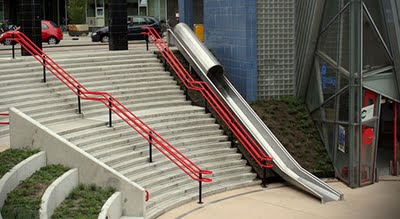
Slide into work with the subway slide in Holland

Thanks to the blog Cup of Jo for finding this:

Leave it to the Dutch to install a slide in a subway station. Commuters are encouraged to use it if they’re running late, and the official name is a “transfer accelerator.” At night they play Bach. How rad is that?!

more via A CUP OF JO: Dutch subway slide.

I love the idea of putting a little fun in your commute, in the community, and just keeping your environment fun in general.

Where else have you seen a little fun put into everyday surroundings? I’ve posted about the musical stairs before, but what else is out there? Some silly graffiti? Colorful cars? Share in the comments below.

community

Seattle gets OK to build Burke-Gilman Trail’s ‘missing link’ in Ballard | Seattle Times

Burke-Gilman trail in Seattle, WA
Burke-Gilman trail in Seattle, WA with the "missing link" shown.


I love cruising down the scenic, flat (which in a city of hills is wonderful), and also pedestrian friendly Burke-Gilman trail on my bike, passing parks, restaurants and coffee shops, trees, and amazing water views all the way from my home (kinda) near Lake Washington all the way to Golden Gardens beach. I have also experienced this “missing link” myself; a spot where the trail just disappears and you’re forced to share the road with giant trucks moving cargo in and out of ports. I always wondered why there was this gap, and I’m glad to see the city pushing to finish the trail.

After months of appeals, the Seattle Department of Transportation SDOT can finally begin construction on the “missing link” of the Ballard portion of the Burke-Gilman Trail, a Seattle hearing examiner ruled last week.

The hearing examiner ruled that the Shilshole Avenue Northwest portion of the “missing link” does not pose a significant environmental risk.

The ruling means the city will not have to conduct a full environmental-impact report for that section of the route, which runs along Shilshole Avenue Northwest between 17th Avenue Northwest and Northwest Vernon Place, and can move forward on its plans for the expanded trail. When that may happen is still undecided, however, said Rick Sheridan, communications manager for SDOT.

“We do fully expect that this will once again be appealed to the King County Superior Court. However, the city is eager to begin construction on a fully funded and fully designed missing-link segment,” Sheridan said.

The missing-link portion of the trail would fill a gap of approximately 1.5 miles between 11th Avenue Northwest and the Ballard Locks on the Ship Canal.

via Outdoors | Seattle gets OK to build Burke-Gilman Trail’s ‘missing link’ in Ballard | Seattle Times Newspaper.

I’m not sure why the city doesn’t have to conduct a full environmental impact, that part is a little concerning. But, considering how built up and industrialized the site already is, I’m also surprised there isn’t one already floating around somewhere they could use or build off of.

I am happy to see cities focusing on making cities more walkable or at least more bike friendly.

behavior · brain · happiness · health · Me · mental health

June is “Me” month

Cardio Boxing Group Fitness Class
This month, kick your self-maintenance into high gear! Image via Wikipedia

Interested in joining me for a little “me” time? How about a whole month of it?

My mother and I have decided that for June, 2011, we are going to be totally self-centered. That’s right, we are going to focus entirely on ourselves; our health, our mental wellness, our physical fitness, taking time for ourselves, and figuring out what we want out of life. Neither one of us is very good at this kind of self-focused behavior, so it will be an interesting experiment to see if we can both pull it off.

So far I have done pretty good: I woke up early and did a productive, challenging workout, I have eaten quite healthy meals (oatmeal with raisins and a tuna salad, thank you very much!), did not spend an exhorbitant amount of time at work, tidied up some stuff online I’ve been meaning to do, finally asked my boss about a couple of nagging issues, and am planning to spend time doing fun stuff with my husband before going to bed at a reasonable hour. I actually started a day early yesterday and bought new clothes (some new, some new-to-me) that made me look and feel good, and had a decent dinner. Pretty good track record for only a day and a half.

I invite everyone to join me for “Me” month. If you can’t do a whole month, maybe choose a week. Or even one day a week. This isn’t about indulging in your every whim or being hedonistic or a narcissist. It’s about taking care of yourself for an extended period of time. Getting enough sleep. Eating healthy food, and not too much. Moving around, getting exercise. Figuring out who and what you want to spend more time on and DOING it!

We all have things we could be better at for self-maintenance, and often we take a lopsided approach. Some people focus entirely on what they put in their bodies, some only focus on how their body or mind performs, paying no attention to the other side. But we are all one big giant package of tissue and firing neurons, and all of it needs to be taken care of, not just the muscles OR the brain OR some other feature (your hair?).

Recently I asked what your deathbed regrets would be, so think of this as the next step: what can you do today to take better care of yourself, to make sure you don’t have those regrets, or at least delay that deathbed a bit more? I know some very healthy, well-rounded people, so I’m curious to see what they secretly think they need to work on.

Take some time to think about what your body and mind really need, unless you already know, and leave it in the comments below.

behavior · children · community · creativity · health · play

6 Ways To Get Kids Outside And Moving This Summer, suggested by Kaboom

KaBOOM! CEO Darell Hammond
Kaboom CEO Darrel Hammond (told ya' it wasn't the SNL guy!) Image via Wikipedia

It doesn’t really feel like summer here in the Pacific Northwest yet, but we’re already scheduling picnics and camping trips and weddings and all kinds of outdoor activities in hopes of the weather getting nice. But there are more ideas for getting outside than (hopefully not) tedious nuptials or a forced march uphill. Darrel Hammond, CEO of Kaboom (not the SNL guy), has some ideas specifically for families:

Summer should be a time for roaming, discovering and running outside — but unfortunately, for all too many kids, more free time means more screen time and more structured activities.

It’s up to you to ensure that your kids get a healthy daily dose of unstructured outdoor play. Here are six ways to get your children moving, nurture their creativity and provide them with all the rich learning opportunities that outdoor play presents. In the process, you’ll meet new neighbors and contribute to a nationwide movement to save play.

Suggestion #4: Close a street for play. I’ve actually seen several neighborhoods around town grab a permit for the afternoon to close down their street and have a block party. Some cities are probably easier to work with than others, but the idea of a block play party sounds fabulous!

We all need a little push to get out the door (especially when it’s too hot, too cold, too windy, not windy enough, etc.), so having a planned event or project like this can be very useful.

more suggestions by Darell Hammond: 6 Ways To Get Kids Outside And Moving This Summer.

Kaboom! is a play-focused non-profit that is working to ensure that every child has a great place to play within walking distance of their school or home. They certified a playground here on Mercer Island, WA, and are working to install or certify others all over the U.S. Another idea to get your kids out and active: help build a playground!

architecture · behavior · brain · community · design · disease · environment · health

A Better Way to Fight Obesity: New, Smarter Supermarkets | The Atlantic

"The New Fred Meyer on Interstate on Lomb...
Image via Wikipedia

I heard an interview on the radio today with Rupal Sanghvi, the founder of HealthxDesign (“Healthy By Design”), an initiative she launched in 2010 after a decade of work with the International Planned Parenthood Federation.

During her years in the field, Sanghvi observed numerous instances in which people developing public health solutions overlooked contextual factors that were contributing to the problem. In clinics, for example, she saw how redesigning ventilation systems, retrofitting inefficient lighting, or choosing different building materials could improve
treatment conditions and accessibility, but these things were rarely addressed. Likewise, in supermarkets, features like store layout and air temperature can influence purchasing decisions, but food access initiatives often stop short of such nuances of structural design.

“Standard supermarkets are designed to promote consumption of foods that are high in sugar and preservatives,” explains Sanghvi, “because those are the high-margin items that maximize profit.” According to current guidelines, in an average 10,000-square-foot supermarket, only 500 square feet must be utilized for fresh produce. If the U.S. spends millions to build supermarkets according to the conventional mold, she argues, we may see some improvement in public health simply as a result of increased access to food, but we stand to achieve far better outcomes if we first reconsider supermarket design itself.

more via A Better Way to Fight Obesity: New, Smarter Supermarkets – Sarah Rich – Life – The Atlantic.

This is a great point being made about how our environment has a huge impact on our behavior, as well as corporate responsibility for health and wellness, and not just profits. This seems especially important for food stores, and I’m glad to see somebody taking up the cause.

Related:

Supermarket “Video Game” Designed to Help Shoppers Buy Healthier Food

architecture · behavior · culture · design · environment · happiness · Nature

Seattle has too many bleak public spaces | Crosscut.com

Seattle Skyline view from Queen Anne Hill.
View of Seattle's city skyline. In such a gorgeous part of the U.S., Seattle itself is lacking in pretty public spaces. Image via Wikipedia

In case y’all hadn’t noticed yet, I’m a huge proponent of utilizing public space for community use and creating an overall aesthetically pleasing environment for people. Cities have one of the greatest opportunities to provide that for their citizens. So I was thrilled when I read this article in Crosscut Magazine arguing the same thing, specifically for my hometown of Seattle.

Our landscape-oriented mindset should have been good preparation for what we need in the densifying city now, which is more design intelligence given to the open spaces between buildings — plazas, parklets, and awkward leftovers like the places under freeway overpasses. The more the air space around us becomes stuffed with architecture, the more acutely we need the relief of thoughtfully landscaped open spaces on the ground. Arguably, these spaces are more important in the built environment than most buildings because they’re public — people use them.

Or if they’re emotionally cold, dreary, or austere, people don’t use them, which is the case with a number of Seattle’s precious open spaces. On one of our desperately rare sunny spring days this month, I visited about a dozen open spaces in the dense city and found — no surprise — the bleak ones practically unused and the beautiful ones full of life. What is surprising is that we’re not demanding more graceful, humane, imaginative design — and raising hell over trends such as Seattle Parks and Rec’s inexplicable new fascination with concrete and gravel.

The article goes on to provide examples and suggest different fixes for a couple of spaces. More via Why does Seattle have so many bleak public spaces? | Crosscut.com.