I tweeted about this short film yesterday, but I really feel like this is worth giving some space on the blog for.
The value of play is important for teaching life skills like conflict resolution and collaboration, health lessons, healing from trauma, building community and just overall survival as a child and human being, the work this organization does seems simple but is hugely important.
This short video highlights some of the incredible impact that play can have on a child, or group of children.
You can also visit the organization’s website at Right to Play.
I don’t recall this parable from Dr. Seuss, but I like the idea of a bubblefest!
If you want to recapture your childhood this weekend, head to Cal Anderson Park in Seattle, WA, with a gallon or so of soapy liquid for Bubble Bath Seattle, the biggest bubble fight this city has ever seen.
From 3:00 pm to 5:00 pm, Cal Anderson will transform into a sea of bubbles. Evidently these events have been going on in New York for years, but it’s the first time that Seattle has ever seen something this epic. Organizers draw inspiration from Dr. Seuss’s The Butter Battle Book
These findings make sense to me and yet also don’t.
Image credit: Carnegie Mellon University
Few environments feature such a cacophony of decor as the elementary school classroom. Colorful bulletin boards, scientific posters, state maps, and student artwork tend to cover nearly every inch of wall space. Yet a new study on classroom design from researchers at Carnegie Mellon University suggests that all that educational flair may not be all that great for getting kids to learn.
The study, carried out over two weeks, examined 24 kindergarten students who were taught six lessons on topics they had not yet learned in school. Half the lessons were taught in a highly decorated classroom environment, with posters and art all over the walls, and the other half were taught in a classroom with no decoration.
CMU’s researchers found the kids spent more time off-task and were more distracted when the room was brightly decorated, and they tested better on subjects they learned in the sparser classroom compared to the ones they learned in the more visually stimulating environment.
Elementary school children typically stay in one room all day, so classroom decorations don’t necessarily match the subject matter they’re learning at any given time. If they’re sitting in front of a U.S. map, they’ll be looking at that all day whether the current lesson is on geography or math. This study, though very small, adds to previous research from the same psychologists showing that visual stimulation that’s irrelevant to on-going instruction can distract kids.
The study doesn’t go on to offer any ways to necessarily improve the classroom design, although the article does give other links discussing it.
Nature can be fairly visually cacophonous, so what is it about classroom designs that are so distracting? I also wonder how much of their distraction is from an unnatural learning style, and then other more engaging things to look at. That is not an attack on the teacher, I’m just skeptical whether any human is capable of sitting in one room for 6-8 hours, with a couple of lunch breaks, and concentrate the entire time, for an extended period of time. Even grown-ups have a hard time doing that, and suffer when they try to sustain that for too long.
What are your thoughts? Leave them in the comments below.
This is a nice study that looks at the value for kids, but unstructured creative and/or play time is important for adults AND kids.
German psychologists find people who were allowed to play freely as children have greater social success as adults.
There has been plenty of hand-wringing in recent years about the “overscheduled child.” With after-school hours increasingly dominated by piano lessons, soccer practice, and countless other planned activities, many of us have a nagging sense that kids are missing out on something important if they have no time for unstructured play.New research from Germany suggests these fears are justified. It finds people who recall having plenty of free time during childhood enjoy high levels of social success as adults.
A team of three psychologists from the University of Hildesheim, led by Werner Greve, conducted a survey of 134 people. Participants were presented with a list of seven statements and reported the degree to which they conformed with their own childhood experiences that is, ages three to 10.
Nice to see toys being introduced that work with already existing toys (sticks!), and encourages kids to go find their own sticks and go play in nature.
As an inductee to the National Toy Hall of Fame, the stick doesn’t need much improving as a classic toy. For as long as there have been children and sticks, sticks have served as a versatile toy in outdoor play. But connecting sticks takes a bit of ingenuity.
Enter Christina Kazakia, a design student with a mission. As she explains, “I designed these flexible silicone connectors as part of my graduate thesis in Industrial Design at the Rhode Island School of Design. My goal was to create prompts to engage children with their surrounding natural environment.” Called Stick-lets™, these connectors help small children build big structures like forts, teepees, lean-tos, or other creations.
Visitors to the Philadelphia Zoo might want to beware of stray cats: A new enclosed passageway allows lions and tigers to roam outside their exhibits.
Humans, though, can safely gawk at the predators traveling along Big Cat Crossing. The protected, open-air path snakes above the felines’ habitat to an archway over the zoo’s main promenade and ends at a viewing spot along a lake.
The concept for the catwalk unveiled Wednesday stems from the increasingly common practice of animal rotation, which lets animals take in new stimuli while visitors encounter them in unexpected places.
Big carnivores are roamers, and prefer to have lots of space to patrol. Being able to get a cat’s eye view of their zoo is so much healthier for them, and gives them the enrichment and psychological and physical space they need to stay healthy.
I had heard about the plans to create this space, so it’s really nice to see it implemented and in action.
A great article about how building playful spaces leads to more, and better, play.
Can playgrounds make kids smarter? Yes, say the experts, and landscape architects everywhere are responding. Welcome to outdoor play’s new reality.
All work and no play makes jack a dull boy. Granted, Jack does not lack for innovative toys and gadgets. But what Jack really needs is better playgrounds. These days, reality is exchanged for a simulation of reality, and the sandbox is abandoned in pursuit of the virtual. Cognitive scientists, however, are finding that the unstructured activity children engage in at the playground fosters the social and intellectual abilities they need to succeed in life. Monkey bars and swing sets present opportunities to develop new skills, encourage autonomous thinking and promote flexible problem solving – but they also shape the brain. This is good news. With technology taking over so much of our lives, increased pressure on children to compete academically at a much younger age, and helicopter parenting restricting play for fear of potential danger, many experts – such as David Elkind, psychologist and author of The Hurried Child – are drawing attention to the “reinvention of childhood.” It is time we also reinvent the playground.
A first-hand account of being involved in a large community-organized play event.
As much as I love Philadelphia, I never considered it a breeding ground for innovation, but over the past few years, the city has built up enough of a tech scene to spawn an entire week dedicated to celebrating it. To kick off its fourth year, Philly Tech Week gave locals the chance to play Tetris on the Cira Centre, a building conspicuous for bearing a grid of color changing LEDs that sometimes display the Phillies logo. It’s the second game Drexel University professor Frank Lee has brought to the Cira Centre, topping his giant Pong game last year. “What was gratifying for me about the Pong project last year was not that it was the world’s biggest videogame display, although that’s kind of cool. Rather, it was the sharing of the moment by the two people playing, the hundreds of people watching, and thousands of people across Philadelphia watching,” says Lee. Similarly, giant Tetris is more of an art project than a feat for the record books. Lee aims to create a social benefit, what he calls an “aesthetic of a shared moment.”
Just a fun side note: being part of a large collected effort, whether it’s volunteering at a beach cleanup or playing group Tetris, is very beneficial to mental health as well.
This past Saturday was International Pillow Fight Day, for example, and it received a lot of positive feedback from grown-ups who participated, even with the occasional mention of a hard hit. So pull out the cubes and let’s get it on!
We’re too late to join Elisabeth Stone on her group session she had back in February, but I still loved this idea of making a 21 day challenge to get outside!
21 Days in the Woods is a connection project to get you and your family out in the woods once a day for 21 days. It is well-structured and adaptable to any age range. When you purchase your immediate download of the workbook, you can choose to work through it now or later
April has just started, and it’s starting to feel more and more like Spring, so take a look and see about how you can challenge yourself to get out into the woods.
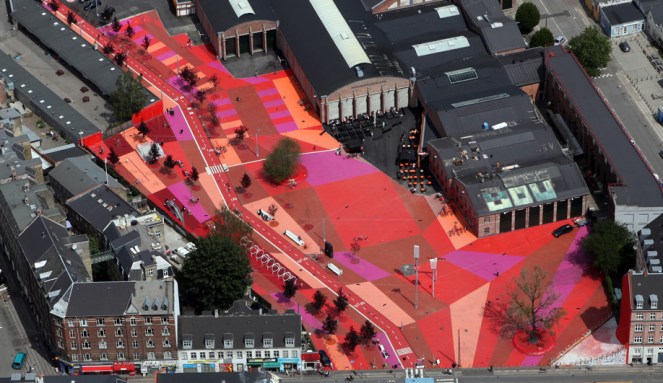
Having fun, exciting spaces to play is important for both kids and grown-ups, so it’s nice to see what’s out there for kids, and hopefully grown-ups will follow suit.
When you’re a kid, visiting an amazing playground is the greatest experience ever. And these fantasy-themed playgrounds around the world have us wishing that we were kids again so we could run around in them like small, crazy people.
All of these are in more urban settings, and it would be cool to see some more natural playscapes, but the ideas behind some of these parks are fantastic!






 Mental Flowers