
Using some creativity, playfulness, and friends to bring “nature” and community to the city? Yes, please!
Tag: creativity
Dalston House: where every visitor becomes Spider-Man – video | Art and design | guardian.co.uk
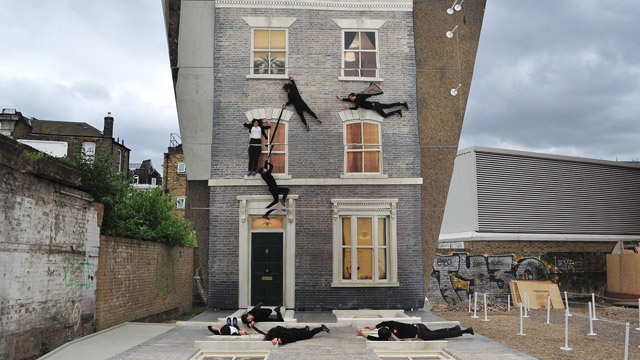
A Victorian terrace has popped up in east London that lets you swing from its ledges, run up its walls and generally defy gravity. Architecture critic Oliver Wainwright hangs loose at Dalston House, the novelty installation by Argentinian artist Leandro Erlich.
The artist talks about “enjoyable discovery” and playing with spaces that you might not otherwise think of.
I love how it is an interactive piece of art that only exists when people play with it.
Related articles
- Dalston House: the building that lets you defy gravity (guardian.co.uk)
- Dalston House project: Deceptively spacious house art pops up in east London street (metro.co.uk)
- Gallery: Gravity-defying Dalston House art installation by Leonardo Erlich in Hackney, east London (metro.co.uk)
- Ooh er: visitors to Dalston town house art installation give passers-by the heebie jeebies (standard.co.uk)
- Artist Leandro Erlich offers ‘crazy perspective’ at his illusion house in east London (telegraph.co.uk)
Teatro del Mare celebrates public space, community
A fun way to encourage public participation in space and creativity.
In order to celebrate its 10 years of activity, the artistic centre Lungomare in Bolzano Italy has recruited the ConstructLab/exyzt team composed by Alexander Römer, Gonzague Lacombe, Patrick Hubmann and Mattia Paco Rizzi. The result is the creation of Teatro del Mare, a wooden temporary structure, both a contemporary stage and street furniture, hosting a series of events, meetings and screenings until the end of June.
LIEU d’ÊTRE by the French Compagnie Acte is more than a performance. The project is an urban collective experience involving, both in the creation and the production of the event, professionals as well as inhabitants of a block of flats or of a whole neighbourhood. It uses the tool of dance to explore the pattern of the city.


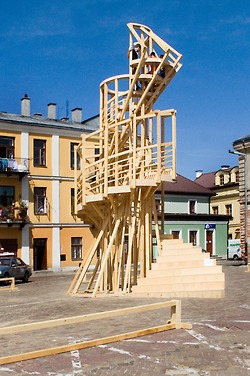
more via In public space we trust.
Related articles
- Reclaiming streets is reclaiming community (mywheelsareturning.com)
- Measuring public space by the handlebar count (mywheelsareturning.com)
- Finding Playful New Uses for Boring Street Infrastructure (theatlanticcities.com)
- Public Spaces for Reading in Queens? (ask.metafilter.com)
How Acting Like a Scientist Can Help You Play

I heard this story on NPR recently, and I think it’s the best advice I’ve heard in awhile on how to get out in the woods and explore, relax, and as they say in the article, take time to smell the roses! The answer: make an exploratory game out of it. “Pretend” to be a naturalist. Yes!
In this permanent state of hyperventilation, the issue for us all is not stopping to smell roses. It’s not even noticing that there are roses right there in front of us. Joseph Campbell, the great scholar of religion, hit the core of our problem when he wrote, “People say that what we’re all seeking is a meaning for life. I don’t think that’s what we’re really seeking. I think that what we’re seeking is an experience of being alive.”
But how can we experience “being alive” in the midst of the crushing urgencies that make up modern life?
Well, it might seem strange, but one answer to that question is “science,” at least science with a lowercase “s.” Science, you see, is all about noticing. This is where it begins, with simple act of catching seeing the smallest detail as an opening to a wider world of wonder and awe. And here is the good news. You don’t need a particle accelerator or well-equipped genetics lab in your basement to practice noticing (that would be science with a capital “S”).
You already are a scientist. You have been since you were a kid playing with water in the tub, or screwing around in the backyard with dirt and sticks and stuff.
If you want to rebuild your inner-scientist-noticing-skills, the best place to begin is with a walk in the woods.
There are lots of reasons to take a walk in the woods. To get away from it all, clear your head, smell the fresh air. The problem, of course, is that even if we get ourselves into a park or a forest, we might still be so lost in our heads that we miss what’s right in front of us. Practicing noticing, like a scientist, can change that by binding us to experience in ways that are thrilling, even in their ordinariness.
Noticing can take many forms. One trick is to count things. Scientists love to count stuff. How many trees are there on the sides of a steep hill compared with its crest? How many leaves are there on the stalks of the blue flowers compared to the yellow ones? How many different kinds of birdsong do you hear when you stop and listen, (by the way, this requires really stopping and really listening, which is awesome). Counting things forces you to pay attention to subtleties in the landscape, the plants, the critters.
Other things scientists love: shapes, colors, patterns. Do the rocks at the stream’s edge look different from the ones near the trail? Do the big cattails have the same color as the small ones? Get your naturalist on and bring a notebook. Pretend you are or John Muir. Jot down your findings, make little drawings and always, always ask your yourself those basic questions: why, how, when?
It may seem counter-intuitive, but scientists are all about creativity and exploration, and noticing things outside of the ordinary, so acting like a scientist is great way to see the world in a whole new way by playing with things, seeing what happens when you mess with something. Kids are natural players/explorers/scientists, so you can even bring one along as it might be helpful to get you in the explorer mode.
I would also argue that it doesn’t have to be “the woods” necessarily to get the same playful/exploratory benefits, it can also be short walks around the block, whatever works to get your observational juices flowing.
Related articles
- Noticing: How To Take A Walk In The Woods (wnyc.org)
- Noticing: How To Take A Walk In The Woods (wnyc.org)
- Scientists talk about their outreach experience (scifundchallenge.org)
Offices move towards more playful space design, but what kind of play is best for workspace environments?
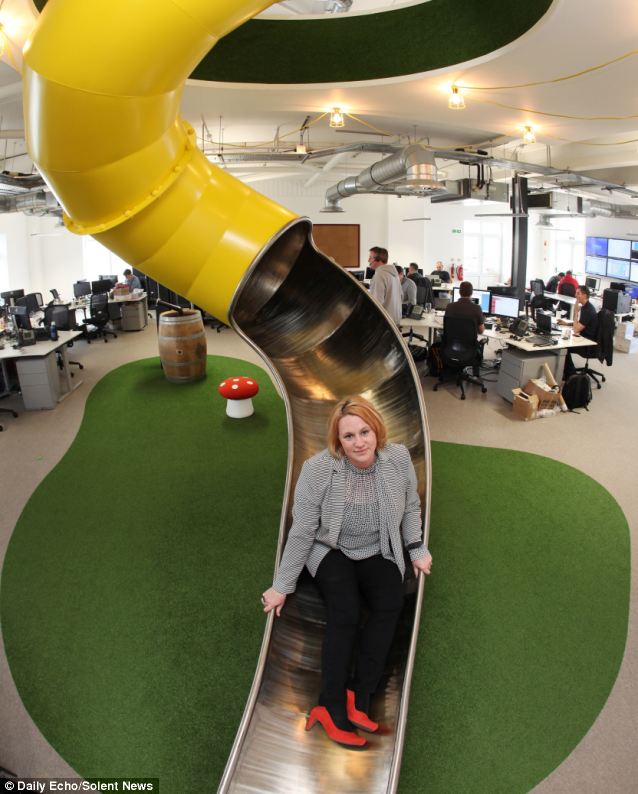
More and more office spaces are trying to become more playful, offering employees a way to destress and/or get more creative. Usually that takes the form of having ping pong tables or video game consoles set up for breaks, but more and more offices are adding slides, swing sets, picnic tables, or other more active and engaging apparatus. They are also bringing in more greenery for workers.
This office may be the most fun in Britain as it comes kitted out with a giant helter skelter slide, a tree house and even a pub.
The unique workplace also boasts a pool table, a putting green, a giant swing and a cinema.
Office designers Space & Solutions were tasked with turning a former pub in Southampton into the home for IT company, Peer 1 Hosting.
‘If you don’t feel comfortable sitting at a desk you can sit on a picnic bench. The reality is that you can do your work from anywhere.’
Read more: UK Daily Mail
The article points out that some people may find all this fun a little distracting to actually work around. Some kinds of play are probably great at cutting stress but may be more of a time suck than creativity inducer. I’m curious what readers think. Are you one of those people who does their best work sitting on a couch, or heck, a swing? Do you prefer quiet and focus without any noise? Do you have a toy or plant on your desk you fiddle with when you’re trying to think or just need to destress?
Another question; do you actually use the toys and playful apparatus in the office? The office I currently work in has a ping pong and air hockey table, but only two people ever use the ping pong table, and I have only seen the air hockey table turned on once for a promo video.
Leave your thoughts in the comments below.
Play anywhere, with anything
A boy slides down a metal beam in Manila, Philippines, on April 23.
According to new census data, the Philippines has failed to make headway in cutting rampant poverty, with more than one in four citizens deemed poor despite the country’s economic growth. However, seeing children play is a good sign for the country’s overall well being of its citizens, since play tends not to occur unless all essential needs have been met (food, shelter, safety).

Photographer Takes a Boy with Muscular Dystrophy on an Imaginary Adventure | Colossal
Undoubtedly inspired by Mila’s Daydreams series, an awesome interpretation:
Slovenia-based photographer Matej Peljhan recently teamed up with a 12-year-named Luka who suffers from muscular dystrophy, to create a wildly imaginative series of photos depicting the boy doing things he is simply unable to do because of his degenerative condition. While he can still use his fingers to drive a wheelchair and to draw, things like skateboarding and swimming are simply not possible.

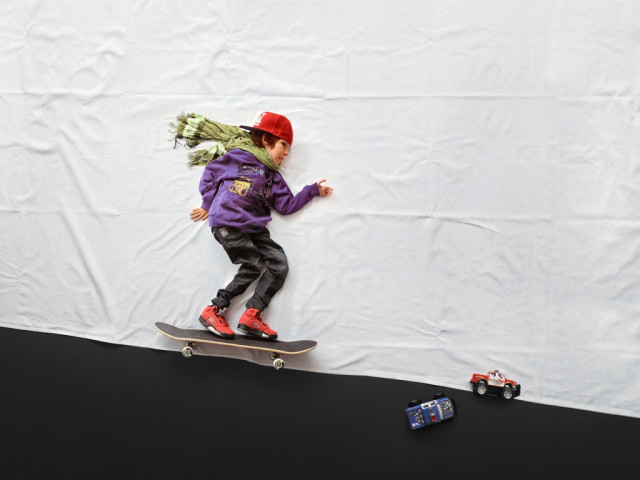
more via Photographer Takes a Boy with Muscular Dystrophy on an Imaginary Adventure | Colossal.
Related articles
- Photographer Takes a Boy with Muscular Dystrophy on an Imaginary Adventure (dailypictur.es)
- Inspiration: Photographer Takes a Boy with Muscular Dystrophy on an Imaginary Adventure (abiitcentral.wordpress.com)
- This Wonderful Photographer Gave a Boy Suffering with Muscular Dystrophy a Chance to Live Out His Dreams (gizmodo.co.uk)
How To Schedule Your Day For Peak Creative Performance | Fast Company | Business + Innovation
I have been struggling, STRUGGLING!, lately with fitting play and relaxation into my new life structure and creating space in my life for everything that needs to get done. I’m curious how other people manage it, so I found this article intriguing:
About four years ago I started working for myself. I wanted the freedom and flexibility to own my schedule and the space to bring my ideas to life.
One of the biggest challenges was structuring my time so I was fully experiencing the benefits of working for myself while also being as creative and productive as possible. At first, the idea of systems and planning made me cringe. I felt like they would hold back my creative potential. Eventually, organization and effectiveness challenges pilled up and I decided to give structure a try.
I wondered:
How do I balance client service with working on my own ideas?
How do I avoid interruptions that mess with my creative flow?
How do I stop putting off the stuff I hate but still have to do?
Behold, her solution…
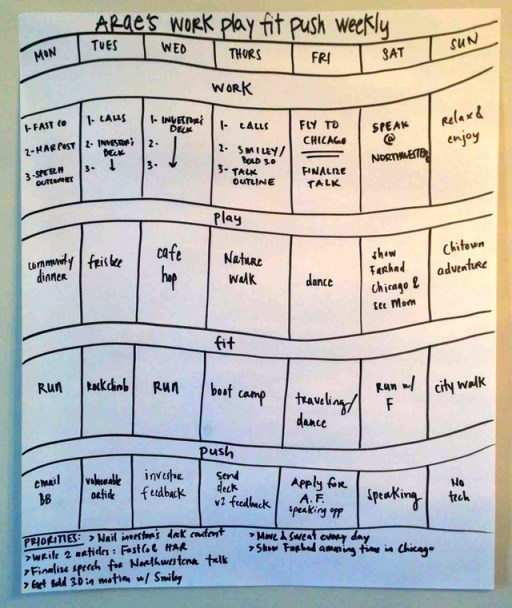
Find out more via How To Schedule Your Day For Peak Creative Performance | Fast Company | Business + Innovation.
Related articles
- How Creative Are You? (reneeainslierodriguez.wordpress.com)
- Critical Difference Between Creativity And Innovation (m2wa2.wordpress.com)
Play and Creativity Require Space and Time
I found this video courtesy of Creativitea. They were using it to explain how they don’t believe in creating things under a time pressure. It really does a great job of illustrating how we all need to give ourselves more time, and space in our lives, to get creative and think about things.
Have a happy weekend, and make sure to make some space for play and creativity.
Color-In Wallpaper from Burger Mash Lets You Draw on the Walls
Do you have a kid (or let’s face it, grown-up) who loves to color? I preferred to embellish on the pictures themselves, but I know a lot of people who still find it relaxing to color in different shapes and colors. Now you can have an entire room, or at least piece of wall, devoted to your pastime, plus you get super-original wallpaper:

The site says you can use any medium you want – felt markers, paint, crayons – so you could also think outside the lines if you were so inclined.
I knowt a lot of people really wanted to draw on the walls when they were younger, or maybe even did. What was your greatest wall masterpiece. Leave your story in the comments below.
 Mental Flowers