anthropology · architecture · community · creativity · culture · design · environment · happiness · Social

How legalizing street art made Rio de Janeiro a prettier, happier place

A recent article in the Huffington Post explored Rio de Janeiro’s acceptance of street art and how it has enriched the various neighborhoods:

Brazilian graffiti art is considered among the most significant strand[s] of a global urban art movement, and its diversity defies the increasing homogeneity of world graffiti.” – Design Week

In March 2009, the Brazilian government passed law 706/07 making street art and graffiti legal if done with the consent of building owners. As progressive of a policy as this may sound, the legislation is actually a reflection of the evolving landscape in Brazilian street art, an emerging and divergent movement in the global street art landscape.

Rio de Janeiro has been particularly progressive in its policy towards street art, with its 1999 “Não pixe, grafite” (Don’t Tag, Graffiti) project that brought together 35 graffiti artists to showcase diversity in local styles. But more unique is the evolution of a permission hierarchy, blurring the line between formal and informal. The new street art law merely reinforced these unique patterns of street art and legitimized an already flourishing form of artistic expression.

Retaining walls on the steep terrain provide canvases for artists.

In Rio de Janeiro, street art is ubiquitous. It exists in all corners of the city, from the favelasto upper class neighborhoods, from residential to institutional. It is bold in scale and aesthetics and is anything but graffiti. The urban fabric of Rio de Janeiro also figures prominently in the evolving street art scene. The high walls, whether for security or to contain the topography, provide ample surfaces for painting. But rather than location dictating art, the relationship between owner and artist has a direct impact on where street art occurs.

Owners of buildings, both residential and commercial, sometimes invite artists for commissions, which is done to protect from tagging, as an aesthetic choice or as an economic choice — painting a façade with art may be cheaper than another mode of beautification. In another case, street artists ask permission from the owner.

Tudo de cor para você, Santa Marta, Rio de Janeiro (photo source: favelapainting.com)

Thanks to the city’s openness to various forms of artwork, and specifically “street” art, Rio de Janeiro is now known for its colorfulness and art. In informal studies the art has also been found to make citizens more invested in their communities and overall happier.

Hooray for public art.

community · creativity · Social

Storefront Seattle: taking art to the street (window)

Before and After example of Storefronts Seattle project.

With the down economy a lot of stores and businesses have gone out of business, leaving a lot of empty store fronts, at least in places around Seattle. But rather than let those places stay dark and dormant, one woman is spearheading an effort to get local Seattle artist’s work installed in these vacant storefronts:

Storefronts debuted in late 2010 as an experiment in activating vacant spaces with art, creative enterprise, and performance… We also revitalize neighborhoods. And we beautify blocks. And we make areas safer at night, and we market real estate, and we paint walls and mop floors and install lighting and turn desolate half-empty blocks into the hippest, happiest, and hottest real estate in town.

Storefronts Seattle leases storefront space from neighborhood property owners for the nominal rate of $1 per month. We can program up to 15 storefronts in any given neighborhood at any given time, and we fill these spaces with art installations, with creative businesses, and with artist’s studios. These projects are proposed by artists throughout the region, and are chosen by a panel that includes neighborhood representatives, local museum curators, arts professionals, and our programming staff.

At full integration into a neighborhood, Storefronts Seattle is programming up to 60 arts installations per year into your spaces. That’s enough to instantly turn any neighborhood into a walking destination, an arts and culture destination, and a shopping destination. It’s enough to generate regional press. It’s enough to get the city’s creative class and cultural leaders to pay attention.

More at Storefronts Seattle

This is a great project where everyone benefits: property managers get free positive attention for their site, artists get their work exposed, and normal people get to benefit from the art for free!

It also involves a lot of local Seattle neighborhood organizations, bringing attention and buy-in from various communities around Seattle. There are quite a few installations in place right now through May.

What a great opportunity to improve and enrich everyone’s environment. Know of other groups out there taking advantage of empty spaces like these in other cities? Share them in the comments below!

behavior · community · culture · environment · happiness · psychology

The Psychological Importance of Home

English: Clayton H. Delano House, Ticonderoga,...
Our sense of place, and particularly our home, can be very intricately woven into our identities. Image via Wikipedia

As the weekend, approaches, many of us are making plans to go out to events in our local cities, or work around the house, or just sleep in our own beds after several weeks of visiting and traveling. The psychology of home is very important to us humans, and was captured really well in an article by Julie Beck in The Atlantic:

Susan Clayton, an environmental psychologist at the College of Wooster, says that for many people, their home is part of their self-definition, which is why we do things like decorate our houses and take care of our lawns. These large patches of vegetation serve little real purpose, but they are part of a public face people put on, displaying their home as an extension of themselves. It’s hardly rare, though, in our mobile modern society, to accumulate several different homes over the course of a lifetime. So how does that affect our conception of ourselves?

When you visit a place you used to live, these cues can cause you to revert back to the person you were when you lived there.

For better or worse, the place where we grew up usually retains an iconic status, Clayton says. But while it’s human nature to want to have a place to belong, we also want to be special, and defining yourself as someone who once lived somewhere more interesting than the suburbs of Michigan is one way to do that. “You might choose to identify as a person who used to live somewhere else, because it makes you distinctive,” Clayton says. I know full well that living in Paris for three months doesn’t make me a Parisian, but that doesn’t mean there’s not an Eiffel Tower on my shower curtain anyway.

We may use our homes to help distinguish ourselves, but the dominant Western viewpoint is that regardless of location, the individual remains unchanged. It wasn’t until I stumbled across the following notion, mentioned in passing in a book about a Hindu pilgrimage by William S. Sax, that I began to question that idea: “People and the places where they reside are engaged in a continuing set of exchanges; they have determinate, mutual effects upon each other because they are part of a single, interactive system.”

Read the full article here.

I definitely feel like I have a connection and identify with every place that I’ve lived, although some have felt more like home and have shaped me more than others. A lot of that has been due to how safe or at peace I feel in a place, and how much I have bonded with the people around me.

I also think one thing that was so traumatic about the housing bubble was that sense of losing your home. Not just a piece of property you owned, but this landmark of who you were, the space where you kept all of your memories and built new ones, your safe house, literally.

What is your experience with home? What makes a place “home” for you?

behavior · community · environment

“Ag”tivism!

Promoting backyard farms, (or even large scale farms and modern-day homesteading), has a new term: "Ag"tivism. From the young and idealistic to the old and curmudgeonly, many people are finding time, space, and energy to grow their own tomatoes.

From The New Agtivist: Edith Floyd is making a Detroit urban farm, empty lot by empty lot:

Edith Floyd is the real deal. With little in the way of funding or organizational infrastructure, she runs Growing Joy Community Garden on the northeast side of Detroit. Not many folks bother to venture out to her neighborhood, but Edith has been inspiring me for years. I caught up with her on a cold, rainy November afternoon. While we talked in the dining room, her husband Henry watched their grandkids. Q. What neighborhood are we in? What is it like?

A. This is the northeast side — near the city airport. It’s surrounded by graveyards on three sides and then the other barrier is the railroad track; we are surrounded by railroad tracks, and sometimes those trains stay for like 30 minutes, so you are trapped; ain’t no way out.

Q. So you’ve seen a lot of changes.

A. Yeah, when I came it was beautiful — there were grocery stores in the center, like in the middle of the neighborhood, but … There was like 66 houses on this block, and now [there are] about six that people live in, and three need to be torn down, and the rest of it is empty. That’s where I’m putting my farm on, all the lots. [Editor's note: some are calling this practice "blotting." Here's a recent NPR story on blotting in Detroit.] …

Q. What are you growing on those lots?

A: Across the street I have my strawberry lot. I try to plant by lot. I have a collard green lot, a kale lot, an okra lot, an eggplant lot, green bean lot. I had a corn lot, but it didn’t work so well. Right now I have a garlic lot, I had a tomato lot, cucumber lot, squash, cabbage, broccoli, watermelon, cantaloupe. I like flowers, so I planted some of them. I had potatoes, mustard greens, turnip greens.

Q. That’s a lot of food!

A. Well, if it comes up it’s a lot, but I give some to the Capuchin Soup Kitchen. I sell some at Eastern Market, and Wayne State Market, but the cabbage does not sell so I don’t take cabbage there. (I still have about two of 300 pounds of cabbage I need to harvest.)

More at The New Agtivist: Edith Floyd is making a Detroit urban farm, empty lot by empty lot

NPR recently had an article about how people of my generation are also taking up organic farming with a passion:

…there’s a new surge of youthful vigor into American agriculture — at least in the corner of it devoted to organic, local food. Thousands of young people who’ve never farmed before are trying it out.

Some 250 of them gathered recently at a gorgeous estate in the Hudson River valley of New York: the Stone Barns Center for Food and Agriculture in Tarrytown.

Some of these young farmers already have their own farms. Some are apprentices, working on more established farms for a year or two. And others are still just thinking about it. But the overwhelming majority of farmers here at this conference want to farm without chemical fertilizers or pesticides.

They were there to learn skills — from seminars on soil fertility, handling sheep, and how to find affordable land — and just as importantly, to meet each other. In the evening, they played music and danced.

They represent a new breed of farmer. Very few of them grew up on farms. Most of them went to college. And now, they want to grow vegetables, or feed pigs.

More at Who Are The Young Farmers Of ‘Generation Organic’?

The biggest question interviewers often ask is "why?" Why farm? Why go "backwards" to a life of farming.
For many people, it’s economical (see an earlier blog post about young entrepreneurs making a living farming, growing eggs and herding sheep). But an even bigger driver for most is the desire to feel connected to their environment, to enrich their surroundings with greenery and healthy food.

From Grist:

Q. You haven’t always been an urban farmer. What did you do before this?

A. I worked at Detroit Public Schools. I started out with the Head Start Center and then I went to the middle school, to the Ed Tech, [which is] now the Computer Lab. I started farming because they laid me off and didn’t call me back. Farming is not making a living, it’s just keeping food in my freezer. I try to sell some so I can get some more equipment, so it will be easier for me to farm.

Q. So how much money are you making in a season?

A. I was trying to reach for 3,000, but I only made it to two something. I have to add up the last bit; I haven’t got my last check. Every year I try to up it; the first year I made 1,000. The second year I went 2,000; this year I was trying to go for $3,000.

From NPR:

"It was born out of a concern for the environment," says Brian Bates, who plans to work at a farm in northern Michigan after he graduates from Penn State. "I spent the first two years of college with one question in mind – basically, how can I have the greatest impact in my life in the world. And the thing that I kept coming back to, that everyone connected to, was food."

Others say that they simply enjoy the work, the style of agrarian life, and the connection to food.

"I feel lost when I’m not farming, when I’m not out in the field. It’s where I find the most peace and harmony in my life," says Liz Moran, who helps manage Quail Hill Farm in the eastern end of Long Island, New York.

"When I look around, and you’re amongst the plants and the sunshine – that’s my office, that’s where I want to be," said Rodger Phillips, who grows food on an urban farm in Hartford, Conn.

Others talk about the satisfaction of doing something practical, creating something valuable. "Having a skill was really important to me. Having studied political science, I wanted to do something that was productive, that was real. To have a real skill, and be able to provide my family, my community, a vital element," says Kristin Carbone, who runs Radix Farm in Upper Marlboro, Maryland.

And then there was Lindsey Shute. "How did I get into farming? Because I started dating a farmer!" she says with a laugh. [blogger's note: check out a similar story in the book "xx"]

It seems that people are looking for more control over their wallets, their lives, and what they put in their stomachs, and are doing it through farming.

I know a lot of medical and researched reasons why playing in the dirt is good for you, but I’m curious about anecdotal reasons. Leave your experiences with gardening and farming in the comments.
anthropology · architecture · community · creativity · design · environment

Coloring inside the lanes: Art that creates community | Grist

The Fremont Turtle - Grist

I found another great article from Grist magazine about how something as simple as a bucket of paint, or several different colored, buckets of paint, can have a huge positive impact on a neighborhood:

Sunnyside Piazza, it is called, which may seem a bit much for a splash of color on asphalt, but in person, it seemed fitting. This whimsical design, interrupting the functional but monotonous gray of Portland’s street grid, felt like a somewhere. It seemed like a place deserving a name. It even felt like a “piazza.”

That was in 2002. I later learned that the Sunnyside Piazza was the second painted public square in Portland, facilitated by the nonprofit City Repair Project. Now, dozens of painted plazas, dubbed Intersection Repairs, pepper the map not just of Portland but also of Los AngelesNew YorkSt. Paul, and Seattle.

It all started in the mid-1990s with Share-It-Square, in Portland’s Sellwood neighborhood, where architect and City Repair co-founder Mark Lakeman lives. After visiting villages in Central America where residents gather around common spaces, Lakeman decided to bring similar spaces to Portland. “Putting the public space back where it’s supposed to be may not sound like a huge change,” Lakeman says, “but it has a profound effect on the social culture … We know that Americans are more lonely and isolated than ever before, but we don’t realize that the absence of cohesion in American communities is totally related to the absence of places where people can actually build that.”

more via Coloring inside the lanes: Art that creates community | Grist.

The article goes on to discuss how creating a group mural creates a sense of community:

“It’s not about the paint,” says professor Jan Semenza, a professor of public health at Portland State University who lives near the Sunnyside Piazza and has researched intersection repairs. “It’s about neighbors creating something bigger than themselves.” As an everyday intersection becomes someplace special, residents begin to experience the value of community. Neighbors paint themselves out of a corner — of the intersection, of their individual homes — and into the middle of the street. By turning an intersection from a dividing line between neighbors into a gathering place, residents begin to solve the problems that plague neighborhoods and cities. Where isolation existed, they find community. Where cars dominated, they create a people place. With a little paint, neighbors are solving big problems.

I have seeen some great community spaces also created out of roundabouts, water fountains at outdoor shopping centers, and often at landmarks like stairs or trees. Sometimes, if a natural landmark or meeting space isn’t in place, all it takes is some paint, chalk, or even ribbon to make a place significant and identify it as a community gathering space.


anthropology · behavior · community · happiness · hugs · psychology · Social

For those days you really need a hug

Ever have a day when you just really need a hug, like, right now? Well now you’re in luck:

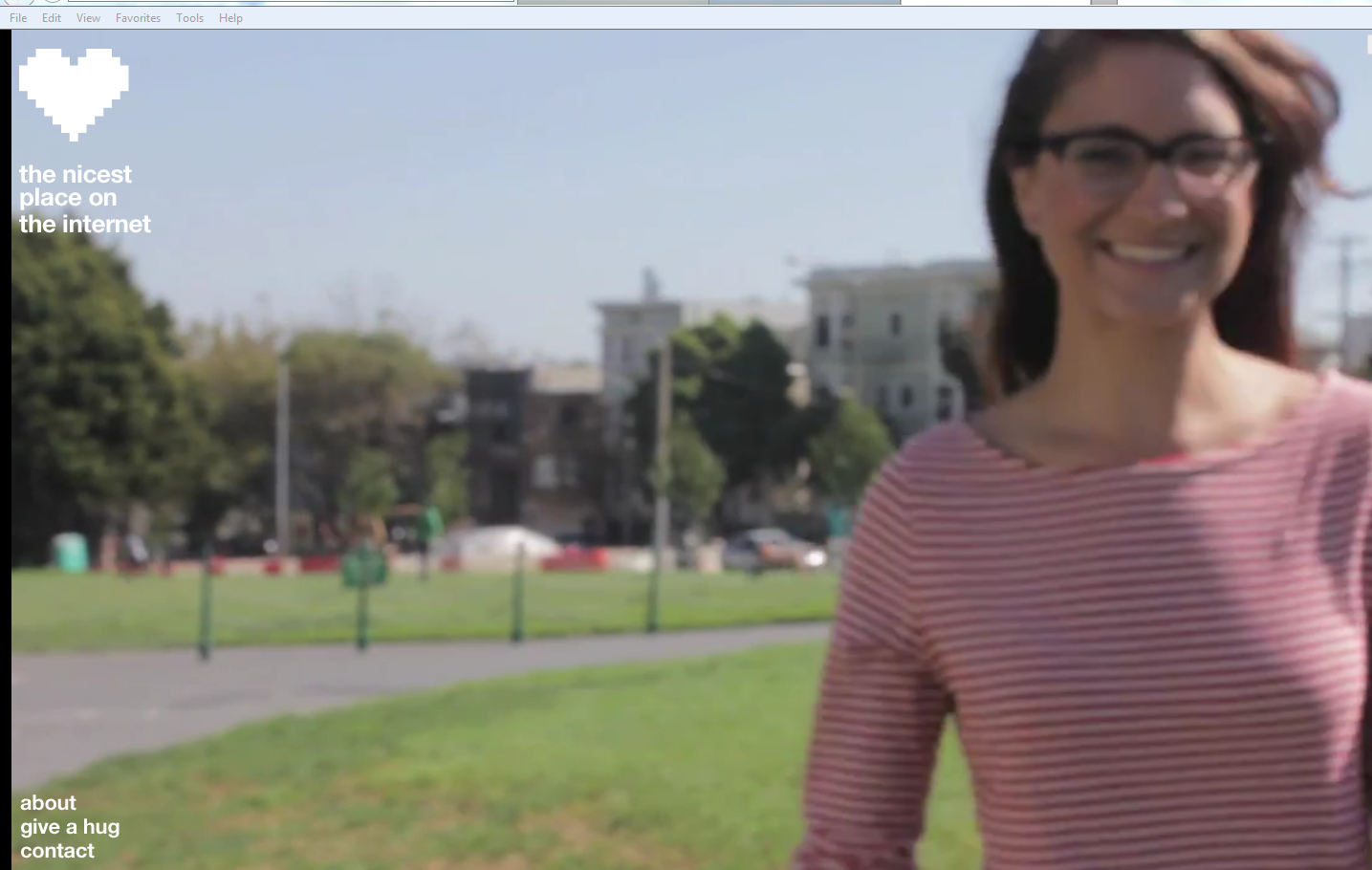
"Jeff Lam and Lauren Perlow created The Nicest Place on the Internet, a place where you can feel warm and fuzzy with virtual hugs, because they were having an off day. It’s perfect for those chilly winter days."

Check out Creativity Online.

You can also go directly to the site: The Nicest Place on the Internet

You can also contribute your own hug.

I love this idea of virtual kindness; it’s a weird concept in a way, of people donating hugs (so to speak) to complete strangers. But, it’s great because it’s using the World Wide Web to create community and connections with people all over the world. Somehow, by being open to receiving a hug, even a virtual one, we are able to create connections and feel like part of a larger tribe or cohesion.

So often online communities can turn harsh or downright mean; it’s great to see online crowdsourcing being used for positive psychological benefits!

anthropology · community · education · happiness · school

Creating tribe through education

Students at Washington High School at class, t...
Working on a project together with a group can create a sense of "tribe." Image by The Library of Congress via Flickr

Having a community or “tribe” is one of the essential things all humans need in order to be happy, healthy, and really survive. In the predominantly urban, mobile environment most of us live in now, it can be hard to develop and maintain a tribe.

The UW Professional & Continuing Education Program recently published a blog post addressing the idea of tribe, and how we create that in modern, usually urban settings through education. One of the most common ways we create tribe is through what we spend time learning; taking Yoga, getting certified in Fiber Arts, sharing this knowledge, love, and in a way a rite of passage with others definitely creates a sense of community and tribe.

History defines tribes as groups united by shared ideas, values and goals. Godin and others put a 21st century spin on the term to empower ordinary people to lead big changes, including the pursuit of a new career.

For Tammie Schacher, the big change was to transition out of the architecture profession and into the nonprofit sector, where her goal was to align her values and passions with a new career. To get started, Schacher enrolled in the UW Certificate in Nonprofit Management where she joined a cohort of fellow students who would go through the program together.

“At the beginning the instructor told us that these groups become very tight knit and that we’d start relying on each other,” she says. “We didn’t necessarily believe that, but by the second quarter we realized we had not only started to rely on each other but that we’d become a family.”

The blog post goes on to discuss how to get the most out of putting yourself in this new, tribal situation:

Both Matthews and Schacher believe that getting the most out of being part of a tribe that starts in a continuing education classroom is fairly simple. First, say both, be open. “Have a little courage and put yourself out there,” says Matthews. “The structure of a classroom is a great place to try something out.”

Read more at: Find Your Tribe, Foster Your Future

There are lots of opportunities to create a tribe based on shared knowledge, and to create new ones based on group learning. We can also create tribes online through forums and blogs, as well as allegiances to sports teams or other athletics. Anything from military service to attending a concert can create a sense of tribe.

What are some of the surprising places you have found and/or created a tribe of like-minded people?

behavior · community · happiness · hugs · psychology

10 Psychological Effects of Touch — PsyBlog

A closeup of a hug.
A hug or touch can have a major influence on mood, overall attitude, and even income. Image via Wikipedia

I’m not a very “huggy” person, but this article makes me give that attitude a second thought. Touch, particularly the non-sexual kind, has many benefits for humans, such as creating friendly feelings, calming nerves, and help others be more sympathetic.

Touch is a sense that’s often forgotten. But touch is also vital in the way we understand and experience the world. Even the lightest touch on the upper arm can influence the way we think. To prove it, here are 10 psychological effects which show just how powerful nonsexual touch can be.

via 10 Psychological Effects of Nonsexual Touch — PsyBlog.

The ten benefits of touch mentioned in the article are:

  1. Money
  2. Help
  3. Compliance
  4. More touch leads to more compliance
  5. Fighting (there’s a benefit to fighting, really)
  6. Selling
  7. Dating (yes, nonsexual touch helps sexual touching too)
  8. Power, influence
  9. Clearer communication
  10. Boosting brain power!

Find out more details in the article, plus the multiple studies used to contribute.


behavior · brain · community · emotion · happiness · mental health · Social

Yes, you can now be addicted to social media

Illustration of Facebook mobile interface
Social media keeps us connected with friends, but for some can be detrimental to everyday life. Image via Wikipedia

I love being able to connect to old friends, classmates, and coworkers via social media, as well as share thoughts, ideas, and new developments. But some people can take it too far, and while I have my weaknesses as much as the next gal, I don’t think I’d consider myself addicted as they describe it. Apparently people can receive intense highs from the social interactions and feel like they need a “fix” if they go on too long without checking in to one of their social media networks.

When you hear the word ‘addiction’ perhaps you think of alcohol, drugs and sex. But what about social media? Over recent years there’s been an emergence of studies into social media as a new form of addiction.

Research by Retrevo Gadgetology looked into how people use social networking sites. Out of those asked, 45% said they check Facebook or Twitter after getting into bed. People under the age of 25 were the more extreme with 19% saying they log on any time they wake up during the night, 27% said they sometimes check when they wake up during the night and 32% check in first thing in a morning.

via Social Media: The Pursuit of Happiness.

To me this indicates just how detached and isolated many of us are, that instead of going to a local gathering or even a bar or club when we’re feeling lonely, we go online. It’s been shown that Americans feel more isolated and alone than at any other time in our history (or at least history of checking for this kind of thing), and I would hypothesize we’re turning to these social media networks as some way to retain communities we’ve established in other physical locales, or create new ones that are entirely virtual. I also wonder if the meta-interaction makes people feel less fulfilled than dealing with people in real, physical life and make them anxious to get more. I believe social media networks are useful, no doubt, but I do wonder if we are using them as a crutch rather than actually meeting people in person. Granted a lot of social media sites encourage actual in-person meetings, from online dating sites to the new GrubwithUs startup that acts as matchmaker for hungry social types in various cities across the U.S.

What are your thoughts about social media networks and people who can’t seem to unplug from them? Leave your thoughts and/or experiences in the comments below.

behavior · community

Noted: Collaborative Consumption | The Etsy Blog

Helsinki city bikes
Helsinki's "city bikes." Image via Wikipedia

I used to live in a house with my husband, dog, and three or more roommates. While this lifestyle was a little too “collaborative” for us at times, I did appreciate the ability to borrow tools from one another, be able to cook a large meal and know that somebody would eat the leftovers, and have built-in dog sitters for a quick weekend getaway. I definitely see this idea catching on in people my age (the younger Gen-Xers and older Millenials), and while I don’t know if it’s because we’re younger and have no money, or if we’re all brain-washed commies, but I’m glad to see our ideas weren’t that unique.

Collaborative consumption, a movement recently highlighted by Morgan Clendaniel for Co.Design, encourages communities to monetize their unused goods through a system of borrowing. Zip Car and bike sharing programs are excellent examples of rethinking consumption, enabling people to borrow a method of transportation for the few hours it’s needed. “You might own some tools that you never use, or perhaps you have a backyard that you just don’t have the time to do anything interesting with,” explains Clendaniel. “Today, they can look like revenue streams, not wastes of money.”

via Noted: Collaborative Consumption | The Etsy Blog.

As a sort of antithesis to “Keeping Up with the Joneses,” we borrow books from friends, have slow food dinners that are really just giant potlucks, and practice other collaborative consumption.Other communities have city bikes and cars that anyone can use, as well as “free” stores where people can drop off stuff they no longer need and pick up anything they like.

But we live in a fairly hippy city; what is it like in other communities that might not be so collaborative? Leave your observations in the comments below.