
Another great example of creating enriching public spaces out of natural environments and features already in place.
Tag: community

Grown in Detroit
Veggies can be a powerful tool to fight obesity, food deserts, and create beautification and community engagement. This blog post is a great example…
In Philadelphia, More Green Innovations
A great example of re-energizing public space and making it more green and friendly.
Landscapes Can Be Open-ended « The Dirt

An academic take on creating inviting, communal public spaces:
In Operative Landscapes: Building Communities Through Public Space, Alissa North, Assistant Professor in the Landscape Architecture Program at the University of Toronto, argues that the best contemporary landscape designs are concerned with more than just aesthetics. Instead of striving for fixed, static designs, the goals of these landscapes are “operational”: they aim to guide “the transformation of urban environments over time.” By moving away from fixed form, landscapes can be open-ended and non-prescriptive, changing in response to — but also influencing — the development of their communities.
continue reading Landscapes Can Be Open-ended « The Dirt.
Related articles
- Consumerism and Landscape Architecture (dirt.asla.org)
Inhabitat is on a role with their environmental enrichment stories!

OakOak’s street art is created to amuse and inspire – this self-described “fun-loving” artist plays with urban elements to make people laugh. He finds broken infrastructure, crumbling buildings and cracks and gives them a facelift with the simple addition of a character in play. Everything from simple stick figures to smiley faces, animals, objects and superheroes can be seen gracing OakOak’s hometown of St. Etienne, France, where they turn the less than perfect facades into something playful and fun.
Building gardens to promote community
Before I share my ideas for the latest OpenIDEO challenge, I wanted to capture some of the ideas I submitted for their challenge “How might we inspire and enable communities to take more initiative in making their local environments better?”
Here is my first one:
Community gardens create ownership, a sense of place, and shared goals
Community gardens provide green space, community ownership, local landmarks and create a communal space for people to share, and beauty as well as food!

backyard community garden, by Rick Harrison on Flickr
Urban farming and agriculture has exploded in popularity in the United States, and . community gardens are now present in all 50 states. These communal green spaces can be as small as a parking space or as large as a few acres. They can be used to produce food, act as filtering systems for urban runoff such as rain gardens, or simply grow flowers.
Research is finding that these gardens are beneficial to communities for numerous reasons. First, these gardens provide green space and support the local environment, from migrating birds and bees to potentially filtering urban runoff. Second, they can often supplement vegetables for communities who live in densely urban areas where it can be hard to access fresh fruits and veggies through a grocery store. Third, these gardens create a sense of ownership not only for those working actively in the garden, but anyone who lives in the neighborhood. Creating this sense of ownership for a small space makes it more likely that communities will work together to protect and save larger green spaces, such as beaches or parks, that the community can share and enjoy in.
Community gardens are easy to set up and maintain, with minimal initial investment other than some seeds and a shovel. The key to success would be the need to designate a leader at first to spearhead the building and maintaining of the garden, to teach others and look over things until the garden was established and other knowledgeable gardeners began to work the space, or new gardeners who learned from experience in the community garden. The garden leader would need to be able to lead but not “own” the garden, but rather make it accessible for all community members.
Related articles
- Best Community Gardens on the West Coast (apartmentguide.com)
- Community garden in Halifax blossoms into sustainable project (metronews.ca)
- The Ins and Outs of Community Gardening in Hollywood Nov. 18 (browardnetonline.com)
IDEO asks how to inspire communities to care about their environments

I love these OpenIDEO public challenges, so I was thrilled when I saw this challenge alert pop up in my inbox (and then unfortunately let it get buried for a week, oops!) about ideas on how to make communities more involved and engaged in their environments.
Public agencies such as Singapore’s National Environment Agency would like to envision how to rejuvenate our local environments to inspire and enable communities to make our living environments better – and are eager to collaborate with the global community to explore solutions which resonate in Singapore and across the world.
In this challenge we are looking to try and explore the following questions, both for Singapore and for communities everywhere that face similar challenges.How might we better collectively solve problems facing our neighbourhoods?How might communities look out for each other more?How might we provide a safe space for positive and constructive action?How might we help passive citizens become active contributors?How might the role of the government evolve in the future, with regards to local neighbourhoods?In short, what does community ownership look like in 2012 and beyond? The National Environment Agency invites you to join us in designing better answers, together.Let’s collect examples of existing initiatives and explore the challenge topic to inform our ideas for the upcoming Concepting phase.
It’s a question that I bring up a lot on the blog, and share different examples of how communities around the world are doing just that, from adding public art to bee and butterfly gardens to building playgrounds. I am bubbling with excitement over this challenge, and have lots of different ideas, but there are only 14 more days to submit ideas and I want to make sure mine are really good, eek!
What have you seen that worked in growing communities to keep the residents and developers motivated to preserve the surrounding environments, rather than bulldoze them over for a quick couple hundred bucks? What are some of your ideas? Have you seen any story of community building on this blog that screams “Yes, this is the answer!”? Submit your ideas at the OpenIDEO website.
Related articles
- LinkLog: Open IDEO Challenge (dorai.me)
- Opinion: Dignifying Design (nytimes.com)
- 15 Minutes With – Design Thinking – Ideo (designingdesignthinkingdrivenoperations.wordpress.com)
The UN Embraces the Economics of Happiness — YES! Magazine
Should happiness and well being be considered a metric to measure overall success of a country? The UN just voted yes:
Imagine you open the paper tomorrow, and the headlines are not about the “sluggish economy,” but our nation’s quality of life. You turn to the business section, and find not just information about a certain company’s profitability, but also about its impact on community health and employee well-being.
Imagine, in short, a world where the metric that guides our decisions is not money, but happiness.
That is the future that 650 political, academic, and civic leaders from around the world came together to promote on April 2, 2012. Encouraged by the government of Bhutan, the United Nations held a High Level Meeting for Wellbeing and Happiness: Defining a New Economic Paradigm. The meeting marks the launch of a global movement to shift our focus away from measuring and promoting economic growth as a goal in its own right, and toward the goal of measuring—and increasing—human happiness and quality of life.
Not just for dreamers
Some may say these 650 world leaders are dreamers, but they are the sort that can make dreams come true. The meeting began with an address by Prime Minister Jigmi Thinley of Bhutan, where the government tracks the nation’s “Gross National Happiness.”…
UN Secretary-General Ban Ki-moon cited Aristotle and Buddha in calling for the replacement of our current economic system with one based on happiness, well-being, and compassion. “Social, economic, and environmental well-being are indivisible” he said.
Read more at: The UN Embraces the Economics of Happiness by Laura Musikanski — YES! Magazine.
Pretty exciting stuff. Bhutan has been using happiness as a metric for several years. so it’s nice to see the idea get picked up on. I believe emotional well-being and happiness is a very valuable metric. What about you? Leave your thoughts in the comments below.
Walking to learn about your environment better
With gas prices going through the roof, many people are taking to walking more. But after being car-focused in our navigation for decades, it can be unusual for people to know how to get around by walking and how long it will take them. One student from Raleigh, North Carolina, has an idea:
On a rainy night in January, urban planning student Matt Tomasulo and two fellow schemers positioned 27 signs in three strategic locations across central Raleigh. In bold, authoritative letters, each sign indicates the number of minutes it would take for a pedestrian to reach a particular, popular destination.
And for the directionally challenged, the otherwise spartan signs are equipped with a high-tech surprise. By scanning the signs with a smartphone, pedestrians can receive a specially tailored Google Map that will keep them on the right path.
Tomasulo and his colleagues at City Fabric have dubbed their effort Walk Raleigh, and have submitted the project to the Spontaneous Interventions competition, a contest sponsored by the Institute for Urban Design. In terms of impressing judges, the group is off to a good start: far from being displeased by Tomasulo’s guerrilla antics, the city of Raleigh has expressed interest in permanently incorporating Walk Raleigh’s signs into the city’s landscape.
see more at A Walk to Remember.
I’m glad the city of Raleigh is encouraging this, and I hope it catches on in other places. I think it’s great to share our knowledge of neighborhoods with others and let them get to know their cities and environments a little bit better. Plus it’s just fun.
Have you seen similar signs in other cities? Tell me about it in the comments below.
Related articles
- A Walk to Remember (sierraclub.typepad.com)
- Update: Walk Raleigh Signs May Point the Way Once More (sierraclub.typepad.com)
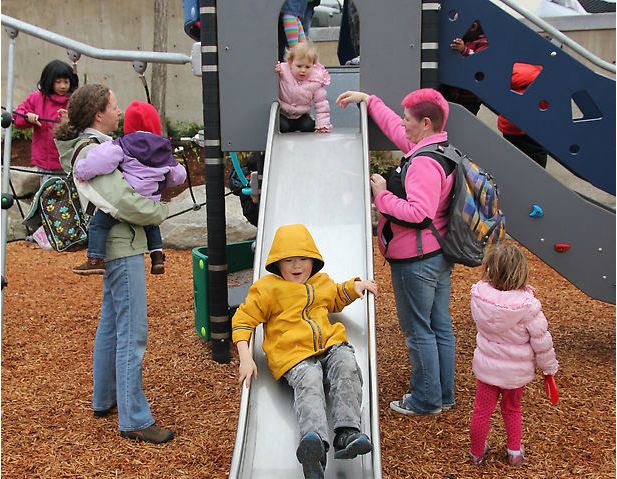
UW professor and students help redesign International Children’s Park
A nice story about a redesign of a park in Seattle so children could actually, you know, play in it:
Located on the northeast corner of Seventh Avenue and South Lane streets in the Chinatown-International District, the park is small – about one-fifth of an acre — but in a key spot.
Vegetation had grown up around the periphery of the 30-year-old park, obscuring views and raising concerns about safety. There were few amenities for adults who bring kids to the park, and no accommodations for people with disabilities. A rock mound posed a hazard, and during the winter, the grass was often soggy.
Cultural and language differences were also part of the landscape, making decisions about the park complicated.
But renewal made sense because the neighborhood has seen increasing residential and commercial development, leading to more active community places such as the Wing Luke Asian Museum and a branch of the Seattle Public Library.
To involve stakeholders young and old, Hou’s group, along with the city and several neighborhood groups, held an intergenerational design workshop in 2007.
“I think the most difficult challenge was to incorporate as much of the feedback we got from the community while still allowing the park to have a clear and concise design,” said student Patrick Keegan.
Engaging multiple generations of users was the most interesting part of the redesign, said Joyce Pisnanont, manager of IDEA Space, which promotes and develops the Chinatown-International District. Desires were consistent across age groups, she said, and the adults “really wanted to ensure that the park was fun for kids to play in.”
The final design by landscape architect Karen Kiest includes an expanded children’s area with a play structure big enough for a dozen kids, a dragon sculpture restored by artist Gerard Tsutakawa, a stainless steel pagoda with seats for grown-ups and a three-level rockery that serves as both gathering space and a climbing area.
Public art by Stuart Nakamira includes a brushed stainless steel top the size of a typical 4-year-old.
In a Lane Street corner, pink viburnum are budding, surrounded by circles of black mondo grass.
See more images of the park:
 Mental Flowers