behavior · children · play

I did these things as a kid (but my kids won’t) – Illustrated with Crappy Pictures™

The blogger of Illustrated with Crappy Pictures posted a couple of years ago about the differences between her childhood and her kids’ childhood, and how we are much more focused on safety, for better or for worse.

There are things I did that my kids will never do.

This type of comparison would be way more interesting coming from my grandparents who walked 50 miles barefoot uphill both ways in the snow and all that.

Still. Times have changed.

My aunt (who is only six years older than me) used to pull me in my Radio Flyer® wagon by tying a rope to her bike. On country roads. Down hills. No helmets.

But the wagon would go too fast.

And she’d yell “put the brakes on!” which actually meant “PANIC!” because there weren’t any brakes. We stopped ourselves by turning into the ditch and wiping out. It was fun.

My kids? They wear helmets at the dinner table. You know, just in case they fall off their chairs.

via I did these things as a kid (but my kids won’t) – Illustrated with Crappy Pictures™.

There are definitely some good things to avoid with her own kids, but even the author questions whether she is being too safe.

Are parents as a whole more protective these days? And where is the line drawn between good protection (seat belts and not letting your kids drink bleach) and being over-protective to where it is stifling for them. I think about this sometimes. FreeRangeKids is an excellent read if you are interested in this sort of discussion.  

What are your thoughts about letting kids go out and explore on their own? Obviously some of it is determined by your local environment, like if you live in the city or a country road. But letting kids explore on their own is also crucial to good development. Tough topic.
behavior · children · creativity · education · health · learning · psychology

The Sometimes Overwhelming Power of Play

This is one of the best descriptions of the power of pretend play, especially dissecting how pretend play is hard work, and can be overwhelming, especially to someone who doesn’t have practice, which is why lots of play is important for practicing real-world feelings and situations like power, restraint, and questioning assumed priors.

Power is intoxicating.

It is also dangerous.

And it is especially dangerous when applied to four-year-olds.

Four-year-olds lack the experience to wield power responsibly. They have no idea what to do with it or how to control it.

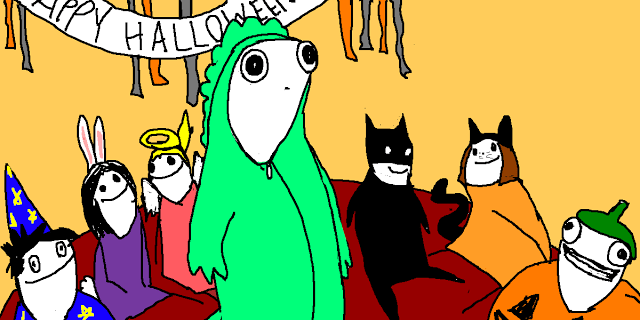
The dinosaur costume was the greatest thing that had ever happened to me.

…All I knew was that being a dinosaur felt very different from being a person, and I was doing things that I had never even dreamed of doing before. …Of course, I had always had the ability to do these things — even as a person — but I didn’t know that. I’d just assumed that I was unable.  As a dinosaur, I didn’t have any of those assumptions.  It felt like I could do whatever I wanted without fear of repercussions.

read the whole comic via Hyperbole and a Half: Menace.

  • Menace (hyperboleandahalf.blogspot.com)
behavior · children · creativity · culture · happiness · health · play

Cool doctors doing what’s right… – The Meta Picture

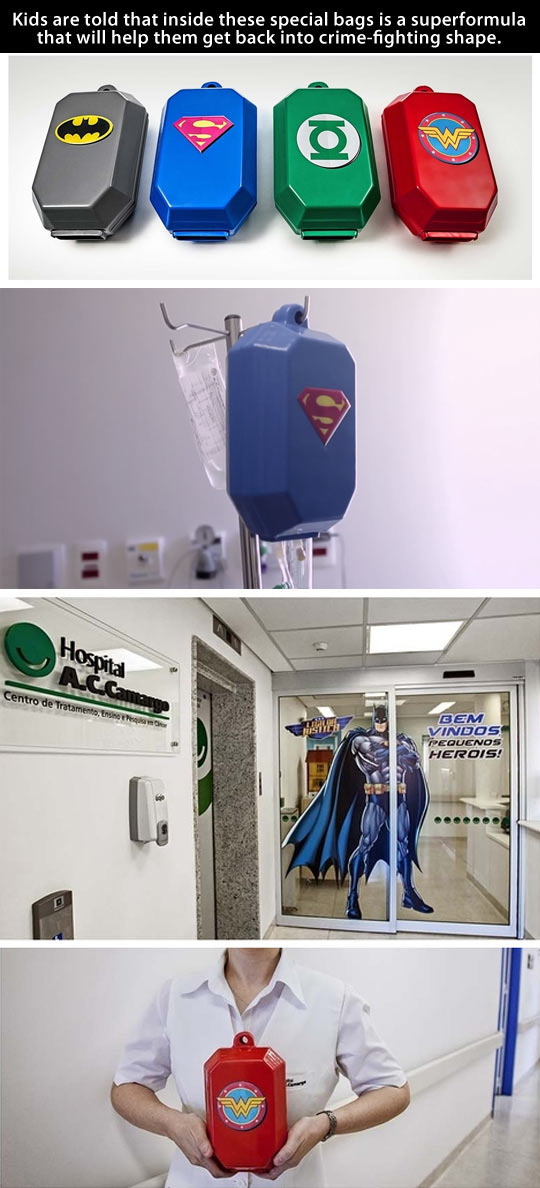
Hospitals can be scary places, for grown ups and for kids. This is a great way to make hospitals a little less intimidating, and add some silliness to an otherwise boring, and possibly painful, medical procedure.

Originally from Cool doctors doing what’s right… – The Meta Picture.

architecture · children · design · environment · happiness · Nature · play

The Best Playground Is The One Nature Provided | Co.Exist: World changing ideas and innovation

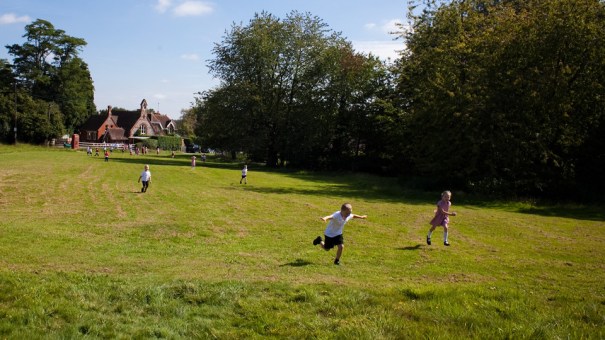
children lawn running

A recent article in the online magazine Co.EXIST discussed a study that found children benefit from being in natural environments, even if the environment is designed to appear natural but is actually human-made:

Dawn Coe, an assistant professor in the Department of kinesiology, recreation, and sport studies at the University of Tennessee spent time observing the behavior and time children spent playing on a local playground. After playground renovations added a gazebo, slides, trees, a creek, and a natural landscape of rocks, flowers and logs, Coe returned a year later to observe differences. Working with a statistician, Coe found children spent twice as much time playing in the natural landscape, and were less sedentary after the renovation and more active.“Natural playscapes appear to be a viable alternative to traditional playgrounds for school and community settings,” said Coe in a university statement. “Future studies should look at these changes long-term as well as the nature of the children’s play.”

via The Best Playground Is The One Nature Provided | Co.Exist: World changing ideas and innovation.

I attended a conference a couple of years ago where playground designers were reporting discovering the exact same thing – if you give a kid a pile of dirt and tree bark to play with and a bucket of water, they will have WAY more fun, play more, and learn some things as well.

This shouldn’t come as a surprise based on previous research on us humans:

For decades, scientists have reported our species exhibits a consistent, if not quite understood, response to spending time around nature: it boosts our mental and physical well being.

The scattering of findings have held in hospital beds, public housing, and Japanese forests. A 2001 study of public housing found the mere presence of trees and grass reduced reduced reported aggression and violence. Another showed people shown a stressful movie recovered to a normal state–as measured by metrics such as heart rate, muscle tension, and blood pressure–“faster and more complete[ly]” when exposed to natural rather than urban environments.

However, a lot of cities and schools are reluctant to install these kinds of playgrounds since they are considered “untested” or approved by several school or city boards. Thankfully, according to the article, cities are beginning to adopt and install these types of playgrounds:

“Natural playscapes are part of a growing trend appearing in cities across the US including Boston, Phoenix, Chicago, New York, Auburn and others.”

I hope to see more of these pop up around major cities. Do you have a natural playscape near your home? Tell us about it in the comments below.

children · community · education · happiness · health · learning · Social

Australian Children’s Play Manifesto Poster

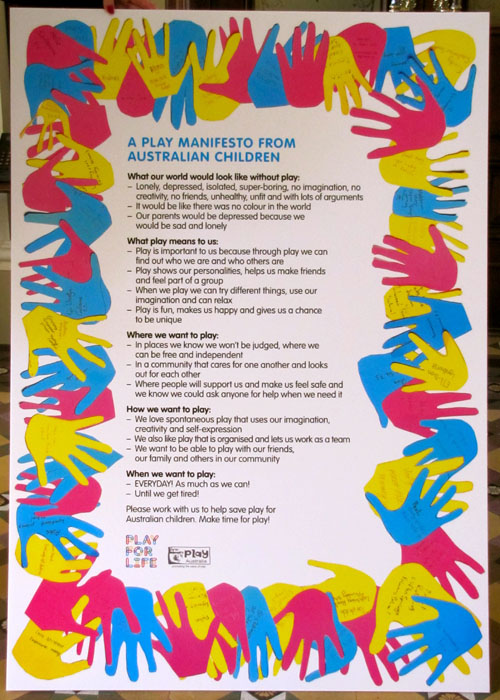
Play Based Learning in Australia is sharing a poster that captures the play manifesto of its children; how awesome!

After the overwhelming reaction to the success of the Australian Children’s Play Summit held in Melbourne on May 17th and 18th 2012 Play for Life Australia is kindly making available a copy of the Play Manifesto created BY Australian children FOR Australian children as a download. Play for Life believes that if we put the future of PLAY back into the hands of Australia’s children, then PLAY will be in very good hands!

Visit the original site for the full size poster.

anthropology · architecture · children · creativity · design · environment · health · Social · technology

6 Future Playgrounds That Harness Kids’ Energy While They Play | Co.Exist

What a great series from Co.Exist and Fast Company: play grounds, and other structures, that harness the energy of people’s movement. This may be the first time employees are actively encouraged to move around all day. 🙂

Kids have boundless energy. What if that energy could be put to some use besides just running around and having a good time. These new jungle gyms convert play to power.

When IBM came up with a list in 2011 of the five technologies it thinks will change the world in five years, kinetic energy–power from people–topped the list. Advancements could come, they say, from developments in devices that might harvest power from your shoes, your exercise, and even the soccer ball you kick. Green gyms are also cropping up. And now the idea has come to playgrounds, where kids’ movement can be harnessed and funneled into powering schools and toys.

Natural Energy Park
Natural Energy Park

This playground–designed by Hyundai engineering and construction–is part jungle gym and part renewable energy science experiment. After climbing a ladder into a laboratory, kids can spin a wheel that will illuminate “Benjamin Franklin’s kite.” An optical illusion will spin at varying speeds as children adjust a solar panel to different angles. Pedaling a bicycle powers a pinwheel and illuminates lights around the structure. Hyundai calls this the “Natural Energy Park” and it looks like a lot of fun.

Empower Playground
Empower Playground

Mixing fun and helping people, Empower Playgrounds is a non-profit organization that provides electricity-generating

playground equipment to villages in Ghana that are too remote to be on their nation’s electricity grid. The school children gain a playground as well as safe, rechargeable LED lanterns to light their homes so they can do their homework. Additionally, the play equipment doubles as part of a hands-on science lab that brings science concepts into their daily lives

See the whole series here.

For more on the future of playgrounds, check out 8 insane playgrounds, schools, and libraries of the future.

Know of other playful energy producers? Let us know in the comments below!

children · creativity · design · learning · play

Designs for Children Showcased at ‘Play In Progress’ During Milan Design Week

Happy Friday! I hope you get a chance to go out and play this weekend. Speaking of play, here is another great find from Milan’s Design week (remember the edible mini furniture from earlier this week?). This exhibit of design focused specifically on children’s spaces, with a focus that was very playful, creative, and also a great idea for grown-ups to incorporate into their own environments.

From Inhabitat:

Students from the HDK master program Child Culture Design created an exhibit to explore new ways of bringing play into everyday objects to help foster imagination and creativity. Dubbed “Play In Progress“, the exhibit was one of our favorites at the Salone Mobile.

Johanna Larsson‘s cool table features transparent color plates that can be arranged and rearranged to create different tabletop scenes that push imaginative thinking.
At first look of Hide||show appears to be nothing special, but just put a kid in front of one of these and you’ll realize that there is definitely something more to this cabinet. The cabinet features two pairs of handles — one ordinary set for adults and a pint-sized set of hole-like handles for children. The variation indicates different accesses to function, and give children the feeling of exclusivity in their own world.
Inspired by the game of “hide and seek”, Behind the Curtain blocks out part of a white curtain with color to create a secret space for a child to be alone in his/her world.
Griet Boucique has designed an ‘Alternative Playground’ – a landscape of soft seats – that questions what is a ‘good’ play environment for a child? The design considers material usage, its impact on the environment, and how different textiles can the way a child engages in play.

Check out more great designs at Inhabitat (I love the block table, for example!)

anthropology · children · community · creativity · design · environment · learning · Nature · play

Kids’ playground goes back to nature – Edmonton Journal

I love the fact that playgrounds are incorporating the stuff that kids love to play with the most – dirt, rocks, and sticks!

Children won’t find new monkey bars and bright plastic play structures at the upgraded Donnan Park.

Instead, the aging playground at 9105 80th Ave. will become Edmonton’s first “natural playground,” part of a growing trend in playground design.

Children in the redesigned Donnan Park will entertain themselves with such timehonoured playthings as rocks, sticks, sand and dirt. The overhauled space will feature a slide built into a hill, a sideways-growing tree, a boulder spiral, a hand pump to pour water into a small stream and plenty of plants, trees and greenery.

It will be “a beautiful garden that everyone plays in,” says Kory Baker-Henderson, co-chair of the neighbourhood committee that worked on the preliminary playground design with expertise from Ontario-based Bienenstock Natural Playgrounds.

“Around us there are already some typical playground structures, so we wanted to have something different that blends in with the (Mill Creek) ravine,” Baker-Henderson says.

“Studies have shown imaginative play is much more stimulated (in natural settings) and children actually will play longer and become much more involved than on a typical red, plastic slide structure. Their games will just get much more imaginative. There’s that connection with nature. We have plans for a community garden, so it’s a learning and teaching tool, too.”

The playground at Donnan Park currently has swings and a slide that will remain for now, but won’t be replaced, she says.

Read the full article.

behavior · brain · children · environment · family · learning · psychology

How To Help Your Child’s Brain Grow Up Strong : NPR

A lot of parents freak out about how to provide enriching environments for their children and help them grow, from music lessons to early reading to math flash cards.

In one of those “well duh” books, two neuroscientists, Sandra Aamodt and Sam Wang remind us it doesn’t take all that much…

Babies may look helpless, but as soon as they come into the world, they’re able to do a number of important things. They can recognize faces and moving objects. They’re attracted to language. And from very early on, they can differentiate their mother from other humans.

“They really come equipped to learn about the world in a way that wasn’t appreciated until recently,” says neuroscientist Sandra Aamodt. “It took scientists a long time to realize that their brains are doing some very complicated things.”

Aamodt and fellow neuroscientist Sam Wang explain how the human brain develops from infancy to adolescence in their new book, Welcome to Your Child’s Brain. The two researchers also offer tips for parents to help their children eat their spinach, learn their ABCs and navigate elementary school.

more via How To Help Your Child’s Brain Grow Up Strong : NPR, on Fresh Air.

They talk with Terry Gross about complicated concepts like self control, abstract thought, and things that are even hard for some grown-ups, and how to create an environment that makes kids want to practice these things.

children · community · design

Kids paint South Seattle mural for safety | Seattle Times

Hajiyeva Aysha, a volunteer from Harborview Medical Center, foreground, and Keith Harrison help paint a whale mural near Graham Hill Elementary School on Sunday. The mural is meant to improve walking conditions for child pedestrians in the Graham Hill Community. Photo credit Ellen Banner. Seattle Times.

Flashing lights or a “Slow Children” sign are common sights around schools, but now a local school has put in a “a huge, round, sea-themed mural right smack in the middle of South Graham Street in South Seattle,” to alert drivers to pint-sized pedestrians:

Some of the kids who had helped earlier talked about what the painting was supposed to accomplish.”It’s there so people will notice it and think they should really, really slow down so they don’t get into accidents,” said Maya Garcia, 8, one of the students the mural is meant to protect at nearby Graham Elementary School.Her friend Lilly King, 9, had another concern. “I hope they don’t crash into each other when they’re slowing down.”

The mural, part of the Safe Kids Seattle project installed this weekend in the 5100 block, is thought to be the fourth in the city and the first south of Interstate 90, according to Graham Elementary Principal Christina Morningstar. Each year, according to officials, more than 244 children under the age of 14 are killed in pedestrian accidents in the nation. All the Safe Kids projects are designed to alert drivers to the presence of children in school zones.

In addition to the mural, which features a whale and several fish, organizers installed speed bumps and school-warning signs using $35,000 in grant money from FedEx and the Seattle Department of Transportation.

via Local News | Kids paint South Seattle mural for safety | Seattle Times Newspaper.

I read this story in the office lounge while I was waiting for my leftovers to warm up in the microwave, and immediately thought this was a good idea not just for schools, but for any place that pedestrians frequent. Often cities will put in colored bricks or tiles at busy crosswalks, but for areas with less options and/or funds to renovate, this is a great solution!