creativity · design · environment

Making the morning commute more colorful

Happy Monday. Ok, so most of us are probably a little bummed that the weekend’s over and we have to go back indoors and work or go to school for most of the day. Many of us (myself included) also take a subway or bus to get to work. And while there is the occasional musician or interesting graffiti, subway stations and bus terminals are usually pretty bland and boring, not the best thing to enliven you and get you ready for the day. Well, thankfully Stockholm, which already suffers from a lot of dark days throughout the winter, has come up with some relief for its subway passengers: beautifully painted subway stations! From Inhabitat:

Metro stations in Stockholm have been elevated to veritable art museums with stunning murals and playful art installations adorning the cave-like walls and ceilings.

The Stockholm subway system is often described as the world’s largest art museum — for the price of a Metro ticket, you can enjoy impressive works of art spanning from the 1950s to the 2000s. The Metro spans more than 110 kilometers, and 90 of the 100 stations in the system have been decorated with world-class murals and sculptures from 150 different artists.

The T-Centralen station — the city’s central subway station — which was designed by Per Olof Ultvedt in 1975, is perhaps the most iconic of them all, and it features massive blue-and-white paintings on its cave-like ceilings. With its bright red walls and ceiling, the Solna Centrum station looks otherworldly. The Kungsträdgården subway station has been designed to look like an archaeological dig, and it features the remains of Stockholm’s old Makalös palace. And the Östermalmstorg stations features art by Siri Derkert that focuses on themes that include the environment and women’s rights.

What a great way to combat the dark, dreary mornings (and evenings) of Sweden in winter, or just give yourself a mental boost on your way to and from work. Nice job Stockholm! 🙂
children · creativity · education · emotion · environment · happiness · health · play · psychology · Social

Exploration of Playful Learning Spaces for Children

toys
toys (Photo credit: red5standingby)

From the blog Art Farm, a play/art therapist who offers some advice on creating spaces that encourage kids to explore, learn and play:

I really learned the importance of organizing and preparing spaces while working with youth in school settings in several public housing developments in Chicago.  So often these youth would come to me (for either individual or group art therapy sessions) filled with anxieties which either manifested as acting out or withdrawn behaviors. The arrangement and presentation of the private space we used was a powerful, non-verbal message to them stating that all things are respected here – including you; everything has a place here – including you; and everything you will need to have a successful experience is here – starting with you.

[Mariah] Bruehl offers some questions to ask when designing a space for your own child:

  • Can your child access the materials in the play space independently? Are they organized in baskets or bins that are clearly labeled so your child knows how and where to put things away when finished with them?
  • Are the materials presented in an attractive manner that invites your child to use them?
  • Do the materials, toys, and games represent a balance between your child’s and your own preferences? Do they represent what you value and thus encourage your child to engage in activities that you feel good about?
  • What is your child currently interested in? If your child no longer plays with dinosaurs, but has been talking a lot about birds, make sure that the play space reflects this current passion. Rotating toys is a great way to keep your child interested in play space activities and ultimately prolongs the life of your child’s playthings. It never ceases to amaze me how excited my girls get about a toy that comes back into rotation. The nostalgia they feel toward a toy they have not seen in a while is almost more than their delight over a brand-new toy.
  • Is the play space a calming environment that allows one to focus on the task at hand without distracting colors, decorations, or objects?
  • Are you seeing things from you child’s perspective? Put yourself in your child’s shoes to determine the right height for displaying and storing materials and hanging art.
  • Is this a space that makes you want to make art, explore science, write stories, and more? If so, would you have everything you need to do what you want to do? What else would you add to enrich and deepen your child’s learning experience in the play space?

What other playful space researchers are out there? Any recommendations? I know about the organization Art With Heart, which focuses on creating therapeutic resources for sick kids. But I’d love to hear more about what’s out there. Let me know in the comments below.

design · play

Abandoned park becomes interactive art installation

Thanks Inhabitat for featuring this great story about reclaiming unused public space and making it more playful:

Berlin’s Spreepark Planterwald amusement park, also called Kulturpark, has been abandoned since 2001, but this summer several curators took over the overgrown park and transformed it into a big, interactive art installation. The park reopened at the end of June, letting visitors tour the ruins and witness nature’s takeover of the Soviet-era amusement park. Inhabitat was on hand to check out the park and explore the art installations at the perimeter of the park.

For ambitious curators, Anthony SpinelloGeorge Scheer,  Stephanie Sherman and Agustina Woodgate (an Inhabitat favorite) were stationed at Kulturpark for the summer, organizing site-specific installations around the park, as well as artistic programming to engage the community once again with this abandoned place. With help from the curators, the fate of the park, which goes up for auction next year, may veer toward a place for public consumption, and hopefully create a place for the public to enjoy the grounds and non-profits to conduct cultural programming for the community.

+ Kulturpark

What unused spaces would you like to have seen turned into a public art space or public park? Leave your ideas in the comments below.
community · creativity · design · education · Social

Public Art Project That Shares, Teaches Art

Another great story about public artwork and interactive public space. This time courtesy of Design*Sponge:

Mike Perry (who was part of Design by the Book four years ago) is launching a new project via Kickstarter called Wondering Around Wandering. It’s a three-month FREE community exhibition and event space where Mike will teach workshops and host screenings, discussions and more. The space will welcome artists and art appreciators alike and, because of the time span, would be a great way for visiting artists and design enthusiasts to learn and experience on a more intimate level.

Holiday Zine, one example of what you’d get as part of your support via Kickstarter

See the original story at Wondering About Wandering | Design*Sponge

Find out more at Wondering About Wandering | Kickstarter

behavior · creativity · emotion · happiness · psychology

Surefire way to make yourself smile

Feeling a little down after the festive weekend with possibly WAY too many chocolate bunnies? There is a cure for that. But don’t take my word for it, ask Canadian artist Alison Ann:

I was a bit sad that my vacation was over until I remembered this little gem of a project that I did on a cool January eve.

The goal here was to draw 100 smiley faces in an act of self cheering.
It totally works.
Here is my sample, and I encourage you to do the same.
If you do do the same you should share it with others too.. or share it with me!!!
Or share on this blog! 🙂

Happy Monday!


anthropology · architecture · community · creativity · culture · design · environment · happiness · Social

How legalizing street art made Rio de Janeiro a prettier, happier place

A recent article in the Huffington Post explored Rio de Janeiro’s acceptance of street art and how it has enriched the various neighborhoods:

Brazilian graffiti art is considered among the most significant strand[s] of a global urban art movement, and its diversity defies the increasing homogeneity of world graffiti.” – Design Week

In March 2009, the Brazilian government passed law 706/07 making street art and graffiti legal if done with the consent of building owners. As progressive of a policy as this may sound, the legislation is actually a reflection of the evolving landscape in Brazilian street art, an emerging and divergent movement in the global street art landscape.

Rio de Janeiro has been particularly progressive in its policy towards street art, with its 1999 “Não pixe, grafite” (Don’t Tag, Graffiti) project that brought together 35 graffiti artists to showcase diversity in local styles. But more unique is the evolution of a permission hierarchy, blurring the line between formal and informal. The new street art law merely reinforced these unique patterns of street art and legitimized an already flourishing form of artistic expression.

Retaining walls on the steep terrain provide canvases for artists.

In Rio de Janeiro, street art is ubiquitous. It exists in all corners of the city, from the favelasto upper class neighborhoods, from residential to institutional. It is bold in scale and aesthetics and is anything but graffiti. The urban fabric of Rio de Janeiro also figures prominently in the evolving street art scene. The high walls, whether for security or to contain the topography, provide ample surfaces for painting. But rather than location dictating art, the relationship between owner and artist has a direct impact on where street art occurs.

Owners of buildings, both residential and commercial, sometimes invite artists for commissions, which is done to protect from tagging, as an aesthetic choice or as an economic choice — painting a façade with art may be cheaper than another mode of beautification. In another case, street artists ask permission from the owner.

Tudo de cor para você, Santa Marta, Rio de Janeiro (photo source: favelapainting.com)

Thanks to the city’s openness to various forms of artwork, and specifically “street” art, Rio de Janeiro is now known for its colorfulness and art. In informal studies the art has also been found to make citizens more invested in their communities and overall happier.

Hooray for public art.

community · creativity · Social

Storefront Seattle: taking art to the street (window)

Before and After example of Storefronts Seattle project.

With the down economy a lot of stores and businesses have gone out of business, leaving a lot of empty store fronts, at least in places around Seattle. But rather than let those places stay dark and dormant, one woman is spearheading an effort to get local Seattle artist’s work installed in these vacant storefronts:

Storefronts debuted in late 2010 as an experiment in activating vacant spaces with art, creative enterprise, and performance… We also revitalize neighborhoods. And we beautify blocks. And we make areas safer at night, and we market real estate, and we paint walls and mop floors and install lighting and turn desolate half-empty blocks into the hippest, happiest, and hottest real estate in town.

Storefronts Seattle leases storefront space from neighborhood property owners for the nominal rate of $1 per month. We can program up to 15 storefronts in any given neighborhood at any given time, and we fill these spaces with art installations, with creative businesses, and with artist’s studios. These projects are proposed by artists throughout the region, and are chosen by a panel that includes neighborhood representatives, local museum curators, arts professionals, and our programming staff.

At full integration into a neighborhood, Storefronts Seattle is programming up to 60 arts installations per year into your spaces. That’s enough to instantly turn any neighborhood into a walking destination, an arts and culture destination, and a shopping destination. It’s enough to generate regional press. It’s enough to get the city’s creative class and cultural leaders to pay attention.

More at Storefronts Seattle

This is a great project where everyone benefits: property managers get free positive attention for their site, artists get their work exposed, and normal people get to benefit from the art for free!

It also involves a lot of local Seattle neighborhood organizations, bringing attention and buy-in from various communities around Seattle. There are quite a few installations in place right now through May.

What a great opportunity to improve and enrich everyone’s environment. Know of other groups out there taking advantage of empty spaces like these in other cities? Share them in the comments below!

architecture · children · creativity · design · play

Playground Crochet by Toshiko Horiuchi

This is from last November, but still amazing!

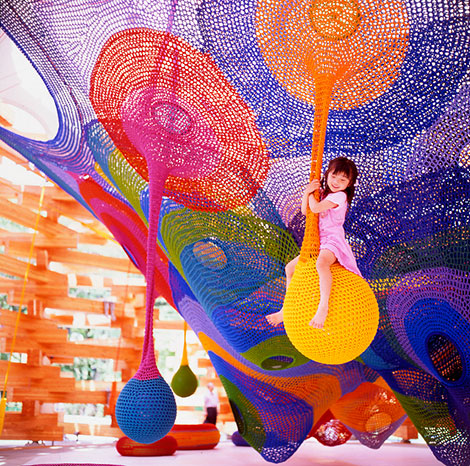
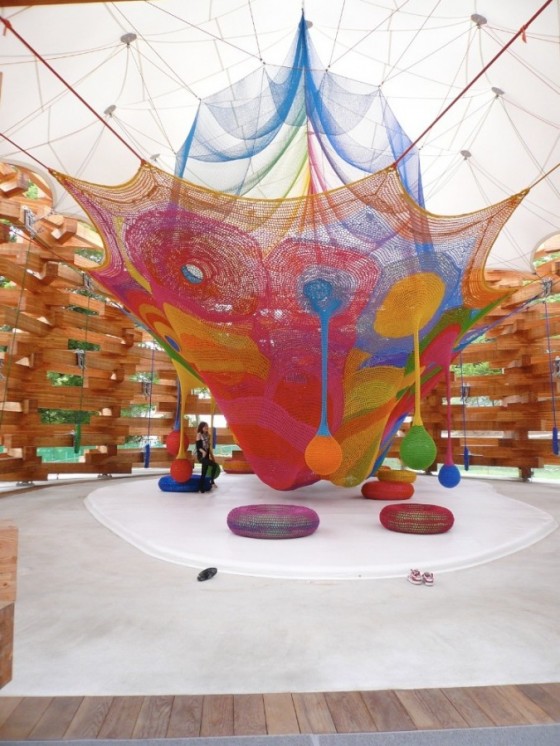
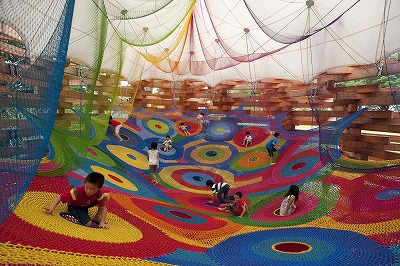
Toshiko Horiuchi MacAdam, who orders yarn by the ton for her creations, is the textile artist behind the oft photographed net constructions at the Hakone sculpture park in Sapporo Japan.

I love the story of how she came to be engaged with children’s play:  “It all happened quite by accident. Two children had entered the gallery where she was exhibiting ‘Multiple Hammock No. 1’ and, blissfully unaware of the usual polite protocols that govern the display of fine art, asked to use it. She watched nervously as they climbed into the structure, but then was thrilled to find that the work suddenly came alive in ways she had never really anticipated. She noticed that the fabric took on new life – swinging and stretching with the weight of the small bodies, forming pouches and other unexpected transformations, and above all there were the sounds of the undisguised delight of children exploring a new play space.”

From that point, her work shifted out of the gallery and a subdued, monochromatic pallet into a riotous rainbow of colors for children’s playscapes.

Rainbow Net was produced in close collaboration with structural engineers TIS & Partners and landscape architects Takano Landscape Planning and opened in July of 2000 after three years of planning, testing, and building.

Note that the project began with a brief not for a playground, but simply for ‘public art‘.   Wouldn’t it be great if when we heard ‘public art’ we automatically thought ‘play’?

But innovative playscapes require an enormous commitment: “…endless cycles of discussion and approval, with meticulous attention to detail…[including] an actual scale wooden replica of the space in Horiuchi’s studio and accurately scaled crocheted nets using fine cotton thread. Even then, it was difficult to assess many things. What difference, for instance, would the weight of the real yarn make when everything increased in scale? All of these factors had to be calculated in order to arrive at a scientific methodology that could eradicate any risk of unacceptable danger.”During final assembly, Toshiko crocheted ten hours a day, often on her knees, until the installation was complete.”

With the current revival of the textile arts and yarn bombings everywhere, I’d love to see more crochet on the playground!

More at: Playground Crochet by Toshiko Horiuchi.

What an amazing use of fabric to create an original, creative play space.

behavior · creativity · environment · happiness · play · youtube

My thesis, summed up in a two-minute video

After working for literally YEARS on my Master’s thesis (I’m still SO excited that I graduated this past quarter and am an official M.A.), I come across this video, which pretty much sums up my years of work in two and a half minutes. It showcases two students from Parkour Visions in Seattle, WA, explaining why they like parkour, mostly because it lets them play again. Upon seeing this I had two thoughts: “well done” and “dang!”

My parkour buddies also showed me this video recently, which in approximately 9 minutes explains the whole reason I wanted to do my thesis in the first place. The video is actually a pitch for funding a documentary called “Seriously!” which interviews a lot of play experts on the subject of play, including many people I cited in my thesis, and why play is important for our survival. In this case, my reaction was wanting to send it to my thesis advisers and scream: “See? See?!”

Ugh.

Anyway, it is a very nice video, so enjoy:

creativity · environment

Friday guerilla art

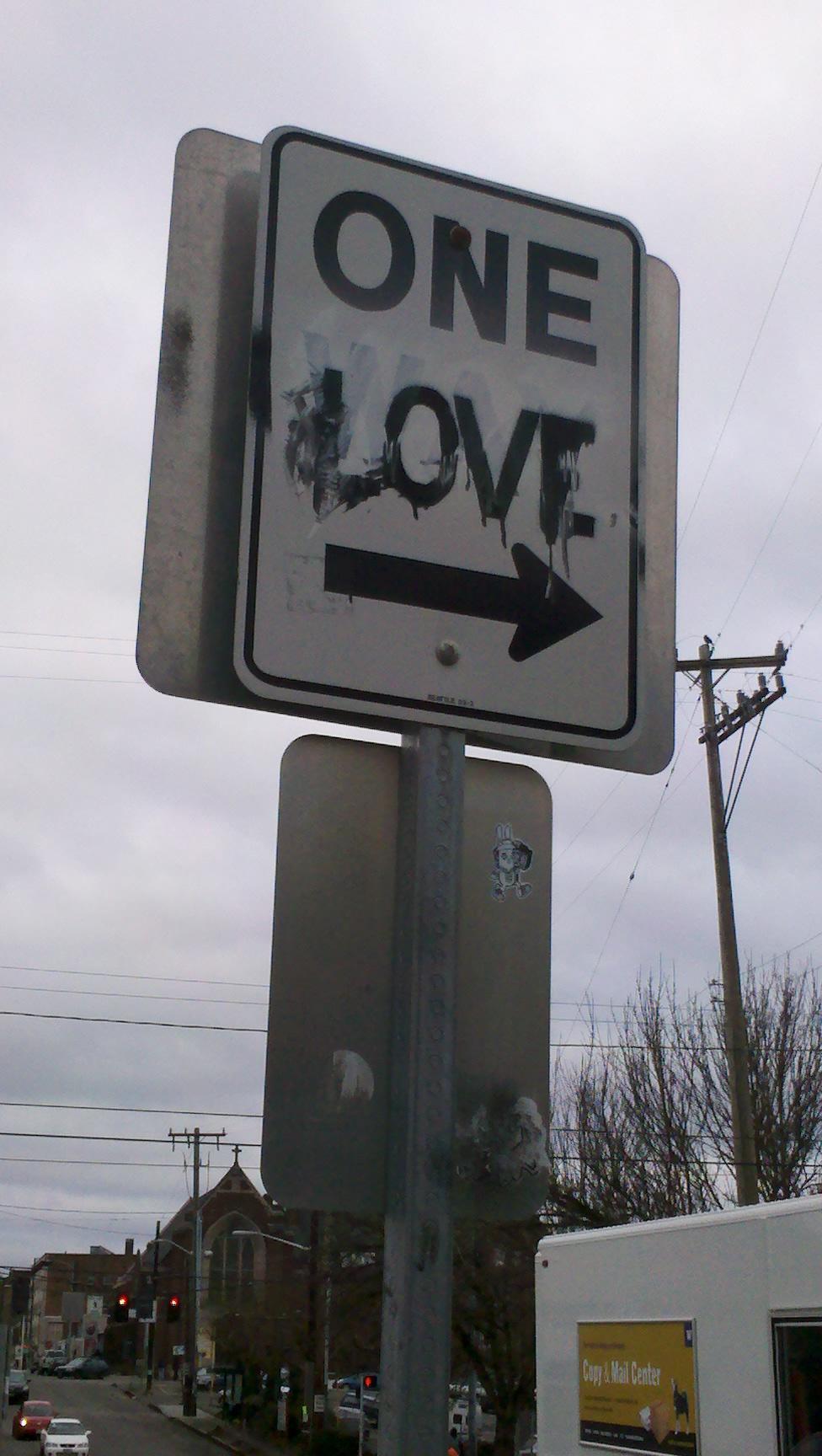
While I don’t condone defacing public street signs, I liked the sentiment. It made me think about how easy it is to make people smile and make a space more friendly with a word.
Happy Friday!