This is an ongoing project in Seattle of sprucing up vacant office or retail space with art. It’s a plus for the artists, the building managers since it brings attention to their space, and the passersby who are charging to and from work or tourists who stop and linger a little bit longer to view. Always love seeing updates on new projects by this group.
Storefronts Seattle is proud to announce the first two of three projects in the Belltown neighborhood!
Ingrid Lahti
One Pacific Tower, 2006 First Avenue, Belltown
Through June 2013
Ingrid Lahtitraditionally works in neon, but has branched out into illuminated lighting gels in her new installation at First and Virginia. Inspired by the saturated color in Matisse paintings and Chinese artwork, Ingrid views the illuminated window pieces as a study on the emotional effects of color and light, fitting seamlessly into the vibrant neighborhood in Belltown.
These installations glow brightly at night, adding to the street-level nightlife of Belltown and kicking off a summer in Seattle with a burst of color.
Chris Papa 2505 Second Avenue
Through June 2013
Chris Papa, a local printmaker and sculptor, has installed 5 sculptures at Second and Wall, featuring playful sewn wood sculptures conflating art, craft, and architecture. Interested in the…
A great example of actively adding art in urban settings in order to create enrichment for its inhabitants:
Urban landscapes have always inspired art, and Brazil is no exception. A new crop of artists like Matos not only is taking inspiration from Sao Paulo‘s streets but also is trying to give something back.
Matos covers trees and street poles with woolen sleeves and small, colorful pompoms. Her works look like whimsical webs of rainbow yarn; the effect is surprising and oddly comforting.
“I want people to have something familiar in the city. Here in Brazil we teach knitting from mother to daughter,” Matos says. “When they see my art, they suddenly feel comfortable walking these cold streets. And you can feel better.”
The newest and the biggest urban art project here is called , and it has an impressive list of corporate sponsors. The idea is to connect graffiti artists with individuals or business owners who have a wall they want covered with original art.
Artist Guilherme Matsumoto says he saw the website and signed up to say he was available to paint a space. Walter Orsati, owner of the Purple House Hostel, responded.
For Turkish artist Mehmet Ali Uysal’s space is paramount, hence the title of this body of work, ‘Space Matters’. Always concerned with how to reshape the space around him, in his art he has achieved this exploration seamlessly. A giant clothespin pinching the landscape, Uysal takes the place of the work as the cause for creating the work. In the end, the gallery space becomes part of the art work, its’ material, form and content. The context becomes the content.Built for the Festival of the Five Seasons in Chaudfontaine Park, on the outskirts of Liege, Belgium generated a bit of attention across the web. It was made for the Festival of the Five Seasons.
I love found art and seeing artists be creative and resourceful and being inspired to create with what they have around them, especially things that would normally be recycled or thrown out.
Using an object as basic as a pencil shaving, artist Marta Altés created these clever, yet simple, drawings in which ink figures interact with colorful and textured pencil remnants. By repurposing the shavings, the artist transformed objects that others see as trash into beautiful and integral elements within each piece, including butterfly wings, a ballet tutu, and a lion’s mane. It’s incredible how many different ways she has morphed her doodles into these adorable drawings, with just these delicate scraps.
As a kid I loved the shapes these pencil shavings created, so I’m glad somebody else noticed this too. There are some great images, so go check them all out at the link above.
Inhabitat is on a role with their environmental enrichment stories!
OakOak’s street art is created to amuse and inspire – this self-described “fun-loving” artist plays with urban elements to make people laugh. He finds broken infrastructure, crumbling buildings and cracks and gives them a facelift with the simple addition of a character in play. Everything from simple stick figures to smiley faces, animals, objects and superheroes can be seen gracing OakOak’s hometown of St. Etienne, France, where they turn the less than perfect facades into something playful and fun.
As kids my friends and I used to imagine creating electricity out of the swings or the merry-go-round. Turns out we weren’t the only geeky kids who thought up that kind of thing:
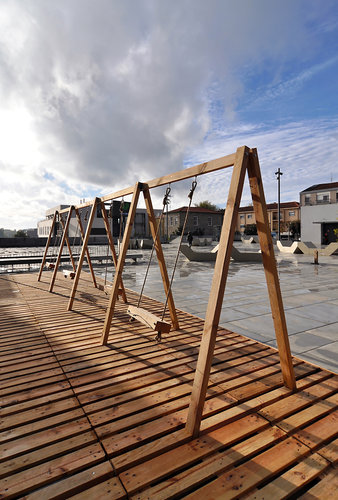
Swinging is a self-contained pleasure, an activity where the work and reward are one in the same. But for their pop-up installation outside the International Centre for the Arts in Guimarães, Portugal, the art collective Moradavaga added an unexpected twist to the childhood pastime: a little bit of light, powered solely by the motion of the swings themselves.
As a pair of European designers have demonstrated, it is in fact possible to intertwine the fun-factor of trampolines with utility. And the world is now a better place. First off is the proposed trampoline “Bridge in Paris,” a design that was put together by Atelier Zündel Cristea of AZC Architecture Studios.
His describes his floaty bridge thusly:
It appears to us that Paris has enough bridges. Our intention is to invite its visitors and inhabitants to engage on a newer and more playful path across this same water.
We propose an inflatable bridge equipped with giant trampolines, dedicated to the joyful release from gravity as one bounces above the river.
Is it dangerous? Probably. Would it ever get approved? Doubtful. But I’m still excited to see this getting so much press, since that indicates that people are interested and hungry for opportunities to get outside and play!
ASLA blog The Dirt has been reporting on their annual meeting, and mentioned a talk discussing why public art is important. I couldn’t agree more!
…art occupies a unique position within the art world. In comparison with big-name gallery shows, public art is often “under appreciated” much like landscape architecture. But there’s lots to laud: “It’s free. There are no tickets. People don’t have to dress up. You can view it alone or in groups. It’s open to everyone.”
Community art can also create attachment to one’s community. According to Bach, studies have looked at the economic development benefits of art, but only just recently have there been wider examinations of the effect of art on a community’s sense of place. The Knight Foundation’s Soul of the Community initiative surveyed some 43,000 people in 43 cities and found that “social offerings, openness and welcome-ness,” and, importantly, the “aesthetics of a place – its art, parks, and green spaces,” ranked higher than education, safety, and the local economy as a “driver of attachment.” Indeed, the same story may be playing out locally in Philly: a survey of local residents found that viewing public art was the 2nd most popular activity in the city, ranking above hiking and biking.
An example of public art; “Tree Futures” by Suze Woolf. Photo from the Heaven and Earth Exhibition in Carkeek Park, Seattle, 2012.
It creates community by creating a sense of place, it is available for all to enjoy, and it makes a place more enjoyable in which to hang out. All of these are important for creating enriching environments. Also, by making the art public, people often feel they have ownership of the art, or a right to play with it. This can be good and bad; if they art is designed to be engaged with, more power to the people. However, some people do act upon the art in a destructive way, either accidentally or intentionally, which is play to them but ruins it for the rest of the public.
This brings of the life cycle of art, and it being taken care of or abandoned over time, which was also discussed at the meeting:
Bach also made a point of discussing the “afterlife of public art,” what happens once it’s out there. As an example, she pointed a work by Pepon Osorio, a pavilion at a Latino community center that features historical photos of people from the community. Today, kids from the neighborhood take photos of themselves with photos of their ancestors. Another project called Common Ground in a footprint of a church that burnt down was hosting weddings just a week after it opened. While these works became part of their communities, Bach said the group still has to work hard to ensure that all works remain relevant to their communities and aren’t “orphaned.”
Some art is meant to be abandoned; at Carkeek Park in Seattle there is an annual public art exhibit where often the installed art pieces are left at the end of the summer to decay or be destroyed by the elements.
Art installation at Carkeek Park, Seattle, 2012
Overall though I think interaction with public art is a good thing. Do you or have you ever played in fountains, posed with statues or art pieces, or altered them in some way (like the Fremont people in Seattle)? These are all forms of play inspired by public art, which I think are valuable methods of play and should be encouraged so long as it doesn’t damage the artwork.
Waiting for the Interurban is memorial to the trolley/rail line that once ran between Everett and Tacoma. Standing at the north end of the Fremont Bridge, these five aluminum commuters (and one dog) have waited since 1978 for a ride that never came. Decorating the statues with seasonal apparel, political signs and other props has become a Seattle tradition.
What is your experience with public art? Do you find it a good use of real estate? Do you have a statue or fountain or public art piece that speaks to you, that you think of as “yours”?
After all the great stories about zoos adapting their spaces for their animals I’ve stumbled across recently, I was starting to feel a little sad for us humans. Thankfully, here’s another story I found from Inhabitat about re-purposing spaces for human play:
On the Plaza Luis Cabrera in Mexico City, two 1960’s Mitsubishi trolleybuses have been permanently parked for public use as part of a larger arts initiative in the Roma, Condesa and Hipodromo districts of Mexico City. The gutted and repurposed trolleys currently serve the city as vibrant spaces that engage residents and visitors in new art and cultural activities.
The vintage rides, which were donated to Mexico City by the government of Japan in the year 2000, were originally used to host the Galeria Trolebus initiative — a space used to showcase non-traditional art projects. Today the repurposed busses are public spaces for everyone to enjoy. On weekends and afternoons, visitors may stumble upon sculpture arts, free theater, music workshops, as well as concerts. The cultural activities on the trolleybuses even help to activate adjacent public parks, encouraging locals to take advantage of the ample and free space right before their eyes.
In order to keeps things dynamic, each month the buses on Plaza Luis Cabrera are re-painted in mural styles, with bright colors and bold prints by artists, community members and advertisers who volunteer their talents.
In brilliant fashion, the city has come up with a community-sustaining way to keep an outdated trolleybus model in style and out of the junkyard!





 Mental Flowers