A lovely antidote to Monday [or Tuesday] blues! As Jon Stewart of The Daily Show says, “Now here it is, your moment of Zen…”
see the original post Penguins chasing a butterfly – Boing Boing.
Exploring Enriching Environments

A lovely antidote to Monday [or Tuesday] blues! As Jon Stewart of The Daily Show says, “Now here it is, your moment of Zen…”
see the original post Penguins chasing a butterfly – Boing Boing.
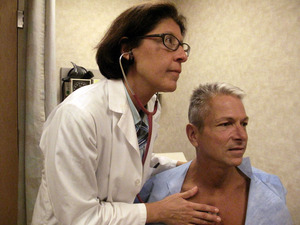
I played sports as a kid, and always had to start my school year with a doctor’s physical exam. Apparently that doesn’t happen much anymore.
Doctors are physically examining their patients less and less, and relying more on technology. Some doctors are bucking this trend and trying to revitalize the practice of listening and actually touching their patients.
As a woman, I am still poked and prodded on a semi-regular basis (yuck!), but I’ve never had to go in for something serious, and I’ve heard others complain about this phenomenon. I’m interested what the experience of others has been.
For centuries, doctors diagnosed illness using their own senses, by poking, prodding, looking, listening. From these observations, a skilled doctor can make amazingly accurate inferences about what ails the patient.
Technology has changed that. “We’re now often doing expensive tests, where in the past a physical exam would have given you the same information,” says Jason Wasfy, a cardiologist-in-training at Massachusetts General Hospital in Boston.
As a result, many doctors are abbreviating the time-honored physical exam — or even skipping it altogether.
I am a little worried it was supposed to be released more than a year ago and I can’t find any updates, but…
Play All Day documents a collection of the most vibrant, stimulating and engaging design products and concepts for children. This book sets a new standard of design for children with fascinating examples of innovative and well-designed toys, playgrounds and play environments, room decorations, wall coverings, furniture and kindergarten architecture. In addition to these products, it also presents illustration and photography as well as new and original ideas offering playful solutions that talented designers and creative parents are designing for and with their kids. It is an inspiring reference for design-savvy parents and other professionals.
more at the Play All Day publisher’s website.


Pesticides used in industrial farming, lawns, and other urban greenery have been linked to all sorts of child development health issues, and now a study is suggesting one more. A study released in the May issue of Pediatrics Journal argues that there’s a connection between high exposure to common pesticides and increased risk for children developing attention deficit hyperactivity disorder, or ADHD.
Maryse Bouchard and colleagues looked at more than 1,100 children aged between 8 and 15. All of them had been sampled by the National Health and Nutrition Examination Survey (NHANES) between 2000 and 2004, and 119 had been diagnosed with ADHD. Bouchard’s team studied their urine samples for chemicals called dialkyl phosphates, which result from the breakdown of organophosphate pesticides used to protect fruits and vegetables.
For a 10-fold increase in one class of those compounds, the odds of ADHD increased by more than half. And for the most common breakdown product, called dimethyl triophosphate, the odds of ADHD almost doubled in kids with above-average levels compared to those without detectable levels [Reuters].
more at via Study: Common Pesticides Linked to Attention Deficit Disorder | 80beats | Discover Magazine.
I posted this on my other blog, Art of Science, because it concerns the science behind pretty sounds, but it’s also important from an environmental enrichment perspective – in fact that’s what Julian Treasure does for a living – so I wanted to also post it here:
From Art of Science –
Listen to Julian Treasure’s TED talk about sound. [And really listen! Close your other computer screens, turn off the email “ping”s and listen.]
Treasure says our increasingly noisy world is gnawing away at our mental health — even costing lives. He lays out an 8-step plan to soften this sonic assault (starting with those cheap earbuds) and restore our relationship with sound.
Julian Treasure is the chair of Sound Agency, “a firm that advises worldwide businesses — offices, retailers, hotels — on how to use sound. He asks us to pay attention to the sounds that surround us. How do they make us feel: productive, stressed, energized, acquisitive?
Treasure is the author of the book Sound Business and keeps a blog by the same name that ruminates on aural matters (and offers a nice day-by-day writeup of TEDGlobal 2009). In the early 1980s, Treasure was the drummer for the Fall-influenced band Transmitters.” (Source: TED)

As the new school year begins, I wanted to mention this article from the New York Times about how schools are discouraging kids from making best friends.
Ahem. Let me repeat that. Schools are discouraging children from having a best friend.
That is just stupid.
Or, put more professionally…
“…such an attitude worries some psychologists who fear that children will be denied the strong emotional support and security that comes with intimate friendships.
“Do we want to encourage kids to have all sorts of superficial relationships? Is that how we really want to rear our children?” asked Brett Laursen, a psychology professor at Florida Atlantic University whose specialty is peer relationships. “Imagine the implication for romantic relationships. We want children to get good at leading close relationships, not superficial ones.”
read the full article via The End of the Best Friend – NYTimes.com.
This is where political correctness and “fairness” go waaaaay too far and ignore human nature and the absolute NEED to have a confidante in life, someone you can rely on, particularly someone outside of your family of origin. Will those people hurt you from time to time? Absolutely. But it’s part of learning how to work within a society and be a social animal.
Studies keep showing how adults today have less and less close friends, and would LIKE to have more. Discouraging kids from learning how to make close bonds with people is just setting them up for this trend to get worse when they become adults.
Now go call your best friend.
As anyone living in the gray, wet Pacific Northwest knows, there is something mentally stimulating and rejuvenating to being able to step outside and get a whiff of fresh air, even if it means getting a bit soggy in the process. Now, research has proven just how beneficial it is for mental health:
Hartig and colleagues suggest that being stuck indoors on vacation can limit mental recuperation. On the other hand, when able to roam outdoors, we can exert ourselves at a favourite sport or simply linger in the park. Psychologically, beautiful scenery can distract us from our troubles, help us forget our normal stressful environments and reconnect us to nature.
more via Happiness is Right Outside — PsyBlog.

Speaking of public creativity, yesterday Seattle held its third annual PARK(ing) Day demonstration. Despite the drizzly weather, several groups such as the Trust for Public Land, Piper Creek Nursery, Hazard Factory, and others* came out to raise awareness about open space and promote public space and parks.
From the website:
PARK(ing) Day is an annual, worldwide event that inspires city dwellers everywhere to transform metered parking spots into temporary parks for the public good.
It’s happening already in Australia, Japan, Korea, and for the first time ever, in China! Rebar is up bright and early for the first major PARK(ing) Day installation in Paris. And hundreds of you are preparing to please the public with your own PARKs across Europe, America and beyond.
More at parkingday.org.
Seattle held their event outside the Seattle Art Museum (SAM) downtown. One of the representatives from the Public Land Trust told me how the rotten economy has led people to hold more events outside in public places, from business picnics to yoga classes, raising awareness of all the public space Seattle has to offer and why it’s important to maintain these and add more. Hopefully people won’t forget that once the weather turns bad, or the economy turns good.
Here are some of the pictures I took at the Seattle event:


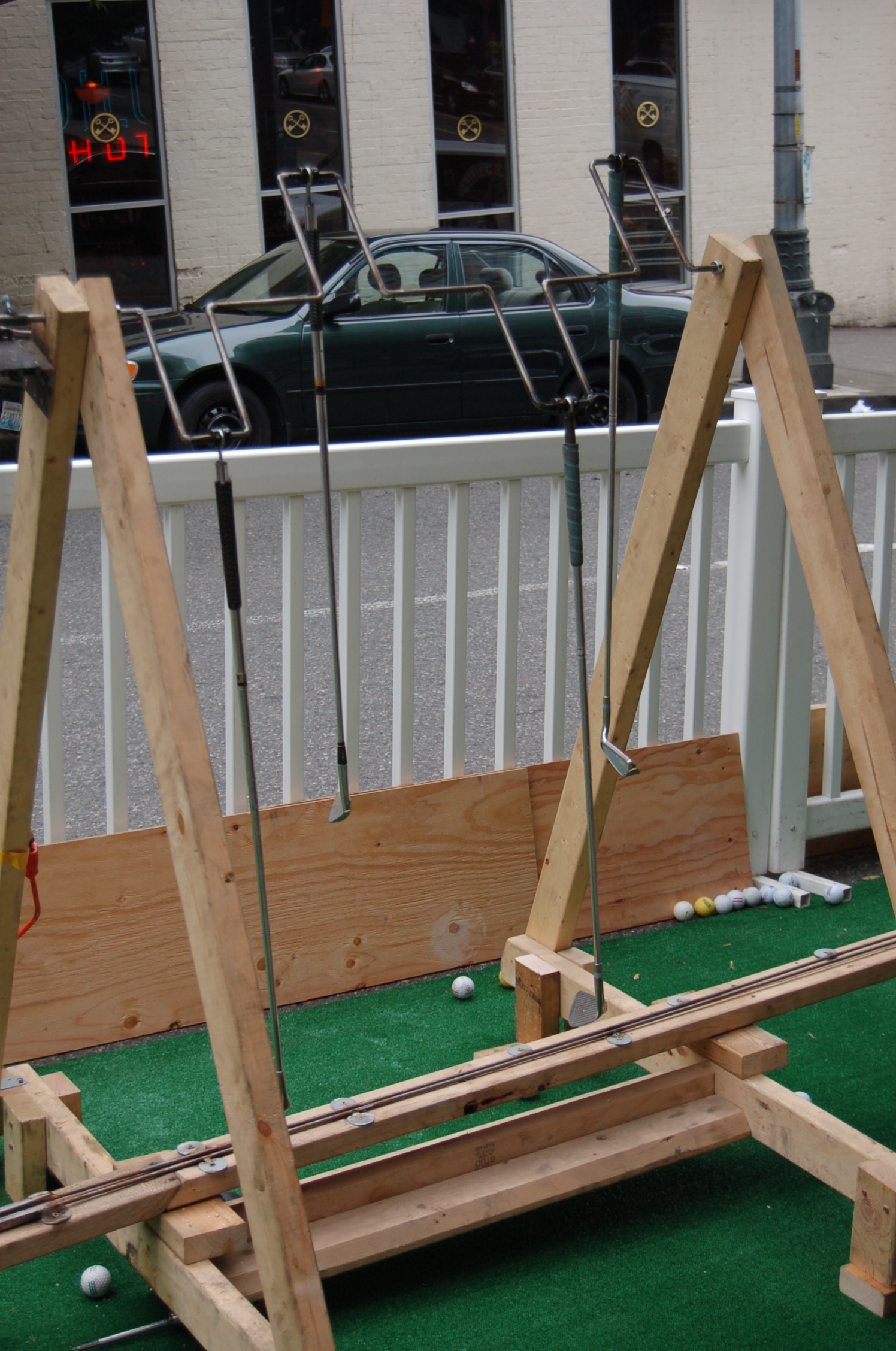
Hopefully the weather next year will be nicer and bring out more participants.
*If I missed any organizers, please leave their names in the comments and I’ll update this post. Thanks!
If you live anywhere near the New York Public Library, go go go right now now now! And then tell me all about it. 🙂
After a talk with Julia, you and fellow attendees will work with the artists to create a collaborative craft project inspired by the book — a classic exquisite corpse, a hand-sewn double-bound book, a giant scroll, or even a crowdsourced short story. Supplies will be on hand (including some amazing images from the NYPL’s image collection) and all you have to do is show up because it’s FREE! So if you’re in town, stop by, get crafty, meet the artists and enter a raffle to win a free copy of the book! (Books will be available for sale, as well.)
Thanks for the tip at Design*Sponge » Blog Archive » crafternoons: the exquisite book + d*s event poll.
 I have always been a HUGE proponent of physical exercise and play for health reasons and brain function, and now here’s more evidence of why physical play is sooooo important:
Animal studies had already established that, when given access to running wheels, baby rodents bulked up their brains, enlarging certain areas and subsequently outperforming sedentary pups on rodent intelligence tests. But studies of the effect of exercise on the actual shape and function of children’s brains had not yet been tried.
…
For budgetary and administrative reasons, school boards are curtailing physical education, while on their own, children grow increasingly sluggish. Recent statistics from the Centers for Disease Control and Prevention show that roughly a quarter of children participate in zero physical activity outside of school.
At the same time, evidence accumulates about the positive impact of even small amounts of aerobic activity. Past studies from the University of Illinois found that “just 20 minutes of walking” before a test raised children’s scores, even if the children were otherwise unfit or overweight, says Charles Hillman, a professor of kinesiology at the university and the senior author of many of the recent studies.
more via Phys Ed: Can Exercise Make Kids Smarter? – NYTimes.com.
Let’s get play back into everyone’s lives!

 Mental Flowers