behavior · creativity · design · psychology · writing

How The Mundane Can Produce Creativity

I subscribe to this business blog, The 99 Percent (Success is 1% inspiration, 99% determination), that typically offers business strategies and stuff, but this article I found really interesting; the idea that having a ritual around your day actually allows your brain to focus on being creative:

You follow the same routine, sipping your coffee, browsing your email, skimming through the same blogs, the same news pages, the same social networks. As your colleagues arrive, you exchange the same greetings, the same gripes and gossip. As you drain the cup, you get the same itch for the same music, take your headphones out and plug yourself in. You open the same blank document, give it the same hard stare. The music kicks in.

Now you can begin.

If that sounds anything like your morning routine, you’re in good company. Over the years, as a coach and trainer, I’ve heard a similar story from hundreds of creative professionals. Of course, the details will vary – if you’re like me, your trip to work will be the “30 second commute” known to freelancers the world over, and you’ll be making your own coffee. You may incorporate meditation, or other exercise into your morning routine. And you may use a camera, easel, guitar or whatever instead of a computer.

But the chances are you’re living proof of one of the great paradoxes of creativity: that the most extraordinary works of imagination are often created by people working to predictable daily routines. There’s even an entire blog (sadly now on hold) devoted entirely to accounts of the Daily Routines of writers, artists, and other interesting people.

more via How Mundane Routines Produce Creative Magic :: Tips :: The 99 Percent.

It says the 3 common threads of these rituals are:

  1. Uniqueness – it should be something (or a combination of things) you don’t associate with other activities, otherwise the effect will be diluted.
  2. Emotional intensity – the kind you experience when you’re really immersed in creative work.
  3. Repetition – the more times you experience the unique trigger in association with the emotions, the stronger the association becomes.

Athletes, actors, and even accountants have these rituals, so why not creative types? What about you, what behaviors or rituals do you have to help you concentrate on being creative?

community · creativity · culture · happiness · music · play · Social

Promoting public dancing through flash mobs!

A pillow fight that took place in Lausanne, Sw...
Flash mob pillow fight in Switzerland (neutral, yeah right!). Image via Wikipedia

Thanks again to the Seattle PI for bringing us great stories of spreading joy and happiness (see posts from earlier this week)!

If you were out and about in Seattle Sunday, you might have encountered more dancing and music than expected.

You can thank the TV show “Glee” and Seattle’s propensity for flash-mob participation for that.

“Glee” flash mobs broke out in several spots around the city Sunday afternoon. Here’s video of one of the best performances I’ve seen out of a bunch posted on YouTube.

Continue on to see the video (direct link below).

http://www.youtube.com/watch?v=RWr-wQ8kBOI&feature=player_embedded

This is such an awesome trend of seeing flash mobs of people performing public dancing and performance, from Michael Jackson’s Thriller to Glee to improv and beyond.

anthropology · behavior · community · happiness · mental health · Social

Transparency: Which Countries Are the Happiest?

Thanks Facebook for directing me to this follow-up to my earlier post!

For decades, the World Database of Happiness has tracked down how happy people are—not at all happy, not very happy, quite happy, or very happy. As it turns out, most of us are mostly happy, even when things aren’t going so well. Here is a look at how happy people said they were (on average) over the last 30 years.

Find out more at Transparency: Which Countries Are the Happiest? – Culture – GOOD – StumbleUpon.

anthropology · behavior · community · emotion · happiness · Social

The State of Happiness in Washington State

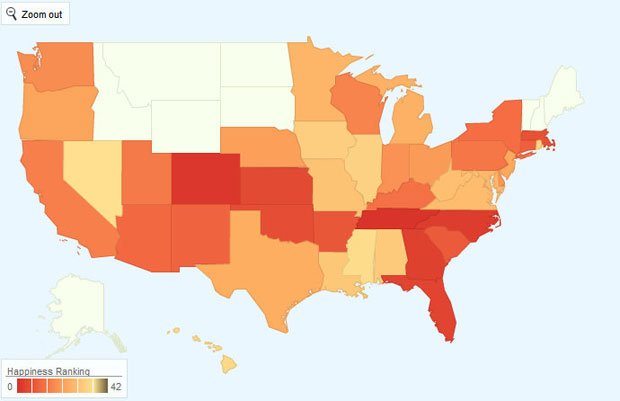
Well, I was having a good day…but enough about me, what’s going on in with the rest of the world? Pretty miserable stuff, actually: Libyan rebels, Japan’s earthquake, tsunami, and nuclear meltdown, the government shut down barely avoided…well, how are individual states doing? Now we know! A map on alexdavies.net used Twitter to determine just how happy each of our fifty nifty states are. Illinois seems darned happy. Washingtonians are – apparently only kinda sorta happy. From the Seattle PI:

On a scale of one to 42 — where one is ecstatically mirthful — Washington state has a happiness index of 21. In other words, it could go either way.

A map from alexdavies.net uses Twitter keywords to pinpoint just how positive or negative states are.

So, if lots of people are using words like “love” and “amazing” when they tweet, their states might get a better ranking.

Oddly enough, sad words for Washington include “Phillies” and “presale,” according to the site. “Starcraft” and “gentleman” also show up as negative words.

Read more at alexdavies.net.

Uncategorized

Fighting for urban trees in Vancouver

Great article from the Vancouver Sun (that’s Vancouver, BC, not Vancouver, WA), about residents fighting to protect their environmental enrichment. No joke; the loudest argument for protecting the trees is "we LIKE them!":

So why do people feel so passionately about the trees in their neighbourhood, passionate enough to throw eggs and compare the act to murder?

Trees certainly have an immediate impact on our senses. We love the way they look, sound and smell.

The breath of a gentle breeze rustling leaves can be immensely soothing. The swaying of taller, slender trees in the wind can be hypnotic to watch. Trunks are huggable. There are books that focus entirely and enthusiastically on the colour and texture of bark.

Lush canopies, as vast as clouds, shade us in summer. Leafless in winter, the graceful framework of a tree’s dark branches can be transformed into art when the contorted shapes are set naked against a cool blue or silver sky.

If a beautiful tree rises up in another’s yard, even in the next street or two lanes over or on a hill at the end of the road, we still somehow feel a compelling sense of ownership.

It may not be legally true, but we feel such a tree belongs to us, all of us; it is a community treasure, a gift, an essential component of the visible landscape, a landmark, a priceless gem of nature that deserves to be admired, maintained and protected.

The article goes on to offer different possible solutions to managing and maintaining community trees.

Go Canucks! 🙂

anthropology · behavior · community · culture · environment · health · mental health · Social

Elderly community centers at risk


elderly communities
From NYT: Ms. Bosco, 95, spends much of her time at Seaside with Delores Brown, 73.

This New York Times article about budget cuts in New York State affecting senior community centers struck a nerve with me. In a good way. I am a strong advocate for promoting quality of life even into old age, especially into old age, and I think we youngsters forget just how important these community spaces can be for old folks.


In these places seniors can get a cheap meal, planned activities like games or fitness classes (we’re talking more Tai Chi than Tai Bo) but also companionship, and opportunities to do new things and learn. They also get experiences they never would have gotten to do otherwise; they realize they love to dance, or simply fall in love again.

However, with states and cities as cash strapped as they are, these places are in jeopardy of closing.

Last year, [New York] state and city budget cuts threatened 75 of the centers… and 29 were ultimately closed. The centers are intended to serve New Yorkers over age 60. This January, the dance began again: Gov. Andrew M. Cuomo proposed redirecting $25 million from the centers to child welfare; that, said the city’s Department for the Aging, would mean closing about a third of its centers; on March 15, the centers got a reprieve, with the Assembly and the State Senate voting to restore the money.

In a country where we are already isolating generations away from each other, it seems all the more important to at least offer a place for this demographic of people to meet and have some kind of community.

My grandparents belonged to a retirement home that practically forced them to go out and socialize with each other, be involved in community efforts, and participate in outreach to youth. I was thrilled to see new activities and challenges thrust upon my grandparents; learning new skills and taking on new responsibilities at 80 plus was revitalizing for them. However, that retirement home also ate up a lot of money, money that most folks don’t have, and soon-to-be-old folks are in worse shape as far as savings go due to the economy.

Some people may argue that it’s not worth investing in a demographic that isn’t giving back to our society. Besides the argument that they already GAVE to our society for 50 or more years, I’d argue that many of them could give back if we gave them the opportunity. There are lots of volunteer and time-bank programs where retired folks can donate their skills, from fixing leaky faucets to knitting to mentoring.

One of the programs my grandfather was in was a mentor for “troubled kids” as he’d call them who were bussed into the retirement home every other week or so to sit for an hour to talk to an old person. It was community service that a lot of them probably didn’t like the idea of at first, and to their friends they probably didn’t get all that excited about it. But when you actually saw the kids interact with the older folks, these kids opened up and really enjoyed their time with him. This was the first time in a long time that a lot of these kids got to say what was on their minds, and were really listened to. My grandfather also just happened to be a guidance counselor for many, many years, so for him this was also a treat to brush up on his old guidance counseling skills and feel like he was helping kids along the path “to the straight and narrow.” But even without that training, the older mentors felt like they were contributing to society, and so did the kids, as well as both getting something in return.

So before we look to cutting budgets on senior community centers, I argue we should look at these as possible hubs for other community activities, or community focal points. Just like lots of groups rent out the church basement for meetings or choir rehearsals, city planners should be looking at these spaces as community centers, not just senior centers. These centers offer a chance for a human being, of any age, to feel like a party of a community again, to feel human.


environment · Me · mental health · Nature · play · smell

A morning communion

deciduous azaleaEnrichment is…

Waking before dawn, and being called out by the morning birds to go participate in the celebration of dawn.

I lie in bed, awaken from being overheated under my down comforter. I had been cold and left the heat on last night, foolishly, for now I am up and alert, at 5:30 in the morning. I toss and turn a little, and lie on my back, hands resting on my chest and stomach, almost as if in meditation or prayer.

I don’t know how long I lie there, but soon enough the light outside changes from cold, harsh street lamps to a softer natural light. Suddenly I hear a bird announcing his presence in the tree above my bedroom. His song is joined by a second kind of beat, the first lolling, the other more short and chirpy. A third chimes in with his sing-songy notes. For whatever reason, I am moved to join them. Not in song, but a need to be witness to this ageless ritual of the morning, of virility, of male posturing, of spring.

It is spring; after a long rainy winter, it is finally starting to be spring. In the dark of my bedroom I feel for my grandfather’s work shirt and a pair of leggings. I find a pair of Converse waiting by the back door. Slowly, so as not to wake the dog or my husband I left behind both soundly asleep, I unlock the door, tie my shoes, and I am gone.

I could easily just stand out in my backyard, listening, still as a newly budding daffodil in this morning gray. But I must move. I must be a part of it. I want to deeply breathe in the cold wet air, to feel the morning on my hands and face. While it is a warmer morning than I’ve felt in awhile, the air is brisk with only one layer on, but walking keeps me just warm enough. I walk north past the church where last weekend the boy scouts had their gardening fundraiser, the yard now empty, abandoned in this pre-morning gray. There are no cars, no people. Just me and birds, and they are the only ones brave enough to break the silence.

I see fat robins picking at things in the street; they must have better eyes than me to make out anything edible in this pre-dawn light, or maybe just being closer to the ground helps.

A pair of runners and their dog cross my path a block up, reminding me that I am not the only human alive. Gaining momentum before charging up a small hill, they do not see me, they are lost in their own morning meditation.

I pass under a series of pink blooming plum trees, and as I pass their fragrance fills my nostrils. It is glorious. I breathe in deeply, letting the fruity blossom smell reach all the way into the back of my throat. My pace is perfect so that I am able to perform a deep, yoga-like breath under each tree, taking the smell in, considering the slightly different fragrance each tree puts off. One is farther along in its blooming cycle, and the white flowers are less fruity than the pink ones, more subtle. As I walk under them the air temperature changes to just a few degrees warmer. It is a pleasant respite from the cool morning air.

The houses on the street are all darkened, except for the occasional porch light or living room lamp left on. They are still asleep. Wise souls. Foolish souls for missing the morning.

The street dead ends onto another cross street, and I turn, starting to make my rectangular route around the neighborhood. Each garden’s plants are in a different state of bloom, from sticks to buds to a few purple and pink azalea blooms already in full show. Some gardeners have already started their new beds this year, others haven’t touched them, or let them go to weed.

My study of the local architecture is distracted by another human; a homeless man with shaggy graying, sun-bleached hair, in baggy clothes and a plastic bag tied to his shirt is walking down the other side of the street, slowly but with a purpose. He ignores me as we walk towards each other on opposite sides of the street. As he passes from my peripheral view I wonder what he is doing out wandering around the neighborhood this time of morning, then realize he could just as easily think the same of me; what is this strange girl doing in just a large flannel work shirt and leggings doing wandering the neighborhood this time of morning?

I see another runner reach his front walkway as I make the final turn onto my street. The light is finally starting to turn yellow, streaming up under the clouds, lighting them with streaks of yellow and orange. The birds are now in full chorus. My hands are chilled, but I am filled with gratitude that I got to see this morning arrive. I lift my up my back gate and carefully swing it open so it won’t scrape the pavement, still trying to keep quiet.

I take a moment, standing on my back porch, letting the bird song and wet, cold morning air drift over me. I want to share this with my entire household. I want to share this moment of awakeness, aliveness, and sense of being a part of the world. But the secret to this moment’s success is that it is a solitary event, it is alone and quiet. Just me and the birds, the plum blossoms, the rhododendron bushes, and the cold wet air.

I go inside to get warm just as the sun splits the clouds open and it starts to rain.
Uncategorized

Levi’s waterless pants game/campaign

Mwamanongu Village water source, Tanzania. &qu...
Drinking hole in Tanzania. Image via Wikipedia

Since my day job is looking at how messages are spread through social media, it’s hard to miss some of the interesting ways corporations are trying to tap into it. There is an interesting trend of companies supporting global campaigns for water rights, raising money for earthquake victims, or other humanity efforts. Some people just see it as corporations trying to make themselves look nicer, and in some ways that’s probably right, yet maybe despite their marketing efforts, or on top off, they’re also promoting community, group involvement, and making a change.

For example, Levi’s recently launched a game that also supports water rights around the world. Sure it’s raising awareness about Levi’s, but it also supports the efforts of clean drinking water, and play!

Through the initiative, Levi’s plans to donate $250,000 to Water.org to fund programs that will provide at least 200 million liters of water to the more than 1 billion people who lack access to potable sources. The point of the game goes beyond Levi’s largesse, however. Participants also help telegraph word of the water crisis while reexamining their own use of the precious commodity. (Pledging to wash your jeans less and take shorter showers is another challenge.

I say, go play the game, and when the boss comes by, explain it’s for humanitarian reasons. She’ll buy it, really! 🙂

culture · disease · environment · happiness · health · mental health · play · psychology · Social

Secrets To Longevity: patience, planning, and moderation

This is a very cool study that was featured on NPR; it is in fact a follow-up study done back in the 1950’s on the habits of successful kids, almost 1,500 of them. These new researchers picked up on the study and tried to track down the kids to see how they were doing.

They found some interesting patterns appear in the kids who live the longest and healthiest:

"The most cheerful, optimistic kids grew up to take more risks," explains Martin. "By virtue of expecting good things to happen and feeling like nothing bad ever would, they predisposed themselves to be heavier drinkers, they tended to be smokers, and their hobbies were riskier."

So, she concludes, "some degree of worrying actually is good." And, in fact, adds Friedman, "the prudent, persistent, planful people — both in childhood … and then in young adulthood we measured that — that was the strongest individual difference, or personality predictor, of long life."

Friedman and Martin also found that the conventional wisdom on fitness isn’t quite right. If we try too hard to push ourselves into exercise regimens, it can backfire. Physical activity is important, they found, but it’s more about doing what you love than adhering to a certain fitness program.

Read more about The Longevity Project.

community · smell

The Pantry – a community kitchen – to debut in Seattle

I’m so excited! This is awesome, woot!

You may have noticed how I’ve been really getting into the idea of community cooking and gardening as a way of creating not only better community, and a better environment for human beings to reside in, but also a better environment to live in physically, AND better, healthier food!

I am also a bit of a foodie, and really like how homemade has now also come to mean quality made, at least when it comes to cooking.

With that train of thought, one of my favorite food bloggers, Molly at Orangette, who also just happens to be part owner/operator of a restaurant Delancey in Seattle (where I just happen to currently reside), has announced some of her staff are opening up a community kitchen, called The Pantry at Delancey.

The Pantry is a community kitchen. It’s a space for hands-on cooking classes, family-style dinners, private events, and locally sourced catering. It’s located directly behind Delancey, on Alonzo Avenue NW, with a garden entrance designed by Fresh Digs. (There’s only mud and fence posts right now, but not for long.) There’ll be a 16-foot farm table, a cooking camp for kids in the summertime, and a small retail area stocked with independent food magazines, Weck canning jars, Delancey cookie dough and pizza dough, all our best stuff. Brandi and Olaiya already have a number of classes in development: a pizza-making class with Brandon, butchering and meat-curing with Russ Flint of Rainshadow Meats, a food writing course with Francis Lam, a City Chickens class with the good people of Stokesberry Farm, classes with Olaiya, classes with Brandi, a class or two with me – more than I can easily list here. And eventually, the Pantry will also make a lot of products for Delancey, products that we currently have to source elsewhere, like fresh mozzarella, pepperoni, bacon, pancetta, and salame. The projected opening date is sometime in late spring. Cross your fingers.

more via Orangette: It’s called the Pantry.

Fingers crossed! I can taste the hand-rolled pancetta now!