In 2009, Juliana Santacruz Herrera began filling Paris’s potholes with elaborate knitted plugs; she called it “Projet Nid de Poule” (Project Pothole). What the yarn lacks in durability it makes up for in whimsy.
projet nid de poule (via Craft)
Exploring Enriching Environments
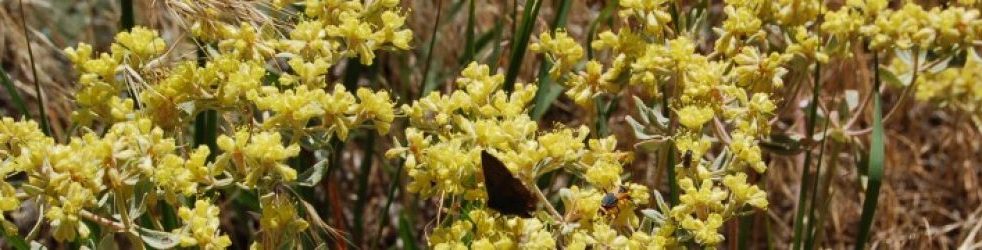
In 2009, Juliana Santacruz Herrera began filling Paris’s potholes with elaborate knitted plugs; she called it “Projet Nid de Poule” (Project Pothole). What the yarn lacks in durability it makes up for in whimsy.
projet nid de poule (via Craft)

I originally wrote this essay as a response to the daily prompt at StoryPraxis, a very cool project that encourages people to write for just ten minutes a day. The particular prompt inspired me to write about my current hometown, Seattle, and how enriching its natural environment is. For example, I probably have one of the prettiest commutes in the United States. You can read the original post here.
Seattle is probably the prettiest city to have to commute through. You drive over lakes, over sounds, past mountains, past forests. You cross microclimates, and probably experience at least three kinds of weather in 20 minutes or less.
Cresting over one of the many hills the Olympics suddenly burst out onto the horizon in front of you, the bright morning sun making the snow caps shine just below the cloud layer so it looks like a clear, sunshine day “over there.” The sky above you is filled with gray clouds, but today they are more textured than a gray blanket, allowing the light to bounce off creating interesting shapes and textures.
Each neighborhood you pass is very distinct, either due to geographical divisions like water or hills, or more cultural markers like Buddhist prayer flags mixed with solar panels on 1950s bungalows which two blogs later transform into modern condos with Priuses parked out front.
Coming up over the I-5 bridge you’re now high above the city, the commercial waterways 100s of feet below. From here you can see almost all of Seattle’s signature neighborhoods in a 360 degree view – University district, Wallingford, Fremont, Ballard, Queen Anne, South Lake Union, Downtown, Capitol Hill. You see the Olympics on your right, and now the sun is reaching its fingers over the Cascades on your left, injecting the gray clouds with pink and purple, adding bursts of color to the gray sky above.
The freeway has ivy and trees growing over the sides, threatening to spill onto the roadway. You merge onto one of the eastbound bridges, and suddenly you’re cresting over a giant lake, now so close to the water you’re almost floating. To your right off in the distance across the water is Mt. Rainier, shooting its head above the clouds, fighting to keep them from swallowing it whole. A great blue heron casually floats over the morning commuters, and a bald eagle stands vigil on top of one of the lamp posts dotting the bridge.
You pull off your exit, the trees and shrubs now practically enfolding the off ramp. On a sunny day they call to you, “come climb in my branches, come run through my meadow fields.” It’s good that it’s so damp and gray today, or you’d never get to work. The tulips and crocus popping up in the road dividers, almost weed-like in their determination to grow anywhere and everywhere, add some color now that the sun has risen above the clouds, taking the pink streaks with it.
You’re sad to go inside, but know you’ll have a literal birds-eye view into the trees growing just across the street of your office building.
You’re thankful to have one of the most beautiful commutes in the world, and just sad you have to experience it all from a car.
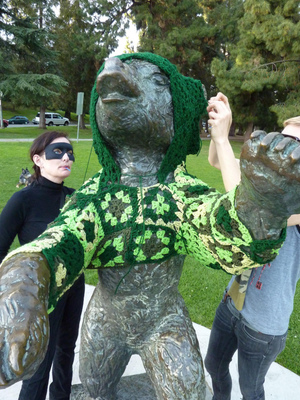
I love this kind of public art! There was a tree in town that got a sweater a couple of years ago, and I’m so excited to see this is now becoming a “movement.”
“Captain Hook” is part of an international movement of so-called yarn bombers taking an old-school approach to street art. Unlike most street artists who travel with spray paint or markers, Captain Hook — as she asked NPR to call her — works with a crochet hook and yarn.
Her “walls” are public fixtures, like the bronze bear statue in L.A.’s Griffith Park that stands zombie-like with its paws out. “This is crochet on a statue,” she says, sitting in her Los Angeles apartment, a pile of granny squares in her lap. “This could be happening in 1725.”
more via Crochet Vandals Do Graffiti … Like Your Grandma : NPR.
An interesting social experiment as well as clinical study, from the Wall Street Journal; while the study itself, which looked at using Lithium to treat ASL (Lou Gehrigs disease) found the treatment didn’t work, they DID find that using social networks to recruit people for the study turned out to be incredibly effective.
The new study, published online in the journal Nature Biotechnology, represents an early example of how social networking could play a role in clinical trials, an area of medical science with strict procedures that many would consider especially difficult to apply in the online world.
“The approach has tremendous potential,” said Lee Hartwell, a Nobel Prize-winning scientist now at Arizona State University, and formerly president of the Fred Hutchinson Cancer Research Center. Standard clinical trials play a central role in the research enterprise of both of those institutions.
Dr. Hartwell, who wasn’t involved in the study, said social-network trials aren’t likely to replace conventional randomized, double-blinded, placebo-controlled trials, the gold-standard for generating medical evidence. But such trials have become so complicated and time-consuming that new models are needed, he said.
I think this is a great example of the power of communities, whether they exist online or are geographically-based, or both. People with illnesses and their families need support networks, which they find online. I think this is great that doctors and clinicians are also able to tap into these communities and ask for their input and insight into the treatment. Not only is it a great instant resource for the doctors, it loops the patients back into the whole treatment process.

Oh, all right, but only because you asked soooo nicely; for Earth Day, an example of how communities in the Puget Sound are coming together to protect the Earth and improve their own personal environments as well.
Researchers have pointed the finger at stormwater runoff as the top source of pollution that’s getting into Puget Sound and other Northwest waterways. And because runoff comes from just about everywhere — roofs, roadways, parking lots, farms, and lawns — the solution has to be just as widespread.
Enter 12,000 Rain Gardens.
This week Washington State University and Stewardship Partners, a nonprofit working on land preservation, announced a campaign to promote the installing of 12,000 rain gardens around Puget Sound by 2016. The website even has a counter tracking the number of gardens and encourages folks to enter their rain garden into the database.
more via It’s Raining Rain Gardens — Sightline Daily – Northwest News that Matters.
Happy Earth Day! I feel like I should have a blog post dedicated to the benefits of nature and why we need the Earth, but to be perfectly frank none of those environmental changes we talk about are going to happen unless we get everybody on board and engaged!
So, instead, here is one example of getting people, and particularly kids, involved and engaged, thinking critically about what they did or did not like about their experience, and giving it credibility and recognition by posting it to a public forum, and not just the online kind:
Flights of fancy, lively drawings, dreams of piloting the Bell helicopter, disdain for a museum with no dinosaurs… many of our absolute favorite “MoMA stories” were left by kids, from toddlers to teenagers. So for our second post about the “I went to MoMA and…” project, it wasn’t hard to pick a theme.
Some people think modern and contemporary art is too “hard” or “weird” for kids to understand and get excited about. Not the way our younger visitors tell it, though! It made us incredibly happy to hear from so many kids who thoroughly enjoyed their day at MoMA: admiring colors and shapes, learning new things, trying out Material Lab, picking a favorite artist, getting inspired to draw, and spending time with friends, parents, and grandparents. Take a look at some of the responses below, and a big thank you to all the kids who participated!
check it out at MoMA | “I went to MoMA and…”: The Kids Are All Right.


More and more research is finding that the ability to cope with stress and bounce back better correlates with long life. Just a reminder to take it easy…
Gerontologist and commentator Mark Lachs says one of the keys to a long, healthy old age is the ability to keep moving forward after life’s inevitable setbacks.
listen via Want To Live To 100? Try To Bounce Back From Stress : NPR.
One study found that 50 year olds with a negative outlook on life lived seven years shorter than those with a positive outlook.
What’s interesting is that more than avoiding stress it seems more important to have the ability to bounce back from it. So healthy coping mechanisms for handling stress, as well as a good attitude about life, seems to be more important than nutrition and exercise.
 I’m seeing lots of different examples of people using nature to help heal, from the physically injured to those with aggression issues cut off from the rest of the world.
For example, I was just listening to a program this weekend on the local NPR station about a biologist at Evergreen State College who is greenifying a local prison, as well as working with inmates to grow new prairie grass and frogs (I can’t find the original story but here’s some similar coverage):
The frog rearing program here pairs inmates with scientists from the Evergreen State College as part of the Sustainable Prisons Project. So far, the frogs grown at Cedar Creek Correctional Center are doing better than those grown by professional zoologists.
LIESL PLOMSKI, graduate student, The Evergreen State College says, “They have a lot more time here to care for the frogs that a zoo wouldn’t have. I mean they’re here all day with them, so they change the water frequently. They feed them more frequently than a zoo could ever do.”
And then this morning stumbled upon this story:
Henning Larsen Architects recently won an international design competition with their plans for the new Odense University Hospital in Denmark. Situated close to the city center amidst a scenic old-growth forest, the OUH will use the surrounding landscape as a way to heal its patients. The holistic facility features a light footprint that incorporates nature at every turn to create an environment replete with peace and serenity. Daylight floods in through the glass-lined buildings, and rainwater will be collected to feed the many ponds and surrounding landscape.
I am blown away by all the different applications of nature into therapy and recovery practices.

My new year’s resolution this year was to start taking better care of myself; more sleep, healthier food (no more sneaking chocolate out of the secretary’s candy dish!) and getting regular exercise if for nothing else just to move and remember what it feels like to use your muscles.
But up until recently I had never acknowledged some of the things that had caused me the most stress. One of them was changing jobs after seven years and becoming a freelance writer/editor, while also moving away from a city I’d lived in for that long as well. That loss of identity, of sense of self and how you fit into the world, can have a profound effect on mental and physical health, as one New York Times article recently discussed, focused more on job loss, but very similar emotionally and the physical repercussions:
The first to have a heart attack was George Kull Jr., 56, a millwright who worked for three decades at the steel mills in Lackawanna, N.Y. Three weeks after learning that his plant was closing, he suddenly collapsed at home… Less than a month later, Don Turner, 55, a crane operator who had started at the mills as a teenager, was found by his wife, Darlene, slumped on a love seat, stricken by a fatal heart attack.
It is impossible to say exactly why these men, all in relatively good health, had heart attacks within weeks of one another. But interviews with friends and relatives of Mr. Kull and Mr. Turner, and with Mr. Smith, suggest that the trauma of losing their jobs might have played a role.
A growing body of research suggests that layoffs can have profound health consequences. One 2006 study by a group of epidemiologists at Yale found that layoffs more than doubled the risk of heart attack and stroke among older workers. Another paper, published last year by Kate W. Strully, a sociology professor at the State University of New York at Albany, found that a person who lost a job had an 83 percent greater chance of developing a stress-related health problem, like diabetes, arthritis or psychiatric issues. In perhaps the most sobering finding, a study published last year found that layoffs can affect life expectancy…
Continue reading at the New York Times.
It was hard to explain to people why I wasn’t thrilled and exhilarated to be living with my husband again, out of a seemingly dead end job and taking my life into my own hands. I wasn’t thrilled or exhilarated. And I wasn’t even scared in that good kind of way; I was just scared and isolated. At least now I know I wasn’t as weird as I was made to feel.
I’m dreaming of warm sandy beaches, or high mountain meadows, and realized it’s been awhile since I’ve gone on a good, solid, outdoors-focused vacation. Apparently I’m not the only one. From the magazine Landlopers, introduced to me by the non-profit environment-and-culture group Izilwane…
For more than a decade, visitation numbers at America’s National Parks have been dropping steadily. At first glance, the numbers are encouraging, around 280 million visitations in 2010. Impressive until you peel back the numbers and realize that this includes everything from people driving along the Blue Ridge Parkway to the annual Cherry Blossom Festival attendees. The actual number of people who hike, boat, fish or paddle is much lower, and that number is not increasing.I’m not sure for the drop in numbers, but it’s disheartening. I’m just as guilty as anyone about not visiting our common inheritance nearly as often as I should.

more via Last Tourist in the Woods – Health and Financial Benefits of Outdoor Tourism | LandLopers.
More and more people are discovering the importance of interacting with the outdoors, even in small doses like walking down a tree-line street. And now, the one plus-side of our current Federal and State funding in a crisis is that a lot of national and state parks are offering deals to entice visitors; so aside from supporting your parks and the economy, it’s a good time to think about vacationing in the great outdoors.
 Mental Flowers