architecture · behavior · culture · design · environment · happiness · Nature

Seattle has too many bleak public spaces | Crosscut.com

Seattle Skyline view from Queen Anne Hill.
View of Seattle's city skyline. In such a gorgeous part of the U.S., Seattle itself is lacking in pretty public spaces. Image via Wikipedia

In case y’all hadn’t noticed yet, I’m a huge proponent of utilizing public space for community use and creating an overall aesthetically pleasing environment for people. Cities have one of the greatest opportunities to provide that for their citizens. So I was thrilled when I read this article in Crosscut Magazine arguing the same thing, specifically for my hometown of Seattle.

Our landscape-oriented mindset should have been good preparation for what we need in the densifying city now, which is more design intelligence given to the open spaces between buildings — plazas, parklets, and awkward leftovers like the places under freeway overpasses. The more the air space around us becomes stuffed with architecture, the more acutely we need the relief of thoughtfully landscaped open spaces on the ground. Arguably, these spaces are more important in the built environment than most buildings because they’re public — people use them.

Or if they’re emotionally cold, dreary, or austere, people don’t use them, which is the case with a number of Seattle’s precious open spaces. On one of our desperately rare sunny spring days this month, I visited about a dozen open spaces in the dense city and found — no surprise — the bleak ones practically unused and the beautiful ones full of life. What is surprising is that we’re not demanding more graceful, humane, imaginative design — and raising hell over trends such as Seattle Parks and Rec’s inexplicable new fascination with concrete and gravel.

The article goes on to provide examples and suggest different fixes for a couple of spaces. More via Why does Seattle have so many bleak public spaces? | Crosscut.com.

community · creativity · education · health · learning · school · technology · youtube

Google Global Science Fair 2011: Finalists announced

What a great way to support kids’ love of science and exploration! I also like how the proposals are via YouTube videos. This is more than just the typical science fair fare (so to speak), it contains some pretty hard-hitting science stuff.

The Judging Panel has identified the 60 semi-finalist entries, and now it’s up to YOU to decide which project will take home the People’s Choice Award. You can vote once in each of the three age-group categories until 20 May at 11:59 PM EST. The People’s Choice winner will be announced on 23 May, along with 5 finalists in each age category.Click on a project title below to learn more and vote for your favorites.

more via Google Global Science Fair 2011.

education · learning

The Poor Quality of an Undergraduate Education – NYTimes.com

Academic procession at the University of Cante...
Is your college degree really worth it? Image via Wikipedia

This is a great Op-Ed piece from the New York Times. More and more people are getting brave enough to come out and say that a college education, as it currently exists, is often NOT worth it for students.

In a typical semester, for instance, 32 percent of the students did not take a single course with more than 40 pages of reading per week, and 50 percent did not take any course requiring more than 20 pages of writing over the semester. The average student spent only about 12 to 13 hours per week studying — about half the time a full-time college student in 1960 spent studying, according to the labor economists Philip S. Babcock and Mindy S. Marks.

Not surprisingly, a large number of the students showed no significant progress on tests of critical thinking, complex reasoning and writing that were administered when they began college and then again at the ends of their sophomore and senior years. If the test that we used, the Collegiate Learning Assessment, were scaled on a traditional 0-to-100 point range, 45 percent of the students would not have demonstrated gains of even one point over the first two years of college, and 36 percent would not have shown such gains over four years of college.

Why is the overall quality of undergraduate learning so poor?

While some colleges are starved for resources, for many others it’s not for lack of money. Even at those colleges where for the past several decades tuition has far outpaced the rate of inflation, students are taught by fewer full-time tenured faculty members while being looked after by a greatly expanded number of counselors who serve an array of social and personal needs. At the same time, many schools are investing in deluxe dormitory rooms, elaborate student centers and expensive gyms. Simply put: academic investments are a lower priority.

more via The Poor Quality of an Undergraduate Education – NYTimes.com.

I LOVE learning and have seriously considered continuing my graduate studies beyond my MA. But after looking at the hard facts of cost vs. time investment vs. returns, even at the undergraduate level, I have unfortunately determined that it’s just not a good investment, especially for a non-engineering or similar degree.

Some students swear it’s worth it, and while I’m glad I have my BA and (almost) MA, I know enough people who are doing fine without theirs that I wonder if those of us with a BA aren’t slightly brainwashed, or simply trying to convince ourselves it’s worth it because we put so much time and money (and for some of us sincere effort) into getting it.

What has your experience been? For those who want or have a career outside of a University, what has your experience been and what kind of education did you WISH you had received? I, for example, had wished they had required more Science and Math as an undergrad (or high school), even for a social science major like me. It was all stuff I ended up needing for my MA and wishing I’d studied it earlier in my academic career.

behavior · community · culture · environment · happiness · Social

“The Economics of Happiness” documentary argues buying local will save the planet, ourselves

Helena Norberg-Hodge
Helena Norberg-Hodge, director of "The Economics of Happiness" and founder of ISEC. Image via Wikipedia

I am a huge fan of buying local (although I could be a lot better at it). This film makes an interesting argument that buying local is not only good for the environment and the local economy, but also connects us back to our spiritual sense of community.

Economic globalization has led to a massive expansion in the scale and power of big business and banking. It has also worsened nearly every problem we face: fundamentalism and ethnic conflict; climate chaos and species extinction; financial instability and unemployment. There are personal costs too. For the majority of people on the planet, life is becoming increasingly stressful. We have less time for friends and family and we face mounting pressures at work.

The Economics of Happiness describes a world moving simultaneously in two opposing directions. On the one hand, an unholy alliance of governments and big business continues to promote globalization and the consolidation of corporate power. At the same time, people all over the world are resisting those policies, demanding a re-regulation of trade and finance—and, far from the old institutions of power, they’re starting to forge a very different future. Communities are coming together to re-build more human scale, ecological economies based on a new paradigm – an economics of localization.

more via The Economics of Happiness | Full Synopsis.

I have seen this same community/spirituality argument proposed as well with farmers in Hawaii trying to preserve traditional knowledge of taro planting, as well as other indigenous groups in South and Central America, and all over the world, so it is interesting to see this documentary maker make the argument on a larger scale, saying it can benefit all of us. I tend to agree.

I also like the idea of “grandmother universities,” which fit in well with the current trend of DIYers.

Has anybody seen this film, or know more about it? It’s sponsored by the International Society for Ecology & Culture, and directed by Helena Norberg-Hodge.

behavior · children · creativity · design · play

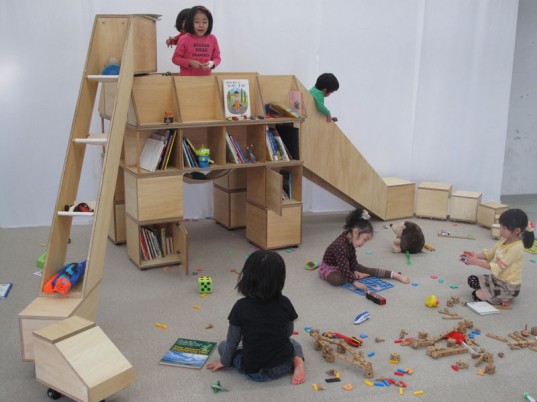
Bookshelf/Playground combo makes putting your toys away fun

Casasaurus

My mom always told me not to climb up my bookshelves when I was a kid; now I wish I was little again and could beg her to get me one of these. This is actually a great tool for learning, because it allows kids to think three dimensionally, in a playful way. Trying to decide which cubbies hold what items, and climbing, sliding, and thinking of an object as two things at once (a bookshelf AND a dinosaur) are great exercises for the brain at any age.

Casaurus, the senior thesis project of student designer Koichiro Hoshino from Tokyo University of the Arts. The designer’s dinosaur-shaped bookshelf includes plenty of space for a bookworm’s library, a tail-like slide for kids to whiz down, shelves made for climbing and small boxes that add length to the dino’s tail. Kids can also find a reading nook underneath the dino’s belly.

more via Koichiro Hoshino’s Casaurus is a Bookshelf and a Playground | Inhabitots.

behavior · children · community · environment · family · learning · Nature

7 Creative Ways to Experience your Local Farm this Spring | Inhabitots

A pastoral farm scene near Traverse City, Mich...
Image via Wikipedia

Where I grew up and where I live now, though focusing on very different kinds of agriculture, were both very farm-focused communities, and I always encourage people to  go out and see what a working farm is all about. It is a great way to learn about where your food comes from, different jobs, and all about nature.

Beyond simply stopping by to view the animals at your local farm, there are many other hands-on and creative activities you can do with your family — and the spring is a great time to go. Visiting your local farm during the spring comes complete with baby animals, plus the weather is warming up and it’s the perfect opportunity for outdoor learning time with your children. To get the most out of your springtime visit to the farm, you’ll want to explore it with a different lens and look at your local farm as more than just a place that keeps animals and agriculture. Read on to learn seven creative ways to experience your local farm this spring with your family.

more via 7 Creative Ways to Experience your Local Farm this Spring | Inhabitots.

Me

On Vacation

The coconut tree
Coconut tree. Image via Wikipedia

Tomorrow I will be in Maui.

Tomorrow I will lie on the beach, belly exposed to the tropical sun, letting the rays warm me to my core and awaken me from a long winter doldrum semi-slumber, like a sunbear coming out of hibernation.

I will eat fresh pineapple, and coconut that actually tastes like coconut and not stale sweet water.

I will float on the top of the water in shallow pools like seaweed, wearing my mask and snorkel watching colorful flat fish peck at corral, hearing the tap, tap, tap noises they make with their fishy beaks.

I will hike to the top of recently retired volcanoes, through lush forests, up waterfalls, under strange birdcalls, to view the ocean from as far west as I’ve ever been.

I will feel the rough bark of trees and grain of rocks. I will smell flowers. I will hear the wind and warm afternoon rains.

I will not miss the cold, gray rain of today. I will not miss the hum of fluorescent lights, buzzy speakers, traffic, printers and computers. I will definitely not miss the sense of helplessness while stuck in traffic, fighting deadlines and work, and responding to correspondences.

But that is tomorrow. Today I am here, now, ready.

Note: *inspired by yesterday’s prompt from StoryPraxis. I didn’t end up posting this to their site because they tend to favor creative writing, but it’s a good writing exercise nonetheless.

behavior · brain · disease · health · learning · Mental · neuroscience · technology

Sensor Glove Could Help Stroke Patients Recover Mobility Through Gaming | Ecouterre

The brain is such an amazing thing, and has such amazing capabilities to recover, it just needs the right tool; in this case, using video games as a type of mental and physical therapy for stroke victims. Using computer games is also useful because it is more engaging for the brain, rather than traditional physical exercises like “pick up the cup” since framing it as a game often makes it seem less consequential for players (this is a new exercise whereas they used to know how to pick up a cup) and therefore less pressure and more fun:

Four mechanical-engineering students at McGill University in Canada have developed an inexpensive sensor glove that allows patients to exercise in a game-like fashion at home with minimal supervision. Self-therapy? Well, yes and no. Using the accompanying software, doctors will be able to monitor their charges’ progress off-site, cutting down on hospital visits and costs.

The added benefit of remote monitoring for doctors is also good for the patient, as the doctor can respond right away if they see something wrong or can provide immediate feedback, rather than having to schedule an appointment, travel to the doctor’s office, and have all of your questions answered, all of this being extra hard after you’ve had a stroke and need others to help transport you.

Check out the original story at  Sensor Glove Could Help Stroke Patients Recover Mobility Through Gaming | Ecouterre.

anthropology · behavior · children · culture · education · family

Children’s past role and identity as worker

Children in Jerusalem.
The role of children has changed significantly over the past 100 years. Image via Wikipedia

This call for paper submissions from the The Society for the Study of Childhood in the Past got me thinking about how actively children used to participate in the daily household and economic life of families, from general maintenance like sweeping the kitchen to vital income by helping during harvest time.  Children used to have to help out on the farm, and later work in factories, in order to help their families make ends meet. While some of the work was dangerous and unhealthy, some of the work was beneficial to both the kid and the family. Kids felt like they contributed to their family, and learned skills from farming to general entrepreneurship. I wonder what kids are missing out on by not having as many daily chores to do, or summer jobs like mowing lawns and lemonade stands, and how children fit into our idea of work now.


In 2011, the themed session will be on children and work. The aim of the themed papers will be to bring together scholars from a wide range of academic disciplines who are studying any aspect of children and work in the past – children as economic contributors, children as slaves, elite children taking on adult roles, children as carers, children as consumers, the impact of working in childhood on children and society. The aim will be to advance cross-cultural knowledge and understanding of childhood and children in the past, and in particular to evaluate the varying nature and impact – social, economic, cultural, medical – of work performed by or for children in the past. Archaeology, history, literature and other sources will be explored.
In providing this opportunity for scholars of childhood to present their work to an international, interdisciplinary audience, the SSCIP International Conference aims to generate new perspectives on existing knowledge and to stimulate new avenues of research for the future.

I’d be interested to hear what jobs you had growing up, before the age of 18. Did your parents encourage you to work? Did you get an allowance or did you get paid by the job, or were you just expected to “earn your keep”? How is it different with your own kids, or nieces and nephews?

behavior · community · culture · Social

From Tsunami to Storm, communities continue to give

The worldwide expansion of Salvation army
Salvation Army's presence throughout the world. Image via Wikipedia

My work was having a bake sale today for the tsunami victims of Japan when we heard the news about the major tornado in Alabama (one of the managers’ first thoughts: “maybe we should have another bake sale for Alabama.”). For my birthday we made crafts to donate to a local children’s hospital.

While it seems like the last couple of years have been filled with horrible natural disasters (or man-made; thanks BP!), and a bake sale isn’t going to fix much in the large scheme of things, what struck me is that despite our nation’s economic woes and our disaster-weary national psyche, we are still interested in reaching out to help each other, whether across the nation or across the Pacific.

As organizations and first responders offer emergency relief, food and shelter, many people across the country are looking for ways to help storm victims.

The Salvation Army has set up 10 mobile kitchens to provide hot meals to survivors in hard-hit areas like Tuscaloosa, Guntersville and Lauderdale in Alabama and Montpellier and Oxford, Mississippi.

Another 22 mobile kitchens are on standby.

Follow The Salvation Army’s blog for updates, visit its website or text “GIVE” to 80888 to make a $10 donation to the organization’s relief efforts. It will show up on your next mobile phone bill.

Samaritan’s Purse has dispatched experts and two disaster relief units, tractor trailers stocked with emergency supplies and tools, to assess the needs in Tuscaloosa, Birmingham and Cullman, Alabama.

more via Storm recovery: How you can help – CNN.com.

There are lots of different ways to help both nations. Post here for different ways you have seen your community reach out, either for these disasters or others.