anthropology · behavior · creativity · happiness · health · mental health · play

The Shape of Enrichment – ICEE conference taking place this weekend in Portland, Oregon

There are people who get paid to come up with games and toys for animals. Just like people, animals need something to do all day to keep themselves fit and healthy, both mentally and physically. This has been dubbed “enrichment” by people who study this kind of thing, but it basically is just looking at ways to encourage animals to play.

This weekend enrichment experts are all getting together to discuss different ways to provide better enrichment (i.e. toys, games, crossword puzzles) for animals that live in zoos, aquariums, research centers, and so on.

I am sorry I am missing this conference; it sounds amazing!

The mission of the ICEE is to improve the wellbeing of captive animals by providing a venue for the exchange of information among the many diverse groups that participate in environmental enrichment. A key feature of the ICEE is the participation and interaction of animal welfare scientists and all those responsible for the care of captive animals. To further this mission, the ICEE Committee organizes a biennial conference, with published proceedings, in locations around the globe.

more via The Shape of Enrichment – ICEE.

I wish I could go, but I’m doing a little bit of self-enrichment this weekend so am otherwise engaged (plus $400 is a bit steep for me), so I will just lurk on the website for awhile and see what updates pop up. OR, if you’re going you could post in the comments and let me know what I missed? Or, even better, if you know of other events coming up soon, share them here! Thanks!

behavior · brain · community · emotion · happiness · mental health · Social

Yes, you can now be addicted to social media

Illustration of Facebook mobile interface
Social media keeps us connected with friends, but for some can be detrimental to everyday life. Image via Wikipedia

I love being able to connect to old friends, classmates, and coworkers via social media, as well as share thoughts, ideas, and new developments. But some people can take it too far, and while I have my weaknesses as much as the next gal, I don’t think I’d consider myself addicted as they describe it. Apparently people can receive intense highs from the social interactions and feel like they need a “fix” if they go on too long without checking in to one of their social media networks.

When you hear the word ‘addiction’ perhaps you think of alcohol, drugs and sex. But what about social media? Over recent years there’s been an emergence of studies into social media as a new form of addiction.

Research by Retrevo Gadgetology looked into how people use social networking sites. Out of those asked, 45% said they check Facebook or Twitter after getting into bed. People under the age of 25 were the more extreme with 19% saying they log on any time they wake up during the night, 27% said they sometimes check when they wake up during the night and 32% check in first thing in a morning.

via Social Media: The Pursuit of Happiness.

To me this indicates just how detached and isolated many of us are, that instead of going to a local gathering or even a bar or club when we’re feeling lonely, we go online. It’s been shown that Americans feel more isolated and alone than at any other time in our history (or at least history of checking for this kind of thing), and I would hypothesize we’re turning to these social media networks as some way to retain communities we’ve established in other physical locales, or create new ones that are entirely virtual. I also wonder if the meta-interaction makes people feel less fulfilled than dealing with people in real, physical life and make them anxious to get more. I believe social media networks are useful, no doubt, but I do wonder if we are using them as a crutch rather than actually meeting people in person. Granted a lot of social media sites encourage actual in-person meetings, from online dating sites to the new GrubwithUs startup that acts as matchmaker for hungry social types in various cities across the U.S.

What are your thoughts about social media networks and people who can’t seem to unplug from them? Leave your thoughts and/or experiences in the comments below.

architecture · behavior · community · creativity · environment · happiness · play

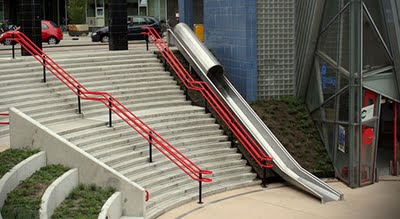
Slide into work with the subway slide in Holland

Thanks to the blog Cup of Jo for finding this:

Leave it to the Dutch to install a slide in a subway station. Commuters are encouraged to use it if they’re running late, and the official name is a “transfer accelerator.” At night they play Bach. How rad is that?!

more via A CUP OF JO: Dutch subway slide.

I love the idea of putting a little fun in your commute, in the community, and just keeping your environment fun in general.

Where else have you seen a little fun put into everyday surroundings? I’ve posted about the musical stairs before, but what else is out there? Some silly graffiti? Colorful cars? Share in the comments below.

brain · cognition · learning · school

Understanding numbers, quanity early key to later educational success

Cover of "Numbers (Step Ahead)"
Playing with Flashcards as a kid could give you a step up in your future. Cover of Numbers (Step Ahead)

I’m crunching numbers this morning, and after reading this I wish I’d paid more attention to Math in first grade; at least I got to study addition twice thanks to moving to a new school half way through the school year!

A long-term psychology study indicates that beginning first graders that understand numbers, the quantities those numbers represent, and low-level arithmetic will have better success in learning mathematics through the end of fifth grade, and other studies suggest throughout the rest of their lives.

“Math is critical for success in many fields, and the United States is not doing a great job of teaching math,” said David Geary, Curator’s Professor of Psychological Sciences. “Once students fall behind, it’s almost impossible to get them back on track. We wanted to identify the beginning of school knowledge needed to learn math over the next five years. We found that understanding numbers and quantity is a necessary foundation for success as the student progresses to more complex math topics. In order to improve basic instruction, we have to know what to instruct.

more via Key early skills for later math learning discovered.

I also remember loving Math until about middle school when I had the Algebra teacher from hell! What are your Math memories? Are they good, traumatic, mediocre? Share in the comments.

disease · environment · health

Noise pollution

A landing Qantas Boeing 747-400 passes close t...
Image via Wikipedia

Great editorial about the effects of noise pollution on people in populated areas, and from a source who would know; Burma, or Myanmar, a country with over 55 million people crammed into a relatively small space:

The Manipur Pollution Control Board has been making efforts to lessen pollution in this fast growing city of ours. However one dimension of pollution seems to be neglected comparatively speaking, and that is noise pollution. Most citizens are unaware that prolonged exposure to noise pollution can lead to deafness or hearing impairment.

To get a clearer picture of the menace of noise pollution let us get down to a few facts. Noise is measured by its loudness and the technical measuring unit is decibel (dB).

The quietness we get in a library is surprisingly measured at 30 dB. Perhaps the flipping of pages are responsible for that. The quietness in a garden, far from the madding crowd, is slightly higher.

It is not known how many decibles are registered by a nagging wife. But it is bound to make a few neighbours raise their eyebrows and plead for calm. However Rip Van Winkle left his wife and slept in quiet and solitude for twenty years.

On the other hand a pair of young lovers will of course, make sure that at least sound does not betray their presence.

City traffic, heard from inside a car is measured at 85 dB. A police whistle is measured above 90 dB. The level at which sustained exposure may result in hearing loss is between 90-95 dB.

What is of concern, particularly related to our children, is that even short term exposure to excessive loudness can cause permanent damage.

more at The Menace of Noise Pollution.

I have moved from a couple of different apartments because of the associated noise pollution from busy streets or freeway noises, and I can’t work with super loud music on (although a little white noise is actually useful for me).

What are some of the biggest noise polluters where you live?

technology

Microsoft Research paper proposes using ‘Data Furnaces’ to heat the home

Diagram showing overview of cloud computing in...
All this cloud computing heats up data centers; now they may be able to help keep you warm AND informed. Image via Wikipedia

Keeping data centers cool is one of the costliest parts for a company running a computer and data system. Microsoft and other companies have already moved many of their data centers to cooler climes like North Dakota and Idaho. Now, the data centers may be able to give something back; all that heat they produce.

The U.S. EPA estimated that servers and data centers were responsible for up to 1.5 percent of the total U.S. electricity consumption, or roughly 0.5 percent of U.S. greenhouse gas emissions, in 2007. With companies such as Apple and Google strongly pushing the move to cloud computing, that figure is likely to increase significantly in the coming decade. Since a lot of energy is consumed keeping the computer systems cool, colder climates are seen as more favorable sites for data centers. But a new paper from Microsoft Research proposes a different approach that would see servers, dubbed Data Furnaces, distributed to office buildings and homes where they would act as a primary heat source.

The Microsoft Research paper says that at around 40-50°C (104-122 °F), the temperature of the exhaust air from a computer server is too low to regenerate electricity efficiently. However, this temperature is perfect for heating purposes, such as home/building space heating, clothes dryers and water heaters. So the researchers argue that placing servers used for cloud computing operations directly into homes and/or office buildings would turn heat generation from a problem into an advantage.

more via Gizmag’s Microsoft Research paper proposes using ‘Data Furnaces’ to heat the home.

autism · behavior · children · cognition · creativity · mental health · psychology · technology

Using Play and Technology for Therapy

Griffin Wajda and Juan Pablo Hourcade in Iowa City, IA, play a collaborative-storytelling app.

I truly think technology (and play) are underutilized when it comes to all kinds of therapy, partially because it’s expensive, and partially because people don’t know how to implement it. This article in the Wall Street Journal offers a great example of how people are integrating play AND technology into therapy.

Multitouch technology—which turned smartphones, iPads and other tablet computers into consumer sensations—has a new function: therapy for cerebral palsy and autism spectrum disorders, as well as a range of developmental disabilities. Researchers from at least three North American universities, including Iowa, are developing therapeutic applications for multitouch devices. Games developed by the Scientists’ Discovery Room Lab at Harvard University, and by University of Alberta researcher Michelle Annett, encourage children with cerebral palsy and stroke victims to stretch their range of upper arm and wrist motion.

“It’s a very motivating tool for the patients. It’s visual, the feedback is instant and it’s fun,” said Isabel Henderson, vice president of Glenrose Rehabilitation Hospital in Edmonton, Canada, where games on a touch-screen table are part of stroke victims’ physical rehabilitation.

The new apps offer patients engaging ways to address their medical conditions over the long term, said Quentin Ranson, an occupational therapist at the Alberta hospital. They also could help reduce the time patients need to spend in expensive traditional therapy, Mr. Ranson said.

Children with cerebral palsy—a group of disorders caused by brain damage before or shortly after birth—work to improve their motor skills and coordination through repetitive exercises like wiping a cloth across a table, stringing beads on a pipe cleaner or throwing a ball back and forth. Patients recovering from stroke do much of the same, stacking cones and flipping cards to help them lift their arms against gravity.

more via the Wall Street Journal.

This is just one example of how using play and the right tools can encourage development and healing.

behavior · environment · Nature · technology

ParksByNature Smart Phone Apps Make State Parks Accessible Like Never Before | Inhabitat

Buffalo appWe hear stories of people getting lost or running into dead end streets because they are too religiously following their GPS or smart phone directions. And I’ve definitely been to dinner a couple of times in groups with one or two people who wouldn’t get off their phone. However, some smart phone apps can be useful and engaging, such as apps that encourage people to get out into nature. Inhabitat offered a write-up of one such app that’s tied into the U.S. park system.

Okay, so the article is totally written as a pitch to sell the app, but why not? This is an actually somewhat useful app that gets people more engaged with nature!

Many of us remember spending summers driving to lakes, hiking with the family and camping in the great outdoors, but some of today’s kids would rather spend some alone time with their iPhones than with Mother Nature. ParksByNature’s apps engage the gaming set with an interactive tour guide called The Pocket Ranger. Available in the free Lite Version or the upgraded Pro Version ($3.99), the app features park information, weather alerts, a social network to share favorite spots and photos in real time, and safety features like Friend Finder and Alert Feature, which helps coordinate rescues if a natural disaster were to strike.

The Pro version has guided tours and hikes with GPS tracking, downloadable detailed maps and best of all, supports the park directly. ParksByNature shares the fee with the parks system and Friends of State Parks, a nonprofit partner.

more via ParksByNature Smart Phone Apps Make State Parks Accessible Like Never Before | Inhabitat – Green Design Will Save the World.

They are also planning to expand to zoos, museums, and other nature experiences.

Now I just wish they’d make one for all us non-iPhone aficionados.

autism · brain · cognition · mental health · neuroscience

Gardening in the brain: Cells called microglia prune the connections between neurons, shaping how the brain is wired

Wow, speaking of mental flowers. Researchers have found that the brain has its own weeding/pruning capabilities:

Gardeners know that some trees require regular pruning: some of their branches have to be cut so that others can grow stronger. The same is true of the developing brain: cells called microglia prune the connections between neurons, shaping how the brain is wired, scientists at the European Molecular Biology Laboratory EMBL in Monterotondo, Italy, discovered. Published online in Science, the findings could one day help understand neurodevelopmental disorders like autism.

Microglia are related to the white blood cells that engulf pathogens and cellular debris, and scientists knew already that microglia perform that same clean-up task when the brain is injured, ‘swallowing up’ dead and dying neurons. Looking at the developing mouse brain under the microscope, Gross and colleagues found proteins from synapses — the connections between neurons — inside microglia, indicating that microglia are able to engulf synapses too.

more via Gardening in the brain: Cells called microglia prune the connections between neurons, shaping how the brain is wired.

Now I have some high standards to live up to; making this blog act like a proverbial brain cleaner!

Original paper: European Molecular Biology Laboratory (2011, July 22). Gardening in the brain: Cells called microglia prune the connections between neurons, shaping how the brain is wired. ScienceDaily. Retrieved July 25, 2011, from http://www.sciencedaily.com­ /releases/2011/07/110721142410.htm

architecture · community · creativity · design

6 Awesome Parks Made From Rehabilitated Urban Structures | Inhabitat

It’s starting to be State Fair time around the U.S., so what better time to talk about interesting parks, particularly those made from rehabbed structures?

Over the past few years we’ve seen some very creative minds transform urban ruins into spectacular parks for us to enjoy. If you can brave an abandoned nuclear plant turned into an amusement park, head to Germany – or see how old train tracks can be transformed into beautiful and fun parks in New York City and Lima.

see all of the 6 Awesome Parks Made From Rehabilitated Urban Structures | Inhabitat – Green Design Will Save the World.