You’ve seen those glass containers sitting on people’s desks that are supposed to be self-sustaining mini ecosystems. What if you could create one in your own apartment, out of your own apartment?
The Microbial Home Probe project consists of a domestic ecosystem that challenges conventional design solutions to energy, cleaning, food preservation, lighting and human waste.
I found another great article from Grist magazine about how something as simple as a bucket of paint, or several different colored, buckets of paint, can have a huge positive impact on a neighborhood:
Sunnyside Piazza, it is called, which may seem a bit much for a splash of color on asphalt, but in person, it seemed fitting. This whimsical design, interrupting the functional but monotonous gray of Portland’s street grid, felt like a somewhere. It seemed like a place deserving a name. It even felt like a “piazza.”
That was in 2002. I later learned that the Sunnyside Piazza was the second painted public square in Portland, facilitated by the nonprofit City Repair Project. Now, dozens of painted plazas, dubbed Intersection Repairs, pepper the map not just of Portland but also of Los Angeles, New York, St. Paul, and Seattle.
It all started in the mid-1990s with Share-It-Square, in Portland’s Sellwood neighborhood, where architect and City Repair co-founder Mark Lakeman lives. After visiting villages in Central America where residents gather around common spaces, Lakeman decided to bring similar spaces to Portland. “Putting the public space back where it’s supposed to be may not sound like a huge change,” Lakeman says, “but it has a profound effect on the social culture … We know that Americans are more lonely and isolated than ever before, but we don’t realize that the absence of cohesion in American communities is totally related to the absence of places where people can actually build that.”
The article goes on to discuss how creating a group mural creates a sense of community:
“It’s not about the paint,” says professor Jan Semenza, a professor of public health at Portland State University who lives near the Sunnyside Piazza and has researched intersection repairs. “It’s about neighbors creating something bigger than themselves.” As an everyday intersection becomes someplace special, residents begin to experience the value of community. Neighbors paint themselves out of a corner — of the intersection, of their individual homes — and into the middle of the street. By turning an intersection from a dividing line between neighbors into a gathering place, residents begin to solve the problems that plague neighborhoods and cities. Where isolation existed, they find community. Where cars dominated, they create a people place. With a little paint, neighbors are solving big problems.
I have seeen some great community spaces also created out of roundabouts, water fountains at outdoor shopping centers, and often at landmarks like stairs or trees. Sometimes, if a natural landmark or meeting space isn’t in place, all it takes is some paint, chalk, or even ribbon to make a place significant and identify it as a community gathering space.
I read this article in the New York Times a couple of days ago, and it really bothered me:
Since second grade, Nathaly has taken advantage of a voluntary integration program here, leaving her home in one of the city’s poorer sections before 6:30 a.m. and riding a bus over an hour to Newton, a well-to-do suburb with top-quality schools. Some nights, she has so many activities that she does not get home until 10 p.m.; often she’s up past midnight studying.
“Nathaly gets so mad if she doesn’t make the honor roll,” says Stephanie Serrata, a classmate.
Last Wednesday, Nathaly did it again, with 5 A’s and 2 B’s for the first marking period.
At first I couldn’t figure out why; it was a story essentially about all the great programs that our K-12 education system has for getting help and getting ahead in school and prepping to apply for prestigious colleges. Then, when I looked closer at the lead picture of the article it hit me:
Nathaly Lopera in her Passport class, one of several programs she attends to help her get into college. Article by MICHAEL WINERIP, New York Times, Nov 20th, 2011
This 17 year old girl is yawning in her class, and it’s not from boredom or because she stayed up too late the night before chatting with her friends online. It’s because she is working so hard to get into college she isn’t getting enough sleep. Her health is suffering for a future prospect of getting into a “good” secondary education facility.
I find this idea horrible. Yes, it’s great that all these programs exist for kids to get help in applying to college and help in school. I was a tutor in high school, and I took SAT-prep courses which helped me immensely. I applaud this girl’s dedication to her education and her future. I absolutely appreciate the idea of staying up late to study for finals every once in awhile. However, constant sleep deprivation is REALLY dangerous, both in the immediate present (poorer performance, slowed reaction times) and in the future (delayed physical and mental growth). Being sleepy is just as dangerous and being drunk behind the wheel of a car.
I truly believe that this push to get kids into a “good” school, focusing on the future, is a really bad idea.
There was the uproar earlier this year about the self-described “Tiger Mom” and her pride in how hard she pushed her kids. Again, while I appreciate how much she is dedicated to her daughters’ success, there have been numerous studies that show kids do just as well without the focused drilling by their parents. An extra push every now and then, and support driving them to piano lessons or football games? Absolutely! But a parent does not need to be a drill sergeant, nor does the kid need to be literally killing themselves to get into a decent college. A documentary came out in April discussing the phenomenon, called The Race To Nowhere, which does a really nice job of capturing how a lot of this college-prep focus is about as useful as a chicken running around with their head cut off.
I understand this kind of drive starts as early as preschool in many communities, but that doesn’t mean you have to buy into it! Yes, of course I want my future children to get a good college education. Yes, I want them to receive quality primary education. But focusing so much on the future is absolutely detrimental to the health of the child and to the parent.
I would love to hear back from people who have either dropped out of this school rat race to focus more on developing and spending time with their child now, or from people who feel this kind of dedication is essential and worth the health risks.
Meditation helps people stay on task and reduce stress. Image by plemeljr via Flickr
Thanksgiving and the Black Friday rush are behind us, but for many it is just the beginning of a crazy month. How to destress from last week’s trials and tribulations (and sales) and stay focused on this month’s tasks, including work? Meditation:
The brains of experienced meditators appear to be fitter, more disciplined and more “on task” than do the brains of those trying out meditation for the first time. And the differences between the two groups are evident not only during meditation, when brain scans detect a pattern of better control over the wandering mind among experienced meditators, but when the mind is allowed to wander freely.
Those insights emerge from a study to be published next week in the Proceedings of the National Academy of Sciences, which looked at two groups: highly experienced meditators and meditation novices, and compared the operations of the “Default Mode Network” — a newly identified cluster of brain regions that go to work when our brains appear to be “offline.”
“I think its safe to say this is brain-training at work,” says Yale University psychiatrist Judson Brewer, who conducted the study with psychologists from Yale, the University of Oregon and Columbia University. “It makes sense,” adds Brewer. “Anything you train to do, you do better.”
In fact, some studies have found that too much daydreaming or getting off task can have negative effects:
Now truth be told, I am not that great at sitting still and clearing my mind. In fact none of us are. But, even attempting to clear one’s mind for 30 seconds at a time has been found to be truly beneficial. Just focusing on one’s breathing for two or three rounds of breathing in and out has been shown to be calming and rejuvenating.
If sitting still is not your thing, stretching, walking or running are also good ways to clear your mind, and they provided the added benefit of exercise.
Remember to breath deep this holiday season! It will improve your mood and overall ability to handle tense situations in any environment, from shopping to grandma to bad weather.
Being thankful for the little everyday things, like just being able to eat, is better for you psychologically over the long haul. Image via Wikipedia
I received this newsletter post from financial advice blog LearnVest. It provided some interesting insight into another reason why practicing how to be grateful in itty-bitty ways (see my earlier post) is actually better for you in the long run.
—
Lately, I’ve been thinking a lot about gratefulness and what really makes us happy. This has been a truly happy year for me personally—the LearnVest audience has grown 310%, our company is celebrating its two-year anniversary, our team has tripled in size, and, to top it all off, I got engaged last month to the best guy I know.
All of this has reminded me of the “happiness lab” I worked at back in college, where I witnessed one psych study that changed my life:
When given the hypothetical choice between lots of big wins in a short amount of time (like all of your dreams coming true in a week) and one consistent thing they already liked, guaranteed forever (like a warm cup of coffee every morning), most people chose the big wins: a bigger house, a fancy car, a promotion, winning the lottery.
But the lab’s researchers found that the coffee-every-day-forever approach really makes people happier when push comes to shove. Why?
We say we want a bigger house, but then we have to maintain it. We say we want a promotion, but it comes with more stress and longer hours. Meanwhile, one reliable, comforting constant in our lives—like a soothing cup of coffee every day—can make us feel great. In general, the big things we strive for don’t necessarily make us happier.
This study proves scientifically what many of us have always known: Money can’t buy happiness.
This Thanksgiving, I encourage you to think about what really makes you happy. Is it writing? Taking pictures? Giving back to the community? I have a feeling you’ll find that many of the best things in your life don’t cost a thing, or are well within your reach right now.
I hope you can find the laughter and the joy in every situation. May this year and every year bring you a lot to be thankful for.
Humans are greatly effected by the greenery in their environments, but remember how a few weeks back I was lamenting that not much robust analysis or study had been done on this kind of positive impact? Well, voila!
ScienceDaily (2011-11-17) — Greening of vacant urban land may affect the health and safety of nearby residents. In a decade-long comparison of vacant lots and improved vacant lots, greening was linked to significant reductions in gun assaults across most of Philadelphia and significant reductions in vandalism in one section of the city. Vacant lot greening was also associated with residents in certain sections of the city reporting significantly less stress and more exercise.
C. C. Branas, R. A. Cheney, J. M. MacDonald, V. W. Tam, T. D. Jackson, T. R. Ten Have. A Difference-in-Differences Analysis of Health, Safety, and Greening Vacant Urban Space. American Journal of Epidemiology, 2011; DOI: 10.1093/aje/kwr273
Cultivating an “attitude of gratitude” has been linked to better health, sounder sleep, less anxiety and depression, higher long-term satisfaction with life and kinder behavior toward others, including romantic partners. A new study shows that feeling grateful makes people less likely to turn aggressive when provoked, which helps explain why so many brothers-in-law survive Thanksgiving without serious injury.
But say you’re not in the habit of giving thanks. After all, we’re only asked to officially do it once or twice a year. Well, there are some pointers in the article to get you going:
Start with “gratitude lite.” – start out with writing just five things, and maybe a sentence or two about why you’re appreciative of them.
Don’t confuse gratitude with indebtedness – you don’t need to owe anybody anything to be grateful for them.
Try it on your family – even if they are horribly dysfunctional, you can still be grateful they passed the peas without throwing you a dirty look.
Don’t counterattack – okay, so maybe they did throw you a dirty look. By being grateful to them anyway, it puts individuals off guard and makes them more likely to be kinder in the future, according to some studies.
Share the feeling – … “More than other emotion, gratitude is the emotion of friendship,” Dr. McCullough says. “It is part of a psychological system that causes people to raise their estimates of how much value they hold in the eyes of another person. Gratitude is what happens when someone does something that causes you to realize that you matter more to that person than you thought you did.”
Try a gratitude visit.This exercise, recommended by Martin Seligman of the University of Pennsylvania, begins with writing a 300-word letter to someone who changed your life for the better. Be specific about what the person did and how it affected you. Deliver it in person, preferably without telling the person in advance what the visit is about. When you get there, read the whole thing slowly to your benefactor. “You will be happier and less depressed one month from now,” Dr. Seligman guarantees in his book “Flourish.”
Contemplate a higher power. Religious individuals don’t necessarily act with more gratitude in a specific situation, but thinking about religion can cause people to feel and act more gratefully, as demonstrated in experiments by Jo-Ann Tsang and colleagues at Baylor University. Other research shows that praying can increase gratitude.
Go for deep gratitude. Once you’ve learned to count your blessings, Dr. Emmons says, you can think bigger…
And if that seems too daunting, you can least tell yourself —
Hey, it could always be worse. When your relatives force you to look at photos on their phones, be thankful they no longer have access to a slide projector. When your aunt expounds on politics, rejoice inwardly that she does not hold elected office. Instead of focusing on the dry, tasteless turkey on your plate, be grateful the six-hour roasting process killed any toxic bacteria.
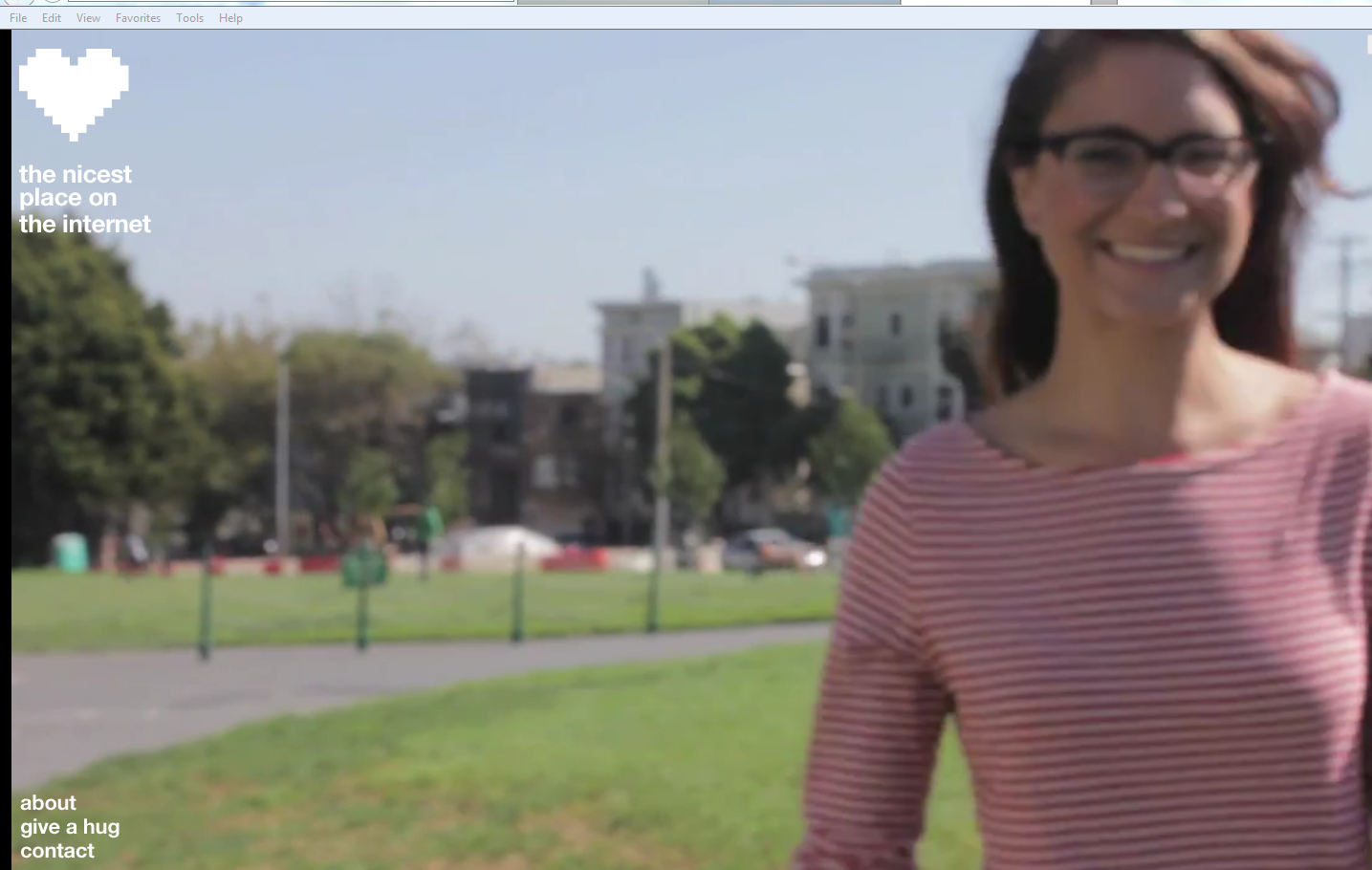
Ever have a day when you just really need a hug, like, right now? Well now you’re in luck:
"Jeff Lam and Lauren Perlow created The Nicest Place on the Internet, a place where you can feel warm and fuzzy with virtual hugs, because they were having an off day. It’s perfect for those chilly winter days."
I love this idea of virtual kindness; it’s a weird concept in a way, of people donating hugs (so to speak) to complete strangers. But, it’s great because it’s using the World Wide Web to create community and connections with people all over the world. Somehow, by being open to receiving a hug, even a virtual one, we are able to create connections and feel like part of a larger tribe or cohesion.
So often online communities can turn harsh or downright mean; it’s great to see online crowdsourcing being used for positive psychological benefits!
Indigenous peoples are key to preserving the world’s forests, and conservation reserves that exclude them suffer as a result, according to a new study from the World Bank.
Its analysis shows how deforestation plummets to its lowest levels when indigenous peoples continue living in protected areas, and are not forced out.
Across the world millions of tribal people are conservation refugees, but the World Bank says its evidence shows ‘forest conservation need not be at the expense of local livelihoods.’
Using satellite data from forest fires to help indicate deforestation levels, the study showed rates were lower by about 16% in indigenous areas between 2000-2008.
This is something Woodland Park Zoo, Izilwane, and many other non-profit organizations have been working on for years, so it’s nice to see the World Bank back them up.
So, the next question is what can be done to support local, indigenous groups to protect and care for their natural surroundings? Most groups want to preserve their environments and keep them handy for the next generation, but it is simply economically not viable, at least not how they see it.
Uptake helps you ask locals what to do in different locations
On a recent roadtrip, my husband and I stopped in a medium-sized town out in the middle of nowhere, tired, dirty, and famished. Neither one of us are McDonalds or Subway types, but we definitely needed meat, and fast. What to do? My husband spent 10 minutes on my smartphone trying to read Yelp for a decently reviewed restaurant, which turned out to be a real dive but had somewhat tolerable pizza. Long story short, I bet this app would have helped us out a lot:
Uptake is set up to have a web community of people passionate about their local bars, hotels, and restaurants, but the key is that they let you ask questions of your Facebook friends who are local in the city you’re interested in.
When you ask questions in an open community, you’re not guaranteed to get an answer. If you’re looking at reviews on Yelp, you don’t really know who are behind them [Editor’s note: Yeah, tell me about it!]. Your friends are usually the people you trust the most with picking a great bar or pub to eat at, so Uptake takes the extra step of drilling down to the friends who are relevant to your question.
A lot of apps and services like Nomad for iPad and Trazzler let you ask for travel recommendations, but Uptake helps you ask the people who probably know best.
Local destinations still need technology, as sites like Yelp have become a stomping ground for trolls sounding off about bad experiences. Social is the key to a good recommendation, but not many services have nailed the experience yet. When I see a recommendation from a name or avatar that I recognize, it instantly has more value to me.
Uptake is in beta right now and promises a few features that aren’t available yet.
One interesting trend of crowd-sourcing apps is an attempt to reach out to pre-established tribes and communities (see yesterday’s post about creating tribes through community) and trying to tap into that local’s knowledge. As the author of the article mentioned, people trust other people they know, and getting “local” knowledge is very important to us humans. We want to feel like we’re an insider, included, and not some dumb tourist who gets taken advantage of or just looks silly.
We also trust other tribe members and their knowledge more than anything else. It’s been shown we trust word of mouth and let it influence us more than advertising, and our peers are hugely influential on what we buy, use, and spend time doing. As we travel, we will also trust our peers over guidebooks on what to do, what to see, and where to eat.
I’ll be interested to see how these social peer-sourcing apps continue to evolve over time. Visit Uptake‘s website to find out more about the app.




 Mental Flowers