Just goes to show you can have fun pretty much anywhere:
Richard Dunn, when stuck overnight in Las Vegas’ McCarran Airport he busied himself making a music video for Celine Dion’s “All By Myself”, complete with improvised dolly tracking shot and bottom of the escalator ‘fall to knees’ for the crescendo.Dunn admitted to having actually had a ‘quite fun’ time the first recorded instance of this in an airport, getting behind the Delta check-in desks, crooning in those massage chairs no-one actually uses and utilising the inherently cinematic horizontal escalators.
I tweeted about this short film yesterday, but I really feel like this is worth giving some space on the blog for.
The value of play is important for teaching life skills like conflict resolution and collaboration, health lessons, healing from trauma, building community and just overall survival as a child and human being, the work this organization does seems simple but is hugely important.
This short video highlights some of the incredible impact that play can have on a child, or group of children.
You can also visit the organization’s website at Right to Play.
I don’t recall this parable from Dr. Seuss, but I like the idea of a bubblefest!
If you want to recapture your childhood this weekend, head to Cal Anderson Park in Seattle, WA, with a gallon or so of soapy liquid for Bubble Bath Seattle, the biggest bubble fight this city has ever seen.
From 3:00 pm to 5:00 pm, Cal Anderson will transform into a sea of bubbles. Evidently these events have been going on in New York for years, but it’s the first time that Seattle has ever seen something this epic. Organizers draw inspiration from Dr. Seuss’s The Butter Battle Book
James brought me a caterpillar the other day. Never having met him before, I was impressed with this 10 year old’s gumption in bringing an insect on a milkweed leaf, unsolicited, to the office of the executive vice president of the hospital. I was even more impressed when he started to talk. James, who has spina bifida, has spent a lot of time at Children’s Hospital of Wisconsin. But he’s pretty unimpressed with our clinics and operating rooms. What gets him going is the park-like space across the street on the County Grounds. Once the home of the Milwaukee County School of Agriculture and Domestic Economy, Asylum for the Insane, TB sanitorium, and poor house, among other things, the County Grounds is now largely occupied by the Milwaukee Regional Medical Center, UW-Milwaukee Innovation Campus, a golf course, and stormwater detention ponds. But pockets of the grounds remain undeveloped, including the
Beautiful sculptures, and a great way of being playful with gardening and making gardens more engaging for everyone.
Mosaiculture is an excellent art form for those among us with the green thumbs and the space to do it. An excellent example of this complex but beautiful artistic process would be the “Imaginary Worlds” mosaiculture exhibition at the Atlanta Botanical Gardens – these elaborate and massive green structures create mystical and fantastic worlds that are lush with living foliage.There is more to these amazing works of living art than meets the eye. Most of them begin with a steel frame of some sort, which is covered with steel mesh. This mesh is then covered with sphagnum moss and soil, which is seeded with all sorts of plants. Underneath the mesh, a network of irrigation channels supply water to the plants on the surface, helping them grow.
These findings make sense to me and yet also don’t.
Image credit: Carnegie Mellon University
Few environments feature such a cacophony of decor as the elementary school classroom. Colorful bulletin boards, scientific posters, state maps, and student artwork tend to cover nearly every inch of wall space. Yet a new study on classroom design from researchers at Carnegie Mellon University suggests that all that educational flair may not be all that great for getting kids to learn.
The study, carried out over two weeks, examined 24 kindergarten students who were taught six lessons on topics they had not yet learned in school. Half the lessons were taught in a highly decorated classroom environment, with posters and art all over the walls, and the other half were taught in a classroom with no decoration.
CMU’s researchers found the kids spent more time off-task and were more distracted when the room was brightly decorated, and they tested better on subjects they learned in the sparser classroom compared to the ones they learned in the more visually stimulating environment.
Elementary school children typically stay in one room all day, so classroom decorations don’t necessarily match the subject matter they’re learning at any given time. If they’re sitting in front of a U.S. map, they’ll be looking at that all day whether the current lesson is on geography or math. This study, though very small, adds to previous research from the same psychologists showing that visual stimulation that’s irrelevant to on-going instruction can distract kids.
The study doesn’t go on to offer any ways to necessarily improve the classroom design, although the article does give other links discussing it.
Nature can be fairly visually cacophonous, so what is it about classroom designs that are so distracting? I also wonder how much of their distraction is from an unnatural learning style, and then other more engaging things to look at. That is not an attack on the teacher, I’m just skeptical whether any human is capable of sitting in one room for 6-8 hours, with a couple of lunch breaks, and concentrate the entire time, for an extended period of time. Even grown-ups have a hard time doing that, and suffer when they try to sustain that for too long.
What are your thoughts? Leave them in the comments below.
This is a nice study that looks at the value for kids, but unstructured creative and/or play time is important for adults AND kids.
German psychologists find people who were allowed to play freely as children have greater social success as adults.
There has been plenty of hand-wringing in recent years about the “overscheduled child.” With after-school hours increasingly dominated by piano lessons, soccer practice, and countless other planned activities, many of us have a nagging sense that kids are missing out on something important if they have no time for unstructured play.New research from Germany suggests these fears are justified. It finds people who recall having plenty of free time during childhood enjoy high levels of social success as adults.
A team of three psychologists from the University of Hildesheim, led by Werner Greve, conducted a survey of 134 people. Participants were presented with a list of seven statements and reported the degree to which they conformed with their own childhood experiences that is, ages three to 10.
Having a quiet, peaceful place to work makes a huge difference on the human psyche. Some people find they work best with music blasting or in a loud cafe, but for most of us that workstyle is only good for certain projects or for a short period of time (say while we’re cleaning the house). In the long run, we can concentrate longer in a quiet, but not too quiet, environment.
Nice to see toys being introduced that work with already existing toys (sticks!), and encourages kids to go find their own sticks and go play in nature.
As an inductee to the National Toy Hall of Fame, the stick doesn’t need much improving as a classic toy. For as long as there have been children and sticks, sticks have served as a versatile toy in outdoor play. But connecting sticks takes a bit of ingenuity.
Enter Christina Kazakia, a design student with a mission. As she explains, “I designed these flexible silicone connectors as part of my graduate thesis in Industrial Design at the Rhode Island School of Design. My goal was to create prompts to engage children with their surrounding natural environment.” Called Stick-lets™, these connectors help small children build big structures like forts, teepees, lean-tos, or other creations.
Public, collaborative art happening in Seattle. Go be a part of it!
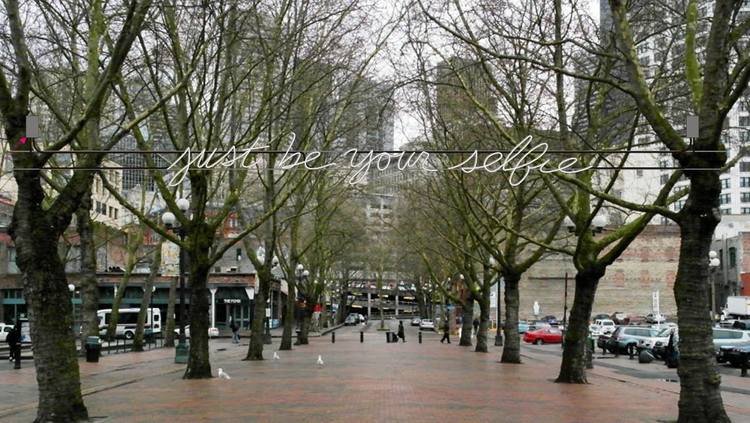
Just Be Your Selfie in Occidental Park, Seattle by Dylan Neuwirth
I am pleased to announce a new large-scale public work coming to Seattle in late May and on display in Occidental Park from June to September, 2014 as a part of ArtSparks.
“JUST BE YOUR SELFIE” is a monumental neon status update rendered in cursive.
Designed to initiate personal and shared, web-based experiences; this social sculpture is an iconic contemporary work of real-time internet art embedded into an urban environment. Not necessarily a solid structure, or a pure concept; this slippery expression bridges the gap between existing in both the analog and digital realities we now accept as inseparable.
The work will have its own Instagram account, associated hashtags, and is intended to take on a life of its own.



 Mental Flowers