I recently got to visit Chicago and was excited to see all the public art and architecture in the downtown, Millennium Park area. This is a great continuation of that focus on public access to art and enrichment.
On a rainy afternoon, surrounded by musicians, dancers, and dignitaries, artist Yoko Ono spoke at an “earth healing” ceremony, celebrating the dedication of the site of what will be her only permanent installation in the Americas, Sky Landing. The installation will be in Chicago’s Jackson Park, on the Wooded Island, which is currently undergoing extensive restoration work, including the reconstruction of natural areas and the creation of a new pavilion.
Sky Landing will be located on a site adjacent to the Osaka Garden in Frederick Law Olmsted’s bucolic park. The site is historically significant, as it is the location of the original Phoenix Pavilion, which was built in 1893 as a part of the World’s Fair Columbian Exposition to promote American understanding of Japanese culture and as a means to unite the East and West. The original pavilion burned to the ground…
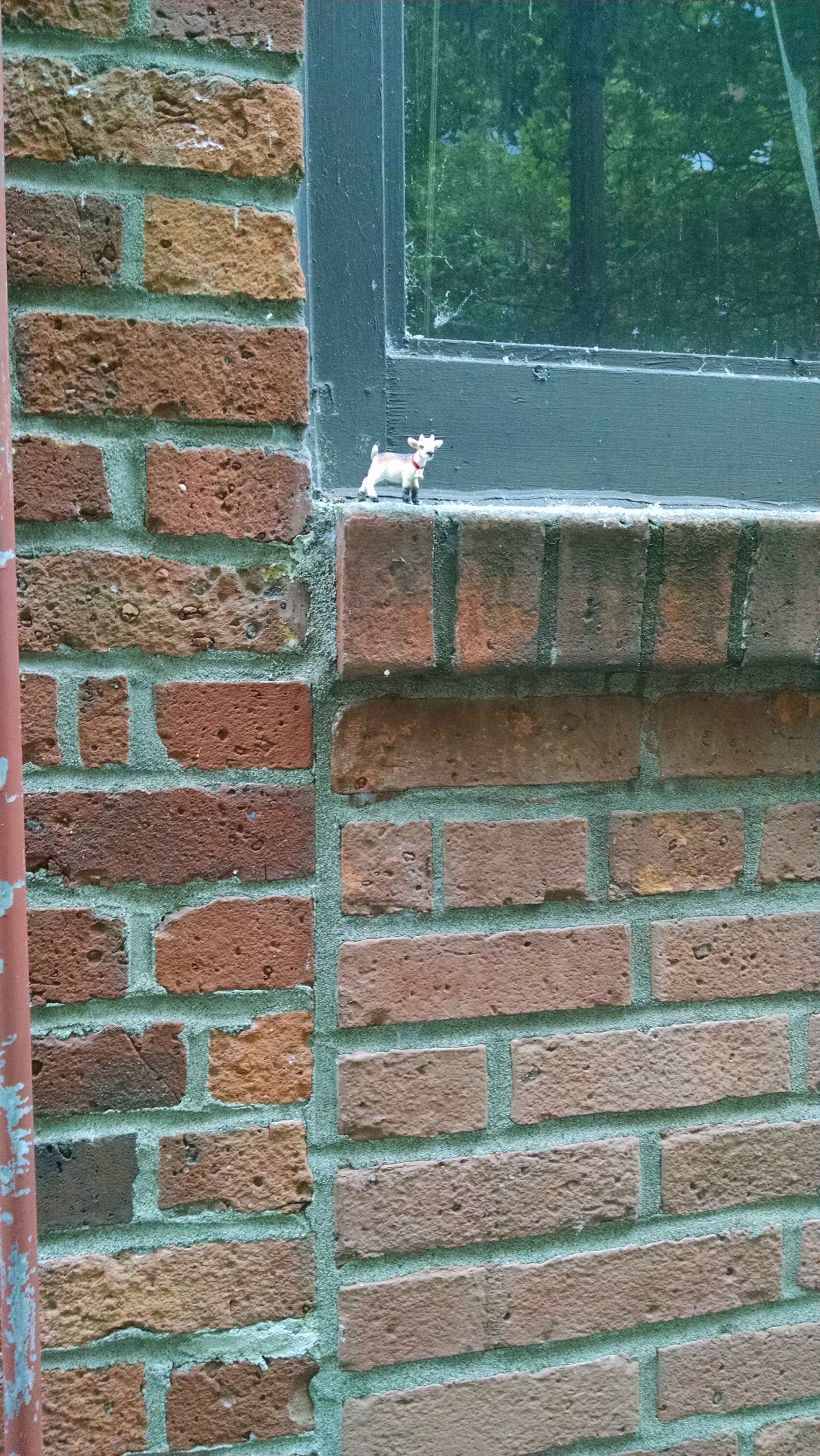
A little plastic goat views the valley below his window sill.
I took a couple of weeks off, but I am now getting back in to taking little toys out into the world and taking pictures of them in unique environments, creating little vignettes in the wild.
I’ve upped my game a bit and am going to start leaving them out for people to find. The tricky thing, and that adds to the fun, is there’s no way to control how long these toys will stay put before people notice and decide they want to play with them themselves. This one was placed somewhere near Pioneer Square.
Where you live can have a huge bearing on how healthy you’re likely to be. And, sometimes the gaps open up over just a few miles. A few subway stops in New York, for example, could mean up to nine years difference in how long someone might live.
Mitchell’s research, while still at a relatively early stage, suggests green-space might serve to reduce these gaps.
The research doesn’t prove the strength of the relationship between individual neighborhood services and well-being, but does show that well-being gaps are smaller where services are better, Mitchell notes in an email. Research he’s conducting now, which hasn’t been published, does show green spaces having the strongest bearing on well-being differences.
A million times yes! This article focuses on one of my biggest pet peeves and challenges as a play advocate; play not being taken seriously.
The author, Hilary O’Shaughnessy, and also the producer of the Playable City Award, discusses her play competition and the usual rub of people asking whether this is really all “worth it.” I’m quoting over half of her article, but she very eloquently covers an entire blog post I was planning on writing (I will still write it, I promise):
Amongst the usual squeals of anticipation [around the competition], there are questions about the value of these ideas to the “real” world. Fun is all well and good – but surely fun is the stuff we get to when the grown up work of building hospitals and roads is done with? When we’ve fixed the economy, let’s play. Cities are full of problems, why are we not fixing them first?
Herein lies the real issue. When we see play simply as fun, a whimsy for those of us lucky enough to have the time to engage in it, we underestimate the transformative power of play and it’s role in our lives.
Fixing problems, making our living and working spaces more livable and resilient, designing better cities, starts at every level with the people that Iive in those cities. Increasingly we are realising that our cities are designed for exclusivity, so it makes sense that we don’t feel part of shaping the future. This is revealed in the language we use to describe our relationships to the services and organisations that our cites are made of. We want them to fix it, they don’t want us to have a say, they give money to them to exclude us: the language is divisive and separating, and that’s the problem. Even the descriptions of the projects fail to deliver what they promise, because a playable city is experienced, not described.
The idea of what our cities should mean, how public money is spent, what we imagine as good for us and who is involved in designing them, is only ever addressed when we have a complaint or we feel excluded. We talk to the city council when the road is road is torn up or the lights won’t come on. We complain that our voices are unheard, but we never seize opportunities to speak, fearing that if we do we will be ignored or shouted down by the loudest ones.
This feeling of separation cannot be undone overnight. We need new approaches, new tools, and new ways to talk to one another about how to live together in cities.
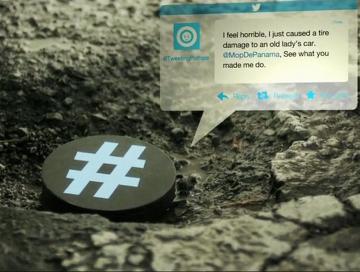
From a different article, but an example of using play as political protest: a device placed in large potholes that tweets whiny complaints when it is run over in order to publicly shame govt. into action.
Conversations about the future, about how we want to live, have to begin from a level playing field, and crucially that level playing field may not be where we expect. Play is a leveler: when we play, we play as humans, first. Traditional status markers like wealth, celebrity, or qualifications are not really much use when invited to dance with your shadow or conduct lights like a demi-god.
Addressing problems and finding solutions that work for us all begin with inviting everyone into conversation. Play as unexpected interventions in familiar places act as invitations to connect, an offer to begin to talk about those parts of our cities that we feel excluded from. To new eyes and ears, some projects can seem esoteric – but that is because we have become numbed to dull public announcements, badly designed flyers and clunky websites which act as information dumps that no-one reads, let alone takes as an invitation to work together. Yet, this is important stuff: we need to talk about the kind of future we want or it be will be decided for us while we look the other way.
As our climate becomes more unpredictable, finding better ways to manage stormwater is crucial to mitigating flood damage. However, traditional stormwater management strategies can be unforgettable at best and unsightly at worst. In the new book, Artful Rainwater Design: Creative Ways to Manage Stormwater, authors and Pennsylvania State University professors, Stuart Echols, ASLA, and Eliza Pennypacker, ASLA, prove that this doesn’t always have to be the case — it is possible to effectively manage runoff without sacrificing aesthetics.
In this well-organized how-to guide for designers, Echols and Pennypacker highlight the benefits of Artful Rainwater Design (ARD), a term coined by Echols in 2005 to describe rainwater collection systems that are not only functional, but also attractive and engaging. These systems are usually designed to handle small rain events and the initial — and dirtiest — events, rather than major flooding from large storms…
This is a great example of how even “country kids” – all of these kids come from communities surrounded by farmland and agriculture – enjoy and appreciate hands-on experiences and learning about gardening and the natural environment.
About 70 classmates participated Thursday in the Washington State University Skagit County Extension Master Gardener’s “Discovery In Gardening — Is Terrific” (DIG-IT) youth education program.
“It introduces kids to how the garden works, from the growth of the plants to how it arrives in your kitchen and what to do with the scraps,” said Master Gardener Chuck Howell.
The program was started in 2002 by two teachers, Master Gardener Gail Messett said.
The format of the program has changed over the years, Messett said, but the goal has remained the same: Get kids outside and into the garden.
“They’re learning respect for insects and bees and flowers,” Messet said. “I think they go home pretty awestruck, actually.”
Looking to have a little fun with your walk? Now you can use mapping technology to do so…
The Trace app will let you turn a sketch on your smartphone into a physical walking route around a city. You can share your route with a friend, and the recipient gets step-by-step directions. Eventually, the app will reveal the shape on a map.
The walk creator can add signposts along the way—images, audio recordings, messages—which will pop-up at specific places in-route. Walkers can begin their walk anywhere in the city, and pick the duration of their walk. The app adjusts the size of the shape accordingly.
Sixteen walkers in Seattle, Boston and Chicago tested out Trace for a week, drawing over 150 shapes. They sent the walks to friends or tried the routes themselves. The results were presented in a study in Seoul, at the Association for Computing Machinery’s CHI conference last month.
This is a very well thought out and researched article about the benefits of pretend play, specifically creating and playing with puppets.
The [Puppet School] curriculum establishes the tenets of puppeteering education, which put educational theories about the importance of play and grit and resilience into practice.
In the beginning classes, students start to learn basic head and mouth movements, using motor skills in both hands and both arms, choreographed to pre-existing sound tracks of well-known pop songs. Students learn to articulate vowels and develop a sense of rhythm with their bodies. As the exercises advance, students learn to improvise using their own voices and hand movements, and eventually choreograph movement to material they’ve written. From motor skills, to communication and improv skills, then finally written skills, students exercise many parts of their brains at Puppet School, increasing communication between their two brain hemispheres.
According to Eric Jensen’s Teaching with the Brain in Mind, when brain signals are passed from one side to the other quickly, or when the left and right sides of bodies work simultaneously, the brain is able to function more efficiently, and the stronger the brain’s connections become—thereby improving literacy, movement coordination, processing data, and communication skills.


 Restoration of Jackson Park / Project 120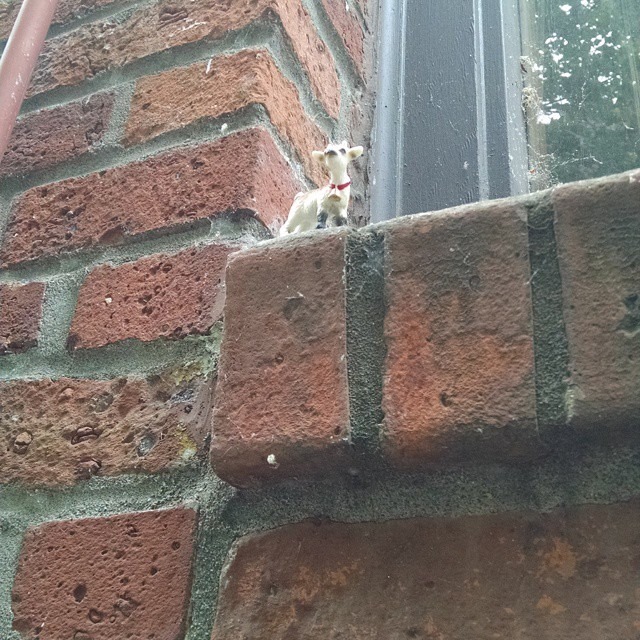


 Artful Rainwater Design / Island Press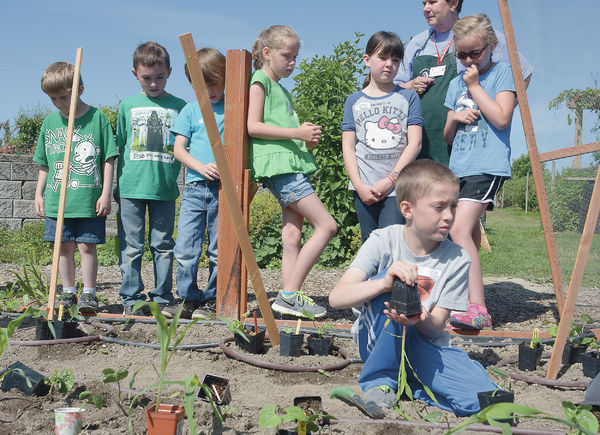


 Mental Flowers