It is in our nature to pick up interesting rocks, sticks, and leaves as part of our exploration of our surroundings. Some people bring their treasures home and display them on a fireplace mantle or little shadow box.
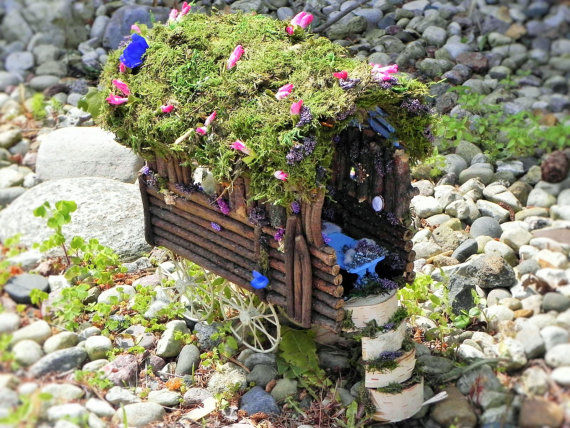
For a husband and wife team, they have been turning their little finds into fairy houses, which is another playful way of exploring their surroundings and getting to engage in make believe play as a grown up. They are also one of the lucky few people who get to sell their play creations. They were interviewed on the Etsy blog about their creations:
Etsy: When did you make your first fairy house? And had you ever heard of one before you made one?
Debbie: I grew up writing poetry and playing musical instruments and I had always loved doing different kinds of crafts like making dolls, handmade books and cards. But no, we’d never really heard of fairy houses before we started doing this 25 years ago. At the time, our sons had just started going to grade school, and when I found I had more time to myself, I was excited to use my creative talents again. The first project I tried was making a full-size Adirondack chair; when that didn’t work out, Mike suggested that I try making a miniature chair instead. I used some materials I had gathered from a couple of acres near my mom and dad’s place in Washington, and it was so much fun I kept doing it.
Mike: We have always loved nature. When we would go for hikes, Debbie was always picking up things she found, so we already had quite a collection of wild grasses and flowers. And Debbie’s mom was our biggest mentor. She always said, “You have so much talent. I wish you would use your talent.” She really encouraged us.
How wonderful that Debbie’s mom continued to encourage to play and explore with creating these miniatures.
Have you ever built little fairy houses when you go for a walk? Or seen someone else’s creation? Do you build with LEGOs or other miniatures? Or K’nex (Connector) Sets or Lincoln Logs or other building set? Do you wish you still did? Share in the comments below.
I wanted to share a great list from full time mom/worker/author/etc. Katrina Alcorn about how to fit in some play and laughs into a busy schedule.
Whether or not laughter is the best medicine, it’s certainly a great coping technique. It may not make you less busy, but it will boost your immune system, protect your heart, help you handle stress, lower your blood pressure, and improve your intake of oxygen. Also, it has zero calories, zero negative side effects, and it’s free.
Katrina also wrote a great book about her experience being Maxed Out and ways that we can all fight for more time and space to play and be balanced in our lives. It is a wonderful, fast, engaging read. Go check it out.
A well-written article discussing how to get trees back into cities and especially to communities that need them. I would love to see this plan implemented in all city and urban planning offices.
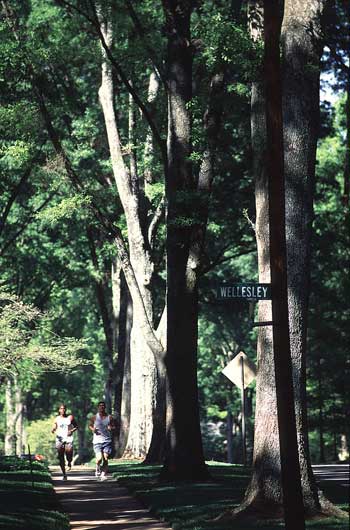
Charlotte, North Carolina street trees / Kenny Craft on Pinterest
The science is increasingly clear: trees are central to healthy, livable cities. New studies are only adding to this understanding. For example, recent research published in the prestigious journal Nature found that having 10 more trees on your block, on average, improves the perception of your own health in ways comparable to an increase in annual income of $10,000 or being 7 years younger. However, according to Cene Ketcham, a graduate student in urban forestry at Virginia Tech, the benefits of urban trees rarely fan out equally across a city.
“We know trees have a lot of benefits. And if we know that having trees in our cities is important for our health, the converse must also be true — a lack of trees hurts your health,” Ketcham said at a conference organized by Casey Trees in Washington, D.C.
The kids take a break from walking to analyze a babbling brook.
Kids are amazing explorers. Their drive for exploration and play can overpower their desires for sleep, food, and general grumpiness.
This past Monday we had a sitter sick day, and I was in charge of the kids. To get them out of the house we took a four hour round-trip hike down to the park near our house. This park is more like a nature preserve, with a trail that follows a quick drop down from street level into a canyon where a small creek that still supports a salmon run every year slowly meanders down to a mostly sandy beach and the Puget Sound, where local families dig their plastic shovels in the gravely soil and watch sail boats, freight ships, and the occasional harbor seal, bald eagle, or osprey fishing off the shore.
My daughter loved walking over the wooden bridges, stomping her feet to make the boom boom echo noise that only comes from wooden bridges. We went at her pace, taking as much time as she wanted at each spot, stopping at every bridge to look over its edge into the babbling brook or stream below, stopping to touch a cool tree, as well as the fire trucks that happened to be at the park. A few times I got bored and suggested we move on, and if she said yes we went and if not we stayed. Even towards the end of our adventures, although she was simultaneously starting to complain about being hungry and thirsty, she was the one demanding that we go down to the beach to at least sit on a log for awhile and touch the sand. She also wanted to go swimming in the creek and the sound, but we skipped those activities mostly because I did not feel like adding “wet” to the description of things I had to lug back out of the canyon, and she didn’t protest too much.
She balanced, climbed, slid, see-sawed, and ran up and down hills, falling and tripping a couple of times but brushing herself off each time and only needing one kiss to make a finger better before moving on to the next activity. She got to try an apple that fell off the park’s apple orchard, picked up leaves, and analyzed different rocks strewn on the beach. She walked more than half of the time down and around the canyon and park, and returning walked all the way down the hill from the beach cliff and towards the lower parking lot. She had an amazing time and had lots of things to share with her dad when we got back from our adventure.
But my son, my son enjoyed the day on an entirely different level. My son was so happy during our walk through the woods he looked like an animal released from its cage and realizing it has been returned into its home forest.
He would just lean over, reaching down over the edge of his stroller trying to touch the ground as it whizzed by him, feeling any dirt kick up off the path with those pudgy little hands that an instant later were reaching up up up into the sky, trying to touch the leaves high above and sunlight sparkling through them.
He was always sitting literally at the edge of his seat, at times riding his stroller like a chariot, bracing his feet against the step and grabbing the guard rail, standing straight up and wiggling his body to urge his rickety chariot to go faster. He would lean back into his chair, arching his back to look up at the tops of the trees, and look back at me as if to say “Mom, this is so cool!”
He wanted to taste and experience everything, and although he tired much more quickly than his sister he still grabbed for various sticks, rocks, and chunks of wood to taste as we sat on the beach. He would understand when I told him no and take the rock out of his mouth, but would then start searching for another one, thinking, “maybe this cracker shaped piece of wood is okay.” When he found an apple on the ground in the orchard, He was so proud and protective of it he struggled with wanting to show me but wanting to keep it for himself. He actually tried to pick up all the apples while holding on to his tiny little apple, but I tossed the rotten ones further into the field and tried to get him to focus on his precious little apple that he had already started chewing. He spent a long time nibbling at it, getting it about half eaten, and when I finally snuck it away from him to bite away a wormy spot I found that in fact it was pretty good, better than the one I picked off the tree for my daughter.
He had exhausted himself by the time we walked through the woods again and looked dazedly up into the sparking tree canopy before he drifted to sleep about half way up the canyon trail. My daughter rested in her seat, chatting here and there but was overall surprisingly quiet for a two year old.
After I made us a very late lunch and we sat around the kitchen table hungrily munching our pasta and sausages, I was still, and am still, blown away by just how long the kids both wanted to be out there in the park, playing, exploring, and just how happy they were to be out experiencing nature. I try to let the kids explore on their own at their own pace, but this day took that experience to a whole new level for me, one I will try to remember as we continue to explore and learn about our world together.
This is a great blog post from a teacher re-learning the value of creative free play and specifically outside.
I highly recommend you read the whole post, but for me this sentence summed up the whole experience:
“…As I witnessed these projects I realised that children and adults can only be as creative as their environment allows them to be and that by letting children spend time in a natural environment like the woods or to be surrounded by loose parts, we can but only help them to become or remain creative.”
AUB Landscape Society celebrates Park(ing) Day / outlookaub.com
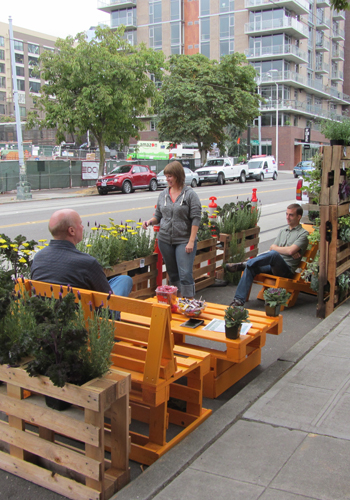
Founded in 2005 by landscape architect John Bela, ASLA, a founding principal of Rebar, PARK(ing) Day is September 18 this year. PARK(ing) Day is a global, open-source phenomenon in which landscape architects and other designers transform metered parking spaces into temporary mini-parks, or parklets. The event helps the public visualize just how much of our public realm is given over to cars and all the other potential ways these spaces could be used by communities.
The American Society of Landscape Architects (ASLA) encourages its professional and student members to lead the design and installation of parklets and show the public how surprising designed parklets can be.
Rebar’s original PARK(ing) Day in San Francisco, 2005 / parkingday.org
Whether it’s simply a new place to sit and relax, or play a game, parklets will draw a crowd.
This is a blog post from my husband, who teaches movement (and writes about it occasionally) under the brand Evolve Move Play. I thought it was worth sharing:
Last week my family went to the Oregon coast.
At the beach my son encountered an estuary that fed into and mixed with the rising and falling ocean waves. This was a new experience, and he was enraptured, charging into it at full speed until he was swamped by the water, popping back up, with a huge smile on his face charging back up the beach, only to turn around and do it again. Over and over for twenty minutes he did this. I have rarely seen such pure unadulterated joy and for so long.
What wonderful movement nutrition he was experiencing, moving up and down slope, on changing surfaces, tensions of sand, feeling the resistance of water and its changing currents, the rapid change in temperature as the warm water of the estuary would be rapidly cooled by an incoming wave, and here and there moments where he was lifted by the water and had the first stimulations of swimming.
My wife was initially worried about letting him charge into the water, but each wave’s passing meant it was only briefly deep enough to touch his face, and we have been developing his mammalian diving reflex since he was 3 months old. I was there to catch him if he was overwhelmed, but every time he did get swamped he just came up smiling bigger than ever.
The surfaces and environments we move through are impoverished. We eliminate as many sources of challenge as possible and so increase our convenience. What we don’t notice is how we are removing our movement nutrition.
It’s like replacing real whole food meals with processed foods, convenient but not nourishing.
Small children are especially sensitive to this, a developing locomotive system that is only challenged by flat ground is like a developing a body that is only fed corn, it’s not going to develop optimally.
Children innately understand this and are intrigued by new movement environments and when they find a new and intriguing movement challenge they will want to repeat it over and over.
We need to recognize how we can support and keep them safe without limiting them and how we can follow their lead.
This article was first published in Playground Professionals Newsletter, July 20, 2015
As a child of the sixties I spent my teen years grappling with the issues of the Vietnam War, the free speech movement, and civil rights. Our generation wanted to do something to make the world a better place.
Having graduated from San Francisco State with a major in art I went on to Pacific Oaks to learn to be an early childhood educator. One of the great things about Pacific Oaks is that they had preschool classes on campus and all of the graduate students had daily interaction with children. It was at Pacific Oaks that I first experienced a loose parts playspace. We used cable spools, old doors, boxes, tarps, and the like.
Seeing how well these worked I realized that I could combine what I could use in my background from both school and like…
A really fascinating read about improving air quality through design by architect Blaine Brownell:
During a study-abroad tour of China that I led in May and June through the University of Minnesota’s School of Architecture (read more about the trip here and here), one topic, aside from architecture, that my students and I discussed regularly was air pollution. Although we were in southern and central China, which are less affected than Beijing and other northern cities, we often found ourselves in a murky atmosphere. For three weeks, we rarely saw blue sky even on sunny days, and the air imparted a palpable thickness.
We checked the country’s Air Quality Index (AQI) daily via mobile app for the local forecast—especially after a bout of intense allergies sent me to a local pharmacist. This led us to question how we as architects and designers can counter such an ever-present problem.
Air pollution influences not only our physical health but also our experience of the built environment. Buildings and landscapes become soft and gritty, losing their clarity, sharpness, and color behind a veil of smog. The azure backdrop that is beloved in architectural representations is rarely witnessed. Rather, gray predominates, at times accompanied by brown. Despite this reality, blue sky persists in renderings of projects in China.







 Mental Flowers