community · happiness · Social · technology · youtube

Social Networks Can’t Replace Real Human Interaction

Virtual space, including friendships there, does not fully replace that real live human interaction we get in real world spaces. More and more studies are finding this out, and people are reacting to it, often on social media.

graphic designer Shimi Cohen, based in Tel Aviv, has provided “a fresh and subtly soul-wrenching reminder of the way our screens can become cells of solitary confinement.”

The animation was Cohen’s senior project at Shenkar College of Engineering and Design. Based in part on MIT professor Sherry Turkle’s book Alone Together and Yair Amichai-Hamburger’s article “The Invention of Being Lonely,” inspiration also came from a personal place. “Like many others,” Cohen tells Co.Design, “I became addicted to socializing through my phone and social media. This started to bother me and intrigue me at the same time.”

Discovered at Co.Design.

This is a wonderful and simple reminder to get off the computer from time to time and actually go interact outside with real people.

anthropology · behavior · creativity · culture · happiness · play · Social · technology · youtube

Lolcats and the Harlem Shake: Play on the Internet


An article from the head of Google’s Agency Strategic Planning team published in Fast Company talks about why we play on the Internet; it’s a really good dive into the need and importance for play in our lives and share that playful experience with others, and how as we move towards a more digital space we are taking that need to share play with us. It is marketing/branding focused, but the message is clear; we all need play and are making space for it, at least in our Internet lives:

We [netizens] uploaded over half a million variations of Harlem Shake to YouTube in the past few months. Google searches for Cat GIFs hit an all-time high last month. And we took 380 billion photos last year–that’s 10% of all the photos taken . . . ever. But let’s be honest–these memes are fun, but they don’t matter, right? They’re pretty much a waste of time.

As the head of Google’s Agency Strategic Planning team, it’s my job to work with brands and creative agencies to help develop their ideas in the digital space. So I had to ask: Why would we be doing so much of all this “visual play” if it really means so little to us?
To get to the bottom of these memes, we assembled a team of original thinkers–anthropologists, digital vanguards, and content creators–to dig a little deeper into this “visual web.” We also spoke to gen-Cers–the people who grew up on the web or behave as though they did–and who thrive on creation, curation, connection, and community.

The research showed us that far from distracting us from more serious things, these viral pictures, videos, and memes reconnect us to an essential part of ourselves.

It may seem that all we’re doing is just capturing every mundane moment. But look closely. These everyday moments are shot, displayed, and juxtaposed in a way that offers us a new perspective. And then all of a sudden these everyday moments, places, and things look . . . fascinating.

As kids, that happens all the time because everything is new. Everything is unlike. And we aren’t constrained by the rules about what “goes together.” Why else was putting the Barbie in the toy car wash more fun than putting the car in the car wash?

Read the whole article here: Memes With Meaning: Why We Create And Share Cat Videos And Why It Matters To People And Brands

community · creativity · environment · play · Social · technology

Music for the Masses

Happy Friday everyone. Be sure to go out and play today. 🙂

Unknown's avatar

Happy Friday everyone. Be sure to go out and play today. 🙂

View original post

architecture · play · technology

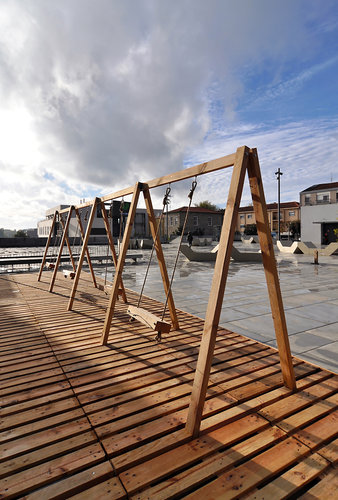
A Swing Set That Powers An Electric Light With Every Pump | Co.Design

As kids my friends and I used to imagine creating electricity out of the swings or the merry-go-round. Turns out we weren’t the only geeky kids who thought up that kind of thing:

Swinging is a self-contained pleasure, an activity where the work and reward are one in the same. But for their pop-up installation outside the International Centre for the Arts in Guimarães, Portugal, the art collective Moradavaga added an unexpected twist to the childhood pastime: a little bit of light, powered solely by the motion of the swings themselves.

more via 1 | A Swing Set That Powers An Electric Light With Every Pump | Co.Design: business + innovation + design.

If you could turn any play equipment into a power generator, what would it be? Leave your ideas in the comments below.

architecture · design · environment · happiness · health · technology

A happy view, thanks to your window glass

English: A 100 watt "black light" ul...
Get some healthy UV light thanks to newly designed window coatings (Photo credit: Wikipedia)

From Co.Design:

Scientists at the Fraunhofer Institute for Silicate Research in Germany have invented a new type of window that is conceived to improve concentration, regulate sleep, and even make you happier. The so-called “feel-good glass” has a special .1-micrometer-thick inorganic coating that is optimized to transmit wavelengths between 450 and 500 nanometers, where the effects of blue light are most pronounced. Blue light is the part of the spectrum which promotes the balance of biorhythm-moderating hormones (and which traditional glass largely blocks). “The coating we’ve developed helps people to feel they can perform better and makes it less likely they will fall ill,” Dr. Jörn Probst says.

Of course, you could soak up plenty of mood-enhancing light just by stepping outside. But given that Americans spend as much as 90% of their lives indoors, it makes perfect sense to welcome the healthiest aspects of the outdoors inside. The effects can even be felt in spaces criminally low on natural light, the researchers say; as long as there is at least one small window, blue light can creep in.

The patent-pending Uniglas | Vital feel-good glass isn’t on the market yet, and still requires some tinkering. Says researcher Walther Glaubitt: “Up to now we’ve only applied our special coating to the side of the glass facing into the cavity between panes. In future we will also be coating the glazing’s exposed surfaces–in other words, the outside and the inside of the window. That will allow us to achieve around 95 percent light transmissivity at 460 nanometers.”

[see also PSFK]

Neato! I feel happier already! Of course I’m always an advocate of the real thing, but I also work in an office all day and know just how powerful a little sunshine on my shoulder can be for my productivity (unless it’s a REALLY nice day outside and then I’m about as productive as a surgeon with two left hands. Thankfully I’m also left-handed).

But until this glass becomes commercially available, your best bet for better health really is step outside and get a few minutes of sun every day – even 20 minutes daily makes a huge difference.

anthropology · architecture · community · creativity · environment · Social · technology

Mapped out Missed Connections

I’m a very visual person, so I like to map stuff out as much as possible. It looks like some artists had the same sentiment and took it to the next level. I argue this is environmental enrichment because it takes human connections (or missed human connections) and marks them in the universe, in a fun way!
From Wired:

You know Craigslist’s Missed Connections, right? The personals page where you log a brief interaction with a stranger who you hope to see again? The posts are a candid, wistful, often hilarious look at interactions — or the lack thereof — between people in the digital age, and beg the question, “Have we become so used to interacting online that we can’t say ‘hi’ in person?”

That question, among others, inspired artists Lisa Park and Adria Navarro to take these digital love notes and turn them back into physical markers. The pair made oversize stickers based on Missed Connections posts, then affixed them at the exact spot where the missed connection occurred. They document the entire project, called I Wish I Said Hello, online, completing the loop.

To me this is kind of like marking your initials in a tree without hurting a living organism. It’s fun, it tells a story, and it helps us make connections with people; even if we never meet them in real life, we learn a little bit about who they are, how they see the world, and a moment in their lives. That helps us in turn feel more connected to our communities and large, ever-expanding tribes.

Locations also hold special meaning to people; pilgrimages to the cafe where their favorite singer performed to Mecca and everything in between. These also create small landmarks that are probably insignificant in the long run, but help orient us in the world in some way.

Have a special place or spot? Why not mark it with a ribbon or rock, or just let us know about it in the comments below.

behavior · brain · community · culture · emotion · environment · happiness · health · Social · technology

Crowdsourcing Quiet Spaces in the City

For the past month I have been staying in a surprisingly noisy apartment. The neighborhood itself is very quiet, but just my luck to be staying over a night club and all-night grocery store. After this month the importance of being able to find quiet, peaceful places in a city rings all the more true and important to me (and it’s not just the ringing in my ears). From Inhabitat:

Cities have always been bustling environments, and with more and more of us living in them it can be difficult to find a quite place to relax or contemplate. Sound Artist Jason Sweeney‘s winning proposal for the TED Imagining the City 2.0 Prize is a crowdsourcing project that seeks to locate and map the places that provide silence in the urban din. The Stereopublic Project will be a public guide for those who crave a retreat from the crowds.

Based in Melbourn’s city center, Sweeney found himself attracted to tucked-in corners, where the city’s sound fades into the background and where the built environment is experienced as a sound environment. Inspired by his own experiences, he’s looking to create a platform where others can geo-tag and share their favorite quiet space. Sweeney is interested in helping those who are sensitive to noises, with disabilities, or just seeking respite from the constant din of the streets.

The TED City 2.0 prize will help his team develop a digital tool for crowdsourcing those places, adding a new layer of awareness to the cityscape for its occupants.

Cities are large, complex environments and the project is a unique way to understand the acoustic dynamic of city life. Stereopublic is based on active users sharing their findings, but ironically, the project’s success will likely make those quiet spaces busier, further pushing inhabitants to explore new places. The idea may become a failed experiment if it becomes too successful, but it also very well might help create new venues that improve the “sonic health” of a city — adding a vital resource to urban life.

Know of a quiet place in your city? Add it to the list, or leave it in the comments below and I’ll add it for you and if it’s in the Pacific Northwest may just try it out first. You know, for research).
anthropology · architecture · children · creativity · design · environment · health · Social · technology

6 Future Playgrounds That Harness Kids’ Energy While They Play | Co.Exist

What a great series from Co.Exist and Fast Company: play grounds, and other structures, that harness the energy of people’s movement. This may be the first time employees are actively encouraged to move around all day. 🙂

Kids have boundless energy. What if that energy could be put to some use besides just running around and having a good time. These new jungle gyms convert play to power.

When IBM came up with a list in 2011 of the five technologies it thinks will change the world in five years, kinetic energy–power from people–topped the list. Advancements could come, they say, from developments in devices that might harvest power from your shoes, your exercise, and even the soccer ball you kick. Green gyms are also cropping up. And now the idea has come to playgrounds, where kids’ movement can be harnessed and funneled into powering schools and toys.

Natural Energy Park
Natural Energy Park

This playground–designed by Hyundai engineering and construction–is part jungle gym and part renewable energy science experiment. After climbing a ladder into a laboratory, kids can spin a wheel that will illuminate “Benjamin Franklin’s kite.” An optical illusion will spin at varying speeds as children adjust a solar panel to different angles. Pedaling a bicycle powers a pinwheel and illuminates lights around the structure. Hyundai calls this the “Natural Energy Park” and it looks like a lot of fun.

Empower Playground
Empower Playground

Mixing fun and helping people, Empower Playgrounds is a non-profit organization that provides electricity-generating

playground equipment to villages in Ghana that are too remote to be on their nation’s electricity grid. The school children gain a playground as well as safe, rechargeable LED lanterns to light their homes so they can do their homework. Additionally, the play equipment doubles as part of a hands-on science lab that brings science concepts into their daily lives

See the whole series here.

For more on the future of playgrounds, check out 8 insane playgrounds, schools, and libraries of the future.

Know of other playful energy producers? Let us know in the comments below!

anthropology · behavior · community · environment · happiness · Nature · psychology · technology

Mappiness: Mapping Happiness

A shot of the app.

From the blog How Do you Landscape; a group from the UK has created an app that can be used to measure our happiness based on our surroundings, and using maps to look at the data:

“People feel better outside than inside”. “People feel better in the park/woods/nature than in the city”. These are some of the conclusions from a project with the telling title ‘Mappiness’ Good news for landscape and Landscape Architecture on first sight. But are these only one-liners or firmly based scientific statements? Well, that depends on the quality of the empirical evidence of course. Most experience sample methods (ESM) have a hard time getting a representative group (in the end almost only colleagues) that has to struggle trough tedious interview forms (“it will take only twenty minutes”) to step-by-step end up with modest results. How about a sample group of 47.331 people (and growing by the day) who willingly support their data three times a day to the researchers that by now collected over three million forms in a few months? I stumbled upon these remarkable Experience research feats in a TedxBrighton 2011. In this “Twenty minutes lectureGeorge MacKerron explains why and how he and Susana Mourato (both from the Department of Geography & Environment at the London School of Economics and Political Science) created ‘mappiness’. They want to better understand how people’s feelings are affected by features of their current environment. Things like air pollution, noise, and green spaces influence your well being is their hypothesis.

This is how it works. They developed an app that can be downloaded for free. It must be one of the most irritating apps around on the web because it rings you (with your approval, you can influence the settings) three times a day to ask you three simple questions.

When put through a big regression model they can gauge the happiness as the function of habitat type, activity, companionship, weather conditions (there is of course a link between meteorological data and the GPS data), daylight conditions, location type (in, out, home, work, etc), ambient noise level, time of the day, response speed, and individual ‘fixed-effects’ (that come out of your personal Mappiness-history). Factors can be plotted out against each other.

How awesome is that? What a neat piece of technology to measure our surroundings and how they influence us!

behavior · brain · children · culture · education · learning · mental health · play · technology

Toddlers to tweens: relearning how to play

Español: Guiliana moreno Jugando en bogota
Free play is finally getting the recognition it deserves. Image via Wikipedia

Great article from the Christian Science Monitor about the value of play:

In recent years, child development experts, parents, and scientists have been sounding an increasingly urgent alarm about the decreasing amount of time that children – and adults, for that matter – spend playing. A combination of social forces, from a No Child Left Behind focus on test scores to the push for children to get ahead with programmed extracurricular activities, leaves less time for the roughhousing, fantasizing, and pretend worlds advocates say are crucial for development.

Meanwhile, technology and a wide-scale change in toys have shifted what happens when children do engage in leisure activity, in a way many experts say undermines long-term emotional and intellectual abilities. An 8-year-old today, for instance, is more likely to be playing with a toy that has a computer chip, or attending a tightly supervised soccer practice, than making up an imaginary game with friends in the backyard or street.

But play is making a comeback. Bolstered by a growing body of scientific research detailing the cognitive benefits of different types of play, parents such as Taylor are pressuring school administrations to bring back recess and are fighting against a trend to move standardized testing and increased academic instruction to kindergarten.

more at: Toddlers to tweens: relearning how to play.