community · environment · play · Social

Fear, Traffic Largest Inhibitors of Outdoor Play in UK

This makes me sad to see that fear is stopping a lot of kids from playing outdoors in the U.K. From the national organization Play England:

Traffic and a fear of strangers are preventing children from playing outdoors, new research released for Playday 2012 has found. Almost half (49%) of parents report that fear of strangers stops their children from playing out, while 46% say traffic and almost a third (31%) highlight fear of accident and injury as barriers to outdoor play.

The findings of the survey have been released today as an estimated half-a-million children and families nationwide celebrate Playday- the national day for play in the UK, held this year on Wednesday 1st August. Around 500 community events are taking place across the UK to celebrate 25 years of the campaign, which raises awareness about children’s right to play and the importance of play for children’s health, wellbeing and happiness.

The Playday 2012 theme isGet out and play! The campaign, which is co-ordinated by Play England (part of the National Children’s Bureau), Play Wales, Play Scotland and PlayBoard Northern Ireland has gone from strength-to-strength since its conception in London in 1987, when the first events were held to raise awareness about the effects of cuts to local play services.

Cath Prisk, Director of Play England, said: “Simply playing outside should be a normal, everyday event for all children. If we want to foster the next generation of Olympians and sports stars, then we need children with confidence, who love being active and are confident in tackling challenges. If parents are too afraid to let their children play out – because of fear of strangers, traffic or their children having accidents – then we as a society need to address this fear. Whether that’s a community living in a cul-de-sac agreeing children will be playing out every day, a street applying to the council to close the road for play regularly, or residents volunteering to help local play projects reach more children, we can all do our bit to make sure every day is a Playday.”

Mike Greenaway, Director of Play Wales, said: ‘… As a society we have developed an irrational fear that our children are unsafe outside. Compound this with the domination of cars and their drivers, and the world outside the front door doesn’t look particularly attractive for anyone who wants to play there … and children regularly tell us that outside is where they want to play. Children value time, quality places and freedom to play in their own way; we need to support them, recognise that for their wellbeing, they need to play outside and that it’s safer than we think.’

Read the full release.

I am glad, however, that the U.K. seems to be taking play more seriously than the U.S.; just the fact that they have a Play Day (August 1), is pretty cool. And the Quote from Mike Greenaway is as accurate for the U.S. as it is for the U.K.: serious crime has actually been decreasing since the early 1990s.

Thankfully where I grew up was pretty rural, so as long as we were within whistle-shot (my mom would blow a whistle rather than yell), we could roam as far and wide as we wanted. What rules did your parents have about playing outside? What rules do you have for kids you are in charge of (kids, nieces and nephews, neighbor kids, grandkids, etc.)? Leave a note in the comment below.

anthropology · behavior · environment · Social

Letting the seasons influence work hours

English: New York, New York. Newsroom of the N...
Do you find yourself more or less productive during certain times of the year? (Photo credit: Wikipedia)

In this blog I often talk about play and creating space for play in our busy lives.  A recent article in Good magazine discussed the idea of changing our work habits to match the seasons, making more room for play (or at least less work time) in the summer:

Jason Fried, CEO of 37Signals, recently wrote for the New York Times that his company’s work schedules change with the seasons.

“For example, from May through October, we switch to a four-day workweek. And not 40 hours crammed into four days, but 32 hours comfortably fit into four days. We don’t work the same amount of time, we work less.”

We work less, he says. I can imagine it’s pretty easy to get buy-in for that idea around the office.

“When there’s less time to work, you waste less time. When you have a compressed workweek, you tend to focus on what’s important. Constraining time encourages quality time.”

This is a pretty rare set-up, but I have worked at places where they did offer 4 10-hour days in the summer, or 4 9-hour days and a half day on Friday, or some other kind of flexibility so people could take advantage of the nice weather. Europeans will often take a month off in later summer for vacation.

First, I think this is a great idea, and I think Fried makes a good argument that with less work time, people will prioritize work and really get the essential stuff done. From an anthropologist’s perspective, however, this dichotomy of summer equaling less time in the office, and theoretically less work, I find somewhat interesting, since as humans we traditionally tend to be MORE active and alert when we have more sunlight. In winter there was traditionally less food and worse weather conditions, so we would stay inside, hunkering down with our tribe or family, and maybe catch up on repairing clothing or tools. Late spring (when it stays light the longest) and late summer/early fall (just after the hottest temperatures) was a time of planting, hunting, gathering, harvesting, and getting stores up for the long winter months.

Today, we still hunker down inside during the colder months, but I find it interesting that this has translated into a tendency to stay inside busy over paperwork or computer work while summer, our traditionally busier work time, has become a time associated with leisure and play, or at least that’s what many of us would like it to be.

What are your thoughts? Do you like the idea of having work schedules that adjust with the seasons? Do you find yourself more or less productive in summer or winter, ignoring factors like kids home from school, etc.? Leave your thoughts in the comments below.

behavior · community · creativity · happiness · play · Social

Why The Nose working to get a laugh out of the world

A clown nose

Happy Friday! Have you been waiting all week for some fun? Why the wait? Why not get a quick giggle in now? All it takes is a little red piece of foam, and the ability to not take yourself too seriously. I saw this shared on Facebook and had to spread the good cheer.

Why The Nose is a movement in clown accessories laughter and clowning around:

Whythenose.com is dedicated to the act of wearing a clown nose everyday, in order to make people smile.

It’s here for YOU…to encourage you with an act of Heroic Uninhibited Innocence :)

It’s really that simple. In a world filled with distractions and distrust, you’d be amazed at how many people (of all ages) have lost a sense of childlike wonder. Or maybe you wouldn’t…

Wearing a clown nose is fun, it’s easy, and it’s free (if you already have the nose).

We’re not trying to sell anything, we’re only showing you how joyful it is to change someone’s day.
Trust us, the nose breaks through barriers and opens doors every time you wear it…give it a try!

This phenomenon of adults wearing silly noses has been seen around both the 2011 and 2012 Burning Man Festival and other playful grown-up events courtesy of Tex Allen, who according to the website is a “responsible burner” but also wants to encourage people to enjoy themselves and enjoy their lives. I honestly hope this becomes a movement beyond just the Burning Man circuit, although I don’t think you’d need to wear the nose all day to get the effect he’s looking; maybe just for a quick trip to the grocery store. Visit the website for videos of some high quality goofing off. Or visit them on their Facebook page to see who else is getting their silly on.

Check out the video from Burning Man 2011 for more examples and maybe some inspiration.

community · creativity · design · environment · play · Social

Buses converted to portable public art spaces

After all the great stories about zoos adapting their spaces for their animals I’ve stumbled across recently, I was starting to feel a little sad for us humans. Thankfully, here’s another story I found from Inhabitat about re-purposing spaces for human play:

On the Plaza Luis Cabrera in Mexico City, two 1960’s Mitsubishi trolleybuses have been permanently parked for public use as part of a larger arts initiative in the Roma, Condesa and Hipodromo districts of Mexico City. The gutted and repurposed trolleys currently serve the city as vibrant spaces that engage residents and visitors in new art and cultural activities.

The vintage rides, which were donated to Mexico City by the government of Japan in the year 2000, were originally used to host the Galeria Trolebus initiative — a space used to showcase non-traditional art projects. Today the repurposed busses are public spaces for everyone to enjoy. On weekends and afternoons, visitors may stumble upon sculpture arts, free theater, music workshops, as well as concerts. The cultural activities on the trolleybuses even help to activate adjacent public parks, encouraging locals to take advantage of the ample and free space right before their eyes.

In order to keeps things dynamic, each month the buses on Plaza Luis Cabrera are re-painted in mural styles, with bright colors and bold prints by artists, community members and advertisers who volunteer their talents.

In brilliant fashion, the city has come up with a community-sustaining way to keep an outdated trolleybus model in style and out of the junkyard!

What a great reuse of an item, that is dynamic and allows the public to truly get creative together.
creativity · design · learning · play · Social

Making stuff at Science Gallery

Makeshop
Picture from Science Gallery’s Makeshop. (Photo credit: David Ramalho)

I used to write about Science Gallery in Dublin, Ireland, a lot on my now defunct blog The Art of Science. They have now been open for a couple of years, and are huge proponents of hands-on science, art, and learning. This week they’re debuting their new MAKESHOP.

MAKESHOP is a new collaborative workshop space where you can learn everything from cross-stitching to DIY robotics, from origami to 3D printing. It’s for everyone from novices to advanced makers, the only thing you need to get involved is a curious mind and a yearning to make stuff.

We’ll be running these free, drop-in workshops over the weekend to celebrate the opening:

  • LED throwies – LED throwies were developed by the Grafitti Research lab at Eyebeam’s R&D OpenLab. LED throwies are a simple combination of a magnet, LEDs and some sticky tape and allow you to attach coloured lights to any (ferromagnetic) metal surface. They are called throwies because they can be thrown in clusters to attach to high up metal objects and structures for impressive colourful interventions in public space or simply to liven up your fridge door.
  • Paper Toys – The status of the paper toy lies somewhere between an art object, admired for it’s ultra cool design and a quirky DIY aesthetic. Choose from a range of templates in the form of flat 2D pattern that you can fold together and transform into awesome paper toys by some of the worlds best paper toy designers. Alternatively you can colour in your own blank template to give your paper toy a unique look.
  • Extract your DNA – Ever wonder what your made up of? In this simple extraction workshop you will be able to isolate your own DNA strands from your saliva and take home a sample to keep.
  • 8 bit Cross Stitch – Inspired by the simple grid layout of retro computer characters, 8 bit cross stitch combines old world craft with old school aesthetic. You’ll learn the basics of needle work and take home a starter kit that will get you well on your way to making a wonderful wearable.
  • Drawing Robots – Drawing Robots are autonomous drawing robots that people can make without any knowledge of electronics. Participants connect a battery pack to a weighted motor, some paper cups and magic markers and watch as the drawbots begin to draw incredible images by bouncing around on paper.
  • Read about more activities here.

What a great space to explore and play! The Science Gallery is one of the many reasons I’d love to visit Dublin someday. Science Gallery has lots of exhibits rotating in and out throughout the year, and a coffee shop to hang out at after your science-y/artistic adventures.

Have you ever been into the Science Gallery? What was it like? What about the one opening in London (see related articles below)? Share your experience in the comments below.

architecture · community · environment · health · mental health · Social

Community gardens improve health, enrichment

Garden/Allotment
Garden/Allotment (Photo credit: tricky (rick harrison))

I’ve been pulling from The Dirt, the blog for the American Society of Landscape Architects, a lot lately, but there’s been a lot of great stuff coming off of their blog lately, including this conversation about the increase of urban agriculture, usually in the form of community gardens:

At the Greater & Greener: Reimagining Parks for 21st Century Cities conference in New York City, Laura Lawson, ASLA, Professor and Chair of the Department of Landscape Architecture at Rutgers University, described how urban agriculture has experienced explosive growth in recent years. According to a survey produced by the American Community Gardening Associationand Rutgers University, community gardens are now found in all 50 states. Some 445 organizations responded to the survey, listing a total of 9,030 gardens. Of these organizations, 90 percent have seen increased demand over the past five years. Also, some 39 percent of the gardens listed were built just in the past five years. These organizations have a variety of goals, including food production and access, social engagement, nutrition, education, and neighborhood revitalization.

Sarita Daftary then discussed her work as Project Director of East New York Farms. East New York is the easternmost neighborhood of Brooklyn. A community of 180,000 residents, East New York is underserved by fresh food markets. The East New York Farms program (see image above) seeks to engage the community through its 30 backyard gardens and 24 community gardens, employing 33 youth interns, 80 gardeners, and 100+ volunteers.

The program addresses neighborhood food access through its farmers markets, growing and selling a diversity of unusual foods that reflect the diversity of the neighborhood.

Read more at City Bountiful: The Rise of Urban Agriculture

Community gardens put power back in the hands of people to improve their environment AND their nutrition. Feeling like you have control of your self and your situation is extremely important to humans, both at home and in the workplace, so even if it’s not going to solve world hunger, or even hunger in the U.S., it will help out a lot of people live happier, healthier, more enriching lives.

children · community · education · happiness · health · learning · Social

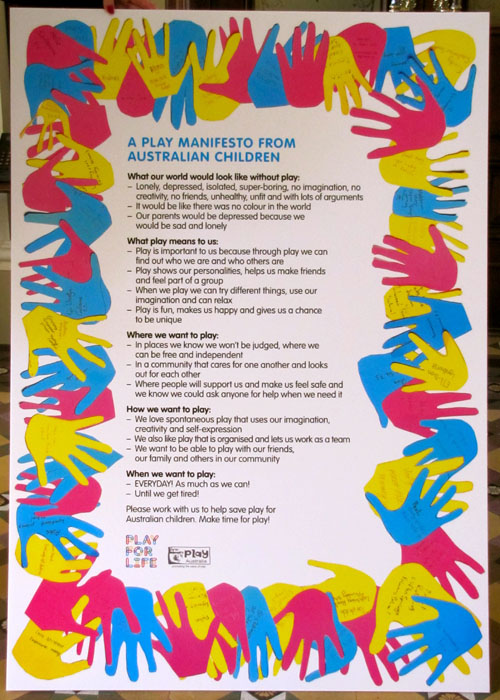
Australian Children’s Play Manifesto Poster

Play Based Learning in Australia is sharing a poster that captures the play manifesto of its children; how awesome!

After the overwhelming reaction to the success of the Australian Children’s Play Summit held in Melbourne on May 17th and 18th 2012 Play for Life Australia is kindly making available a copy of the Play Manifesto created BY Australian children FOR Australian children as a download. Play for Life believes that if we put the future of PLAY back into the hands of Australia’s children, then PLAY will be in very good hands!

Visit the original site for the full size poster.

community · creativity · music · play · Social

Making a little street music

For the past four years, inspired by artist Luke Jerram, donated and painted baby grand pianos have been showing up in London during the summertime. This trend has now started to be picked up in major cities around the world, from Toronto, Canada, to Salem, Oregon.

From Now. Here. This.:

‘Play Me, I’m Yours’, an installation of street pianos created by artist Luke Jerram, is back in the capital for the fourth year. This time, in celebration of the City of London Festival’s Golden Jubilee anniversary, 50 *golden* pianos are popping up across London for three weeks until July 13. They can be found all over the city including Soho Square, St Pancras International Station and Parliament Hill – you may well hear the soft tinkling of the ivories before you see them.

From the Everett City Blog:

Pianos will be out August 1-22, 2012 for the Everett Street Tunes: An Invitation To Jam. Make music in the streets during Everett’s new interactive art project, Street Tunes! Musicians – both professional and novice – are invited to play any of the ten pianos located in downtown Everett.

Everett Street Tunes is an interactive art project, from start to finish, beginning with the commissioning of artists to paint and embellish each piano.

From the source itself, Street Pianos‘ website:

Touring internationally since 2008, “Play Me, I’m Yours” is an artwork by British artist Luke Jerram. Reaching over a two million people worldwide more than 600 pianos have now been installed in cities across the globe, from New York to Sydney, bearing the simple instruction ‘Play Me, I’m Yours’.

Located in public parks, bus shelters and train stations, outside galleries and markets and even on bridges and ferries, the pianos are available for any member of the public to play and enjoy. Who plays them and how long they remain is up to each community. Many pianos are personalised and decorated by artists or the local community. By creating a place of exchange ‘Play Me, I’m Yours’ invites the public to engage with, activate and take ownership of their urban environment.

The pianos are loaned with the understanding that they might not make it back in one piece, but so far in the past four years the most destruction to the pianos has been due to rain or other inclement weather.

Visit the website to find out more about this cool, interactive, playful art project, and locations near you.

children · creativity · education · emotion · environment · happiness · health · play · psychology · Social

Exploration of Playful Learning Spaces for Children

toys
toys (Photo credit: red5standingby)

From the blog Art Farm, a play/art therapist who offers some advice on creating spaces that encourage kids to explore, learn and play:

I really learned the importance of organizing and preparing spaces while working with youth in school settings in several public housing developments in Chicago.  So often these youth would come to me (for either individual or group art therapy sessions) filled with anxieties which either manifested as acting out or withdrawn behaviors. The arrangement and presentation of the private space we used was a powerful, non-verbal message to them stating that all things are respected here – including you; everything has a place here – including you; and everything you will need to have a successful experience is here – starting with you.

[Mariah] Bruehl offers some questions to ask when designing a space for your own child:

  • Can your child access the materials in the play space independently? Are they organized in baskets or bins that are clearly labeled so your child knows how and where to put things away when finished with them?
  • Are the materials presented in an attractive manner that invites your child to use them?
  • Do the materials, toys, and games represent a balance between your child’s and your own preferences? Do they represent what you value and thus encourage your child to engage in activities that you feel good about?
  • What is your child currently interested in? If your child no longer plays with dinosaurs, but has been talking a lot about birds, make sure that the play space reflects this current passion. Rotating toys is a great way to keep your child interested in play space activities and ultimately prolongs the life of your child’s playthings. It never ceases to amaze me how excited my girls get about a toy that comes back into rotation. The nostalgia they feel toward a toy they have not seen in a while is almost more than their delight over a brand-new toy.
  • Is the play space a calming environment that allows one to focus on the task at hand without distracting colors, decorations, or objects?
  • Are you seeing things from you child’s perspective? Put yourself in your child’s shoes to determine the right height for displaying and storing materials and hanging art.
  • Is this a space that makes you want to make art, explore science, write stories, and more? If so, would you have everything you need to do what you want to do? What else would you add to enrich and deepen your child’s learning experience in the play space?

What other playful space researchers are out there? Any recommendations? I know about the organization Art With Heart, which focuses on creating therapeutic resources for sick kids. But I’d love to hear more about what’s out there. Let me know in the comments below.

architecture · community · design · environment · happiness · Social

This morning on Robson: Constructing an Urban Pasture

Interesting experiment happening in Vancouver, BC. Reminds me of the PARKing days that happen here in the U.S., only this one’s permanent.

Gordon Price's avatarPrice Tags

The City’s Green Team was out shovelling dirt on Robson Street:

.

“Urban Pasture” is another trial project in amenity-making, this time in the parking lane on the south side of the 1000-block Robson – just in front of the Cafe Crepe where the sidewalk narrows.  (Decades ago, the City required six-foot setbacks for any new construction, the intent being to widen the street for another traffic lane to handle vehicle growth.  That ain’t gonna happen – but the setback remains so that now the sidewalks can be widened for pedestrians.  This is one of the remaining choke points.)

Similar to Parallel Park off Main Street, Urban Pasture will provide a small seating space and landscaping.  It isn’t even finished, and already people are filling the seats.

But there are two other aspects of note:  first, this structure is in what was once the rush-hour lane, where the parking was stripped during the morning…

View original post 105 more words