anthropology · behavior · brain · community · culture · happiness · health · mental health · play · psychology · Social

Unhappy Employees Cost More (and how to reduce that cost)

Employment Exhibition
What does it take to reduce on-the-job depression and create an overall happier work environment? (Photo credit: Modern_Language_Center)

A recent study of health factors and their associated costs at seven companies, published in the journal Health Affairs, found that “depression is the most costly among 10 common risk factors linked to higher health spending on employees.”

The analysis, found that these factors — which also included obesity, high blood sugar and high blood pressure — were associated with nearly a quarter of the money spent on the health care of more than 92,000 workers.

First the employees were assessed for health risks, then researchers tracked their medical spending from 2005 through 2009.

The average medical spending for each employee was $3,961 a year. In total, $82 million, or 22 percent, of the $366 million annually spent on health care for the workers was attributed to the 10 risk factors, the study found.

The relationship between higher spending and depression was the strongest, with 48 percent more spending for workers with a propensity for that widespread problem.

via VPR News: Depression And Health Spending Go Together.

Now, to be fair, this is a fairly small study of just seven companies, and the article didn’t say how many employees worked at these companies. However, this is definitely a trend that has been spotted at least anecdotally by many HR managers, so it’s nice to see that there is some “official” analysis being done on the issue.

So what can employers do about this? My fear is that employers would discriminate, unintentionally or intentionally, against people who suffer from depression. But these days many people will be diagnosed with depression due to a temporary life situation such as a death in the family, or their jobs, so being fired for temporary sadness is probably not a good idea for companies.

Instead, my hope is that companies would invest more on making people’s job satisfaction higher. As of two years ago, Americans reported the lowest job satisfaction ever recorded. That means employers can be doing A LOT more to improve their employees’ lives at work. And a lot of that has to do with feeling supported by their managers, and feel like they are heard and respected and overall a part of the team. A lot of that comes from having fun at work.

This philosophy has been spouted in several different books and magazines, and has been shown to work well in classrooms as well, referred to as the “Responsive Classroom” approach.

The Responsive Classroom approach centers on several ostensibly mundane classroom practices. Each morning students form a circle, greet one another, share bits of news, engage in a brief, fun activity and review the day’s agenda. The idea is to build trust, ensure a little fun (which adolescents crave) and confront small problems before they become big. Students might welcome one another with salutations from a foreign language. An activity might involve tossing several balls around a circle in rapid succession. Students share weekend plans or explore topics like bullying before lessons begin. (New York Times)

This approach could very easily be applied to a business setting, in fact it sounds like a team kick-off meeting one might see in a corporate environment. Taking time to connect with other coworkers and laugh a little before diving in to the day’s work has been shown to work wonders for productivity and boost morality in both school and work settings.

There is definitely a  drive and expectation in many industries to work longer, faster, harder hours, and be available and working at all hours. But that drive is unsustainable, demonstrated by the low job satisfaction and high burnout rates in many industries, from high-tech to physicians. Taking time to play a little bit at work, or just connect with coworkers, is being shown as an effective way to reduce depression related to work and job burnout, increase productivity, and create a more cohesive company with more loyalty overall to the company’s mission.

So long story short: remember to bring the koosh ball to your next meeting.

anthropology · behavior · community · creativity · Social

When Play Gets Political: Puppets Protest At The U.S. Capitol

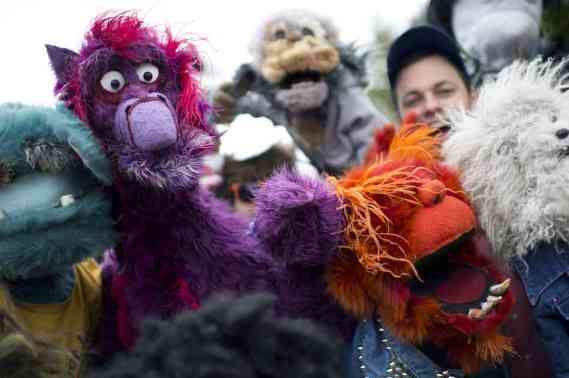
Puppets at the Million Muppet March protest this past weekend.

When presidential hopeful Mitt Romney threatened a childhood icon with funding cuts during a debate last month, people took to the streets and protested…with puppets. In what was deemed the Million Muppet March, people used puppets, marionettes, and other toys to show their unhappiness with the idea of funding for public broadcasting being cut:

Organizers say at least 600 people signed up to attend the march in person, with a few thousand more participating virtually on Facebook, Twitter and their own marches around the country. So far, the pictures on the group’s Facebook page show the marchers bundled in puppet-like hats with animal ears, carrying coffee, placards with statements like “Grouches of the World, Unite!” and, yes, more than a few puppets.

via They’re Furry And Furious: Puppets Protest At The U.S. Capitol : The Two-Way : NPR.

This protest is not only about supporting Public Broadcasting, but is also about play on several different levels. First, Big bird and other Sesame Street characters are a big part of many Americans’ childhoods. While imaginary, to many people these Muppets were very real and very important play characters during the formative years of their lives.

Second, the use of puppets and toys to protest politics is an age-old tradition. People in countries ranging from the England to Venezuela to Thailand have used puppets and epitaphs during protests to get a laugh out of people as well as get their attention. Even the court jester in days of old could get away with some nasty political commentary because it was said “in jest.”

Full disclosure, I am a huge Muppet fan, and am happy to see that others agree with me that Big Bird and PBS are worth funding, and I’m especially happy that people showed their support using puppets.

community · creativity · happiness · Social

Matthew Silver, The Great Perfomer is simply silly for a living

I read about this street performer on Mashable. Based in Manhattan, he sounds like a guy with the same passion and vision for a play-filled world that I have, so I just had to share:

Photo image courtesy of Flickr, charlesdyer.

Matthew Silver just wants people to smile.

Silver, “The Great Performer,” can be seen throughout Manhattan using dance, song and oversized props to ease the tension of everyday life — because, as he says on his website, “it’s OK to be silly from time to time.”

Matthew describes his work on his website as an antidote to seriousness:

My role as a clown, trickster and village idiot is to parody excessive seriousness by playing with taboos, rules, and social norms.  My inspiration comes from my heart.  I perform for smiles and laughter, loosening people’s armor, and opening up a portal for imagination, creativity and love.

Silver reaching out to his audience, literally. Photo from his website.

Glad there is somebody out there who spends his time encouraging people to be silly.

Check out Matthew Silver on his website or Facebook page.

anthropology · architecture · community · environment · health · Social

IDEO asks how to inspire communities to care about their environments

English: Overview of Singapore's financial dis...
Overview of Singapore’s financial district; how do we make our living environments better as our cities grow? (Photo credit: Wikipedia)

I love these OpenIDEO public challenges, so I was thrilled when I saw this challenge alert pop up in my inbox (and then unfortunately let it get buried for a week, oops!) about ideas on how to make communities more involved and engaged in their environments.

Public agencies such as Singapore’s National Environment Agency would like to envision how to rejuvenate our local environments to inspire and enable communities to make our living environments better – and are eager to collaborate with the global community to explore solutions which resonate in Singapore and across the world.

In this challenge we are looking to try and explore the following questions, both for Singapore and for communities everywhere that face similar challenges.
How might we better collectively solve problems facing our neighbourhoods?
How might communities look out for each other more?
How might we provide a safe space for positive and constructive action?
How might we help passive citizens become active contributors?
How might the role of the government evolve in the future, with regards to local neighbourhoods?
In short, what does community ownership look like in 2012 and beyond? The National Environment Agency invites you to join us in designing better answers, together.

Let’s collect examples of existing initiatives and explore the challenge topic to inform our ideas for the upcoming Concepting phase.

It’s a question that I bring up a lot on the blog, and share different examples of how communities around the world are doing just that, from adding public art to bee and butterfly gardens to building playgrounds. I am bubbling with excitement over this challenge, and have lots of different ideas, but there are only 14 more days to submit ideas and I want to make sure mine are really good, eek!

What have you seen that worked in growing communities to keep the residents and developers motivated to preserve the surrounding environments, rather than bulldoze them over for a quick couple hundred bucks? What are some of your ideas? Have you seen any story of community building on this blog that screams “Yes, this is the answer!”? Submit your ideas at the OpenIDEO website.

anthropology · behavior · children · community · creativity · Social

Halloween, the most playful time of year

Cute Kids in Children's Costumes
Kids in Halloween Costumes (Photo credit: epSos.de)

Ah, Halloween, originally considered the betwixt and between time of year when ghosts and souls past could pass over into our world and scare the crud out of their relatives.

But these days, Halloween is really a celebration of play. No, really! When else is it perfectly acceptable to dress up in funny costumes, stay up late on a week night running around banging on peoples doors, play tricks on people, and create food that looks spooky or gross but is really just lots of sugar?

The tradition of dressing up and playing for Halloween is alive and well in the tradition of Dia de los Muertos, for example. To deal with and make light of mortality, grown-ups and kids will put on make-up and costumes that represent death and the dead. They’ll make and eat sugary confections, parade down the street, play music, sing songs, and overall try to make a party out of a normally scary and sad phenomenon. Yes, there is some sadness involved, such as visiting relatives’ graves and setting up alters to reflect their passing, but for some even the act of creating the alter, i.e. being creative, is cathartic and helps with the loss of a loved one.

In the play deprived United States, Halloween has become one big kid’s night out for adults as well as kids. Children and grown-ups alike look forward to dressing up, pretending to be a character, and be silly with friends. Often the costume is a parody or commentary on something political, but that’s just as playful as covering yourself as marshmallows, although potentially socially sticky instead of just physically sticky.

That’s why it makes me sad that so many K – 12 schools have banned Halloween for fear of these socially sticky situations or fear of kids bringing weapons to school as part of their costumes, plus some religious groups find Halloween offensive. While I understand and respect all of these concerns, I disagree with the idea that we should just get rid of it outright. How are we going to learn to get along and get over differences if we just avoid them? Play and school are both supposed to be about learning, so why not turn Halloween into a learning opportunity?

As a proponent of play, I feel like Halloween is an important holiday, not because of what it originally stood for, but for what it stands for now. Being socially allowed to play and pretend, even for one day, is important for humans’ mental health. It also creates bonds between people who share in the activity, not just from sharing the experience but learning more about each other through their costumes.

I will definitely be buying candy and supporting Halloween this year, not for the sweet tooth but for the costumes. Play on!

architecture · behavior · community · design · Social

Why Public Art Is Important « The Dirt

ASLA blog The Dirt has been reporting on their annual meeting, and mentioned a talk discussing why public art is important. I couldn’t agree more!

…art occupies a unique position within the art world. In comparison with big-name gallery shows, public art is often “under appreciated” much like landscape architecture. But there’s lots to laud: “It’s free. There are no tickets. People don’t have to dress up. You can view it alone or in groups. It’s open to everyone.”

Community art can also create attachment to one’s community. According to Bach, studies have looked at the economic development benefits of art, but only just recently have there been wider examinations of the effect of art on a community’s sense of place. The Knight Foundation’s Soul of the Community initiative surveyed some 43,000 people in 43 cities and found that “social offerings, openness and welcome-ness,” and, importantly, the “aesthetics of a place – its art, parks, and green spaces,” ranked higher than education, safety, and the local economy as a “driver of attachment.” Indeed, the same story may be playing out locally in Philly: a survey of local residents found that viewing public art was the 2nd most popular activity in the city, ranking above hiking and biking.

An example of public art; “Tree Futures” by Suze Woolf. Photo from the Heaven and Earth Exhibition in Carkeek Park, Seattle, 2012.

more via Why Public Art Is Important « The Dirt.

It creates community by creating a sense of place, it is available for all to enjoy, and it makes a place more enjoyable in which to hang out. All of these are important for creating enriching environments. Also, by making the art public, people often feel they have ownership of the art, or a right to play with it. This can be good and bad; if they art is designed to be engaged with, more power to the people. However, some people do act upon the art in a destructive way, either accidentally or intentionally, which is play to them but ruins it for the rest of the public.

This brings of the life cycle of art, and it being taken care of or abandoned over time, which was also discussed at the meeting:

Bach also made a point of discussing the “afterlife of public art,” what happens once it’s out there. As an example, she pointed a work by Pepon Osorio, a pavilion at a Latino community center that features historical photos of people from the community. Today, kids from the neighborhood take photos of themselves with photos of their ancestors. Another project called Common Ground in a footprint of a church that burnt down was hosting weddings just a week after it opened. While these works became part of their communities, Bach said the group still has to work hard to ensure that all works remain relevant to their communities and aren’t “orphaned.”

Some art is meant to be abandoned; at Carkeek Park in Seattle there is an annual public art exhibit where often the installed art pieces are left at the end of the summer to decay or be destroyed by the elements.

Art installation at Carkeek Park, Seattle, 2012

Overall though I think interaction with public art is a good thing. Do you or have you ever played in fountains, posed with statues or art pieces, or altered them in some way (like the Fremont people in Seattle)? These are all forms of play inspired by public art, which I think are valuable methods of play and should be encouraged so long as it doesn’t damage the artwork.

Waiting for the Interurban is memorial to the trolley/rail line that once ran between Everett and Tacoma. Standing at the north end of the Fremont Bridge, these five aluminum commuters (and one dog) have waited since 1978 for a ride that never came. Decorating the statues with seasonal apparel, political signs and other props has become a Seattle tradition.

What is your experience with public art? Do you find it a good use of real estate? Do you have a statue or fountain or public art piece that speaks to you, that you think of as “yours”?

Leave your thoughts in the comments below.

architecture · community · creativity · design · environment · play · Social

The Games These Benches Play « The Dirt

Playful design in an urban environment? My favorite!

Clever and talented Danish artist Jeppe Hein has been custom-making his “Modified Social Benches” for museums, arts festivals, and plazas since the mid-2000s. Most recently, he created a unique set of art you can sit on for Beaufort04, the fourth Triennial of Contemporary Art by the Sea this summer in Belgium. Kids, cool kids, and adults all seem to love playing with these.

Hein says his powder-coated aluminium “social benches” borrow their basic form from the standard park bench, but are altered to make the “act of sitting on them a conscious physical endeavor.” As they mutate, the benches become spaces to “inhabit,” rather than just places to park it and relax for a moment.

more via The Games These Benches Play « The Dirt.


The pieces may seem like fun one-offs, but something then happens between the work and the community: “As is the case with much of Hein’s work, the Modified Social Benches on the dyke in De Haan seem to hide behind a disguise of fun and entertainment. But what they actually evoke is a process of interaction and communication that works on different levels.”

Check out more at ASLA’s blog The Dirt.

community · environment · health · Social

Bee boulevard: How to turn an urban corridor into a haven for native pollinators | Grist

English: Amber Flush rose - Bagatelle Rose Gar...
 (Photo credit: Wikipedia)

I couldn’t stay away for long, could I?

I thought this was an interesting article about actively creating space in urban environments to promote biodiversity and making our lives as humans healthier (more bees means more flowers, fruits and veggies), and it just so happens to make the space prettier and more enjoyable visually as well.

Several years ago, Sarah Bergmann, a painter by training, started asking questions about the fate of the world’s pollinators. And while she’s not an environmentalist per se, Bergmann’s art and graphic design work never stray far from the environmental sphere. To her, the complex and shifting relationships between pollinators and plants have always begged further investigation. Bergmann’s response to what she learned is a work-in-progress called the Pollinator Pathway, a mile-long corridor of pollinator-friendly, mostly native plants stretching between two green spaces in the heart of Seattle.

Bergmann chose the pathway’s two endpoints — the Seattle University campus and a lot-sized forest called Nora’s Woods — for their diverse plant life and lack of pesticides. Since building the first test garden in 2008 with the help of a small city grant, she and hundreds of volunteers have installed 16 more gardens in parking strips along the way. “It’s not just a random line of plants; it’s meant to find two existing green spaces within the city and draw a line between them,” she says.

Gardens are built with the cooperation and enthusiasm of homeowners on the corridor, who have also agreed to maintain them. They must be drought-tolerant, pesticide free, and, ideally, contain at least 70 percent native plants — though Bergmann says the project hasn’t quite hit that target yet. And of course, the plants must be appealing to bees and other pollinators. These requirements, combined with city height restrictions for parking-strip vegetation, led to a list of about 50 plants that can be part of the pathway.

Biologists have been promoting migration corridors for mammals and birds for decades, so why not bees? Gardening is also a fun, playful activity for many people, and the idea that they’re helping out something else in return is also satisfying.

Find out more about creating bee corridors via Bee boulevard: How to turn an urban corridor into a haven for native pollinators | Grist.

behavior · community · creativity · education · emotion · environment · mental health · play · psychology · Social

Outdoor Play Poster

From the nonprofit organization Voice of Play and their host organization, the IPEMA (International Play Equipment Manufacturing Assocation):

This poster is appropriate for any player, whether you are 2 or 92.

What other reasons can you think of to play outside? Leave them in the comments below.


behavior · children · cognition · education · learning · play · Social

Montessori Google Doodle

Friday’s Google doodle honoring Maria Montessori’s 142nd birthday.

Have you noticed Google’s doodle for today yet? It is in honor of Maria Montessori, founder of the Montessori style of learning, which focuses on open-ended, free-form learning, which involves a lot of play. From PC Magazine:

Google on Friday honored Italian physician and educator Maria Montessori with a homepage doodle celebrating her 142nd birth anniversary.

The drawing features some of the tools that form the basis of Montessori’s educational methods, which emphasize hands-on, individualized learning within mixed age groups in a child-friendly setting.

After working in insane asylums with mentally handicapped children, in 1904 she began re-engineering the field of children’s education. She believed that all children have an inner drive to learn, and that children learn best when in a safe, hands-on learning environment.

Montessori also found that children help teach each other when put into groups with other kids of their own age range. She believed that teachers should pay close attention to students, not the other way around.

Her early efforts were so successful that she amassed a large following of parents and teachers who wanted to learn her methods. She later gained support from Thomas Edison, Helen Keller, and Alexander Graham Bell, who founded the Montessori Educational Association, headquartered in Washington D.C.

Read the full article.

Thanks Google for showcasing a great woman who was a pioneer in creating more playful and therefore better learning environments for kids.

Hope everyone has a great looong weekend before school starts up for a lot of people (appropriate timing to honor Montessori, eh?), filled with lots of learning, exploration, and playful environments.