Salvation Army's presence throughout the world. Image via Wikipedia
My work was having a bake sale today for the tsunami victims of Japan when we heard the news about the major tornado in Alabama (one of the managers’ first thoughts: “maybe we should have another bake sale for Alabama.”). For my birthday we made crafts to donate to a local children’s hospital.
While it seems like the last couple of years have been filled with horrible natural disasters (or man-made; thanks BP!), and a bake sale isn’t going to fix much in the large scheme of things, what struck me is that despite our nation’s economic woes and our disaster-weary national psyche, we are still interested in reaching out to help each other, whether across the nation or across the Pacific.
As organizations and first responders offer emergency relief, food and shelter, many people across the country are looking for ways to help storm victims.
Follow The Salvation Army’s blog for updates, visit its website or text “GIVE” to 80888 to make a $10 donation to the organization’s relief efforts. It will show up on your next mobile phone bill.
Samaritan’s Purse has dispatched experts and two disaster relief units, tractor trailers stocked with emergency supplies and tools, to assess the needs in Tuscaloosa, Birmingham and Cullman, Alabama.
There are lots of different ways to help both nations. Post here for different ways you have seen your community reach out, either for these disasters or others.
An interesting social experiment as well as clinical study, from the Wall Street Journal; while the study itself, which looked at using Lithium to treat ASL (Lou Gehrigs disease) found the treatment didn’t work, they DID find that using social networks to recruit people for the study turned out to be incredibly effective.
The new study, published online in the journal Nature Biotechnology, represents an early example of how social networking could play a role in clinical trials, an area of medical science with strict procedures that many would consider especially difficult to apply in the online world.
“The approach has tremendous potential,” said Lee Hartwell, a Nobel Prize-winning scientist now at Arizona State University, and formerly president of the Fred Hutchinson Cancer Research Center. Standard clinical trials play a central role in the research enterprise of both of those institutions.
Dr. Hartwell, who wasn’t involved in the study, said social-network trials aren’t likely to replace conventional randomized, double-blinded, placebo-controlled trials, the gold-standard for generating medical evidence. But such trials have become so complicated and time-consuming that new models are needed, he said.
I think this is a great example of the power of communities, whether they exist online or are geographically-based, or both. People with illnesses and their families need support networks, which they find online. I think this is great that doctors and clinicians are also able to tap into these communities and ask for their input and insight into the treatment. Not only is it a great instant resource for the doctors, it loops the patients back into the whole treatment process.
Flash mob pillow fight in Switzerland (neutral, yeah right!). Image via Wikipedia
Thanks again to the Seattle PI for bringing us great stories of spreading joy and happiness (see posts from earlier this week)!
If you were out and about in Seattle Sunday, you might have encountered more dancing and music than expected.
You can thank the TV show “Glee” and Seattle’s propensity for flash-mob participation for that.
“Glee” flash mobs broke out in several spots around the city Sunday afternoon. Here’s video of one of the best performances I’ve seen out of a bunch posted on YouTube.
This is such an awesome trend of seeing flash mobs of people performing public dancing and performance, from Michael Jackson’s Thriller to Glee to improv and beyond.
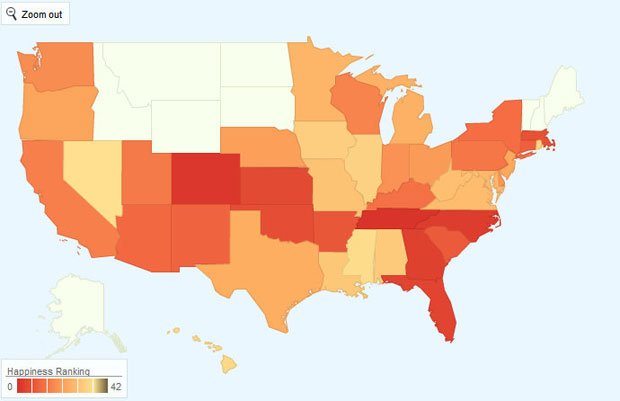
Well, I was having a good day…but enough about me, what’s going on in with the rest of the world? Pretty miserable stuff, actually: Libyan rebels, Japan’s earthquake, tsunami, and nuclear meltdown, the government shut down barely avoided…well, how are individual states doing? Now we know! A map on alexdavies.net used Twitter to determine just how happy each of our fifty nifty states are. Illinois seems darned happy. Washingtonians are – apparently only kinda sorta happy. From the Seattle PI:
On a scale of one to 42 — where one is ecstatically mirthful — Washington state has a happiness index of 21. In other words, it could go either way.
A map from alexdavies.net uses Twitter keywords to pinpoint just how positive or negative states are.
So, if lots of people are using words like “love” and “amazing” when they tweet, their states might get a better ranking.
Oddly enough, sad words for Washington include “Phillies” and “presale,” according to the site. “Starcraft” and “gentleman” also show up as negative words.
From NYT: Ms. Bosco, 95, spends much of her time at Seaside with Delores Brown, 73.
This New York Times article about budget cuts in New York State affecting senior community centers struck a nerve with me. In a good way. I am a strong advocate for promoting quality of life even into old age, especially into old age, and I think we youngsters forget just how important these community spaces can be for old folks.
In these places seniors can get a cheap meal, planned activities like games or fitness classes (we’re talking more Tai Chi than Tai Bo) but also companionship, and opportunities to do new things and learn. They also get experiences they never would have gotten to do otherwise; they realize they love to dance, or simply fall in love again.
However, with states and cities as cash strapped as they are, these places are in jeopardy of closing.
Last year, [New York] state and city budget cuts threatened 75 of the centers… and 29 were ultimately closed. The centers are intended to serve New Yorkers over age 60. This January, the dance began again: Gov. Andrew M. Cuomo proposed redirecting $25 million from the centers to child welfare; that, said the city’s Department for the Aging, would mean closing about a third of its centers; on March 15, the centers got a reprieve, with the Assembly and the State Senate voting to restore the money.
In a country where we are already isolating generations away from each other, it seems all the more important to at least offer a place for this demographic of people to meet and have some kind of community.
My grandparents belonged to a retirement home that practically forced them to go out and socialize with each other, be involved in community efforts, and participate in outreach to youth. I was thrilled to see new activities and challenges thrust upon my grandparents; learning new skills and taking on new responsibilities at 80 plus was revitalizing for them. However, that retirement home also ate up a lot of money, money that most folks don’t have, and soon-to-be-old folks are in worse shape as far as savings go due to the economy.
Some people may argue that it’s not worth investing in a demographic that isn’t giving back to our society. Besides the argument that they already GAVE to our society for 50 or more years, I’d argue that many of them could give back if we gave them the opportunity. There are lots of volunteer and time-bank programs where retired folks can donate their skills, from fixing leaky faucets to knitting to mentoring.
One of the programs my grandfather was in was a mentor for “troubled kids” as he’d call them who were bussed into the retirement home every other week or so to sit for an hour to talk to an old person. It was community service that a lot of them probably didn’t like the idea of at first, and to their friends they probably didn’t get all that excited about it. But when you actually saw the kids interact with the older folks, these kids opened up and really enjoyed their time with him. This was the first time in a long time that a lot of these kids got to say what was on their minds, and were really listened to. My grandfather also just happened to be a guidance counselor for many, many years, so for him this was also a treat to brush up on his old guidance counseling skills and feel like he was helping kids along the path “to the straight and narrow.” But even without that training, the older mentors felt like they were contributing to society, and so did the kids, as well as both getting something in return.
So before we look to cutting budgets on senior community centers, I argue we should look at these as possible hubs for other community activities, or community focal points. Just like lots of groups rent out the church basement for meetings or choir rehearsals, city planners should be looking at these spaces as community centers, not just senior centers. These centers offer a chance for a human being, of any age, to feel like a party of a community again, to feel human.
This is a very cool study that was featured on NPR; it is in fact a follow-up study done back in the 1950’s on the habits of successful kids, almost 1,500 of them. These new researchers picked up on the study and tried to track down the kids to see how they were doing.
They found some interesting patterns appear in the kids who live the longest and healthiest:
"The most cheerful, optimistic kids grew up to take more risks," explains Martin. "By virtue of expecting good things to happen and feeling like nothing bad ever would, they predisposed themselves to be heavier drinkers, they tended to be smokers, and their hobbies were riskier."
So, she concludes, "some degree of worrying actually is good." And, in fact, adds Friedman, "the prudent, persistent, planful people — both in childhood … and then in young adulthood we measured that — that was the strongest individual difference, or personality predictor, of long life."
Friedman and Martin also found that the conventional wisdom on fitness isn’t quite right. If we try too hard to push ourselves into exercise regimens, it can backfire. Physical activity is important, they found, but it’s more about doing what you love than adhering to a certain fitness program.
I have heard of this kind of therapy before, how autistic kids tend to respond better to robots teaching them emotions and proper social responses; the robot acts as a sort of bridge, or neutral third party for the kid:
STEVENAGE, England (AP) – Eden Sawczenko used to recoil when other little girls held her hand and turned stiff when they hugged her. This year, the 4-year-old autistic girl began playing with a robot that teaches about emotions and physical contact – and now she hugs everyone.
“She’s a lot more affectionate with her friends now and will even initiate the embrace,” said Claire Sawczenko, Eden’s mother.
The girl attends a pre-school for autistic children in Stevenage, north of London, where researchers bring in a human-looking, child-sized robot once a week for a supervised session. The children, whose autism ranges from mild to severe, play with the robot for up to 10 minutes alongside a scientist who controls the robot with a remote control.
The robot, named Kaspar, is programmed to do things like smile, frown, laugh, blink and wave his arms. He has shaggy black hair, a baseball cap, a few wires protruding from his neck, and striped red socks. He was built by scientists at the University of Hertfordshire at a cost of about 1,300 pounds (US$2,118).
This is an interesting follow-up/add-on to the RadioLab “Cities” episode I blogged about a couple of weeks ago. The Healing Cities Working Group of planners and health professionals in Vancouver, BC is working to create healthy environments in urban areas, particularly focusing on food and food sources.
It’s possible to interest public officials in the health impact of the built environment because Canada has nationalized health care.
“When you have a public health care system like we have in Canada, we all collectively pay the end-of-pipe costs,” said Holland. “So anything we have in our society that makes us unhealthy, we end up paying for it.” Of course, that’s true in the United States as well, but there is much less transparency and awareness of those costs because of the way our system is set up.
In Canada, Holland hopes to be able to involve doctors and public health authorities in the fight against sprawl and for more walkable and transit-oriented neighborhoods. Among the Healing Cities Working Group’s many planned initiatives is a partnership with health officials to advocate for more health-enhancing infrastructure and development at the local level.
Other studies have found that greener neighborhoods also decrease stress and make people more likely to walk or bike places. Where you live, what have you found works best for you personally to motivate you to get you outside, moving, and buying less insta-food?
Game board from India; looks kind of like a city grid. Image via Wikipedia
An article featured on the O’Reilly Radar last month that interviews Kevin Slavin, managing director of Area/Code, who is currently working with Frank Lantz to integrate gameplay into the fabric of reality, or what he calls “Big Games.”
Big games are “games that take place using some elements from the game system and some elements of the real world. Something Frank Lantz had worked on with Katie Salen and Nick Fortugno was called the Big Urban Game. It involved transforming the city of Minneapolis into a game board. They did that by using huge inflatable game pieces, about 25-feet high. The players, among other things, were moving these huge pieces around the city.”
“There’s a few of us who have been thinking about how “play” and the “city” were going to combine. We’ve been drinking the same Kool-Aid from the same cooler for quite a while.”
The way Slavin’s describing his vision reminds me a lot of parkour. Interesting ideas.





 Mental Flowers