
children · education · happiness · health · learning · play

Play is a crucial part of learning

Great article from The Atlantic about how squeezing recess and playtime out of education is a really bad idea:

Play is important for the emotional, social, cognitive, and physical development of children. In addition to being critical for general health and a preventative against overweight, play develops life skills for children and communication skills among peers and family members.

But because of over-scheduling, over-supervision, lack of appropriate play environments, and too many entertaining screens many children have less access to play time and play spaces than children in the past.

Children living in poverty experience these barriers and more, according to a recent clinical report from the American Academy of Pediatrics. Underprivileged children often have less access to recess and school-based creative arts, music, and physical education programs. Additionally, the socioeconomic stressors on poor families often conspire against parents having the time, energy, or skills to engage in play with their children.

Poor children’s access to outdoor play spaces may be compromised by the safety of their neighborhoods and the decrease in parks and open spaces in urban areas. Children who are unable to play outside tend to spend more time on screen-based activities such as watching TV or playing video games. Excessive screen time takes a huge toll on mental and physical health and academic achievement

Many urban schools have replaced recess and purely recreational after-school activities with academic enrichment activities to help close the academic achievement gaps between lower-income children and their more privileged peers. While improved academics is an important goal, the report emphasizes that the developmental role of play should not be forgotten and the benefits of play should not be traded off in favor of academics.

According to the report, play’s benefits extend to psychological well-being. Play provides an opportunity for a student to shine in areas that are not strictly academic and thus contributes to the child’s personal sense of pride and belonging in her school environment. This has the potential to discourage truancy and encourage children to remain in school to complete their education

Twenty-eight percent of schools with children in the highest poverty levels have no recess at all. This impacts a population of children who already have limited opportunities for creative experiences and social play, especially since research that has shown that physical education periods and recess enhance a child’s readiness for academic pursuits during the school day. They suggest that the elimination of these pace-changing opportunities may in fact be counterproductive for academic success.

More at Recreational Play Can Be Far More Important Than Academics
behavior · play · youtube

Crow sledding

In this video, we have a crow. Using a tool. To play!

This is amazing! You thought only otters and humans sled? Well think again!

I have been finding some great examples of play lately. What examples do you have of animals at play?

behavior · creativity · environment · happiness · play · youtube

My thesis, summed up in a two-minute video

After working for literally YEARS on my Master’s thesis (I’m still SO excited that I graduated this past quarter and am an official M.A.), I come across this video, which pretty much sums up my years of work in two and a half minutes. It showcases two students from Parkour Visions in Seattle, WA, explaining why they like parkour, mostly because it lets them play again. Upon seeing this I had two thoughts: “well done” and “dang!”

My parkour buddies also showed me this video recently, which in approximately 9 minutes explains the whole reason I wanted to do my thesis in the first place. The video is actually a pitch for funding a documentary called “Seriously!” which interviews a lot of play experts on the subject of play, including many people I cited in my thesis, and why play is important for our survival. In this case, my reaction was wanting to send it to my thesis advisers and scream: “See? See?!”

Ugh.

Anyway, it is a very nice video, so enjoy:

behavior · community · emotion · happiness · play · youtube

Laughter infects Berlin Train – the power of others and place

People often wonder just how powerful the people and spaces around us can be. Well, it turns out they can be pretty dang powerful! Just check out the video. Thanks Guy Kawasaki for sharing this out:

Giggles spread through an U-Bahn train in Berlin after one woman starts laughing. Happiness: the best infectious thing you can catch on a train.


play

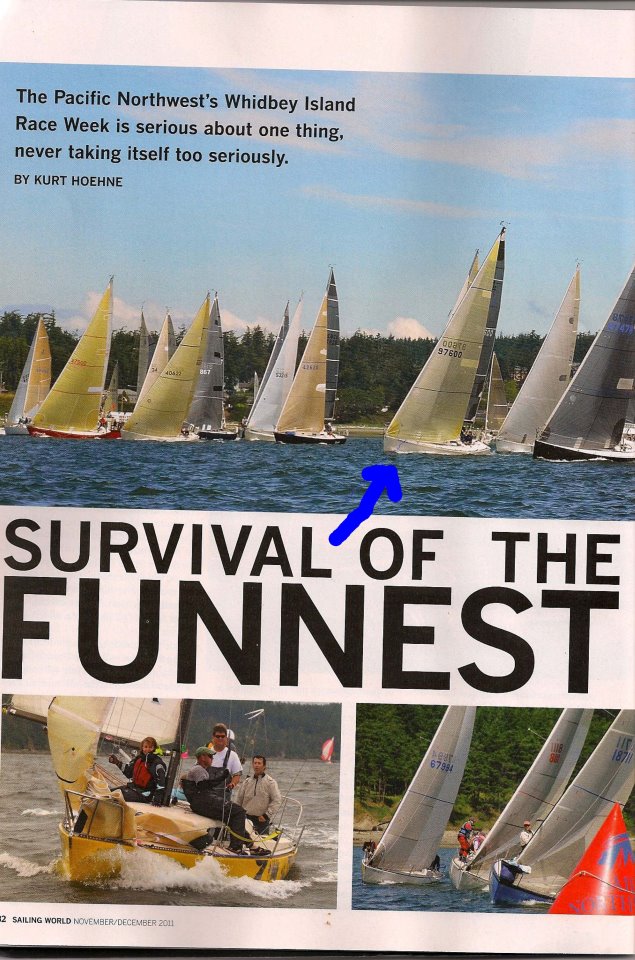
Hooray for play, sailing edition

A scan of a picture in this month’s Sailing World Magazine featuring one of my old college professor’s boats as part of the Whidbey Island Race Week this past summer.

I love the fact that the article headline is advocating and encouraging play, rather than competition or adventure.

Happy to see some healthy, outdoorsy, environmentally friendly play get some attention and respect in a nationally syndicated magazine (even if it is already preaching to the choir).

education · learning · play

Kevin Byrne Wins Month at the Museum Chicago Contest

Museum of Science and Industry (Chicago) Crew ...
Kevin Byrne, the winner of the Month at the Museum contest, will get to play with this while he's living at Chicago's Museum of Science and Industry for a month. Image via Wikipedia

For the second time, the Museum of Science and Industry in Chicago offered one person the chance to live in their museum for a month, cataloging their day and sharing news and insights from the museum:

Month at the MuseumTM 2’s assignment: spend a month at the Museum of Science and Industry, Chicago (MSI) to live and breathe science 24/7 for 30 days. From Oct. 19 to Nov. 17, 2011, this person’s mission will be to experience all the fun and education that fits in this historic 14-acre building, living here and reporting your experience to the outside world. There will be plenty of time to explore the Museum and its exhibits after hours, with access to rarely seen nooks and crannies of this 77-year-old institution. (more via Museum of Science and Industry | Month at the Museum | The Details).

The winner, Kevin Byrne, is a 33-year-old who works as a marketing analyst at a digital agency and holds a degree in biology.

He will leave his Uptown home Oct. 19 and stay at the museum until Nov. 17. The public will be able to follow his adventure at monthatthemuseum.org.

“I’m excited about pouring myself into science 100 percent, 24/7 living and breathing science, he said. “I think it’s rare an adult gets to really dedicate themselves to something they find so fascinating.” (more via The Chicago Tribune).

The announcement was made last week with jack-o-lanterns representing the six finalists. The one with Kevin’s name on it was filled with hydrogen, so when they lit his pumpkin it exploded. Pretty dramatic announcement!

If you could live in any museum, zoo, or other informal learning space in the United States, where would you want to live for a month and why?

architecture · children · creativity · design · play

Playground designs curated on Flickr

One job that has always sounded super fun is playground designer. Playgrounds can be fun, exciting, inspiring places, full of color, creative design, and above all inspire play.  Some of the different playground designs from around Sweden got the spotlight recently on Flickr.

[Last week], @megrosker shared a link to Swedish Aesthetic, a gallery featuring colorful and very creative Swedish playground designs and play structures… be sure to visit the gallery for all photos curated by PlayGroundology.

view the gallery via Swedish playground design « Flickr Blog. PlayGroundology’s photostream includes photos from Canada and other adventures around the world.

Flickr has quite a few different playground designs scattered throughout the Flickrverse:


I even got so inspired I started my own Playground gallery on Flickr. Check it out, and if you have any photos you’d like to contribute, let me know.

behavior · happiness · health · play

Growth of playful fitness for grown-ups

IMG_6278
Adults are starting to turn fitness back into play. Image via Wikipedia

I have noticed a growing trend in fitness. Rather than taking Spin classes or training to run marathons, or even heavy weight lifting, many adults are starting to pay to play. They are buying gym memberships or punch cards for classes that offer an hour of having fun! Many classes that incorporate dance, parkour, or toys like hula hoops or trampolines, are starting to become very popular all over the United States.

The majority of these classes are geared towards women. Jazzercise has had a resurgence in popularity the past couple of years, while new fitness classes like Zumba or HoopDance are starting to surface. There are also trampolining classes offered in some places. Below are descriptions of some of these classes for those of you like me who had no idea what these classes were exactly, (thanks to Vibe Dance Studio and Sky High Sport for descriptions):

Zumba: This Adult Fitness class features easy-to-follow routines of interval training sessions where fast and slow Latin rhythms and resistance training are combined to tone and sculpt your body while burning fat. Add some Latin flavor and international zest into the mix and you’ve got a Zumba class!

HoopDance: This fun, low impact Adult Fitness class will tone the entire body while using a hula hoop on and off the body. You will explore dancing while hooping and linking moves together to create a feeling a flow. This class will build coordination, body awareness, and is great for any fitness level. You laugh and smile while learning a new skill and burning calories.

AIRobics, or trampolining: AIRobics is low impact fat burning exercise that improves balance and coordination and it is fun and energizing! The workout consists of moves from many different workout activities, and it incorporates some moves that can only be done on a trampoline.

For men, there are also options:  rock climbing has been around in the U.S. since the mid to late 70s, and  gyms geared towards those athletes opened up soon after. More recently sports like Parkour or Freerunning are also being offered in gym or class settings. Interestingly, at least anecdotally it seems that women are more likely to try these “manly” sports in the safe confines of a gym and with a coach’s guidance.

Adult recreational sports are also gaining popularity, from rugby and soccer to even roller derby.

Why the sudden increase in playful classes and gym offerings?

I suspect it’s because we adults are super stressed out (according to the American Psychological Association, Three quarters of Americans experience physical and psychological symptoms related to stress in a given month) and don’t get enough time to play and relax, but know we need to workout and at least attempt to stay healthy. Rather than do the traditional workout activities like running or lifting weights, which some find relaxing while others just find it tedious or stressful or even painful, I think many adults figure if they’re going to devote what little time they have to working out, it might as well be FUN!

What are your thoughts, experiences, attitudes towards fitness? Have you discovered other fun sports teams or classes that people wouldn’t usually think of as fitness-focused?

community · environment · play

It’s PARK(ing) Day!

Park(ing) Day in Indianapolis
Park(ing) Day in Indianapolis. Image by DanO'Connor via Flickr

Today in Seattle, S.F., and other major cities, activists are taking over one or several parking spaces and turning them into parks!

PARK(ing) Day is an annual, worldwide event that invites city dwellers to transform metered parking spots into parks for the day. PARK(ing) Day in Seattle happens to fall on the first day of the [Seattle Design] Festival.

We’ll be partnering with the Seattle Art Museum (SAM) at their impromptu “park.” Drop by and join us in a Festival photo/design activity open to everyone.

SAM will also be offering an all-ages, hands-on artmaking activity; an artist-designed Cornhole game (bean bag toss); and a noon concert by James Whetzel, classically trained on the sarod and tabla.

More via the Seattle Design Festival, which is going on from the 16th until the 25th!   The festival is also pretty relevant since its goal is to explore our environments, how we use them, and how to make them better.

I was able to go see the Seattle exhibit last year, but unfortunately am parked at work today, so go see it and report back. Last year they had lots of games and give aways, and maps featuring the many parks that are scattered around the Seattle metro area.

community · creativity · design · play

The Design Your Own Park Competition | American Journal of Play

Mitsuike Park03
How would you design the perfect park? Image via Wikipedia

The City of Binghamton, New York has a great solution for the empty lots and spaces in its area: parks! As David Sloan Wilson describes in his journal article published in the American Journal of Play:

“the thinking behind and the implementation of the Design Your Own Park (DYOP) Competition, a collaborative project of a university, a city, and a fund-raising organization to empower neighborhoods and restore outdoor play citywide in Binghamton, New York. The city makes vacant lots and other neglected spaces available for neighborhoods to turn into parks that residents design and build with the assistance of faculty and students from Binghamton University’s Binghamton Neighborhood Project.

The Design Your Own Park Competition (DYOP), launched in 2010, is a collaborative effort … to enhance opportunities for unstructured play on a citywide scale by empowering neighborhoods to create parks of their own design.

Neighborhoods typically are not well suited for collective action. From the richest gated communities to the poorest ghettos, most people scarcely know their neighbors. But there is nothing like a common goal such as creating a neighborhood park to bring people together.

more via The Design Your Own Park Competition | American Journal of Play.

The city of Seattle, WA, proposed a similar project, although it fizzled out somewhat after initial interest from various organizations (does anybody remember the name of that project? If so, leave it in the comments below, thanks!).

Check out some of the other articles published in the Spring edition of the American Journal of Play. They deal with some really interesting issues of play, child devleopment, and overall health.