Happy Monday and happy summer, wherever you are!
Hot Enough for Ya?
Happy Monday and happy summer, wherever you are!
Exploring Enriching Environments

Happy Monday and happy summer, wherever you are!
Every kid can get overwhelmed playing on the playground. But imagine that for you, or your child, it happens way, way too easily.
Play is usually beneficial, not just for exercise and fun but for learning and therapy. So it’s interesting to see how people are using play, and playgrounds, to help kids who can often get overwhelmed in normal play situations.
A Kansas State University graduate student is creating a schoolyard that can become a therapeutic landscape for children with autism.
Chelsey King, master’s student in landscape architecture, St. Peters, Mo., is working with Katie Kingery-Page, assistant professor of landscape architecture, to envision a place where elementary school children with autism could feel comfortable and included.
“My main goal was to provide different opportunities for children with autism to be able to interact in their environment without being segregated from the rest of the school,” King said. “I didn’t want that separation to occur.”
The schoolyard can be an inviting place for children with autism, King said, if it provides several aspects: clear boundaries, a variety of activities and activity level spaces, places where the child can go when overstimulated, opportunities for a variety of sensory input without being overwhelming and a variety of ways to foster communication between peers.
“The biggest issue with traditional schoolyards is that they are completely open but also busy and crowded in specific areas,” King said. “This can be too overstimulating for a person with autism.”
King researched ways that she could create an environment where children with autism would be able to interact with their surroundings and their peers, but where they could also get away from overstimulation until they felt more comfortable and could re-enter the activities.
More at http://www.autism-society.org/news/a-place-to-play-researcher.html.
For so long playgrounds have been designed to be “safe,” but now they’re being designed and adapted to be “inclusive” to kids with all sorts of limitations, which I think is a much better focus, especially since it reintroduces play equipment like…wait for it…dirt! Or more specifically, gardens:
King designed her schoolyard with both traditional aspects — such as a central play area — and additional elements that would appeal to children with autism, including:
- A music garden where children can play with outdoor musical instruments to help with sensory aspects.
- An edible garden/greenhouse that allows hands-on interaction with nature and opportunities for horticulture therapy.
- A sensory playground, which uses different panels to help children build tolerances to difference sensory stimulation.
- A butterfly garden to encourage nature-oriented learning in a quiet place.
- A variety of alcoves, which provide children with a place to get away when they feel overwhelmed and want to regain control.
Unfortunately there are currently no plans to actually build this playground, since these sensory elements are beneficial to all kids (and grown-ups). Where do you see this kind of design being the most welcome? In schools, city parks? Leave your thoughts in the comments below.

From Science Daily:
Exercise clears the mind. It gets the blood pumping and more oxygen is delivered to the brain. This is familiar territory, but Dartmouth’s David Bucci thinks there is much more going on.
“In the last several years there have been data suggesting that neurobiological changes are happening — [there are] very brain-specific mechanisms at work here,” says Bucci, an associate professor in the Department of Psychological and Brain Sciences.
From his studies, Bucci and his collaborators have revealed important new findings:
The effects of exercise are different on memory as well as on the brain, depending on whether the exerciser is an adolescent or an adult.
A gene has been identified which seems to mediate the degree to which exercise has a beneficial effect. This has implications for the potential use of exercise as an intervention for mental illness.
more via How exercise affects the brain: Age and genetics play a role.
A little more play for your Friday. Via Inhabitat and PSFK:

Artist Florentin Hofman’s giant yellow duckie puts a smile on the faces of passers-by as it floats from city to city along the Loire river in France. The hilarious and striking sight has already traveled the world before through cities such as Osaka and Sao Paulo.

The 25 meters tall and 25 meters wide friendly creature’s mission is to provide a joyful interruption to people’s daily routines. People from all over the world connect the rubber duck with their childhood memories and are brought up with positive sensations.
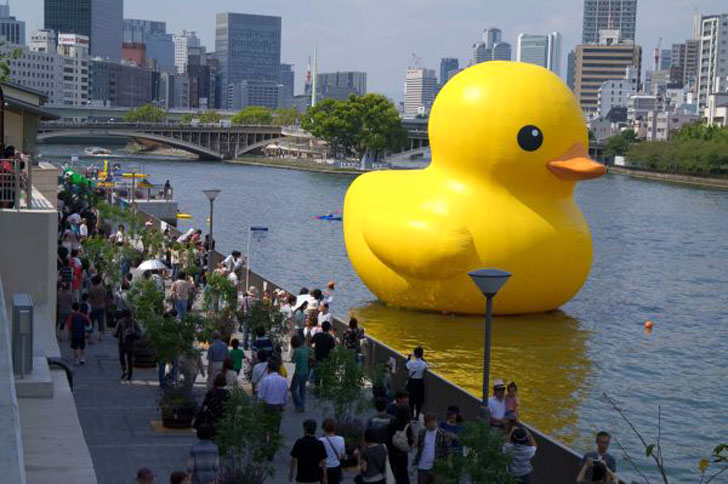
Famous for his humoristic pieces, the Dutch artist Florentin Hofman used rubber coated PVC to built the duck on a pontoon with a generator. Hofman believes that the soft giant can relieve global tensions through delighting people coming from different countries and backgrounds. Hofman has generated smiles many times before. In 2011, the Kobe Frog, an enormous frog wearing a party hat, was sitting on the edge of Hyogo Prefectural Museum of Art in Kobe, Japan.
The duck itself is a durable vessel, made from inflatable rubber-coated PVC, a pontoon boat, and generator to help propel it forward downstream.
more via PSFK.
Happy Friday! I hope you get a chance to go out and play this weekend. Speaking of play, here is another great find from Milan’s Design week (remember the edible mini furniture from earlier this week?). This exhibit of design focused specifically on children’s spaces, with a focus that was very playful, creative, and also a great idea for grown-ups to incorporate into their own environments.
From Inhabitat:
Students from the HDK master program Child Culture Design created an exhibit to explore new ways of bringing play into everyday objects to help foster imagination and creativity. Dubbed “Play In Progress“, the exhibit was one of our favorites at the Salone Mobile.


Check out more great designs at Inhabitat (I love the block table, for example!)
Great story from TreeHugger about self-proclaimed “Urban Hacktivist” Florian Riviere and some of the various “hacks” he’s done:
When it comes to redefining public space and objects, Florian Rivière is a master. The self-described “urban hacktivist” transforms parking spots into hockey rinks, sidewalk barriers into tables, and uncomfortable benches into lounge chairs for the homeless.
I absolutely agree with TreeHugger when they say:
I love it when people re-imagine how urban space is used; it’s a fantastic way to make cities more liveable, practical and fun, without needing major construction projects or the hassle of red tape.
Here are some of his best “hacktions.”

Visit Florian Riviere‘s site and see more of his work.
I particularly like these hurdles he’s set up:

This is just one example of “hacking” public space in a fun creative way. I still remember the yarn-bombing movement that really took off a couple of years ago but seems to have died down for now.

There was also the Swing at the bus stop.

What other examples of urban “hacktivism” have you seen? Share them in the comments below.
Who says Easter is all about bunnies, or has to be for little kids? It can also be for big cats. Very nice video of a Easter gourd hunt for the residents at Big Cat Rescue.
Enjoy!
I love the fact that playgrounds are incorporating the stuff that kids love to play with the most – dirt, rocks, and sticks!
Children won’t find new monkey bars and bright plastic play structures at the upgraded Donnan Park.
Instead, the aging playground at 9105 80th Ave. will become Edmonton’s first “natural playground,” part of a growing trend in playground design.
Children in the redesigned Donnan Park will entertain themselves with such timehonoured playthings as rocks, sticks, sand and dirt. The overhauled space will feature a slide built into a hill, a sideways-growing tree, a boulder spiral, a hand pump to pour water into a small stream and plenty of plants, trees and greenery.
It will be “a beautiful garden that everyone plays in,” says Kory Baker-Henderson, co-chair of the neighbourhood committee that worked on the preliminary playground design with expertise from Ontario-based Bienenstock Natural Playgrounds.
“Around us there are already some typical playground structures, so we wanted to have something different that blends in with the (Mill Creek) ravine,” Baker-Henderson says.
“Studies have shown imaginative play is much more stimulated (in natural settings) and children actually will play longer and become much more involved than on a typical red, plastic slide structure. Their games will just get much more imaginative. There’s that connection with nature. We have plans for a community garden, so it’s a learning and teaching tool, too.”
The playground at Donnan Park currently has swings and a slide that will remain for now, but won’t be replaced, she says.
Interesting exploration of the playful spaces around London:

I’m still buzzing after last weekend’s Open House play space tours. Why?
Simple: I saw some inspirational work, and had some immensely rewarding conversations.
We took a meandering and surprisingly green route across most of the NDC area to Radnor Street Gardens.
This is one of London’s best examples of a ‘playable space’ – in other
words, a space where offering opportunities for play is only one of the
jobs that has to be done. My work for the GLA
[pdf link] helped to embed this idea in London’s planning system. In my
view, it is fundamental to the success of public play facilities in
almost any urban area.What struck me was how the programme combined park, amenity space and
play projects, along with streetscape and highways initiatives, so that
the whole far exceeded the sum of its parts. The ingredients we saw
included [*deep breath*]: new play spaces and toilet blocks in parks and
estates, new public squares from reclaimed street space and car parks, ‘home zone’-style
shared road surfaces, landscaped road closures, greening up an
adventure playground, estate-based allotment projects, cycle lanes,
shared use ball game areas, pushchair-friendly pavements, even (on one
estate) new refuse bin sheds with green roofs. Her approach to
engagement was revealing. Local people were closely involved at all
levels, right up to the NDC board. However, they were seen not simply as
‘stakeholders’ or ‘consumers’, but as people who needed to be inspired,
debated with, and (hopefully) won over.
Read more of Exploring some of London’s most playful spaces and places.
I think this is a great idea; just as we have garden tours, we should have playground tours! Areas that introduce parents and officials alike to playful, fun spaces to take their kids.
This blog actually has some great conversations about play and the need for children to get outside and play more.
via Exploring some of London’s most playful spaces and places.
A nice story about a redesign of a park in Seattle so children could actually, you know, play in it:
Located on the northeast corner of Seventh Avenue and South Lane streets in the Chinatown-International District, the park is small – about one-fifth of an acre — but in a key spot.
Vegetation had grown up around the periphery of the 30-year-old park, obscuring views and raising concerns about safety. There were few amenities for adults who bring kids to the park, and no accommodations for people with disabilities. A rock mound posed a hazard, and during the winter, the grass was often soggy.
Cultural and language differences were also part of the landscape, making decisions about the park complicated.
But renewal made sense because the neighborhood has seen increasing residential and commercial development, leading to more active community places such as the Wing Luke Asian Museum and a branch of the Seattle Public Library.
To involve stakeholders young and old, Hou’s group, along with the city and several neighborhood groups, held an intergenerational design workshop in 2007.
“I think the most difficult challenge was to incorporate as much of the feedback we got from the community while still allowing the park to have a clear and concise design,” said student Patrick Keegan.
Engaging multiple generations of users was the most interesting part of the redesign, said Joyce Pisnanont, manager of IDEA Space, which promotes and develops the Chinatown-International District. Desires were consistent across age groups, she said, and the adults “really wanted to ensure that the park was fun for kids to play in.”
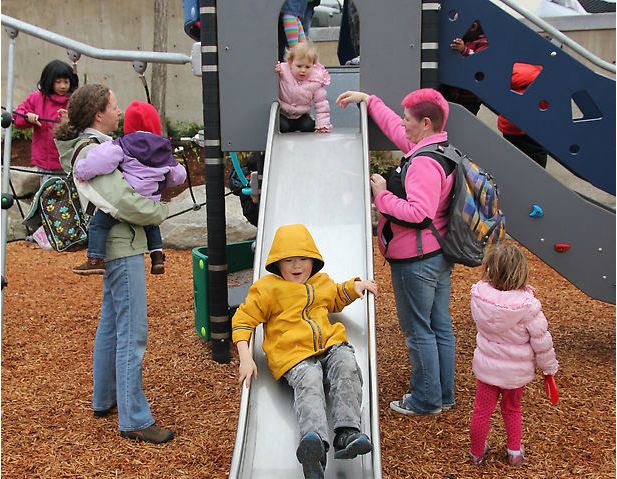
The final design by landscape architect Karen Kiest includes an expanded children’s area with a play structure big enough for a dozen kids, a dragon sculpture restored by artist Gerard Tsutakawa, a stainless steel pagoda with seats for grown-ups and a three-level rockery that serves as both gathering space and a climbing area.
Public art by Stuart Nakamira includes a brushed stainless steel top the size of a typical 4-year-old.
In a Lane Street corner, pink viburnum are budding, surrounded by circles of black mondo grass.
See more images of the park:
 Mental Flowers