environment · play · Social

City-wide public art project invites residents and visitors to talk to Austin’s street furniture | AustinTexas.gov – The Official Website of the City of Austin

Austin is a city with a strong arts culture, and is continuing to showcase that:

The hidden life of Austin’s street furniture will come to light next month with the launch of Hello Lamp Post, an international art project created by London-based designers Pan Studio which invites people to strike up conversations with familiar objects around the city using text messaging.

Hello Lamp Post is a city-wide platform for play that allows participants to talk to the city’s infrastructure and share stories using the text messaging function on any mobile phone – no smart phones required. People can interact with any object they choose, in any part of the city, because the project utilizes the thousands of pre-existing identifier codes that label items of street furniture, including (but not limited to) lamp posts, mail boxes, moontowers, utility boxes, manholes, or telephone poles

more via City-wide public art project invites residents and visitors to talk to Austin’s street furniture | AustinTexas.gov – The Official Website of the City of Austin.

If you are in or near Austin, the public is invited to a free kick-off event, complete with drinks and bites, February 12, 4-6 p.m. at Republic Square Park, 422 Guadalupe Street.

A short video about the project, starring the streets of Austin, is available now at http://www.hellolamppostaustin.com.

learning · play · technology · work

Building Fun into Work (Just Don’t Call it Gamification)

People seem pretty sick of the idea of “Gamification” of things. But here’s the rub: a lot of jobs need to be more fun. And can be made more fun. And technology can have a strong hand in doing that.

One of the best pieces of advice a boss of mine ever received, he said, was that “people like getting points.” Even if the points don’t culminate in anything, just having the most points on a forum board or in an app is a great feeling for people.

History of Mario Museum from Deloitte Digital

Ambition (for example) focuses specifically on gamifying the performance of sales teams. Its software provides customers with a dashboard full of real-time metrics, such as calls made or leads generated or emails opened.

Through Ambition dashboards, employees (and of course, their managers) can track performance in relation to individual and team goals on their computers and mobile devices. The software syncs with a company’s CRM technology, as well as phone systems and spreadsheets and any other tools an organization might use. The cost is between $20 and $30 per employee per month.

Using whatever metrics a client wants to track, the software creates an Ambition Score, which is an aggregate of all the metrics. A score of 100 means an employee or team has reached every benchmark for a given time period.

more via The Hot Software Niche in Search of a New Name.

My company is currently working on creating a way to gamify a frankly otherwise quite boring piece of learning, specifically for employees only.

Many kids enjoy cleaning up their toys if you make it a race.

What are some surprising ways you’ve seen fun and play incorporated into an otherwise boring task? Leave it in the comments below.

anthropology · behavior · children · health · learning · play · school

How schools ruined recess — and four things needed to fix it – The Washington Post

I am aghast at how much structure and lack of free play is out there for kids, “for their safety.”

What if we let children fully move their bodies during recess time, let them get dirty, and even test out new theories? What would recess look like then?

The closest I found to doing just that was the Swanson School in Auckland, New Zealand. I had heard of its nonconventional, yet successful approach to recess through social media and was instantly intrigued. Since I was already going to be in New Zealand for TimberNook, I decided to meet Swanson’s principal, Bruce McLachlan, in person.

We spent a good hour talking over coffee about his now-famous recess. His recess has gotten international attention, because he did something radical: he got rid of the rules. And guess what? When the rules left, so did their “behavior issues.” He saw more independence, improved creativity, healthy risk-taking, less falling, better coordination, and improved attention in the classroom.

There were four main ways he changed his recess in order to see these improvements. Four things that I happen to successfully use in my program as well to enhance child development and inspire creativity. Think of them as a recipe.

Read the 4 things at How schools ruined recess — and four things needed to fix it – The Washington Post.

I’ll wait…

Ok, so now that you’ve read them (and hopefully the full article later), I totally agree and feel like all of those are missing, but especially space and time. Creating playful spaces and allowing that boredom and downtime is crucial.


creativity · design · environment · happiness · health · play

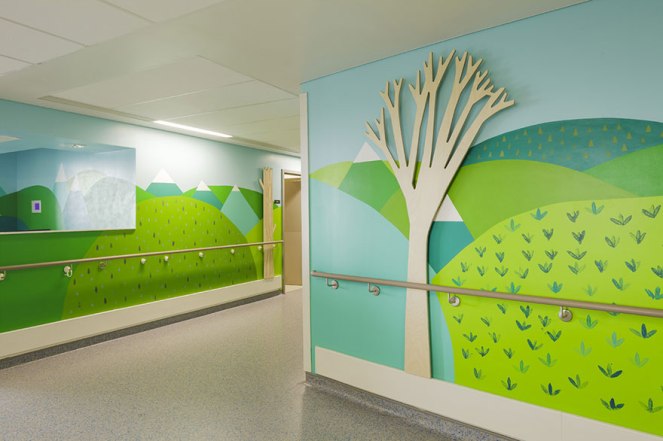
15 Artists Collaborate To Make London Children’s Hospital Cozier For Kids | Bored Panda

Last year I had a stay at a local hospital. I and the people who came to visit me all found the place hard to navigate (we all got lost more than once), and I found parts of it unfriendly and slightly claustrophobic, and not very warming or healing. They had some nondescript pictures on the walls, and that was the only way I could find to navigate my way out of the maze of white and linoleum.

It doesn’t have to be this way.

The sights, sounds and smells of a hospital can make it a terrifying place, especially for children, but it doesn’t have to be that way. Vital Arts, a British arts organization in charge of introducing art to Britain’s hospitals, had 15 artists collaborate to turn the interior of London Royal Children’s Hospital into as fun and colorful a place as a hospital can be.

Despite being limited by the fact that hospital environments need to be easy to clean, the artists were still able to use vinyl, ceramics, wood and even rugs to liven up these hospitals, each approaching the wards they decorated with their own unique style.

via 15 Artists Collaborate To Make London Children’s Hospital Cozier For Kids | Bored Panda.

The author Dovas comments that they wish it wasn’t just for kids. It really can be for everyone. Even something as simple as bright colors can be helpful in orienting patients and helping them feel better.

The nurses who helped me all commented about needing to get outside and get away from the sterile white. I think the curtain example illustrates the value of this beautifully:

“A seminal moment for me was when a three-year-old girl stopped crying the moment she saw the curtains, pointing excitedly to the hidden cats and rabbits. That’s when I knew my design had worked”

It is possible to have art and playfulness in sterile hospitals, as part of the healing process. Plus adding some joviality, like staying in the “monkey room” can make a somewhat painful situation seem less heavy.

Maintenance on some of these installations and art pieces may be higher, but if it leads to faster recovery and shorter hospitals stays, which this kind of enrichment has been found to do, then it is a worthy investment.

community · creativity · play · youtube

City of Play Director Adam Nelson on Designing Play for a City

I have run into the same challenges or questions as Adam Nelson in my play research, so I am glad to hear it expressed by someone else. It’s from a year ago, but still good stuff.

City of Play Director Adam Nelson discusses City of Play’s philosophy on using play to make cities better places to live and work.

via City of Play – Ignite Pittsburgh – YouTube.

behavior · community · happiness · hugs · play · Social

McDonald’s will be accepting hugs, calls to mom, and dance moves as payment

OK, so YES it is being sponsored by a huge megacorporation. YES it is a total gimmick. But it is such a COOL gimmick.

“That will be five hugs, please.”

Randomly selected McDonald’s customers will have the opportunity to pay for their meals with various tasks — such as doing a dance or calling their mom — between Feb. 2 and Feb. 14. The deal is outlined in a Super Bowl ad from the company, above, which will air on Sunday but is already posted on its YouTube page.

So, for example, breakfast might cost a fist bump to a McDonald’s crew member; lunch could be paid for with a call to a loved one; and dinner could go for a hug to a family member. But there will only be 100 winners at each store.

more via McDonald’s will be accepting hugs and dance moves as payment. (Mashable)

Last week I also posted about a major paint company that promoted their paint via enabling the handicapped in China to blow up paint balloons onto a canvas.

While to some it may feel “icky” to have mega-sized companies counting this kind of self-congratulating promotion as “spreading the love” or even “charity work,” frankly I am just happy that anyone, either an individual or a giant corporation, is taking steps to making their spaces a little bit happier and more enriching. Companies spend millions of dollars to make their customers happy, so why not spend a little bit of that on a smile?

When has a corporation made your day better, either through a promotion or just because an employee took some time to acknowledge you? Leave it in the comments below.

children · education · learning · neuroscience · play

Beau Lotto + Amy O’Toole: Science is for everyone, kids included | Talk Video | TED.com

What do science and play have in common? A lot. I would argue that science and play are cut from the same cloth. And so does Beau Lotto.

Neuroscientist Beau Lotto thinks all people (kids included) should participate in science and, through the process of discovery, change perceptions. He’s seconded by 12-year-old Amy O’Toole, who, along with 25 of her classmates, published the first peer-reviewed article by schoolchildren, about the Blackawton bees project. It starts: “Once upon a time … ”

http://www.ted.com/talks/beau_lotto_amy_o_toole_science_is_for_everyone_kids_included#

watch via Beau Lotto + Amy O’Toole: Science is for everyone, kids included | Talk Video | TED.com.

creativity · play · Social · writing

Play ‘Choose Your Own Adventure’ On Twitter

My coworkers and I were just talking about Choose Your Own Adventure books the other day. I hated them, but most people liked them a lot. Now, someone has created a version of CYOA on Twitter.

As  one author points out,

“I am pleased to see interesting uses of Twitter to tell a narrative in a way I might actually consume.”

These are a little more dark than the kid’s versions, but still interesting.

Eden notes that he’s not by any means the first person to try and conduct a CYOA story via Twitter, but he’s the first person we’ve seen try and do it in a fully self-contained way – most use tweets to link to external URLs to continue the story or make choices. The downside of this is that each link cuts down on the amount of the story that can be told in a single tweet. It also ends up with users being redirected all over the place, so the chances of finishing it are probably slimmer.

We’re not going to ruin the story for you, but if you have a few minutes to spare and fancy trying to get through the story without meeting a grisly ending, then you can do so at the starting point above.

try it out via Play ‘Choose Your Own Adventure’ On Twitter.

I agree this is a great use of the platform to tell stories in an interactive, fun way, and play of people’s nostalgia for the book series.

creativity · play · Social · writing

A Videogame That Teaches You to Write Poetry, Even if It Intimidates You | WIRED

I don’t know if I would find this inspiring or not… thoughts?

Videogames and poetry haven’t always gone hand in hand.

We’re still a long way from Master Chief breaking into a Coleridge soliloquy. But game developers Ichiro Lambe and Ziba Scott have edged us a bit closer to that day with Elegy for a Dead World, a game they Kickstarted in October and released on Steam last month.

Elegy lets players write prose and poetry as they explore distant planets and dead civilizations. The player faces 27 challenges in three worlds, each riffing on a specific British Romance-era poem: “Ozymandias” by Percy Bysshe Shelley, “When I Have Fears That I May Cease to Be” by John Keats, and “Darkness” by Lord Byron.

The different challenges find the player in various roles: an emperor rallying his troops before a doomed battle, for example, or a schoolgirl evacuating a city being bombed. Players travel through beautifully designed backgrounds, while on-screen text narrates the story. But much of the text is left blank—that’s when players tap their inner Wordsworths, finishing the tale with their own imaginations.

Throughout their adventure, players are tasked with using several writing styles: Plugging in blanks in prompts like serious Mad Libs, writing poems in rhyming couplets, or going totally freeform.

via A Videogame That Teaches You to Write Poetry, Even if It Intimidates You | WIRED.

behavior · environment · health · mental health · play · work

Creating playful and holistic spaces for healthier employees

The Clinton Foundation recently teamed up with my employer as part of the Clinton Health Matters Initiative (CHMI) to create more healthy, and healthier, employees in a corporate environment. There were five winners chosen, and these two were my personal favorites:

  • Make Work Active
  • Concept: Gamify holistic health and wellness. Design a points based rewards program to incentivize employees for adopting a healthy lifestyle at work, with programs tailored to industry specific wellness issues.
  • Workspace Design
  • Concept: Design workplaces that require regular movement physical activity. Create “motion enhancing workplace” certification. Create certification of “Motion Enhancing Workspaces” if sufficient requirements are met (Similar to Leed Certified buildings).


While some of the other ideas were also great – have fresh food on hand, make a team goal to improve health – I love these ideas in particular because they engage with employees on an individual level, and force the employee to engage with wellness, i.e. via a game and/or their environment.

I know gamification is a super “buzz” term right now, almost to the point of being passe, but I have found it to be a surprisingly powerful tool. A few years ago I organized a walking challenge at work, and bought cheap pedometers for everyone who wanted to participate. The winner ended up being the facilities manager, which surprised everyone but totally made sense since he was on his feet all day, and was a great example of how a lot of little walks add up.

Where have you seen either of these types of initiatives in action, whether at work, school, or in your neighborhood? Do you know of any group working on creating certifications for “healthy workspaces”? Share them in the comments below.