play

Sir Ken Robinson speaks on outdoor play

Interview with a well-known play and education advocate on his views on outdoor play.

Tim Gill's avatarRethinking Childhood

Screengrab of Sir Ken RobinsonEducationalist Sir Ken Robinson, known to millions for his work on creativity in schools, yesterday shared his thoughts on outdoor play.

The 20-minute talk, in a video recorded as part of the Dirt is Good campaign sponsored by Persil (in the UK) and Omo (in many other countries), gives some powerful messages to parents about why play matters for children’s development and learning. This post shares some edited highlights from the talk.

View original post 1,131 more words

play

Adelaide Aims to Plant 100,000 Square Meters of Greenery by 2020

These kinds of “greening” projects almost always have to come from city or county level ordinances to get the funding and city-wide support they need to survive. Well done Adelaide.

Unknown's avatarTHE DIRT

Adelaide Design Manual Adelaide Design Manual

Only a few years ago, if you mentioned the words sustainability, green, or global warming you were probably met with an eye roll and maybe some sort of off-handed remark about being a hippy. Now, the opposite has happened: it’s totally uncool to be disinterested in the environment, as celebrities such as Leonardo DiCaprio bring climate change to the foreground for the public.

Locally, the Adelaide City Council is leading by example. Our new Adelaide Design Manual provides strategic and technical guidance for designing streets, squares, parks, with a strong focus on greening and water-sensitive urban design. The design manual will help the city achieve ambitious goals identified in the 2016-2020 draft strategic plan: to become one of the world’s first carbon-neutral cities; plant an extra 100,000 square meters of greenery by 2020; and provide a path to a real reduction in city temperatures by 2040.

The…

View original post 320 more words

play

The Mary Poppins playground kit

Great example of activism to encourage play in a neighborhood, or what psychologist Peter Gray calls “Playborhoods”. 🙂

Tim Gill's avatarRethinking Childhood

This post shares an idea from a parent who was frustrated that her kids were finding it hard to have much fun in their local playgrounds. I’ve called it the Mary Poppins playground kit, for reasons that should become obvious.

2 bags of play items

At the end of this post, I will say more about why I like the Mary Poppins playground kit so much. First, the idea itself, in the words of the parent herself (whose chosen name is Djindjer):

View original post 1,185 more words

play

Why we should all embrace fika, the Swedish coffee break : TreeHugger

I truly appreciate the important social and emotional value of stopping to think and talk with people, especially over food. The habit/ritual of fika I think is an important one of mindful breaks and letting your brain unwind, something both introverts and extroverts can appreciate.

It’s so much more than an opportunity to consume caffeine. It’s a moment to slow down and appreciate the good things in life. As explained in “Fika: The Art of the Swedish Coffee Break,” written by Anna Brones and Johanna Kindvall: “Functioning as both a verb and a noun, the concept of fika is simple. It is the moment that you take a break, often with a cup of coffee, but alternatively with tea, and find a baked good to pair with it. You can do it alone, you can do it with friends. You can do it at home, in a park or at work. But the essential thing is that you do it, that you make time to take a break: that’s what fika is all about.”

more at: Why we should all embrace fika, the Swedish coffee break : TreeHugger

play

The Likeways App Encourages Users to Walk Around and Discover Their City

More excellent conversation about how we as citizens of a place can change how we view a place, via how we map it and travel through it.

By the most brutal logic, maps exist to get you from point A to point B. Navigation tools like Google Maps prioritize efficiency, generating routes that cater to a presumed preference for speed.In a sense, they’re not wrong; time is a diminishing commodity. But by sticking only to the fastest paths through a city, you miss the very things about it that might incite you to slow down and notice what’s around you.Which is exactly what the Likeways app, launched last month, wants users to do. Developed by Martin Traunmueller, a PhD candidate at University College London’s Intel Collaborative Research Institute for Sustainable Connected Cities, Likeways reclaims urban walking from the realm of necessary drudgery and frames it as an enjoyable activity in and of itself. Traunmueller’s work has taken him from his home in Austria to all over the world; whenever he arrives in a new place, he explores. His aimless wandering through London led him to what his now his favorite coffee shop; in much the same way, he discovered a secret garden in the backyard of an old factory building in London’s tech hub of Shoreditch.

Read the full article: The Likeways App Encourages Users to Walk Around and Discover Their City – CityLab

play

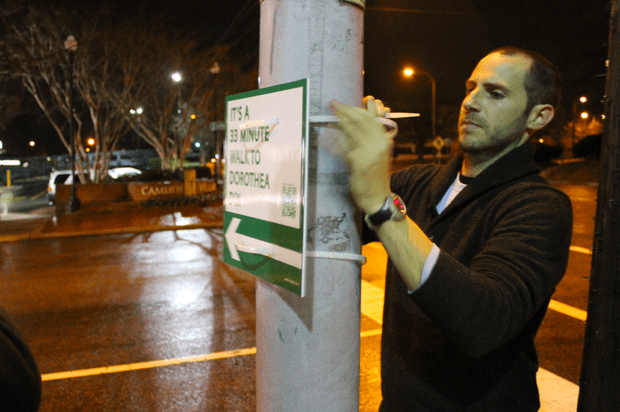
Walk [Your City] started as guerilla public art statement, now a small business.

I think it is a great activist approach to promoting healthy behaviors in a playful way. I’m also thrilled to see that there is a huge demand for this playful kind of sign creation and development, and Tomasulo has been able to turn it into a business.

The signs, the brainchild of then-graduate student Matt Tomasulo, were meant to help people think differently about distances in the city, and to encourage them to get out of their cars and explore the place under their own power.When it debuted in 2012, the project drew international notice and received lots of favorable press coverage, including here on CityLab. It also got the attention of Raleigh’s city government, which eventually took the signs down for violating local ordinances. But the city’s planning director was a fan of the concept behind Tomasulo’s action, and soon they reached a compromise. The signs went back up, with the blessing of the city, as a pilot education project.

More at the source: The Knight Foundation Is Funding a Large-Scale Expansion of Raleigh’s ‘Guerrilla’ Wayfinding Signs – CityLab

I think this kind of placemaking and wayfinding is great, as it promotes the landmarks in a city and promotes walking. I think it would be a great opportunity for actual cities to order these, even for temporary things like festivals or during a longer tourist season.

play

Seattle artist’s works come to life when it rains

Glad to see this guy is still active. I featured him awhile ago on this blog, and I was worried that businesses might have a problem with some guy marking up their sidewalks, but if anything I would argue it provides a nice surprise for people passing by your business location, making it more memorable.

Most of us don’t really like rainy days, but Seattle-based artist Peregrine Church makes good use of the rain.

“We make rainworks to give people a reason to look forward to rainy days! It’s going to rain anyway. Why not do something fun with it?,” he says.

Peregrine uses a product called Always Dry (the Wood & Stone formula), a superhydrophobic coating that protects surfaces from water and other liquids.

With the help of stencils he sprays his artworks onto sidewalks, it will last 4 months to a year depending on the foot traffic. His artworks slowly fade over time and are most vivid in the first couple weeks.

Source: Seattle artist’s works come to life when it rains | News, Weather, Sports, Breaking News | KOMO

play

Don’t Fight the Snow, Build an Apartment Building with an Outdoor Ski Slope

This is an awesome idea! What a great use of space that encourages community involvement, cuts down on long commuting traffic in and out of the city, and more than anything is FUN!

Kazakhstan is no stranger to the harsh winter season. That’s why Shokhan Mataibekov, the brain behind The Slalom House, has proposed it as a 21-story residential apartment with an outdoor ski slope starting from its roof. The proposal is currently in the hands of the Union of Architects of Kazakhstan.Mataibekov, a skier himself, thought of the idea as he would travel four hours to reach the nearest ski slope. On the other hand, the Slalom House will be built in Kazakhstan’s capital, Astana.Residents of Astana experience minus 15 degree Celsius temperatures during winter, hence, the locals take advantage of the bitter cold by flocking the nearest ski slopes. But thanks to Mataibekov’s proposal, skiers need not go further than home anymore.

Source: Don’t Fight the Snow, Build an Apartment Building with an Outdoor Ski Slope

play

The archaeology of childhood | University of Cambridge

In graduate school I had the opportunity to perform a (very light) literary review of any archaeological topic of my choosing. I chose children’s artifacts, for the exact same reason these museum curators chose too; a surprisingly little amount is known about how children lived.

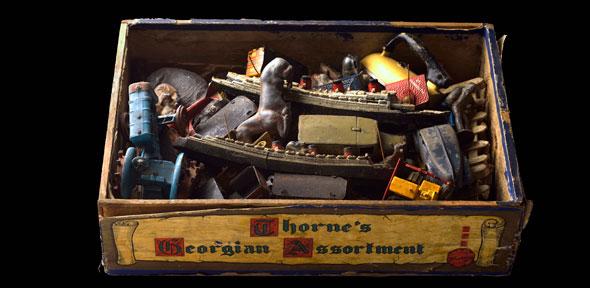
A sledge made from a horse’s jaw, the remains of a medieval puppet, the coffin of a one-year-old Roman child, and the skeleton of an Anglo-Saxon girl will all go on display in Cambridge today as part of a unique exhibition illuminating the archaeology of childhood.

Hide and Seek: Looking for Children in the Past opens today and runs until January 29, 2017, at Cambridge University’s Museum of Archaeology and Anthropology, bringing together collections held by the University and Cambridgeshire County Council.

Unprecedented in its scope and ambition, Hide and Seek examines why so little is known about the life of children when children have outnumbered adults for most of human history.

More photos and the full article at: The archaeology of childhood | University of Cambridge

As the article points out, often artifacts associated with children are often unclear in their use. Were they toys? Tokens of protection? And how many toys made of paper, wood, or other perishable items have been lost to history? A very fascinating topic.

play

New Study: Students Learn Better in Classrooms with Views of Trees

Similar to findings in hospital environments, what you see every day impacts your body and your brain.

Jared Green's avatarTHE DIRT

A Tree Campus, Rice University / Carol Ciarniello A Tree Campus, Rice University / Carol Ciarniello

What if what is outside a school’s windows is as critical to learning as what’s inside the building? A fascinating new study of high school students in central Illinois found that students with a view of trees were able to recover their ability to pay attention and bounce back from stress more rapidly than those who looked out on a parking lot or had no windows. The researchers, William Sullivan, ASLA, professor of landscape architecture at University of Illinois at Urbana-Champaign, and Dongying Li, a PhD student there, reported their findings in the journal Landscape and Urban Planning.

Sullivan and Li argue that “context impacts learning. It is well-documented, for instance, that physical characteristics of school environments, such as lighting, noise, indoor air quality and thermal comfort, building age and conditions all impact learning.” However, schools’ surrounding landscapes have been…

View original post 885 more words