architecture · design · Nature

Norway’s Grassy Rooftops

Boing Boing is an awesome filter for culture and science enrichment! Heck the whole site is enriching. Once again they deliver, with this choice nugget from Norway: rural Norwegian homes whose roofs have been given over to the traditional turf — and even small forests.

Image from Amusing Planet

Turf roofs in Norway are a tradition and you will see them everywhere. Roofs in Scandinavia have probably been covered with birch bark and sod since prehistory. During the Viking and Middle Ages most houses had sod roofs. In rural areas sod roofs were almost universal until the beginning of the 18th century. Tile roofs, which appeared much earlier in towns and on rural manors, gradually superseded sod roofs except in remote inland areas during the 19th century. Corrugated iron and other industrial materials also became a threat to ancient traditions. But just before extinction, the national romantics proclaimed a revival of vernacular traditions, including sod roofs. A new market was opened by the demand for mountain lodges and holiday homes. At the same time, open air museums and the preservation movement created a reservation for ancient building traditions. From these reservations, sod roofs have begun to reappear as an alternative to modern materials.Every year, since 2000, an award is also given to the best green roof project…

The Grass Roofs of Norway (via Geisha Asobi)

Farm buildings in Heidal, Gudbrandadal, Norway
Image via Wikipedia

They remind me a little bit of the houses built by SunRay Kelley (my father-in-law)…

community · environment · Nature

Reclaiming urban space for community use

The recently restored Seward Park Inn, Seward ...
The recently restored Seward Park Inn, Seattle, WA. Image via Wikipedia

I love hearing about citizens taking the initiative to clean up parks, fix up land, and give places names as a sign of ownership for the land, not as in a “I OWN YOU” kind of ownership, but a “I am responsible for you” kind of way.

A group of park-lovers in Seattle took it upon themselves to clean up Seward Park and give the different trails and landmark names.

Knute Berger of blog Crosscut writes that he and a bunch of his friends “floated the idea of naming many of citys unnamed features, including alleys, street ends, trails, and other urban features that are yet unnamed on maps.

“There are many reasons to do this. One is reclaiming urban spaces, like alley ways; another is recognizing more than a centurys worth of life and accomplishment of Seattleites in the years since the streets were named. Yet another is to take the opportunity to include more indigenous names for natural and city features.

“A naming project is currently underway at Seward …”

more via The Crosscut Blog.

Mental · Nature

Study: Common Pesticides Linked to ADHD | Discover Magazine

Exploring
Image via Wikipedia

Pesticides used in industrial farming, lawns, and other urban greenery have been linked to all sorts of child development health issues, and now a study is suggesting one more. A study released in the May issue of Pediatrics Journal argues that there’s a connection between high exposure to common pesticides and increased risk for children developing attention deficit hyperactivity disorder, or ADHD.

Maryse Bouchard and colleagues looked at more than 1,100 children aged between 8 and 15. All of them had been sampled by the National Health and Nutrition Examination Survey (NHANES) between 2000 and 2004, and 119 had been diagnosed with ADHD. Bouchard’s team studied their urine samples for chemicals called dialkyl phosphates, which result from the breakdown of organophosphate pesticides used to protect fruits and vegetables.

For a 10-fold increase in one class of those compounds, the odds of ADHD increased by more than half. And for the most common breakdown product, called dimethyl triophosphate, the odds of ADHD almost doubled in kids with above-average levels compared to those without detectable levels [Reuters].

more at via Study: Common Pesticides Linked to Attention Deficit Disorder | 80beats | Discover Magazine.

Mental · Nature

The importance of healthy sound

I posted this on my other blog, Art of Science, because it concerns the science behind pretty sounds, but it’s also important from an environmental enrichment perspective – in fact that’s what Julian Treasure does for a living – so I wanted to also post it here:

From Art of Science

Listen to Julian Treasure’s TED talk about sound. [And really listen! Close your other computer screens, turn off the email “ping”s and listen.]

Treasure says our increasingly noisy world is gnawing away at our mental health — even costing lives. He lays out an 8-step plan to soften this sonic assault (starting with those cheap earbuds) and restore our relationship with sound.

Julian Treasure is the chair of Sound Agency, “a firm that advises worldwide businesses — offices, retailers, hotels — on how to use sound. He asks us to pay attention to the sounds that surround us. How do they make us feel: productive, stressed, energized, acquisitive?

Treasure is the author of the book Sound Business and keeps a blog by the same name that ruminates on aural matters (and offers a nice day-by-day writeup of TEDGlobal 2009). In the early 1980s, Treasure was the drummer for the Fall-influenced band Transmitters.” (Source: TED)

Mental · Nature

Happiness is Right Outside (PsyBlog)

As anyone living in the gray, wet Pacific Northwest knows, there is something mentally stimulating and rejuvenating to being able to step outside and get a whiff of fresh air, even if it means getting a bit soggy in the process. Now, research has proven just how beneficial it is for mental health:

Hartig and colleagues suggest that being stuck indoors on vacation can limit mental recuperation. On the other hand, when able to roam outdoors, we can exert ourselves at a favourite sport or simply linger in the park. Psychologically, beautiful scenery can distract us from our troubles, help us forget our normal stressful environments and reconnect us to nature.

more via Happiness is Right Outside — PsyBlog.

Nature · Social

PARKing Day in Seattle

Speaking of public creativity, yesterday Seattle held its third annual PARK(ing) Day demonstration. Despite the drizzly weather, several groups such as the Trust for Public Land, Piper Creek Nursery, Hazard Factory, and others* came out to raise awareness about open space and promote public space and parks.

From the website:

PARK(ing) Day is an annual, worldwide event that inspires city dwellers everywhere to transform metered parking spots into temporary parks for the public good.

It’s happening already in Australia, Japan, Korea, and for the first time ever, in China! Rebar is up bright and early for the first major PARK(ing) Day installation in Paris. And hundreds of you are preparing to please the public with your own PARKs across Europe, America and beyond.

More at parkingday.org.

Seattle held their event outside the Seattle Art Museum (SAM) downtown. One of the representatives from the Public Land Trust told me how the rotten economy has led people to hold more events outside in public places, from business picnics to yoga classes, raising awareness of all the public space Seattle has to offer and why it’s important to maintain these and add more. Hopefully people won’t forget that once the weather turns bad, or the economy turns good.

Here are some of the pictures I took at the Seattle event:

Park(ing) Day, SAM, Seattle WA 2010
PARKing Day outside the SAM, Seattle WA
Parking Day Seattle 2010 line-up
an arts+crafts table and lounge area were set up for visitors to PARKing Day
Parking Day Seattle 2010 Mark a Park
The Trust for Public Land set up a map for people to mark parks that they liked, could use a little love, or places they wanted parks.
Parking Day Seattle 2010 Bear feet
Bear feet drawn by a little girl visiting the event
PARKing Day activity, Rusty Oliver, Seattle 2010
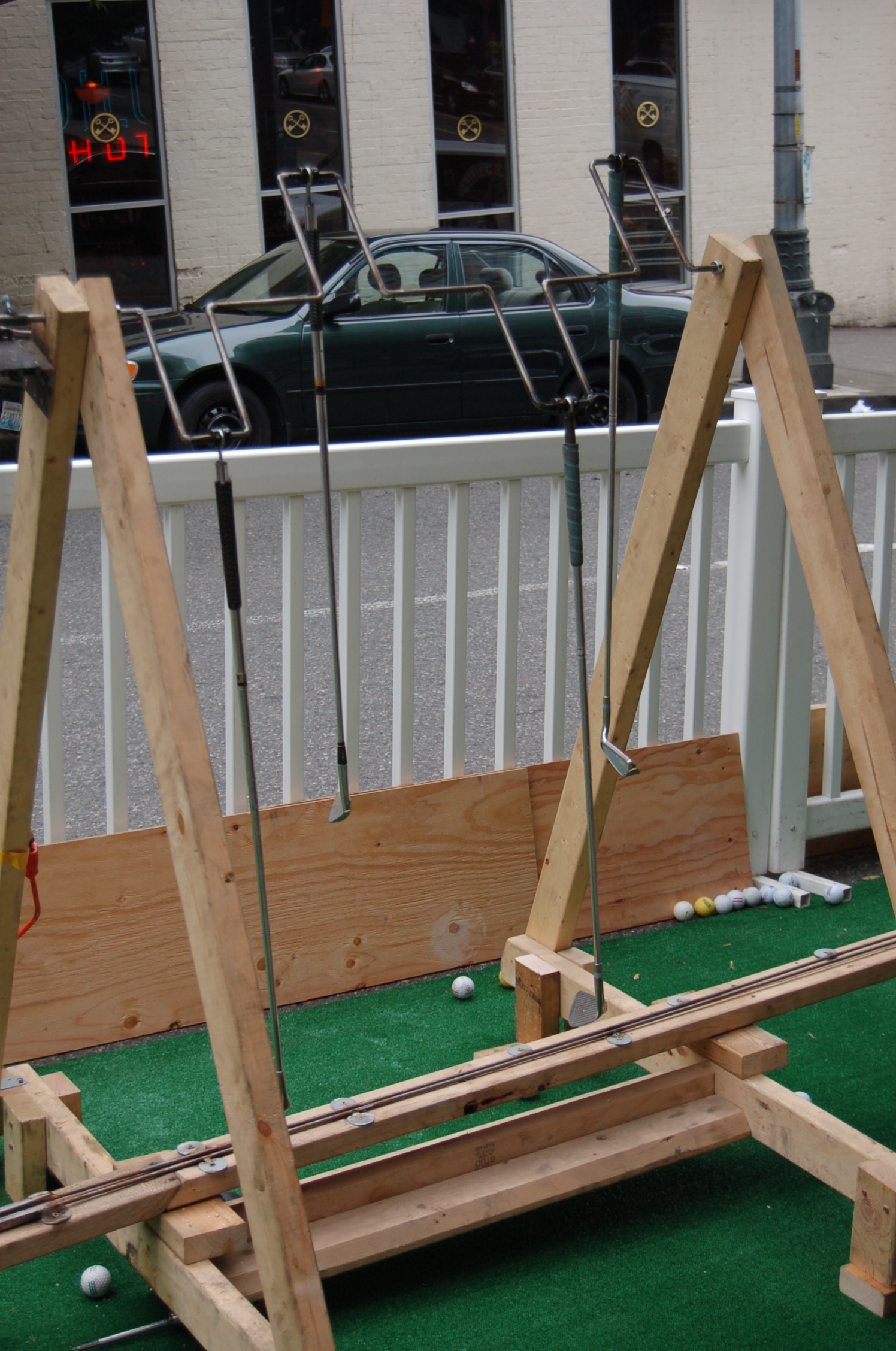
Rusty Oliver, artist behind the Hazard Factory, devoted his PARKing space to this portable mini-golf obstacle he built.

Hopefully the weather next year will be nicer and bring out more participants.

*If I missed any organizers, please leave their names in the comments and I’ll update this post. Thanks!

Nature

10 Easy Steps for Becoming a Radical Homemaker by Shannon Hayes

A small vegetable garden in May outside of Aus...
Image via Wikipedia

So often people want an easy answer about how to make their lives better, and help the environment, and in some ways it is easy, but just having a grocery list of “stuff to do to make the environment better” seems shallow and sort of missing the point. So I’m pleased that Shannon Hayes was reluctant to provide us with an easy out; From 10 Easy Steps for Becoming a Radical Homemaker by Shannon Hayes:

I didn’t see a to-do list as a viable route to a dramatic shift in thinking, beliefs, and behaviors. But since the objective of such a list was smoother discussion and communication of Radical Homemaking ideas with the public, I did it.

I came up with the simplest things I could imagine—like committing to hanging laundry out to dry, dedicating a portion of the lawn to a vegetable garden, making an effort to get to know neighbors to enable greater cooperation and reduce resource consumption.

Thank you, Shannon Hayes, for making such a list. While it may seem shallow, providing a list like this is a way for us easy-answer people to dive in and expand from there.

read the 10 Easy Steps for Becoming a Radical Homemaker by Shannon Hayes.

architecture · Nature · Social · technology

Nine of the World’s Most Promising Carbon-Neutral Communities | Popular Science

Looking for some last minute destinations for Labor Day weekend here in the U.S.? Why not choose a destination that is carbon neutral? Although the plane ticket to get there would cancel out a lot of their hard work. From the article in Popular Science:

In the global race to reduce carbon emissions, these eco-minded communities, from Kansas to the Maldives, lead the pack. Here’s how they’re making their carbon footprints disappear.

See the nine at Nine of the World’s Most Promising Carbon-Neutral Communities | Popular Science.

Nature

BBC NEWS | UK | Education | Rain stops play – but should it?

Growing up in sunny, dry, southern California, my mom always let me go out and play in the rain. Now that I live in Washington, I have go out and play in the rain or I’d never get to go out and play. This article from the BBC discusses why it’s okay to go get wet and playful.

“Why do we let ourselves be penned in so by the rain?

If a small child sees a puddle their first instinct is to jump in it. Perhaps, in a sense, that’s part of the problem.

Are we spoiling their fun or even their learning just so we can cut back on washing?”

via BBC NEWS | UK | Education | Rain stops play – but should it?.

Mental · Nature · Social

Futurity.org – Urban kids view the world in human terms

urban kids and how they see the world

The way children develop reasoning about the natural world is largely influenced by how and where they are raised, a new study finds.

For decades, the consensus was that as young children begin reasoning about the biological world, they adopt an “anthropocentric” stance, favoring humans over non-human animals when it comes to learning about properties of animals. But it appears human-centered reasoning among children is not universal after all.

more via Futurity.org – Urban kids view the world in human terms.