children · culture · education · environment · learning · Nature · school

Students Go Whole Hog with Farm-to-Cafeteria Cooking | Civil Eats

A few schools are adopting a more hands-on way of teaching about food, animal care, and science, which is actually an older technique: farm animals.

Most recently, slow roasting pork tenderloin was part of a homework assignment for a Bend, OR, high school culinary class. And the source of their pork? Mountain View High School, less than a mile away, where FFA formerly known as Future Farmers of America students are raising pigs.

These classes are complementary components of an integrated farm to school program at Bend-LaPine School District, where 29 schools serve more than 16,000 students. Bend-LaPine has students raising animals, butchering animals, and feeding a school meal program. Neatly wrapped packages of pork move from classroom to school kitchen, where they are cooked into succulent carnitas for all 29 school cafeterias.

The program breaks the normal bounds of food in school and has created a whole new arena for students to learn. “It’s a full circle agriculture education experience,” says Katrina Wiest, the manager for the Bend farmers’ market and wellness specialist for the school district.

“Agriculture is a big part of my life,” says Wiest, who was raised on a wheat farm and is married to a farmer. “I feel it’s important that kids know where their food comes from.”

For close to ten years, Wiest has been pioneering the farm to school movement in the high desert of central Oregon: sourcing local food for schools and providing agriculture, health, and nutrition education opportunities in the cafeteria, classroom, and community.

more via Students Go Whole Hog with Farm-to-Cafeteria Cooking | Civil Eats.

I think this is an awesome idea! It’s a great hands-on learning opportunity for kids. A lot of schools have shied away from having animals on or near campus, or having kids even deal with animals, due to safety and health concerns. But how else and where else are kids going to learn about being safe around animals, or safety and caring for the animals themselves, unless they get somewhat structured guidance like this? Most kids don’t have a friendly farmer they can go visit and mess with their livestock on a regular basis.

But more importantly, it is a very hands-on, real-time way of letting kids work on something and seeing the results of their labor, whether it’s a happy pig or a delicious plate of carnitas, while also letting them experience delayed gratification (it takes hard work and a long time to grow a pig). It teaches kids how food is made, which is important when making food decisions. Plus, it can be very therapeutic to pet a pig.

Where I grew up was fairly rural, and yet the 4H/FFA program was still seen as a weird club that involved a lot of horse-showing. I am glad to see it getting integrated more into school programs.

behavior · children · community · education · environment · Nature · play

Let ‘Em Out! The Many Benefits of Outdoor Play In Kindergarten | MindShift

Another take on Free Play Learning:

For the typical American kindergartner, unstructured free play during the school day consists of 20 to 30 minutes of recess, and perhaps some time at indoor “stations” — perhaps creating with building blocks, costumes, or musical instruments. But what if there was more? What if the answer to “what did you do in school today?” was, “I climbed a tree, played in the mud, built a fire”?

That is exactly the kind of learning going on in the Swiss Waldkindergartens, or forest kindergartens, where children ages four to seven spend all of their school days playing outdoors, no matter the weather. With no explicit math or literacy taught until first grade, the Swiss have no set goals for kindergartners beyond a few measurements, like using scissors and writing one’s own name. They instead have chosen to focus on the social interaction and emotional well-being found in free play.

With many parents and educators overwhelmed by the amount of academics required for kindergartners — and the testing requirements at that age — it’s no surprise that the forest kindergarten, and the passion for bringing more free play to young children during the school day, is catching on stateside. Free play and inquiry learning are the cornerstone of Canada’s new all-day kindergarten program; forest kindergartens are popping up in Washington state, Vermont, and even Brooklyn.

At the Waldkindergarten, which takes place in the middle of the woods in Langnau am Albis, Switzerland, dotted with several handmade structures like a rudimentary wood shelter where children and teachers gather around the fire, children play, often away from teachers’ view.

These scenes are captured in “School’s Out: Lessons From a Forest Kindergarten,” a documentary directed by Lisa Molomot. In the 36-minute film, Molomot and producer Rona Richter show scenes from two public schools: the outdoor forest kindergarten in Switzerland and a more typical American kindergarten in New Haven, Connecticut.

more via Let ‘Em Out! The Many Benefits of Outdoor Play In Kindergarten | MindShift.

children · environment · happiness · health · learning · mental health · Nature · neuroscience · play

IS PLAY THE KEY TO ECO-ACTION? : Children & Nature Network

Environmental Psychology and conservationists have, for awhile now, been advocating the importance of letting children get out and play in and with nature to educate them on the value of preserving their environment and benefiting from natural surroundings. It’s nice to see pediatricians also start to embrace and advocate for the need for everyone, including children, get outside and get dirty.

Dr. Lawrence Rosen writes that throughout his practice, seeing children on a daily basis, “I’m often reminded of Winslow Homer’s 1872 painting, “Snap the Whip,” depicting boys playing with abandon in a field outside their rural schoolhouse.”

So eloquently portrayed is the simplicity of another time, kids out in the natural world for no other purpose than to play, freely and without a care in the world.Contrast this with contemporary schoolyards with their meticulously designed jungle gyms and artificial surfacing, often empty throughout the day as more and more schools abolish recess or replace free play with highly structured, adult-supervised activities. I’ve realized, as I see increasingly anxious and depressed children come to my office looking for guidance, that the answers often lie not in my prescription pad but outside my window.

One very recent publication from Dr. Kirsten Beyer and associates at the Medical College of Wisconsin described the influence of green space on mental health outcomes, concluding that “higher levels of neighborhood green space were associated with significantly lower levels of symptomology for depression, anxiety and stress” and that “’greening’ could be a potential population mental health improvement strategy in the United States.”

read more from Dr. Rosen via IS HAPPINESS THE KEY TO ECO-ACTION? : The New Nature Movement.

architecture · creativity · design · environment · Nature · play

Giant Living Sculptures At Atlanta Botanical Gardens’ Exhibition | Bored Panda

Beautiful sculptures, and a great way of being playful with gardening and making gardens more engaging for everyone.

Mosaiculture is an excellent art form for those among us with the green thumbs and the space to do it. An excellent example of this complex but beautiful artistic process would be the “Imaginary Worlds” mosaiculture exhibition at the Atlanta Botanical Gardens – these elaborate and massive green structures create mystical and fantastic worlds that are lush with living foliage.There is more to these amazing works of living art than meets the eye. Most of them begin with a steel frame of some sort, which is covered with steel mesh. This mesh is then covered with sphagnum moss and soil, which is seeded with all sorts of plants. Underneath the mesh, a network of irrigation channels supply water to the plants on the surface, helping them grow.

more via Giant Living Sculptures At Atlanta Botanical Gardens’ Exhibition | Bored Panda.

children · creativity · design · environment · learning · Nature · play

Can This Industrial Designer Get Children Back Outside? | Natural Start

Nice to see toys being introduced that work with already existing toys (sticks!), and encourages kids to go find their own sticks and go play in nature.

As an inductee to the National Toy Hall of Fame, the stick doesn’t need much improving as a classic toy. For as long as there have been children and sticks, sticks have served as a versatile toy in outdoor play. But connecting sticks takes a bit of ingenuity.

Enter Christina Kazakia, a design student with a mission. As she explains, “I designed these flexible silicone connectors as part of my graduate thesis in Industrial Design at the Rhode Island School of Design. My goal was to create prompts to engage children with their surrounding natural environment.” Called Stick-lets™, these connectors help small children build big structures like forts, teepees, lean-tos, or other creations.

Find out more about the toy and her kickstarter via Can This Industrial Designer Get Children Back Outside? | Natural Start.

behavior · brain · cognition · creativity · environment · happiness · health · Nature · work

Why You Should Take Your Work Outdoors

Happy Friday. I got to start off my work day sitting on my back patio drinking coffee. Here’s why more people should do the same.

Do you feel stifled by the four walls of your office or cubicle?

There’s a reason for that.

Trapping ourselves indoors has created what health experts call a “nature deficit disorder” — depression or anxiety resulting from too little time spend outside. Getting outdoors can do great things for your health. Reducing stress, lowering blood pressure and improving immune function are among nature’s health benefits. What’s more, incorporating elements of nature into your workday can also give your brain a boost, resulting in increased productivity, focus and creativity.

Harvard physician Eva M. Selhub, co-author of Your Brain on Nature, says a drop of nature is like a drop of morphine to the brain, since it “stimulates reward neurons in your brain. It turns off the stress response which means you have lower cortisol levels, lower heart rate and blood pressure and improved immune response.”

Turning off the sensors that are involved in the stress response allows the higher brain centers to be accessed, resulting in increased concentration, improved memory, greater creativity and productivity and reduced mental fatigue. While Selhub says spending 20 minutes a day outdoors is recommended, studies have shown even looking at photographs of nature can deliver some of the same cognitive benefits as physically being outdoors. A 2008 study at the University of Michigan showed students who looked at photos of nature performed better on tests of attention and working memory than those who looked at photographs of urban scenes.

More reasons, and tips how, via Entrepreneur Magazine

behavior · environment · happiness · health · mental health · Nature · play

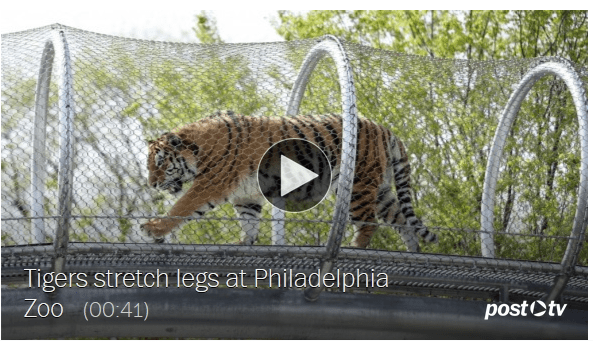
Philadelphia Zoo lets tigers stretch legs on trail – The Washington Post

THIS. IS. SO. COOL!

Not just for visitors, but for the animals!

tiger shot

Visitors to the Philadelphia Zoo might want to beware of stray cats: A new enclosed passageway allows lions and tigers to roam outside their exhibits.

Humans, though, can safely gawk at the predators traveling along Big Cat Crossing. The protected, open-air path snakes above the felines’ habitat to an archway over the zoo’s main promenade and ends at a viewing spot along a lake.

The concept for the catwalk unveiled Wednesday stems from the increasingly common practice of animal rotation, which lets animals take in new stimuli while visitors encounter them in unexpected places.

more via Philadelphia Zoo lets tigers stretch legs on trail – The Washington Post.

Big carnivores are roamers, and prefer to have lots of space to patrol. Being able to get a cat’s eye view of their zoo is so much healthier for them, and gives them the enrichment and psychological and physical space they need to stay healthy.

I had heard about the plans to create this space, so it’s really nice to see it implemented and in action.

behavior · children · community · environment · family · Nature · play

Grab a copy of 21 Days in the Woods and start a group session | Elisabeth M. Stone

We’re too late to join Elisabeth Stone on her group session she had back in February, but I still loved this idea of making a 21 day challenge to get outside!

21 Days in the Woods Poster

21 Days in the Woods is a connection project to get you and your family out in the woods once a day for 21 days. It is well-structured and adaptable to any age range. When you purchase your immediate download of the workbook, you can choose to work through it now or later

more via Grab a copy of 21 Days in the Woods and join us for a group session on February 1st. | Elisabeth M. Stone.

April has just started, and it’s starting to feel more and more like Spring, so take a look and see about how you can challenge yourself to get out into the woods.

behavior · brain · cognition · happiness · health · Mental · mental health · Nature · psychology

Why Your Brain Needs More Downtime – Scientific American

I’m working on an article for work, and came across this article as part of my research for the article. It pretty much sums up everything I wanted to say (darn it!).

Americans and their brains are preoccupied with work much of the time. Throughout history people have intuited that such puritanical devotion to perpetual busyness does not in fact translate to greater productivity and is not particularly healthy. What if the brain requires substantial downtime to remain industrious and generate its most innovative ideas? “Idleness is not just a vacation, an indulgence or a vice; it is as indispensable to the brain as vitamin D is to the body, and deprived of it we suffer a mental affliction as disfiguring as rickets,” essayist Tim Kreider wrote in The New York Times. “The space and quiet that idleness provides is a necessary condition for standing back from life and seeing it whole, for making unexpected connections and waiting for the wild summer lightning strikes of inspiration—it is, paradoxically, necessary to getting any work done.”

In contrast to the European Union, which mandates 20 days of paid vacation, the U.S. has no federal laws guaranteeing paid time off, sick leave or even breaks for national holidays. In the Netherlands 26 days of vacation in a given year is typical. In America, Canada, Japan and Hong Kong workers average 10 days off each year. Yet a survey by Harris Interactive found that, at the end of 2012, Americans had an average of nine unused vacation days. And in several surveys Americans have admited that they obsessively check and respond to e-mails from their colleagues or feel obliged to get some work done in between kayaking around the coast of Kauai and learning to pronounce humuhumunukunukuapua’a.

more via Why Your Brain Needs More Downtime – Scientific American.

The article focuses on mental downtime options like naps and meditation, which are awesome, but I would argue that being awake and aware, but also not actively engaged, like going for a walk or just sitting down and observing a garden, are good options too, especially since getting outside has also shown to be mentally reinvigorating.

behavior · children · environment · happiness · Nature

Make-A-Wish, Woodland Park Zoo grant a child’s wish to play with animals.

When 2 1/2-year-old Rylee, a Make-A-Wish Alaska and Washington kid, said she loved animals, we wanted to give her an unforgettable day at Woodland Park Zoo. Two weeks ago, Rylee arrived in a stretch limo, fed elephants Chai and Watoto, pet and fed the goats, pigs and bunnies, enjoyed a picnic and rode the carousel—and had a wonderful time sharing it all with her family. We’re so sorry to learn that Rylee has since passed. But we know that while we gave Rylee and her family the gift of nature, they gave us the gift of sharing one of Rylee’s last days with her. Go outside and play today—nature and time are gifts we should all treasure together. (Photo: Jessica Johnny Photography)

Photo: When 2 1/2-year-old Rylee, a Make-A-Wish Alaska and Washington kid, said she loved animals, we wanted to give her an unforgettable day at Woodland Park Zoo. Two weeks ago, Rylee arrived in a stretch limo, fed elephants Chai and Watoto, pet and fed the goats, pigs and bunnies, enjoyed a picnic and rode the carousel—and had a wonderful time sharing it all with her family. We’re so sorry to learn that Rylee has since passed. But we know that while we gave Rylee and her family the gift of nature, they gave us the gift of sharing one of Rylee’s last days with her. Go outside and play today—nature and time are gifts we should all treasure together. (Photo: Jessica Johnny Photography)

Biophilia is amazingly strong for all kids, and it’s simultaneously wonderful and heartbreaking that this was a little girl’s last wish.