Fantastic! As a fellow resident of a gray and gloomy city, a little splash of surprise color can do wonders!
The grey weather was no match for a new art installation on London Bridge, which transformed the crossing into a rainbow walkway for one day only.
The project was created by Spark Your City, a global movement “dedicated to spark joy in everyday life”.
According to the group’s Facebook page, they are “travelling the world from city to city”, and London was the first major centre to get the spark makeover.
While it may be better for you to take a walk in the woods than on an urban block, living near trees, even in an urban environment, has been found repeatedly to improve people’s health, even making them feel younger.
In a new paper published Thursday, a team of researchers present a compelling case for why urban neighborhoods filled with trees are better for your physical health. The research appeared in the open access journal Scientific Reports.
The large study builds on a body of prior research showing the cognitive and psychological benefits of nature scenery — but also goes farther in actually beginning to quantify just how much an addition of trees in a neighborhood enhances health outcomes. The researchers, led by psychologist Omid Kardan of the University of Chicago, were able to do so because they were working with a vast dataset of public, urban trees kept by the city of Toronto — some 530,000 of them, categorized by species, location, and tree diameter — supplemented by satellite measurements of non-public green space (for instance, trees in a person’s back yard).
They also had the health records for over 30,000 Toronto residents, reporting not only individual self-perceptions of health but also heart conditions, prevalence of cancer, diabetes, mental health problems and much more.
A million times yes! This article focuses on one of my biggest pet peeves and challenges as a play advocate; play not being taken seriously.
The author, Hilary O’Shaughnessy, and also the producer of the Playable City Award, discusses her play competition and the usual rub of people asking whether this is really all “worth it.” I’m quoting over half of her article, but she very eloquently covers an entire blog post I was planning on writing (I will still write it, I promise):
Amongst the usual squeals of anticipation [around the competition], there are questions about the value of these ideas to the “real” world. Fun is all well and good – but surely fun is the stuff we get to when the grown up work of building hospitals and roads is done with? When we’ve fixed the economy, let’s play. Cities are full of problems, why are we not fixing them first?
Herein lies the real issue. When we see play simply as fun, a whimsy for those of us lucky enough to have the time to engage in it, we underestimate the transformative power of play and it’s role in our lives.
Fixing problems, making our living and working spaces more livable and resilient, designing better cities, starts at every level with the people that Iive in those cities. Increasingly we are realising that our cities are designed for exclusivity, so it makes sense that we don’t feel part of shaping the future. This is revealed in the language we use to describe our relationships to the services and organisations that our cites are made of. We want them to fix it, they don’t want us to have a say, they give money to them to exclude us: the language is divisive and separating, and that’s the problem. Even the descriptions of the projects fail to deliver what they promise, because a playable city is experienced, not described.
The idea of what our cities should mean, how public money is spent, what we imagine as good for us and who is involved in designing them, is only ever addressed when we have a complaint or we feel excluded. We talk to the city council when the road is road is torn up or the lights won’t come on. We complain that our voices are unheard, but we never seize opportunities to speak, fearing that if we do we will be ignored or shouted down by the loudest ones.
This feeling of separation cannot be undone overnight. We need new approaches, new tools, and new ways to talk to one another about how to live together in cities.
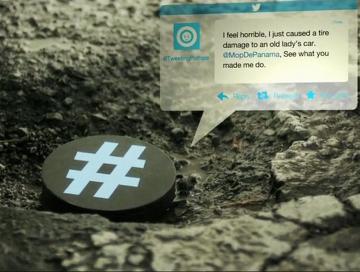
From a different article, but an example of using play as political protest: a device placed in large potholes that tweets whiny complaints when it is run over in order to publicly shame govt. into action.
Conversations about the future, about how we want to live, have to begin from a level playing field, and crucially that level playing field may not be where we expect. Play is a leveler: when we play, we play as humans, first. Traditional status markers like wealth, celebrity, or qualifications are not really much use when invited to dance with your shadow or conduct lights like a demi-god.
Addressing problems and finding solutions that work for us all begin with inviting everyone into conversation. Play as unexpected interventions in familiar places act as invitations to connect, an offer to begin to talk about those parts of our cities that we feel excluded from. To new eyes and ears, some projects can seem esoteric – but that is because we have become numbed to dull public announcements, badly designed flyers and clunky websites which act as information dumps that no-one reads, let alone takes as an invitation to work together. Yet, this is important stuff: we need to talk about the kind of future we want or it be will be decided for us while we look the other way.
This is a very well thought out and researched article about the benefits of pretend play, specifically creating and playing with puppets.
The [Puppet School] curriculum establishes the tenets of puppeteering education, which put educational theories about the importance of play and grit and resilience into practice.
In the beginning classes, students start to learn basic head and mouth movements, using motor skills in both hands and both arms, choreographed to pre-existing sound tracks of well-known pop songs. Students learn to articulate vowels and develop a sense of rhythm with their bodies. As the exercises advance, students learn to improvise using their own voices and hand movements, and eventually choreograph movement to material they’ve written. From motor skills, to communication and improv skills, then finally written skills, students exercise many parts of their brains at Puppet School, increasing communication between their two brain hemispheres.
According to Eric Jensen’s Teaching with the Brain in Mind, when brain signals are passed from one side to the other quickly, or when the left and right sides of bodies work simultaneously, the brain is able to function more efficiently, and the stronger the brain’s connections become—thereby improving literacy, movement coordination, processing data, and communication skills.
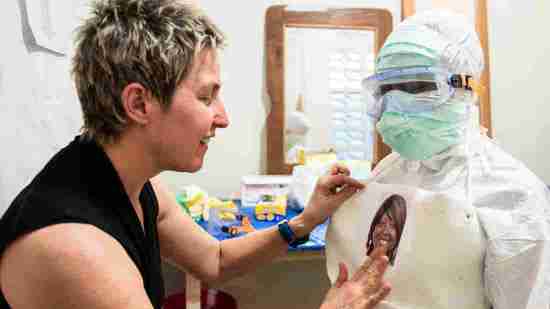
This is an example of how a small addition to a working environment, even a scary working environment, can make things a little less scary.
Last summer, Mary Beth Heffernan, who is an art professor at Occidental College, became obsessed with Ebola — particularly the images of the health care workers in those protective suits, or PPE as they’re called for short.
“They looked completely menacing,” says Heffernan. “I mean they really made people look almost like storm troopers. I imagined what would it be like to be a patient? To not see a person’s face for days on end?”
And what really got Heffernan is that as far as she could tell, there was an easy fix.
“I found myself almost saying out loud: ‘Why don’t they put photos on the outside of the PPE? Why don’t they just put photos on?'”
Here was her idea: Snap a photo of the health worker with a big smile on their face. Hook up the camera to a portable printer and print out a stack of copies on large stickers. Then every time the worker puts on a protective suit they can slap one of their pictures on their chest, and patients can get a sense of the warm, friendly human underneath the suit.
I agree with one of the commenters from the original story I would have liked to have heard a little bit more from the patients’ perspective, since the nurses and doctors all commented on its benefits. But overall I think this is great and wish more people would be willing to take risks like this to help, even if it doesn’t “change the world” it made the world, and in this case a scary, grueling, impoverished world, a little better.
This is a great way to “lure” younger adults to engage with seniors. It’s potentially a bit gimmicky, but the rewards of giving back to your community, and the enrichment of people of both ages, is just phenomenal.
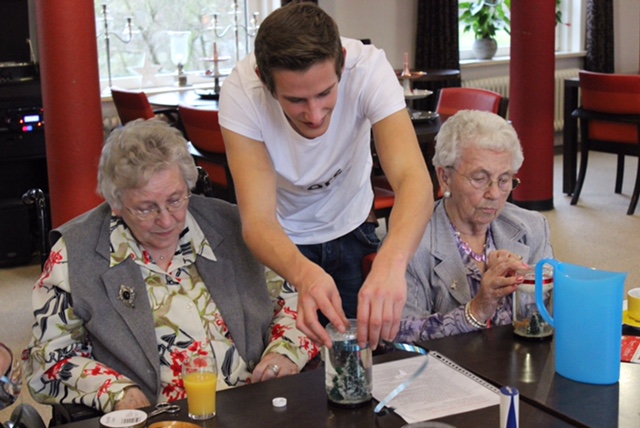
A nursing home in the Netherlands allows university students to live rent-free alongside the elderly residents, as part of a project aimed at warding off the negative effects of aging.
In exchange for small, rent-free apartments, the Humanitas retirement home in Deventer, Netherlands, requires students to spend at least 30 hours per month acting as “good neighbors,” Humanitas head Gea Sijpkes said in an email to PBS NewsHour.
Officials at the nursing home say students do a variety of activities with the older residents, including watching sports, celebrating birthdays and, perhaps most importantly, offer company when seniors fall ill, which helps stave off feelings of disconnectedness.
Both social isolation and loneliness in older men and women are associated with increased mortality, according to a 2012 report by the National Academy of Sciences of the United States of America.
“The students bring the outside world in, there is lots of warmth in the contact,” Sijpkes said.
Great article about the evolution of the playground, as well as the next generation of playgrounds emerging in cities:
After World War II, European architects turned out custom playgrounds that challenged kids both physically and intellectually. Inspired by their work, a few American architects, including Philadelphia’s Louis Kahn, tried their hands at the form. But the movement didn’t get very far. Playgrounds were a casualty of the breakdown of American cities in the ’60s and ’70s. As maintenance was deferred, they fell into ruin. By the time cities began to recover in the ’90s, Solomon says, all that local officials wanted was equipment that was indestructible and vetted for safety.
Moore, a professor at North Carolina State University who has been studying children’s play for 50 years, sees a connection between those designs and the increase in such childhood ailments as obesity, anxiety, and attention-deficit disorder. In the simple act of scrambling up the branches of a tree, a kid learns to monitor risk and deal with fear. But on most playgrounds, the climbing frames are lower than ever.
The concern about such controlled environments has sparked any number of popular books advocating less programming: Free Range Kids, 50 Dangerous Things (you should let your children do), Last Child in the Woods. All see our culture’s fear of risk as worse than the occasional scraped knee or broken bone.
So what’s the alternative to standard-issue playgrounds? Solomon envisions multipurpose, multigenerational urban parks that incorporate spaces where kids can take charge of their own play. Instead of a fixed bridge in a plastic fort, they would have to use their imagination to decide which objects could be converted to play equipment. Such a challenging play space also would include nooks where kids could temporarily escape the nervous gaze of their caregivers. There would be no fences, plenty of trees and bushes, and good seating.
My favorite playground growing up was made of mostly huge sewer pipe pieces, a monkey cage, and random cement shapes. What was your favorite playground as a kid? Or now? Describe it in the comments below.
Art has the power to soothe, to heal, to empower, to raise awareness and to move people to action. Using technology to enable people to express themselves through art is great, whether it’s for a cause, or a brand in this case.
To raise awareness for their brand, an art supply company created this viral campaign featuring real people using technology to create beautiful abstract art. Sixteen disabled individuals in China (home to the world’s largest disabled population) were invited to participate in the project, which involved using advanced brainwave scanning technology in conjunction with detonator-equipped, paint-filled balloons. The video seems to show that by concentrating really hard, the participants were able to trigger the colorful explosions, resulting in some very unique pieces.
My heart will be blessed with the sound of music.. and your brain too.
A recent research study found that those suffering from moderate to severe dementia did particularly well singing show tunes from movies and musicals such as ‘The Wizard of Oz,’ ‘The Sound of Music’ and ‘Oklahoma!’ in group settings and had a marked improvement in their remembering skills versus those who simply listened during the sing-alongs.
The Clinton Foundation recently teamed up with my employer as part of the Clinton Health Matters Initiative (CHMI) to create more healthy, and healthier, employees in a corporate environment. There were five winners chosen, and these two were my personal favorites:
Make Work Active
Concept: Gamify holistic health and wellness. Design a points based rewards program to incentivize employees for adopting a healthy lifestyle at work, with programs tailored to industry specific wellness issues.
Workspace Design
Concept: Design workplaces that require regular movement physical activity. Create “motion enhancing workplace” certification. Create certification of “Motion Enhancing Workspaces” if sufficient requirements are met (Similar to Leed Certified buildings).
While some of the other ideas were also great – have fresh food on hand, make a team goal to improve health – I love these ideas in particular because they engage with employees on an individual level, and force the employee to engage with wellness, i.e. via a game and/or their environment.
I know gamification is a super “buzz” term right now, almost to the point of being passe, but I have found it to be a surprisingly powerful tool. A few years ago I organized a walking challenge at work, and bought cheap pedometers for everyone who wanted to participate. The winner ended up being the facilities manager, which surprised everyone but totally made sense since he was on his feet all day, and was a great example of how a lot of little walks add up.
Where have you seen either of these types of initiatives in action, whether at work, school, or in your neighborhood? Do you know of any group working on creating certifications for “healthy workspaces”? Share them in the comments below.






 Mental Flowers