Play IS a form of learning and experimentation, so it’s nice to see a school try to incorporate this very basic, very elemental learning process into the heart of their education system.
How can we make school a joyful experience without sacrificing rigor? What’s the best way to measure true learning? What’s the purpose of school? The founders and teachers at the PlayMaker School (watch the PBS Newshour report by April Brown), an all-game based school in Los Angeles, are asking those big, abstract questions that all teachers grapple with. And they’re trying to find their own answers through their constantly morphing, complex experiment.
Here are their thoughts about these issues, in their own words, from extended answers to the PBS NewsHour report. How can teachers, parents, and administrators these ideologies to existing public schools?
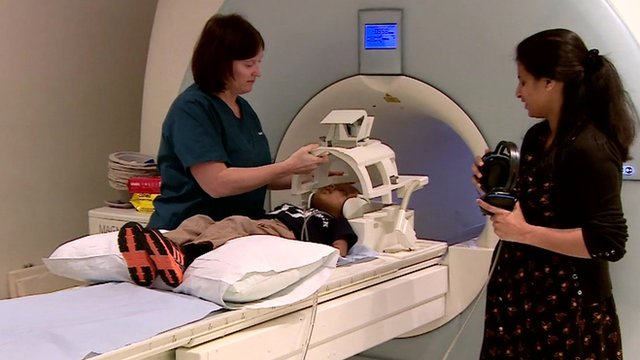
We know children tend to be wiggly, but we’ve also seen them sit stone still when they are engaged in a good book or toy or enraptured by a movie. A hospital in the UK is tapping into that enraptured engaged stillness.
Many adults find the procedure of having a brain scan, which involves having to lie still for an hour or more while images are analysed, an unsettling experience.The process is no less daunting for young children, who are usually given a general anaesthetic when they have the procedure.
However, a pilot scheme at University College Hospital in London is helping young people have a scan without being sedated, by teaching them about it through play.
Environmental Psychology and conservationists have, for awhile now, been advocating the importance of letting children get out and play in and with nature to educate them on the value of preserving their environment and benefiting from natural surroundings. It’s nice to see pediatricians also start to embrace and advocate for the need for everyone, including children, get outside and get dirty.
Dr. Lawrence Rosen writes that throughout his practice, seeing children on a daily basis, “I’m often reminded of Winslow Homer’s 1872 painting, “Snap the Whip,” depicting boys playing with abandon in a field outside their rural schoolhouse.”
So eloquently portrayed is the simplicity of another time, kids out in the natural world for no other purpose than to play, freely and without a care in the world.Contrast this with contemporary schoolyards with their meticulously designed jungle gyms and artificial surfacing, often empty throughout the day as more and more schools abolish recess or replace free play with highly structured, adult-supervised activities. I’ve realized, as I see increasingly anxious and depressed children come to my office looking for guidance, that the answers often lie not in my prescription pad but outside my window.
One very recent publication from Dr. Kirsten Beyer and associates at the Medical College of Wisconsin described the influence of green space on mental health outcomes, concluding that “higher levels of neighborhood green space were associated with significantly lower levels of symptomology for depression, anxiety and stress” and that “’greening’ could be a potential population mental health improvement strategy in the United States.”
In the stuffy, little gymnasium at Richard Kluge Elementary in Milwaukee, 16 boys and girls are stretching, jumping and marching to music.
Two years ago, the school had no gym, art or music classes due to budget cuts. But now, Kluge students get a so-called “special” class three days a week.
Milwaukee Public Schools is one of several school systems across the country — including Los Angeles, San Diego and Nashville, Tenn. — that are re-investing in subjects like art and physical education. The Milwaukee school district is hiring new specialty teachers with the hope of attracting more families and boosting academic achievement.Music teacher Angie Dvorak is one of the teachers that’s been effected. Last year, Dvorak was part time and traveled between schools. This year, she’s stays at Kluge all day, teaching music upstairs from the school’s gymnasium.
Dvorak says she’s seen a different in her students: “I get to have them for class more frequently, which is awesome because their music skills are shooting through the roof this year.”
I tweeted about this short film yesterday, but I really feel like this is worth giving some space on the blog for.
The value of play is important for teaching life skills like conflict resolution and collaboration, health lessons, healing from trauma, building community and just overall survival as a child and human being, the work this organization does seems simple but is hugely important.
This short video highlights some of the incredible impact that play can have on a child, or group of children.
You can also visit the organization’s website at Right to Play.
These findings make sense to me and yet also don’t.
Image credit: Carnegie Mellon University
Few environments feature such a cacophony of decor as the elementary school classroom. Colorful bulletin boards, scientific posters, state maps, and student artwork tend to cover nearly every inch of wall space. Yet a new study on classroom design from researchers at Carnegie Mellon University suggests that all that educational flair may not be all that great for getting kids to learn.
The study, carried out over two weeks, examined 24 kindergarten students who were taught six lessons on topics they had not yet learned in school. Half the lessons were taught in a highly decorated classroom environment, with posters and art all over the walls, and the other half were taught in a classroom with no decoration.
CMU’s researchers found the kids spent more time off-task and were more distracted when the room was brightly decorated, and they tested better on subjects they learned in the sparser classroom compared to the ones they learned in the more visually stimulating environment.
Elementary school children typically stay in one room all day, so classroom decorations don’t necessarily match the subject matter they’re learning at any given time. If they’re sitting in front of a U.S. map, they’ll be looking at that all day whether the current lesson is on geography or math. This study, though very small, adds to previous research from the same psychologists showing that visual stimulation that’s irrelevant to on-going instruction can distract kids.
The study doesn’t go on to offer any ways to necessarily improve the classroom design, although the article does give other links discussing it.
Nature can be fairly visually cacophonous, so what is it about classroom designs that are so distracting? I also wonder how much of their distraction is from an unnatural learning style, and then other more engaging things to look at. That is not an attack on the teacher, I’m just skeptical whether any human is capable of sitting in one room for 6-8 hours, with a couple of lunch breaks, and concentrate the entire time, for an extended period of time. Even grown-ups have a hard time doing that, and suffer when they try to sustain that for too long.
What are your thoughts? Leave them in the comments below.
Nice to see toys being introduced that work with already existing toys (sticks!), and encourages kids to go find their own sticks and go play in nature.
As an inductee to the National Toy Hall of Fame, the stick doesn’t need much improving as a classic toy. For as long as there have been children and sticks, sticks have served as a versatile toy in outdoor play. But connecting sticks takes a bit of ingenuity.
Enter Christina Kazakia, a design student with a mission. As she explains, “I designed these flexible silicone connectors as part of my graduate thesis in Industrial Design at the Rhode Island School of Design. My goal was to create prompts to engage children with their surrounding natural environment.” Called Stick-lets™, these connectors help small children build big structures like forts, teepees, lean-tos, or other creations.
The sport of Parkour is usually focused on finding your own path in non-planned environments. But having a space designated specifically for exploration is great for both beginners and veterans alike to practice seeing routes and trying new skills.
Traceurs and play advocates all over the world have been trying to start up parkour parks in various cities, so this is really exciting to see another one finally come to fruition after the hard work of local citizens. Well done!
Switzerland finally got their first Parkour park. The past 2 years the team “Parkour Luzern” was planning so hard to realize this project and finally Joel helped them to design and build the park. Jesse, Guilaume and Joel went there for training and now we are proud to put out the first video from this awesome location.
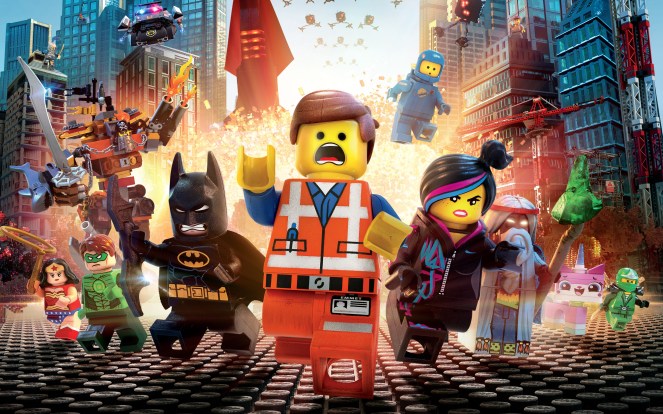
I am a huge fan of Legos, and so the little kid in me was super excited to see this movie trailer. But the more I read about it, the more the grown-up in me gets excited to. The whole premise of the movie is about fighting a bad guy who wants to keep people from getting creative with Legos and playing with them just the way they want. The goal of the heroes is to keep free play, well, free.
Photo from the Forbes review
“The Lego Movie” explores what may be the essential question of Lego building as it applies to life: Must you dutifully follow the instructions, or can you combine pieces creatively to make anything you dream up? In the animated children’s comedy, a repressive overlord voiced by Will Ferrell is so maniacal about controlling the residents of Bricksburg that he has a weapon designed to glue all the pieces of their world together, putting an end to freestyle play. Only a band of wisecracking rebels including Chris Pratt, Elizabeth Banks, Will Arnett and Morgan Freeman can stop him. The film is computer-animated but made to look as if all the scenery is built out of real Lego pieces. Everything moves in a way that simulates the stop-motion films that thousands of Lego customers have created with their pieces and posted online.
I am so excited to see a big budget movie with a lot of big budget actors devoted to promoting free-thinking free play, and some of the clips do in fact look really creative and are all about messing with your perceptions of the Lego reality!
This is one of the best descriptions of the power of pretend play, especially dissecting how pretend play is hard work, and can be overwhelming, especially to someone who doesn’t have practice, which is why lots of play is important for practicing real-world feelings and situations like power, restraint, and questioning assumed priors.
Power is intoxicating.
It is also dangerous.
And it is especially dangerous when applied to four-year-olds.
Four-year-olds lack the experience to wield power responsibly. They have no idea what to do with it or how to control it.
The dinosaur costume was the greatest thing that had ever happened to me.
…All I knew was that being a dinosaur felt very different from being a person, and I was doing things that I had never even dreamed of doing before. …Of course, I had always had the ability to do these things — even as a person — but I didn’t know that. I’d just assumed that I was unable. As a dinosaur, I didn’t have any of those assumptions. It felt like I could do whatever I wanted without fear of repercussions.





 Mental Flowers