behavior · education · health · learning · neuroscience · play · technology

Helping children receive and learn about brain scans through play | BBC News

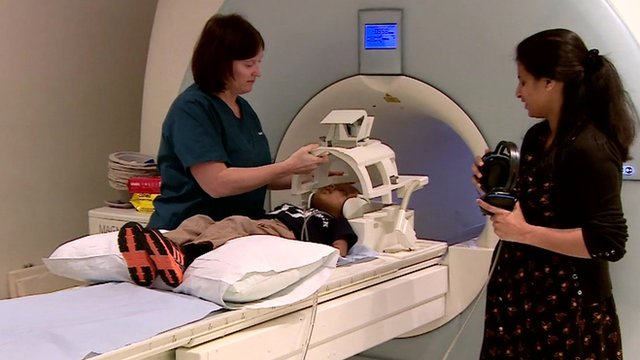
We know children tend to be wiggly, but we’ve also seen them sit stone still when they are engaged in a good book or toy or enraptured by a movie. A hospital in the UK is tapping into that enraptured engaged stillness.

Many adults find the procedure of having a brain scan, which involves having to lie still for an hour or more while images are analysed, an unsettling experience.The process is no less daunting for young children, who are usually given a general anaesthetic when they have the procedure.

However, a pilot scheme at University College Hospital in London is helping young people have a scan without being sedated, by teaching them about it through play.

see the video via BBC News – Helping children learn about brain scans through play.

children · environment · happiness · health · learning · mental health · Nature · neuroscience · play

IS PLAY THE KEY TO ECO-ACTION? : Children & Nature Network

Environmental Psychology and conservationists have, for awhile now, been advocating the importance of letting children get out and play in and with nature to educate them on the value of preserving their environment and benefiting from natural surroundings. It’s nice to see pediatricians also start to embrace and advocate for the need for everyone, including children, get outside and get dirty.

Dr. Lawrence Rosen writes that throughout his practice, seeing children on a daily basis, “I’m often reminded of Winslow Homer’s 1872 painting, “Snap the Whip,” depicting boys playing with abandon in a field outside their rural schoolhouse.”

So eloquently portrayed is the simplicity of another time, kids out in the natural world for no other purpose than to play, freely and without a care in the world.Contrast this with contemporary schoolyards with their meticulously designed jungle gyms and artificial surfacing, often empty throughout the day as more and more schools abolish recess or replace free play with highly structured, adult-supervised activities. I’ve realized, as I see increasingly anxious and depressed children come to my office looking for guidance, that the answers often lie not in my prescription pad but outside my window.

One very recent publication from Dr. Kirsten Beyer and associates at the Medical College of Wisconsin described the influence of green space on mental health outcomes, concluding that “higher levels of neighborhood green space were associated with significantly lower levels of symptomology for depression, anxiety and stress” and that “’greening’ could be a potential population mental health improvement strategy in the United States.”

read more from Dr. Rosen via IS HAPPINESS THE KEY TO ECO-ACTION? : The New Nature Movement.
anthropology · behavior · children · education · health · learning · music · play

To Boost Attendance, Milwaukee Schools Revive Art, Music And Gym : NPR Ed : NPR

This gives me hope:

In the stuffy, little gymnasium at Richard Kluge Elementary in Milwaukee, 16 boys and girls are stretching, jumping and marching to music.

Two years ago, the school had no gym, art or music classes due to budget cuts. But now, Kluge students get a so-called “special” class three days a week.

Milwaukee Public Schools is one of several school systems across the country — including Los Angeles, San Diego and Nashville, Tenn. — that are re-investing in subjects like art and physical education. The Milwaukee school district is hiring new specialty teachers with the hope of attracting more families and boosting academic achievement.Music teacher Angie Dvorak is one of the teachers that’s been effected. Last year, Dvorak was part time and traveled between schools. This year, she’s stays at Kluge all day, teaching music upstairs from the school’s gymnasium.

Dvorak says she’s seen a different in her students: “I get to have them for class more frequently, which is awesome because their music skills are shooting through the roof this year.”

more via To Boost Attendance, Milwaukee Schools Revive Art, Music And Gym : NPR Ed : NPR.

anthropology · behavior · brain · children · community · culture · education · environment · happiness · health · learning · play · psychology · Social

Plug for the NGO Right to Play

I tweeted about this short film yesterday, but I really feel like this is worth giving some space on the blog for.

The value of play is important for teaching life skills like conflict resolution and collaboration, health lessons, healing from trauma, building community and just overall survival as a child and human being, the work this organization does seems simple but is hugely important.

This short video highlights some of the incredible impact that play can have on a child, or group of children.

You can also visit the organization’s website at Right to Play.

Play matters!


behavior · children · environment · health · play

The Value of Unstructured Play Time for Kids – Pacific Standard: The Science of Society

This is a nice study that looks at the value for kids, but unstructured creative and/or play time is important for adults AND kids.

German psychologists find people who were allowed to play freely as children have greater social success as adults.

There has been plenty of hand-wringing in recent years about the “overscheduled child.” With after-school hours increasingly dominated by piano lessons, soccer practice, and countless other planned activities, many of us have a nagging sense that kids are missing out on something important if they have no time for unstructured play.New research from Germany suggests these fears are justified. It finds people who recall having plenty of free time during childhood enjoy high levels of social success as adults.

A team of three psychologists from the University of Hildesheim, led by Werner Greve, conducted a survey of 134 people. Participants were presented with a list of seven statements and reported the degree to which they conformed with their own childhood experiences that is, ages three to 10.

read the rest of the article via The Value of Unstructured Play Time for Kids – Pacific Standard: The Science of Society.

behavior · brain · cognition · creativity · environment · happiness · health · Nature · work

Why You Should Take Your Work Outdoors

Happy Friday. I got to start off my work day sitting on my back patio drinking coffee. Here’s why more people should do the same.

Do you feel stifled by the four walls of your office or cubicle?

There’s a reason for that.

Trapping ourselves indoors has created what health experts call a “nature deficit disorder” — depression or anxiety resulting from too little time spend outside. Getting outdoors can do great things for your health. Reducing stress, lowering blood pressure and improving immune function are among nature’s health benefits. What’s more, incorporating elements of nature into your workday can also give your brain a boost, resulting in increased productivity, focus and creativity.

Harvard physician Eva M. Selhub, co-author of Your Brain on Nature, says a drop of nature is like a drop of morphine to the brain, since it “stimulates reward neurons in your brain. It turns off the stress response which means you have lower cortisol levels, lower heart rate and blood pressure and improved immune response.”

Turning off the sensors that are involved in the stress response allows the higher brain centers to be accessed, resulting in increased concentration, improved memory, greater creativity and productivity and reduced mental fatigue. While Selhub says spending 20 minutes a day outdoors is recommended, studies have shown even looking at photographs of nature can deliver some of the same cognitive benefits as physically being outdoors. A 2008 study at the University of Michigan showed students who looked at photos of nature performed better on tests of attention and working memory than those who looked at photographs of urban scenes.

More reasons, and tips how, via Entrepreneur Magazine

architecture · community · creativity · environment · health · learning · play · youtube

Switzerland Opens its first Parkour Park – YouTube

The sport of Parkour is usually focused on finding your own path in non-planned environments. But having a space designated specifically for exploration is great for both beginners and veterans alike to practice seeing routes and trying new skills.

Traceurs and play advocates all over the world have been trying to start up parkour parks in various cities, so this is really exciting to see another one finally come to fruition after the hard work of local citizens. Well done!

Switzerland finally got their first Parkour park. The past 2 years the team “Parkour Luzern” was planning so hard to realize this project and finally Joel helped them to design and build the park. Jesse, Guilaume and Joel went there for training and now we are proud to put out the first video from this awesome location.

Grandstand Parkour Park

via Free-Z at Switzerland’s first Parkour Park – YouTube.

behavior · environment · happiness · health · mental health · Nature · play

Philadelphia Zoo lets tigers stretch legs on trail – The Washington Post

THIS. IS. SO. COOL!

Not just for visitors, but for the animals!

tiger shot

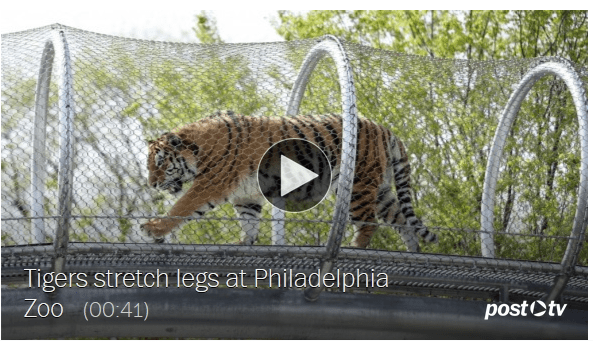
Visitors to the Philadelphia Zoo might want to beware of stray cats: A new enclosed passageway allows lions and tigers to roam outside their exhibits.

Humans, though, can safely gawk at the predators traveling along Big Cat Crossing. The protected, open-air path snakes above the felines’ habitat to an archway over the zoo’s main promenade and ends at a viewing spot along a lake.

The concept for the catwalk unveiled Wednesday stems from the increasingly common practice of animal rotation, which lets animals take in new stimuli while visitors encounter them in unexpected places.

more via Philadelphia Zoo lets tigers stretch legs on trail – The Washington Post.

Big carnivores are roamers, and prefer to have lots of space to patrol. Being able to get a cat’s eye view of their zoo is so much healthier for them, and gives them the enrichment and psychological and physical space they need to stay healthy.

I had heard about the plans to create this space, so it’s really nice to see it implemented and in action.

behavior · brain · children · cognition · creativity · culture · happiness · health · mental health · psychology · Social

20+ Drawing Ideas and Activities | picklebums.com

Staying playful and creative sometimes requires going back to your roots, or at least your crayons. Drawing, scribbling, doodling, and coloring have all been found to help with destressing, thinking out ideas and problems, and keep brains active into old age.

Drawing is also a great learning activity with lots of fine motor skill and development, problem solving, language development and social learning opportunities… (Editor’s note: all of which tie into the above-mentioned benefits, and these skills are all useful for both grownups and kids to practice and refresh on a regular basis).

Drawing is a way for children everyone to process their world, to represent and share their ideas and to explore new skills and information.

Drawing with Geometry Tools
Graph Paper Drawing
Graph Paper Drawing
Collaborative Doodle Drawings

see all 20+ Drawing Ideas and Activities at picklebums.com.

If you think this is just “kid’s stuff” I dare you to try some of these, especially the collaborative drawing exercise. It’ll (potentially) expose some growth areas of yourself and/or others very quickly. 😛

behavior · children · community · creativity · health

Anti-loneliness augmented quilt comforts children in hospital (Wired UK)

An older article, but too charming and innovative not to share on the blog:

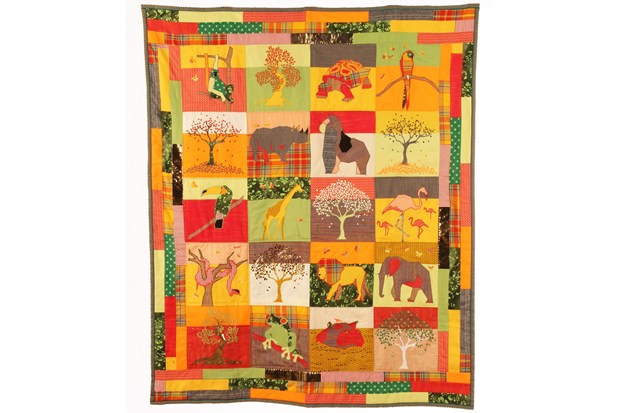
A patchwork quilt aims to combat separation issues and distress in hospitalised children by allowing them to helping them to communicate with their families using augmented reality.

Each of the quilt’s 20 squares is decorated with a unique multi-coloured animal or plant design and can be linked to an individual friend or family member. Loved ones can then leave messages for children to access with Aurasma, an app which uses the camera on a phone or tablet to recognise the unique image and overlay content — a picture, photo or video — so that it pops up on the screen.

The quilt is designed to serve as both a comforting, tactile object and a method of communication

more via Anti-loneliness augmented quilt comforts children in hospital (Wired UK).