architecture · children · community · design · environment · health · mental health · play · school

Changing Skyline: Redesigning playgrounds to promote ‘loose play’ – think pop-up play spaces

Great article about the evolution of the playground, as well as the next generation of playgrounds emerging in cities:

After World War II, European architects turned out custom playgrounds that challenged kids both physically and intellectually. Inspired by their work, a few American architects, including Philadelphia’s Louis Kahn, tried their hands at the form. But the movement didn’t get very far. Playgrounds were a casualty of the breakdown of American cities in the ’60s and ’70s. As maintenance was deferred, they fell into ruin. By the time cities began to recover in the ’90s, Solomon says, all that local officials wanted was equipment that was indestructible and vetted for safety.

Moore, a professor at North Carolina State University who has been studying children’s play for 50 years, sees a connection between those designs and the increase in such childhood ailments as obesity, anxiety, and attention-deficit disorder. In the simple act of scrambling up the branches of a tree, a kid learns to monitor risk and deal with fear. But on most playgrounds, the climbing frames are lower than ever.

The concern about such controlled environments has sparked any number of popular books advocating less programming: Free Range Kids, 50 Dangerous Things (you should let your children do), Last Child in the Woods. All see our culture’s fear of risk as worse than the occasional scraped knee or broken bone.

So what’s the alternative to standard-issue playgrounds? Solomon envisions multipurpose, multigenerational urban parks that incorporate spaces where kids can take charge of their own play. Instead of a fixed bridge in a plastic fort, they would have to use their imagination to decide which objects could be converted to play equipment. Such a challenging play space also would include nooks where kids could temporarily escape the nervous gaze of their caregivers. There would be no fences, plenty of trees and bushes, and good seating.

read more of their ideas for better playgrounds via Changing Skyline: Redesigning playgrounds to promote ‘loose play’ – think pop-up play spaces.

My favorite playground growing up was made of mostly huge sewer pipe pieces, a monkey cage, and random cement shapes. What was your favorite playground as a kid? Or now? Describe it in the comments below.
anthropology · behavior · community · culture · environment · happiness · health

Los Angeles has Cancer — Stephen Corwin on Medium

This is a scathing opinion piece looking at the negative influences of space and place, specifically cars and car culture. Corwin argues passionately against the takeover of cars in to the city space and how it is anything BUT enriching. It is full of examples of what NOT to do, and therefore offers suggestions on how to solve it.

Our experiences driving cars in this city are, for the most part, fleeting. We drive somewhere, we get out of the car, we close the door, and we walk away. But to think that we can escape the world that cars have created as easily as we escape the car itself is foolish. In fact, when we leave our cars, we walk into that world. We have to live in that putrid mess.

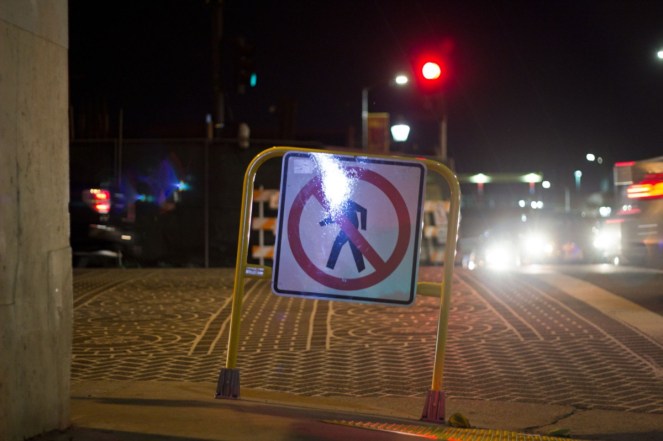
Let’s talk about how Los Angeles is a city where construction projects can fence off whole blocks, including the sidewalks, without offering people on foot an alternative. Let’s talk about how when that happens, no one even considers converting one of the two car lanes into a temporary sidewalk, because dear god, that might cause slight inconvenience to people in cars. And let’s talk about how ironic it is that inconveniencing people in cars is the end of the world, but doing the same to people on foot is a non-issue. Then let’s talk about how when frustrated walkers decide to use the car lane rather than take the ridiculous detour, the city’s totally acceptable solution to that problem is not to concede space to those people, but rather to bolt permanent, metal signs into the middle of the sidewalk to keep them from doing so. That is cancer.

read the whole thing via Los Angeles has Cancer — Medium.

It is worth a read.

anthropology · behavior · children · health · learning · play · school

How schools ruined recess — and four things needed to fix it – The Washington Post

I am aghast at how much structure and lack of free play is out there for kids, “for their safety.”

What if we let children fully move their bodies during recess time, let them get dirty, and even test out new theories? What would recess look like then?

The closest I found to doing just that was the Swanson School in Auckland, New Zealand. I had heard of its nonconventional, yet successful approach to recess through social media and was instantly intrigued. Since I was already going to be in New Zealand for TimberNook, I decided to meet Swanson’s principal, Bruce McLachlan, in person.

We spent a good hour talking over coffee about his now-famous recess. His recess has gotten international attention, because he did something radical: he got rid of the rules. And guess what? When the rules left, so did their “behavior issues.” He saw more independence, improved creativity, healthy risk-taking, less falling, better coordination, and improved attention in the classroom.

There were four main ways he changed his recess in order to see these improvements. Four things that I happen to successfully use in my program as well to enhance child development and inspire creativity. Think of them as a recipe.

Read the 4 things at How schools ruined recess — and four things needed to fix it – The Washington Post.

I’ll wait…

Ok, so now that you’ve read them (and hopefully the full article later), I totally agree and feel like all of those are missing, but especially space and time. Creating playful spaces and allowing that boredom and downtime is crucial.


creativity · design · environment · happiness · health · play

15 Artists Collaborate To Make London Children’s Hospital Cozier For Kids | Bored Panda

Last year I had a stay at a local hospital. I and the people who came to visit me all found the place hard to navigate (we all got lost more than once), and I found parts of it unfriendly and slightly claustrophobic, and not very warming or healing. They had some nondescript pictures on the walls, and that was the only way I could find to navigate my way out of the maze of white and linoleum.

It doesn’t have to be this way.

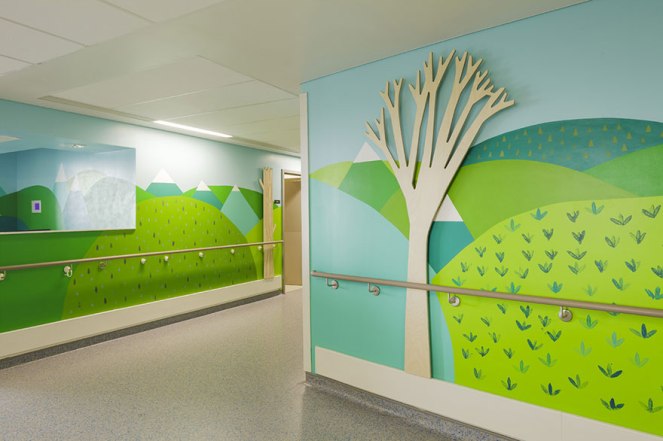
The sights, sounds and smells of a hospital can make it a terrifying place, especially for children, but it doesn’t have to be that way. Vital Arts, a British arts organization in charge of introducing art to Britain’s hospitals, had 15 artists collaborate to turn the interior of London Royal Children’s Hospital into as fun and colorful a place as a hospital can be.

Despite being limited by the fact that hospital environments need to be easy to clean, the artists were still able to use vinyl, ceramics, wood and even rugs to liven up these hospitals, each approaching the wards they decorated with their own unique style.

via 15 Artists Collaborate To Make London Children’s Hospital Cozier For Kids | Bored Panda.

The author Dovas comments that they wish it wasn’t just for kids. It really can be for everyone. Even something as simple as bright colors can be helpful in orienting patients and helping them feel better.

The nurses who helped me all commented about needing to get outside and get away from the sterile white. I think the curtain example illustrates the value of this beautifully:

“A seminal moment for me was when a three-year-old girl stopped crying the moment she saw the curtains, pointing excitedly to the hidden cats and rabbits. That’s when I knew my design had worked”

It is possible to have art and playfulness in sterile hospitals, as part of the healing process. Plus adding some joviality, like staying in the “monkey room” can make a somewhat painful situation seem less heavy.

Maintenance on some of these installations and art pieces may be higher, but if it leads to faster recovery and shorter hospitals stays, which this kind of enrichment has been found to do, then it is a worthy investment.

creativity · design · happiness · health · mental health · technology · youtube

Cool Technology Allows Disabled People To Create Incredible Art With Their Minds

Art has the power to soothe, to heal, to empower, to raise awareness and to move people to action. Using technology to enable people to express themselves through art is great, whether it’s for a cause, or a brand in this case.

To raise awareness for their brand, an art supply company created this viral campaign featuring real people using technology to create beautiful abstract art. Sixteen disabled individuals in China (home to the world’s largest disabled population) were invited to participate in the project, which involved using advanced brainwave scanning technology in conjunction with detonator-equipped, paint-filled balloons. The video seems to show that by concentrating really hard, the participants were able to trigger the colorful explosions, resulting in some very unique pieces.

more via Cool Technology Allows Disabled People To Create Incredible Art With Their Minds.

architecture · design · family · health

Beauty in sadness: reflecting on hospice | @offbeatfamilies

Dying is tough stuff. No question. So it is wonderful to see how facilities are making it easier on the dying and their families to feel comfortable via the design, look, and layout of a space, with everything from the hues on the wall to the view from their window. Amy Marquez shared her observations about her mother’s hospice space a couple of years ago on Offbeat Families (now retired, but visit the sister sites for Pete’s Sake before they meet a similar fate!), and it is a wonderful ode to both her mom and people who cared for her and her family during her last days, but also the importance of creating a great, peaceful, and sometimes playful space.

At first I was impressed with how sensitive and involved the staff was. They made sure she was comfortable, asked us how we were doing and offered to help us if we needed anything. And although my mother had lost the ability to communicate verbally by the third day that she was there, they spoke to her as though she was able to answer and talked her through everything they were doing to assist her.

I spent enough days there to really start looking around. This facility was, at first glance, a very nice, tranquil place that was inviting and welcoming to family and friends of loved ones in residence there. Then I really started looking and I was amazed at the amount of thought that had to go in to building this hospice.

read the entire breakdown at Beauty in sadness: reflecting on the hospice in which my mother passed away | @offbeatfamilies.

Patient's room

behavior · environment · health · mental health · play · work

Creating playful and holistic spaces for healthier employees

The Clinton Foundation recently teamed up with my employer as part of the Clinton Health Matters Initiative (CHMI) to create more healthy, and healthier, employees in a corporate environment. There were five winners chosen, and these two were my personal favorites:

  • Make Work Active
  • Concept: Gamify holistic health and wellness. Design a points based rewards program to incentivize employees for adopting a healthy lifestyle at work, with programs tailored to industry specific wellness issues.
  • Workspace Design
  • Concept: Design workplaces that require regular movement physical activity. Create “motion enhancing workplace” certification. Create certification of “Motion Enhancing Workspaces” if sufficient requirements are met (Similar to Leed Certified buildings).


While some of the other ideas were also great – have fresh food on hand, make a team goal to improve health – I love these ideas in particular because they engage with employees on an individual level, and force the employee to engage with wellness, i.e. via a game and/or their environment.

I know gamification is a super “buzz” term right now, almost to the point of being passe, but I have found it to be a surprisingly powerful tool. A few years ago I organized a walking challenge at work, and bought cheap pedometers for everyone who wanted to participate. The winner ended up being the facilities manager, which surprised everyone but totally made sense since he was on his feet all day, and was a great example of how a lot of little walks add up.

Where have you seen either of these types of initiatives in action, whether at work, school, or in your neighborhood? Do you know of any group working on creating certifications for “healthy workspaces”? Share them in the comments below.


architecture · design · environment · health · mental health · Nature

In Redesigned Room, Hospital Patients May Feel Better Already – NYTimes.com

I recently had a short stay at a hospital (just some minor surgery), and as I lay in my hospital bed I recall looking out my window at a green canopy of trees planted two stories below. I remember how peaceful and pleasant it was to be able to look out and watch the trees. I also noticed my anxiety went down, I was distracted from my pain, and just overall felt better.

More and more research is coming out that is finding the benefits of incorporating nature and natural environments into the healing process, for everything from surgery to PTSD to dementia, and a variety of other ailments. So it’s great to see hospitals incorporating this knowledge into new building designs as well as therapies.

The University Medical Center of Princeton realized several years ago that it had outgrown its old home and needed a new one. So the management decided to design a mock patient room.Medical staff members and patients were surveyed. Nurses and doctors spent months moving Post-it notes around a model room set up in the old hospital. It was for just one patient, with a big foldout sofa for guests, a view outdoors, a novel drug dispensary and a bathroom positioned just so.

Equipment was installed, possible situations rehearsed. Then real patients were moved in from the surgical unit — hip and knee replacements, mostly — to compare old and new rooms. After months of testing, patients in the model room rated food and nursing care higher than patients in the old rooms did, although the meals and care were the same.

But the real eye-opener was this: Patients also asked for 30 percent less pain medication.

Reduced pain has a cascade effect, hastening recovery and rehabilitation, leading to shorter stays and diminishing not just costs but also the chances for accidents and infections. When the new $523 million, 636,000-square-foot hospital, on a leafy campus, opened here in 2012, the model room became real.

read more via In Redesigned Room, Hospital Patients May Feel Better Already – NYTimes.com.

behavior · brain · culture · health · play · Social

Play Doesn’t End With Childhood: Why Adults Need Recess Too | NPR

I’ve already shared this article via Twitter, but it is so important that I just had to re-share via my blog. If there was one mantra I would want to be known for it’s that adults need play. Humans need downtime. Humans need breathing room. Humans need play at any age!

A father and daughter try out a public park piano in Seattle, WA
A father and daughter try out a public park piano together in Seattle, WA

Childhood play is essential for brain development. As , time on the playground may be more important than time in the classroom.But playtime doesn’t end when we grow up. Adults need recess too.

The question is, why? To answer this question, Dr. Stuart Brown says we need to clearly define what play is. He’s head of a nonprofit called the National Institute for Play.

“Play is something done for its own sake,” he explains. “It’s voluntary, it’s pleasurable, it offers a sense of engagement, it takes you out of time. And the act itself is more important than the outcome.”

So, let’s take gambling, for instance. A poker player who’s enjoying a competitive card game? That’s play, says Brown. A gambling addict whose only goal is to hit the jackpot? Not play.

Brown says that children have a lot to learn from what he calls this “state of being,” including empathy, how to communicate with others, and how to roll with the punches.

read the whole article, including more insight from Stuart Brown, a long-time play research and advocate, via Play Doesn’t End With Childhood: Why Adults Need Recess Too : NPR Ed : NPR.

I have met and chatted briefly with Dr. Brown and read his work, and he has done some pretty interesting work on play over the years, using both primary and secondary research (I even cited him in my thesis).

I could easily go on a rant here as to why adult play is so important but so undervalued, but for now just read the article and leave any comments either here or on the actual article’s page.

architecture · behavior · community · creativity · culture · environment · family · happiness · health · play · Social

Cities’ Message to Young Families: Play and Stay – WSJ

City planners are finally starting to grok that in order to keep residents, they will need to offer the whole package, including playful spaces for everyone, kids and grown-ups alike.

About a decade ago, the so-called creative class of 20somethings fueled the revival of urban centers by settling in downtown areas mixing condos and coffee shops. Now, as millennials and other urbanites have children, their needs are changing. Cities want to hold on to them by becoming more “playable,” for both children and adults.

For decades, cities “relegated kids to the playground and said, ‘We’ve done something for you,’ ” says Darell Hammond, chief executive of Washington, D.C. nonprofit KaBOOM!, which consults with city officials on promoting and preserving play. “The whole city should be a playground, and play should happen everywhere.”

That means not only building more parks and bike paths but also incorporating the ideas of “fun” and “play” throughout a city, whether it is musical swings downtown Montreal, a hopscotch crosswalk in an arts district Baltimore or camp sites on a city lake front Chicago.

more via Cities’ Message to Young Families: Play and Stay – WSJ.

I hope that this attitude shift from city planners and designers makes it more acceptable for grown-ups to go out and play, and I mean actually physically play, not just go to bars and concerts that were traditionally classified as the only acceptable adult “play.” Seattle and Portland, and  are definitely accepting and encouraging of grown-ups playing bike polo in city parks or just going for a run. Creating an environment that welcomes play also helps change the attitude of others