I wanted to share a great list from full time mom/worker/author/etc. Katrina Alcorn about how to fit in some play and laughs into a busy schedule.
Whether or not laughter is the best medicine, it’s certainly a great coping technique. It may not make you less busy, but it will boost your immune system, protect your heart, help you handle stress, lower your blood pressure, and improve your intake of oxygen. Also, it has zero calories, zero negative side effects, and it’s free.
Katrina also wrote a great book about her experience being Maxed Out and ways that we can all fight for more time and space to play and be balanced in our lives. It is a wonderful, fast, engaging read. Go check it out.
A really fascinating read about improving air quality through design by architect Blaine Brownell:
During a study-abroad tour of China that I led in May and June through the University of Minnesota’s School of Architecture (read more about the trip here and here), one topic, aside from architecture, that my students and I discussed regularly was air pollution. Although we were in southern and central China, which are less affected than Beijing and other northern cities, we often found ourselves in a murky atmosphere. For three weeks, we rarely saw blue sky even on sunny days, and the air imparted a palpable thickness.
We checked the country’s Air Quality Index (AQI) daily via mobile app for the local forecast—especially after a bout of intense allergies sent me to a local pharmacist. This led us to question how we as architects and designers can counter such an ever-present problem.
Air pollution influences not only our physical health but also our experience of the built environment. Buildings and landscapes become soft and gritty, losing their clarity, sharpness, and color behind a veil of smog. The azure backdrop that is beloved in architectural representations is rarely witnessed. Rather, gray predominates, at times accompanied by brown. Despite this reality, blue sky persists in renderings of projects in China.
Okay, ignore that this is a granola company’s commercial.
And they may have cherry-picked to prove a point.
YET…
The fact that even these kids exist is terrifying.
Just watch the video. And cringe. Mourn. Cry. Then go do something about it!
Children are obsessed with technology, and Nature Valley wants us to be afraid. Very afraid.
That seems to be the message of this new ad for the granola bar company, which asks three generations of families: “When you were a kid, what did you do for fun?”
The elder two generations share memories of blueberry picking, sledding, fishing trips, and playing baseball as airy music plays in the background.
But then it’s the younger generation’s turn, and ominous music suggests these kids aren’t exactly frolicking in the grass and soaking in the sunshine. The kids detail that they spend five hours a day texting, emailing, tweeting, browsing the computer, or playing video games as the parents cry or lament the death of the good old days.
This is not okay people. So, so, the opposite of okay!
Go volunteer to take your niece or nephew to the park, or go hunt for cool leaves and flowers in the park. Grow a flower or even spider plant and give it to a kid! Take action!
While it may be better for you to take a walk in the woods than on an urban block, living near trees, even in an urban environment, has been found repeatedly to improve people’s health, even making them feel younger.
In a new paper published Thursday, a team of researchers present a compelling case for why urban neighborhoods filled with trees are better for your physical health. The research appeared in the open access journal Scientific Reports.
The large study builds on a body of prior research showing the cognitive and psychological benefits of nature scenery — but also goes farther in actually beginning to quantify just how much an addition of trees in a neighborhood enhances health outcomes. The researchers, led by psychologist Omid Kardan of the University of Chicago, were able to do so because they were working with a vast dataset of public, urban trees kept by the city of Toronto — some 530,000 of them, categorized by species, location, and tree diameter — supplemented by satellite measurements of non-public green space (for instance, trees in a person’s back yard).
They also had the health records for over 30,000 Toronto residents, reporting not only individual self-perceptions of health but also heart conditions, prevalence of cancer, diabetes, mental health problems and much more.
Where you live can have a huge bearing on how healthy you’re likely to be. And, sometimes the gaps open up over just a few miles. A few subway stops in New York, for example, could mean up to nine years difference in how long someone might live.
Mitchell’s research, while still at a relatively early stage, suggests green-space might serve to reduce these gaps.
The research doesn’t prove the strength of the relationship between individual neighborhood services and well-being, but does show that well-being gaps are smaller where services are better, Mitchell notes in an email. Research he’s conducting now, which hasn’t been published, does show green spaces having the strongest bearing on well-being differences.
A million times yes! This article focuses on one of my biggest pet peeves and challenges as a play advocate; play not being taken seriously.
The author, Hilary O’Shaughnessy, and also the producer of the Playable City Award, discusses her play competition and the usual rub of people asking whether this is really all “worth it.” I’m quoting over half of her article, but she very eloquently covers an entire blog post I was planning on writing (I will still write it, I promise):
Amongst the usual squeals of anticipation [around the competition], there are questions about the value of these ideas to the “real” world. Fun is all well and good – but surely fun is the stuff we get to when the grown up work of building hospitals and roads is done with? When we’ve fixed the economy, let’s play. Cities are full of problems, why are we not fixing them first?
Herein lies the real issue. When we see play simply as fun, a whimsy for those of us lucky enough to have the time to engage in it, we underestimate the transformative power of play and it’s role in our lives.
Fixing problems, making our living and working spaces more livable and resilient, designing better cities, starts at every level with the people that Iive in those cities. Increasingly we are realising that our cities are designed for exclusivity, so it makes sense that we don’t feel part of shaping the future. This is revealed in the language we use to describe our relationships to the services and organisations that our cites are made of. We want them to fix it, they don’t want us to have a say, they give money to them to exclude us: the language is divisive and separating, and that’s the problem. Even the descriptions of the projects fail to deliver what they promise, because a playable city is experienced, not described.
The idea of what our cities should mean, how public money is spent, what we imagine as good for us and who is involved in designing them, is only ever addressed when we have a complaint or we feel excluded. We talk to the city council when the road is road is torn up or the lights won’t come on. We complain that our voices are unheard, but we never seize opportunities to speak, fearing that if we do we will be ignored or shouted down by the loudest ones.
This feeling of separation cannot be undone overnight. We need new approaches, new tools, and new ways to talk to one another about how to live together in cities.
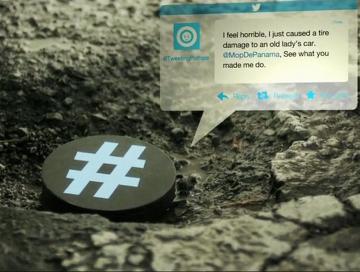
From a different article, but an example of using play as political protest: a device placed in large potholes that tweets whiny complaints when it is run over in order to publicly shame govt. into action.
Conversations about the future, about how we want to live, have to begin from a level playing field, and crucially that level playing field may not be where we expect. Play is a leveler: when we play, we play as humans, first. Traditional status markers like wealth, celebrity, or qualifications are not really much use when invited to dance with your shadow or conduct lights like a demi-god.
Addressing problems and finding solutions that work for us all begin with inviting everyone into conversation. Play as unexpected interventions in familiar places act as invitations to connect, an offer to begin to talk about those parts of our cities that we feel excluded from. To new eyes and ears, some projects can seem esoteric – but that is because we have become numbed to dull public announcements, badly designed flyers and clunky websites which act as information dumps that no-one reads, let alone takes as an invitation to work together. Yet, this is important stuff: we need to talk about the kind of future we want or it be will be decided for us while we look the other way.
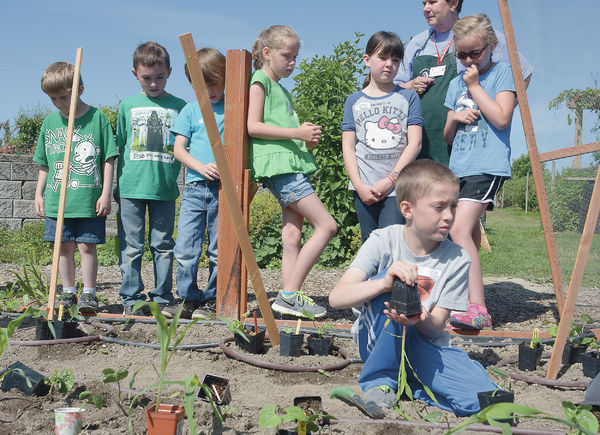
This is a great example of how even “country kids” – all of these kids come from communities surrounded by farmland and agriculture – enjoy and appreciate hands-on experiences and learning about gardening and the natural environment.
About 70 classmates participated Thursday in the Washington State University Skagit County Extension Master Gardener’s “Discovery In Gardening — Is Terrific” (DIG-IT) youth education program.
“It introduces kids to how the garden works, from the growth of the plants to how it arrives in your kitchen and what to do with the scraps,” said Master Gardener Chuck Howell.
The program was started in 2002 by two teachers, Master Gardener Gail Messett said.
The format of the program has changed over the years, Messett said, but the goal has remained the same: Get kids outside and into the garden.
“They’re learning respect for insects and bees and flowers,” Messet said. “I think they go home pretty awestruck, actually.”
Looking to have a little fun with your walk? Now you can use mapping technology to do so…
The Trace app will let you turn a sketch on your smartphone into a physical walking route around a city. You can share your route with a friend, and the recipient gets step-by-step directions. Eventually, the app will reveal the shape on a map.
The walk creator can add signposts along the way—images, audio recordings, messages—which will pop-up at specific places in-route. Walkers can begin their walk anywhere in the city, and pick the duration of their walk. The app adjusts the size of the shape accordingly.
Sixteen walkers in Seattle, Boston and Chicago tested out Trace for a week, drawing over 150 shapes. They sent the walks to friends or tried the routes themselves. The results were presented in a study in Seoul, at the Association for Computing Machinery’s CHI conference last month.
This is an example of how a small addition to a working environment, even a scary working environment, can make things a little less scary.
Last summer, Mary Beth Heffernan, who is an art professor at Occidental College, became obsessed with Ebola — particularly the images of the health care workers in those protective suits, or PPE as they’re called for short.
“They looked completely menacing,” says Heffernan. “I mean they really made people look almost like storm troopers. I imagined what would it be like to be a patient? To not see a person’s face for days on end?”
And what really got Heffernan is that as far as she could tell, there was an easy fix.
“I found myself almost saying out loud: ‘Why don’t they put photos on the outside of the PPE? Why don’t they just put photos on?'”
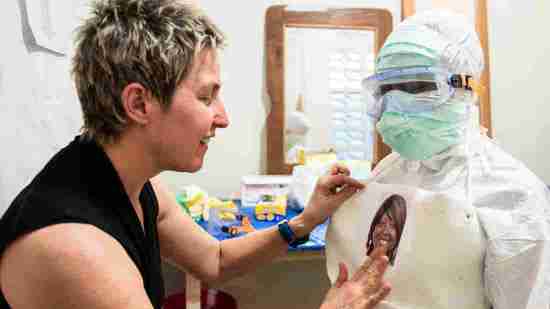
Here was her idea: Snap a photo of the health worker with a big smile on their face. Hook up the camera to a portable printer and print out a stack of copies on large stickers. Then every time the worker puts on a protective suit they can slap one of their pictures on their chest, and patients can get a sense of the warm, friendly human underneath the suit.
I agree with one of the commenters from the original story I would have liked to have heard a little bit more from the patients’ perspective, since the nurses and doctors all commented on its benefits. But overall I think this is great and wish more people would be willing to take risks like this to help, even if it doesn’t “change the world” it made the world, and in this case a scary, grueling, impoverished world, a little better.
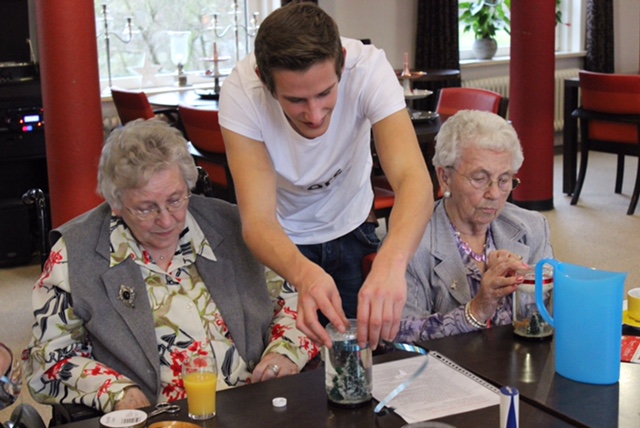
This is a great way to “lure” younger adults to engage with seniors. It’s potentially a bit gimmicky, but the rewards of giving back to your community, and the enrichment of people of both ages, is just phenomenal.
A nursing home in the Netherlands allows university students to live rent-free alongside the elderly residents, as part of a project aimed at warding off the negative effects of aging.
In exchange for small, rent-free apartments, the Humanitas retirement home in Deventer, Netherlands, requires students to spend at least 30 hours per month acting as “good neighbors,” Humanitas head Gea Sijpkes said in an email to PBS NewsHour.
Officials at the nursing home say students do a variety of activities with the older residents, including watching sports, celebrating birthdays and, perhaps most importantly, offer company when seniors fall ill, which helps stave off feelings of disconnectedness.
Both social isolation and loneliness in older men and women are associated with increased mortality, according to a 2012 report by the National Academy of Sciences of the United States of America.
“The students bring the outside world in, there is lots of warmth in the contact,” Sijpkes said.
 I wanted to share a great list from full time mom/worker/author/etc. Katrina Alcorn about how to fit in some play and laughs into a busy schedule.



 Mental Flowers