cognition · environment · health · Nature · neuroscience · play

For developing brains and global health, it’s all about the trees

Nature
Trees are important for childhood development (Photo credit: @Doug88888)

As I head off on my latest grand adventure (a road-trip across Washington State), I will be driving through some fairly pristine landscapes; prairies, desert, forests, river basins. I love experiencing natural environments, even if it’s only from my car window. I find it rejuvenating and relaxing, more than a 90-minute massage! And enough research is coming out these days that finds I am not alone in my need for green spaces. So these two articles that were recently published seemed very timely for me. I know a lot of people wonder, “what does saving trees have anything to do with play?” Well, in a word, LOTS!

A new blog post by No Child Left Inside writer Richard Louv states:

From conception through early childhood, brain architecture is particularly malleable and influenced by environment and relationships with primary caregivers, including toxic stress caused by abuse or chronic neglect. By interfering with healthy brain development, such stress can undermine the cognitive skills and health of a child, leading to learning difficulty and behavior problems, as well as psychological and behavior problems, heart disease, obesity, diabetes and other physical ailments later in life.

A growing body of primarily correlative evidence suggests that, even in the densest urban neighborhoods, negative stress, obesity and other health problems are reduced and psychological and physical health improved when children and adults experience more nature in their everyday lives. These studies suggest that nearby nature can also stimulate learning abilities and reduce the symptoms of attention deficit hyperactivity disorder, and we know that therapies using gardening or animal companions do improve psychological health. We also know that parks with the richest biodiversity appear to have a positive impact on psychological well-being and social bonding among humans.

While we can’t say with certainty that these influences play a direct role in early brain development, it’s fair to suggest that the presence of nature can soften the blow of toxic stress in early childhood and throughout our lives. It’s understandable that researchers have yet to explore the natural world’s impact on brain development because the topic itself is rather new. Also, scientists have a hard time coming up with an agreed-upon definition of nature – or of life itself.

He’s right that we can directly link the two, but we do have research that demonstrates all of the following:

  • play is good for you
  • stress is bad for you
  • less stress = more play
  • more nature = less stress
  • more nature = more play
  • The environment you grow up in as a kid leads to permanent learned behaviors as an adult.

So there is a STROOOONG correlation to more exposure to nature as a kid leading to a less stressed, healthier, more playful brain.

Fortunately or unfortunately, there are now calls out to step up preserving natural forests, with some researchers claiming deforestation poses more of a threat to the planet’s health than global warming:

Bill Laurance, a professor at James Cook University in Cairns, Australia, studied 60 protected areas in tropical regions around the world and is the lead author of an article that will be published in tomorrow’s issue of Nature.

Tropical forests are the most diverse ecosystems on Earth, and failing to maintain them may drive more species to extinction, he said. To serve as a sanctuary for wildlife, the areas must also be protected from nearby development and other activities in adjacent lands that will have impact on designated preserves.

Protecting nature is important for our own health, as well as our children and grandchildren. Remember to be thankful for nature this weekend, and maybe even give a tree a hug; it’s playful and gets you closer to nature, literally.

children · community · education · happiness · health · learning · Social

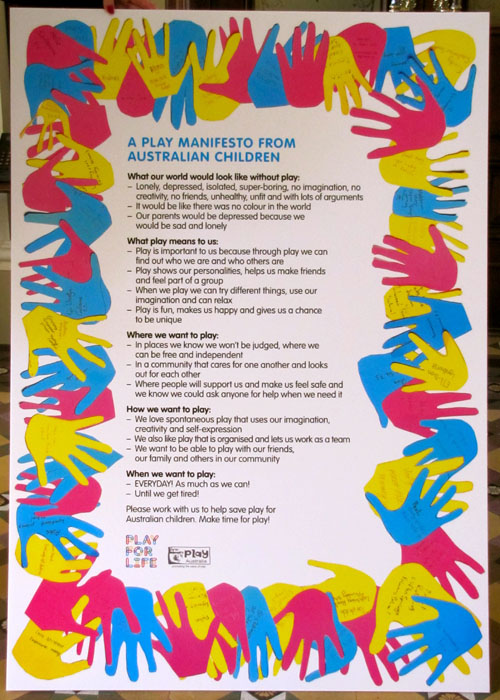
Australian Children’s Play Manifesto Poster

Play Based Learning in Australia is sharing a poster that captures the play manifesto of its children; how awesome!

After the overwhelming reaction to the success of the Australian Children’s Play Summit held in Melbourne on May 17th and 18th 2012 Play for Life Australia is kindly making available a copy of the Play Manifesto created BY Australian children FOR Australian children as a download. Play for Life believes that if we put the future of PLAY back into the hands of Australia’s children, then PLAY will be in very good hands!

Visit the original site for the full size poster.

anthropology · behavior · health · learning · mental health · psychology

I will be speaking on play this Friday, July 20, in Seattle at Parkour Visions

Me showing my serious anthropologist side.

Hi everyone. Just a little self-promotion, plus some promotion for a great organization:

I have been asked to speak this Friday, July 20, at 7:20 pm about play and parkour, at the 3rd annual Parkour Summit hosted by Parkour Visions in Seattle, WA.

As some of you know,  I received my MA in Anthropology this past winter, which focused on play and parkour. My play research has included studies of human-gorilla interaction at Woodland Park Zoo in Seattle, the primary physical play behaviors found in all primates (including traceurs), and how traceurs redefine and interact with space in new and creative ways.

Full disclosure, I have also been an advisory board member for the Pacific Northwest Parkour Association (the nonprofit behind Parkour Visions) since 2006, when it was having board meetings in my kitchen and I would feed all the board members banana coconut pancakes.

I have been asked by Parkour Visions to discuss my findings about parkour and play, why play is vitally important across the human lifespan for physical and mental health, what human play looks like, and how parkour reflects and answers the need for lifelong play.

There will also be lots of other great speakers talking about how movement plays into health in other ways than just strong muscles, including gut health, mental health, and long life, and ways to incorporate movement and play into ones lives. See a list of speakers here. The talks will be after a community dinner, so if you’re interested you can also bring $5 or a plate of something healthy (think fruit or meat) starting at 5pm, and mingle with the speakers before the talk.

The summit also includes an invitational competition of some of the best traceurs in the world, which is free to the public, on Saturday morning, so if you can’t come to the talk please come by and check out these amazing athletes. There are lots of other events taking place, so check out the itinerary and see if there’s something that sparks your interest.

I look forward to seeing you there!

architecture · community · environment · happiness · health

Parks Are the Foundation for New York City’s Future

Interesting initiative by New York’s Mayor Bloomberg. Nice to see his health campaign includes parks and open spaces.

Unknown's avatar

Interesting initiative by New York’s Mayor Bloomberg. Nice to see his health campaign includes parks and open spaces.

View original post

children · creativity · education · emotion · environment · happiness · health · play · psychology · Social

Exploration of Playful Learning Spaces for Children

toys
toys (Photo credit: red5standingby)

From the blog Art Farm, a play/art therapist who offers some advice on creating spaces that encourage kids to explore, learn and play:

I really learned the importance of organizing and preparing spaces while working with youth in school settings in several public housing developments in Chicago.  So often these youth would come to me (for either individual or group art therapy sessions) filled with anxieties which either manifested as acting out or withdrawn behaviors. The arrangement and presentation of the private space we used was a powerful, non-verbal message to them stating that all things are respected here – including you; everything has a place here – including you; and everything you will need to have a successful experience is here – starting with you.

[Mariah] Bruehl offers some questions to ask when designing a space for your own child:

  • Can your child access the materials in the play space independently? Are they organized in baskets or bins that are clearly labeled so your child knows how and where to put things away when finished with them?
  • Are the materials presented in an attractive manner that invites your child to use them?
  • Do the materials, toys, and games represent a balance between your child’s and your own preferences? Do they represent what you value and thus encourage your child to engage in activities that you feel good about?
  • What is your child currently interested in? If your child no longer plays with dinosaurs, but has been talking a lot about birds, make sure that the play space reflects this current passion. Rotating toys is a great way to keep your child interested in play space activities and ultimately prolongs the life of your child’s playthings. It never ceases to amaze me how excited my girls get about a toy that comes back into rotation. The nostalgia they feel toward a toy they have not seen in a while is almost more than their delight over a brand-new toy.
  • Is the play space a calming environment that allows one to focus on the task at hand without distracting colors, decorations, or objects?
  • Are you seeing things from you child’s perspective? Put yourself in your child’s shoes to determine the right height for displaying and storing materials and hanging art.
  • Is this a space that makes you want to make art, explore science, write stories, and more? If so, would you have everything you need to do what you want to do? What else would you add to enrich and deepen your child’s learning experience in the play space?

What other playful space researchers are out there? Any recommendations? I know about the organization Art With Heart, which focuses on creating therapeutic resources for sick kids. But I’d love to hear more about what’s out there. Let me know in the comments below.

behavior · environment · health · play

Create Time and Space in your Day to Play

Play Hooky
Play can involve just sitting in a quiet spot and thinking about the world (Photo credit: Pensiero)

I was introduced to Seattle-based, play-based Jungian therapist Mary Alice Long, PhD, who is the creator of Play=Peace . Her latest article focuses on the different ways that people create play in their lives (found via Seriously! The Future Depends on Play.):

There are as many ways to play as there are people. You might take a morning walk and make discoveries with new eyes. Be a traveler in your city and visit a museum, gallery, or park you have never been to before. Put a date on your calendar to attend a local parade or arts festival with friends. People watch at the farmers market. Once you get started the playful ideas are endless.

Read the full blog post here. (Full copyright Mary Alice Long.)

I like how Long is emphasizing the less physical ways to play, and instead focusing on interacting and being aware of one’s environment, which can often be very playful but not quite as active or aggressive as more

traditionally thought of kinds of play. So often people think that play is only about kicking a ball around the field, and while I don’t think Americans get nearly enough exercise, I do feel that these quieter, more introspective types of play can get overlooked.

What’s your favorite kind of “quiet” or more imagination-focused play? I love people-watching, making up stories about people, attending festivals, or just observing nature. Leave your favorite ways in the comments below.

architecture · design · environment · health · Nature

China’s architects work to preserve natural environment

It is great to hear that Chinese architects and planners are working to retain and or restore the natural environment and beauty of China. And great to hear that Chinese government is more open to preservation rather than focusing purely on “progress.” Restoring and/or preserving the environment is good for China’s people’s physical and mental well-being, and healthier for the world at large.

Unknown's avatar

It is great to hear that Chinese architects and planners are working to retain and or restore the natural environment and beauty of China. And great to hear that Chinese government is more open to preservation rather than focusing purely on “progress.” Restoring and/or preserving the environment is good for China’s people’s physical and mental… Continue reading China’s architects work to preserve natural environment

View original post

architecture · behavior · community · creativity · environment · happiness · health · play · Social

Adults for playgrounds? Yes, please!

Playground
Grown-ups often need a little more persuasion to play than kids. (Photo credit: phalinn)

Earlier this week I brought up the importance of spaces for play in the city, and then yesterday mentioned a scientific study that used traceurs or people who practice parkour, a sport that basically makes any space into a play space. Unfortunately park playgrounds are often verboten to grown-ups without a kid companion. But often grown-ups like the play equipment, or similar play equipment, as much as kids do. Now, the cities of New York and Detroit are determining where and whether to put in playgrounds specifically for adults:

New York City is installing adult playgrounds for fitness-hungry grown-ups, touting the benefits of a grade-school workout. …the Big Apple parks are geared more toward workouts than whiling away the summer hours. There aren’t any slides or swings yet at these outdoor gyms.

The City of New York built its first adult playground in the Bronx’s Macomb Dam Park. The New York Times reports as many as 24 playplaces for grown-up kids could be installed by 2014.

In Europe, where playtime seems to be more a more capricious venture, adult playgrounds tempt grown-ups to get off the couch with detailed outdoor mazes, rock climbing walls, elephant slides and swimming canals.

Philip Lauri is the founder of Detroit Lives!, the media company with the mission of bringing creativity to the streets of Detroit (through an apparel line, murals and the “After The Factory” documentary). Detroit Lives! has recently started experimenting with making places in the city that inspire that same joie de vivre and fun — like the Georgia Street Community Collective’s remote-control racetrack for kids living in the nonprofit’s target neighborhood. He thinks adult playgrounds could be smart additions to neighborhoods who have already installed thriving community gardens.

“In those areas, we install an adult playground as an addendum to that successful effort, and use the kind of neighborhood engagement that the garden created to successfully initiate the adult playground,” Lauri wrote. “Then, both sites grow with participation and we get healthier people and neighborhoods. That’s a simplified progression, but still tangible enough to act upon quite quickly.”

Most people taking the Huffington Post poll are all for adult playgrounds.

In some ways I find it sad that we need to create playgrounds specifically for grown-ups. Don’t we teach our kids to share and cooperate? But, in many ways it makes sense: for one thing, adults are bigger and therefore need different sized equipment. They also tend to play rougher, more competitively, and less cooperatively than children (according to numerous studies I’ll find and source later), so keeping the two play groups separated is probably a safer idea. Finally, grown-ups also need to be given explicit permission to goof off, at least much more so than kids, so giving them a space devoted entirely to play will help them get creative and playful in their movement.

What kind of equipment would you want on an adult playground? Rope swings? Fireman’s pole? Leave your thoughts in the comments below?

behavior · brain · community · culture · emotion · environment · happiness · health · Social · technology

Crowdsourcing Quiet Spaces in the City

For the past month I have been staying in a surprisingly noisy apartment. The neighborhood itself is very quiet, but just my luck to be staying over a night club and all-night grocery store. After this month the importance of being able to find quiet, peaceful places in a city rings all the more true and important to me (and it’s not just the ringing in my ears). From Inhabitat:

Cities have always been bustling environments, and with more and more of us living in them it can be difficult to find a quite place to relax or contemplate. Sound Artist Jason Sweeney‘s winning proposal for the TED Imagining the City 2.0 Prize is a crowdsourcing project that seeks to locate and map the places that provide silence in the urban din. The Stereopublic Project will be a public guide for those who crave a retreat from the crowds.

Based in Melbourn’s city center, Sweeney found himself attracted to tucked-in corners, where the city’s sound fades into the background and where the built environment is experienced as a sound environment. Inspired by his own experiences, he’s looking to create a platform where others can geo-tag and share their favorite quiet space. Sweeney is interested in helping those who are sensitive to noises, with disabilities, or just seeking respite from the constant din of the streets.

The TED City 2.0 prize will help his team develop a digital tool for crowdsourcing those places, adding a new layer of awareness to the cityscape for its occupants.

Cities are large, complex environments and the project is a unique way to understand the acoustic dynamic of city life. Stereopublic is based on active users sharing their findings, but ironically, the project’s success will likely make those quiet spaces busier, further pushing inhabitants to explore new places. The idea may become a failed experiment if it becomes too successful, but it also very well might help create new venues that improve the “sonic health” of a city — adding a vital resource to urban life.

Know of a quiet place in your city? Add it to the list, or leave it in the comments below and I’ll add it for you and if it’s in the Pacific Northwest may just try it out first. You know, for research).
anthropology · architecture · children · creativity · design · environment · health · Social · technology

6 Future Playgrounds That Harness Kids’ Energy While They Play | Co.Exist

What a great series from Co.Exist and Fast Company: play grounds, and other structures, that harness the energy of people’s movement. This may be the first time employees are actively encouraged to move around all day. 🙂

Kids have boundless energy. What if that energy could be put to some use besides just running around and having a good time. These new jungle gyms convert play to power.

When IBM came up with a list in 2011 of the five technologies it thinks will change the world in five years, kinetic energy–power from people–topped the list. Advancements could come, they say, from developments in devices that might harvest power from your shoes, your exercise, and even the soccer ball you kick. Green gyms are also cropping up. And now the idea has come to playgrounds, where kids’ movement can be harnessed and funneled into powering schools and toys.

Natural Energy Park
Natural Energy Park

This playground–designed by Hyundai engineering and construction–is part jungle gym and part renewable energy science experiment. After climbing a ladder into a laboratory, kids can spin a wheel that will illuminate “Benjamin Franklin’s kite.” An optical illusion will spin at varying speeds as children adjust a solar panel to different angles. Pedaling a bicycle powers a pinwheel and illuminates lights around the structure. Hyundai calls this the “Natural Energy Park” and it looks like a lot of fun.

Empower Playground
Empower Playground

Mixing fun and helping people, Empower Playgrounds is a non-profit organization that provides electricity-generating

playground equipment to villages in Ghana that are too remote to be on their nation’s electricity grid. The school children gain a playground as well as safe, rechargeable LED lanterns to light their homes so they can do their homework. Additionally, the play equipment doubles as part of a hands-on science lab that brings science concepts into their daily lives

See the whole series here.

For more on the future of playgrounds, check out 8 insane playgrounds, schools, and libraries of the future.

Know of other playful energy producers? Let us know in the comments below!