architecture · behavior · community · creativity · culture · environment · family · happiness · health · play · Social

Cities’ Message to Young Families: Play and Stay – WSJ

City planners are finally starting to grok that in order to keep residents, they will need to offer the whole package, including playful spaces for everyone, kids and grown-ups alike.

About a decade ago, the so-called creative class of 20somethings fueled the revival of urban centers by settling in downtown areas mixing condos and coffee shops. Now, as millennials and other urbanites have children, their needs are changing. Cities want to hold on to them by becoming more “playable,” for both children and adults.

For decades, cities “relegated kids to the playground and said, ‘We’ve done something for you,’ ” says Darell Hammond, chief executive of Washington, D.C. nonprofit KaBOOM!, which consults with city officials on promoting and preserving play. “The whole city should be a playground, and play should happen everywhere.”

That means not only building more parks and bike paths but also incorporating the ideas of “fun” and “play” throughout a city, whether it is musical swings downtown Montreal, a hopscotch crosswalk in an arts district Baltimore or camp sites on a city lake front Chicago.

more via Cities’ Message to Young Families: Play and Stay – WSJ.

I hope that this attitude shift from city planners and designers makes it more acceptable for grown-ups to go out and play, and I mean actually physically play, not just go to bars and concerts that were traditionally classified as the only acceptable adult “play.” Seattle and Portland, and  are definitely accepting and encouraging of grown-ups playing bike polo in city parks or just going for a run. Creating an environment that welcomes play also helps change the attitude of others

children · environment · happiness · health · learning · mental health · Nature · neuroscience · play

IS PLAY THE KEY TO ECO-ACTION? : Children & Nature Network

Environmental Psychology and conservationists have, for awhile now, been advocating the importance of letting children get out and play in and with nature to educate them on the value of preserving their environment and benefiting from natural surroundings. It’s nice to see pediatricians also start to embrace and advocate for the need for everyone, including children, get outside and get dirty.

Dr. Lawrence Rosen writes that throughout his practice, seeing children on a daily basis, “I’m often reminded of Winslow Homer’s 1872 painting, “Snap the Whip,” depicting boys playing with abandon in a field outside their rural schoolhouse.”

So eloquently portrayed is the simplicity of another time, kids out in the natural world for no other purpose than to play, freely and without a care in the world.Contrast this with contemporary schoolyards with their meticulously designed jungle gyms and artificial surfacing, often empty throughout the day as more and more schools abolish recess or replace free play with highly structured, adult-supervised activities. I’ve realized, as I see increasingly anxious and depressed children come to my office looking for guidance, that the answers often lie not in my prescription pad but outside my window.

One very recent publication from Dr. Kirsten Beyer and associates at the Medical College of Wisconsin described the influence of green space on mental health outcomes, concluding that “higher levels of neighborhood green space were associated with significantly lower levels of symptomology for depression, anxiety and stress” and that “’greening’ could be a potential population mental health improvement strategy in the United States.”

read more from Dr. Rosen via IS HAPPINESS THE KEY TO ECO-ACTION? : The New Nature Movement.

community · culture · emotion · happiness

The World’s Happiest Places, Visualized | Fast Company

Trying to compare “happiness” metrics can be tricky, both because different countries and reports measure “happiness” in different ways, and because a spreadsheet of numbers isn’t all that inspiring (and I work with them, so speaking from personal experience).

I like the fact that they’re using multiple data points to quantify happiness (although it looks more like quality of life, but they definitely overlap).

Data viz wunderkind Moritz Stefaner has been on a happiness kick lately. Earlier this year, he analyzed the data of more than 3,000 images to try to determine the happiness of people New York, Bangkok, Moscow, São Paolo, and Berlin, according to their selfies. And now he’s back, visualizing the happiness of the entire world–using a more objective data source.

Founded in 1961, the Organisation for Economic Co-operation and Development (OECD) is an international policy organization dedicated to stimulating economic progress and world trade. As part of their mission, the OECD has worked to quantify happiness and well-being through their Better Life Initiative, which ranks countries and cities according to metrics such as health, safety, education, jobs, environmental quality, civic engagement, and level of disposable income. Now Stefaner and Dominikus Baur have teamed up with the OECD to visualize this data using a slick, interactive online tool.

Happiness index of France and similar regions

The OECD Regional Well-Being Index tool is easy to use. It asks to access your location, and then visualizes the well-being index of your state or country as a rainbow-hued star, each Pantone-coded arm of which represents one factor of happiness and well-being. You can drill down for more detail, or compare your region’s well-being index to other locations with similar ratings.

Check out how your own neighborhood compares on the OECD Regional Well-Being Index here.

more via Fast Company: The World’s Happiest Places, Visualized

behavior · creativity · culture · happiness · Social

10 Ways to Make Your Life More Playful

As we start summer, remember to spend some time playing! Here are 10 tips how.

“We don’t stop playing because we grow old; we grow old because we stop playing.” ~George Bernard Shaw

I was 25 and traveling through Ireland by myself. I was in Cong, a rural small town outside of Galway. It was quiet. Very quiet. Even though I had met people on my trip, I was starting to feel lonely.

I was thousands of miles from home. I had nobody around who knew me well or cared for me, and in the days before cell phones or internet cafes, I couldn’t just get in touch with my friends or family at the drop of a hat.I went on a walk in a local park, along a wide stream that emptied into a small, pristine pond. The weather was grey and gloomy, the park was damp and romantic-looking, with its bending trees and dark water.

On a whim, I sat down by the edge of the pond and began to do something I hadn’t done in probably 15 years: I started to build a fairy village out of sticks, pebbles, and leaves.As a child I had practically lived in the backyard, building intricate tiny villages, exploring the spaces in between plants and trees, making tree roots into cottages and lumps of mud into hillsides.

It calmed me down and got me away from sometimes troubling thoughts. In Ireland, I found the same thing happened: My loneliness and anxiety vanished, and an hour or so later when I finished, I felt better: lighter, and less worried.

read all about the 10 Ways to Make Your Life More Playful.

anthropology · behavior · brain · children · community · culture · education · environment · happiness · health · learning · play · psychology · Social

Plug for the NGO Right to Play

I tweeted about this short film yesterday, but I really feel like this is worth giving some space on the blog for.

The value of play is important for teaching life skills like conflict resolution and collaboration, health lessons, healing from trauma, building community and just overall survival as a child and human being, the work this organization does seems simple but is hugely important.

This short video highlights some of the incredible impact that play can have on a child, or group of children.

You can also visit the organization’s website at Right to Play.

Play matters!


behavior · brain · cognition · creativity · environment · happiness · health · Nature · work

Why You Should Take Your Work Outdoors

Happy Friday. I got to start off my work day sitting on my back patio drinking coffee. Here’s why more people should do the same.

Do you feel stifled by the four walls of your office or cubicle?

There’s a reason for that.

Trapping ourselves indoors has created what health experts call a “nature deficit disorder” — depression or anxiety resulting from too little time spend outside. Getting outdoors can do great things for your health. Reducing stress, lowering blood pressure and improving immune function are among nature’s health benefits. What’s more, incorporating elements of nature into your workday can also give your brain a boost, resulting in increased productivity, focus and creativity.

Harvard physician Eva M. Selhub, co-author of Your Brain on Nature, says a drop of nature is like a drop of morphine to the brain, since it “stimulates reward neurons in your brain. It turns off the stress response which means you have lower cortisol levels, lower heart rate and blood pressure and improved immune response.”

Turning off the sensors that are involved in the stress response allows the higher brain centers to be accessed, resulting in increased concentration, improved memory, greater creativity and productivity and reduced mental fatigue. While Selhub says spending 20 minutes a day outdoors is recommended, studies have shown even looking at photographs of nature can deliver some of the same cognitive benefits as physically being outdoors. A 2008 study at the University of Michigan showed students who looked at photos of nature performed better on tests of attention and working memory than those who looked at photographs of urban scenes.

More reasons, and tips how, via Entrepreneur Magazine

behavior · environment · happiness · health · mental health · Nature · play

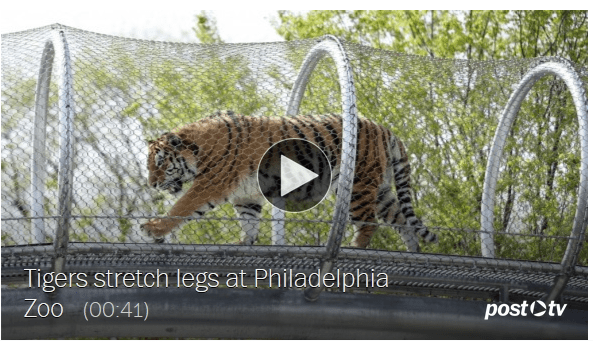
Philadelphia Zoo lets tigers stretch legs on trail – The Washington Post

THIS. IS. SO. COOL!

Not just for visitors, but for the animals!

tiger shot

Visitors to the Philadelphia Zoo might want to beware of stray cats: A new enclosed passageway allows lions and tigers to roam outside their exhibits.

Humans, though, can safely gawk at the predators traveling along Big Cat Crossing. The protected, open-air path snakes above the felines’ habitat to an archway over the zoo’s main promenade and ends at a viewing spot along a lake.

The concept for the catwalk unveiled Wednesday stems from the increasingly common practice of animal rotation, which lets animals take in new stimuli while visitors encounter them in unexpected places.

more via Philadelphia Zoo lets tigers stretch legs on trail – The Washington Post.

Big carnivores are roamers, and prefer to have lots of space to patrol. Being able to get a cat’s eye view of their zoo is so much healthier for them, and gives them the enrichment and psychological and physical space they need to stay healthy.

I had heard about the plans to create this space, so it’s really nice to see it implemented and in action.

behavior · brain · children · cognition · creativity · culture · happiness · health · mental health · psychology · Social

20+ Drawing Ideas and Activities | picklebums.com

Staying playful and creative sometimes requires going back to your roots, or at least your crayons. Drawing, scribbling, doodling, and coloring have all been found to help with destressing, thinking out ideas and problems, and keep brains active into old age.

Drawing is also a great learning activity with lots of fine motor skill and development, problem solving, language development and social learning opportunities… (Editor’s note: all of which tie into the above-mentioned benefits, and these skills are all useful for both grownups and kids to practice and refresh on a regular basis).

Drawing is a way for children everyone to process their world, to represent and share their ideas and to explore new skills and information.

Drawing with Geometry Tools
Graph Paper Drawing
Graph Paper Drawing
Collaborative Doodle Drawings

see all 20+ Drawing Ideas and Activities at picklebums.com.

If you think this is just “kid’s stuff” I dare you to try some of these, especially the collaborative drawing exercise. It’ll (potentially) expose some growth areas of yourself and/or others very quickly. 😛

behavior · community · creativity · culture · environment · happiness · play

An Artist’s Quest: To Force Strangers In Cities To Talk To One Another | Co.Exist

Sometimes all it takes is one person to start a neighborhood to start talking and engaging with one another. Someone moves in and throws an open house. Or even a garage sale. So how can art, or an artist, inject “love and play” into a community, particularly when the younger generations trust each other less than ever before?

San Francisco-based artist Hunter Franks is on a three-week mission across several different cities to explore just that, and hopefully get some “creative intervention” going in these urban areas.

An Artist's Quest: To Force Strangers In Cities To Talk To One Another | Co.Exist | ideas + impact

One Franks’s planned activities is something called “Vacant Love,” which aims to transform abandoned or neglected buildings with messages of affection. Another, called the “Free Portrait Project” asks residents to sit for a Polaroid photo taken by Franks, and during the 120 seconds it takes for the picture to develop, entertain a brief interview about their lives. Other interventions include two-way advice booths, for citizens to both give and take advice from one another, as well as an activity that asks people to write sticky notes about their loves and fears on a public wall. Franks will also be expanding his SF Postcard Project, in which he gathered postcards written from low-income San Francisco neighborhoods and mailed them to homes in ritzier ZIP codes.

more via An Artist’s Quest: To Force Strangers In Cities To Talk To One Another | Co.Exist | ideas + impact.

What activities have you seen, or even been engaged in, that got a neighborhood members involved and communicating? For some, even a Little Free Library can get the ball rolling. Tell us your experiences in the comments below.

behavior · happiness · play

The Secret Lives Of Cows: Jumping For Joy : The Salt : NPR

People often interpret animal behaviors as one thing when in fact it’s something different. But in this case, frolicking is indeed frolicking.

It turns out “cows love a change of scenery. And a switch from the concrete floors of the indoors to a soft green pasture would surely help break a bovine’s winter blues.

In fact, cows are suckers for novelty, adds de Passille’s colleague, . They get an extra spring or leap in their step “whenever something new or unexpected happens,” he says – say, changing their bedding or letting them out or back in. “We think it’s a sign that things are well with them.”

more via The Secret Lives Of Cows: Jumping For Joy : The Salt : NPR.