There are people who get paid to come up with games and toys for animals. Just like people, animals need something to do all day to keep themselves fit and healthy, both mentally and physically. This has been dubbed “enrichment” by people who study this kind of thing, but it basically is just looking at ways to encourage animals to play.
This weekend enrichment experts are all getting together to discuss different ways to provide better enrichment (i.e. toys, games, crossword puzzles) for animals that live in zoos, aquariums, research centers, and so on.
I am sorry I am missing this conference; it sounds amazing!
The mission of the ICEE is to improve the wellbeing of captive animals by providing a venue for the exchange of information among the many diverse groups that participate in environmental enrichment. A key feature of the ICEE is the participation and interaction of animal welfare scientists and all those responsible for the care of captive animals. To further this mission, the ICEE Committee organizes a biennial conference, with published proceedings, in locations around the globe.
I wish I could go, but I’m doing a little bit of self-enrichment this weekend so am otherwise engaged (plus $400 is a bit steep for me), so I will just lurk on the website for awhile and see what updates pop up. OR, if you’re going you could post in the comments and let me know what I missed? Or, even better, if you know of other events coming up soon, share them here! Thanks!
Social media keeps us connected with friends, but for some can be detrimental to everyday life. Image via Wikipedia
I love being able to connect to old friends, classmates, and coworkers via social media, as well as share thoughts, ideas, and new developments. But some people can take it too far, and while I have my weaknesses as much as the next gal, I don’t think I’d consider myself addicted as they describe it. Apparently people can receive intense highs from the social interactions and feel like they need a “fix” if they go on too long without checking in to one of their social media networks.
When you hear the word ‘addiction’ perhaps you think of alcohol, drugs and sex. But what about social media? Over recent years there’s been an emergence of studies into social media as a new form of addiction.
Research by Retrevo Gadgetology looked into how people use social networking sites. Out of those asked, 45% said they check Facebook or Twitter after getting into bed. People under the age of 25 were the more extreme with 19% saying they log on any time they wake up during the night, 27% said they sometimes check when they wake up during the night and 32% check in first thing in a morning.
To me this indicates just how detached and isolated many of us are, that instead of going to a local gathering or even a bar or club when we’re feeling lonely, we go online. It’s been shown that Americans feel more isolated and alone than at any other time in our history (or at least history of checking for this kind of thing), and I would hypothesize we’re turning to these social media networks as some way to retain communities we’ve established in other physical locales, or create new ones that are entirely virtual. I also wonder if the meta-interaction makes people feel less fulfilled than dealing with people in real, physical life and make them anxious to get more. I believe social media networks are useful, no doubt, but I do wonder if we are using them as a crutch rather than actually meeting people in person. Granted a lot of social media sites encourage actual in-person meetings, from online dating sites to the new GrubwithUs startup that acts as matchmaker for hungry social types in various cities across the U.S.
What are your thoughts about social media networks and people who can’t seem to unplug from them? Leave your thoughts and/or experiences in the comments below.
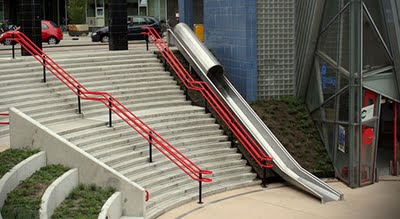
Leave it to the Dutch to install a slide in a subway station. Commuters are encouraged to use it if they’re running late, and the official name is a “transfer accelerator.” At night they play Bach. How rad is that?!
I love the idea of putting a little fun in your commute, in the community, and just keeping your environment fun in general.
Where else have you seen a little fun put into everyday surroundings? I’ve posted about the musical stairs before, but what else is out there? Some silly graffiti? Colorful cars? Share in the comments below.
Being part of a social group at work provides a pillar of support. Image via Wikipedia
Company culture seems to be this ethereal idea that no one can really wrap their head around, but “they know it when they see it.” They also know that employees having a strong connection with peers at work and a social buy-in to their employer promotes loyalty, worker productivity, and less absenteeism. This is an interesting profile of one aspect of Google’s work culture and community – creating mini support groups and internal communities.
Groups have always been an integral aspect of life at Google, but as the company approaches 30,000 employees, they have become an ever more critical mooring for new and veteran employees at a company trying to assimilate “Nooglers” at a pace of more than 100 a week. Many valley companies have groups for employee minority or cultural groups, but Google goes further, actively encouraging, and sometimes evenAdvertisementproviding financial support, for employees to organize special-interest groups ranging from economic theory to photography.
Google has 19 “Employee Resource Groups” or ERGs, employee-initiated entities that receive
financial support from the company and represent social, cultural or
minority groups…
The article goes on to point out, and this should be a no brainer, that having a healthy, enriching work environment is also crucial to overall individual wellness and work fulfillment. Many companies are afraid to let their teams “goof off.” Maybe they should consider it “Googling off.”
Countries with national health care. Does it make them happy? Image via Wikipedia
Turns out Americans aren’t so happy right now; we didn’t even make it into the top ten. In fact, eight of the top ten happiest nations are in Europe.
There is more to happiness than raw economic growth. What happens when you measure countries by employment, health care, and life satisfaction? The United States and Europe run in opposite directions.
#1: Denmark
Employment Score: 5th Self-Reported Health:15th Employees Working Long Hours: 3rd Disposable Income:18th Educational Attainment: 18th Life Expectancy: 25th
I was surprised to see that Danes worked some of the longest hours of all the nations polled. They also didn’t score super high on life expectancy or disposable income.
#2, Canada, had a seemingly more balanced ranking, ranking tenth in long hours worked and 2nd for self-reported health. Norway at #3 also had pretty good scores all around.
What are the real keys to a fulfilling career? Image via Wikipedia
As a child growing up smooshed in between the “Me” generation and the Millenials, I have always been told that I could be whatever I wanted when I grew up, and to follow my passion; pursue my dreams and the money will follow. After going to college, getting a real job, going back to college, and getting several other jobs, it started to dawn on me that this whole “pursue your dream” thing might not be the best strategy after all, (although I wouldn’t say I’ve completely abandoned the idea). So I was intrigued when I read this post from the blog Study Hacks by David Shenk, full-on condoning this sneaking suspicion I’ve had for awhile.
For the past couple years I’ve been advancing a controversial argument: “follow your passion” is bad advice.
I’m not against feeling passionate about your work — in fact, I think this is a fantastic goal. But from my experience studying this issue, passion is not something that you discover and then match a job to; it is, instead, something that grows over time along with your skills.
In other words, working right trumps finding the right work.
“College grads are often sent out into the world amid rapturous talk of limitless possibilities. But this talk is of no help to the central business of adulthood, finding serious things to tie yourself down to.”
It’s nice that “grown-ups” are finally acknowledging that we’re not all going to grow up to rock stars or astronauts. That there needs to be more behind “finding your passion” in order to succeed in a competitive capitalist market structure.
However, my vision is slightly skewed, because of how many people in my family DID follow their passions. My mom, my dad, two of my cousins, my husband, my mother-in-law, and multiple siblings-in-law, all of them made money at one point in their lives (or continue to) doing what they loved, following what was their “passion” at the time. Only a couple of them have made much money doing it, and many of them eventually got “real jobs.” But still, many of my family members were able to turn their passions into a career.
So I think there IS a part of the equation where passion is important; if the subject matter doesn’t interest you, then you’re asking for a looooong slog. The difference between their success and others’ failures, I think, is that they weren’t just “following” their dream; they all actively pursued it! They wrote up business plans and proposals. They sold their cars and slept of friends’ sofas and lived off of beans and rice while they got started. Maybe they were only able to pursue it part-time because they had to take a “real” job to pay rent. When more training was needed they got it. When long nights were needed, they put them in.
I think the idea is we are more motivated to put these long hours in if we are passionate about something. However, I do think both Brooks and Shenk are also right in that it is NOT always fun, it is NOT always easy, and there is realistically more value in dedicating yourself to what you are doing right now!
Another factor is prioritizing what’s important to you, including your time. In the world of the desk job and remote access, there is more flexibility. I think it is harder to be dedicated to something than simply passionate about it. Stenk has a great post from last year about how to love your career. I’m sure I’m butchering the message, but basically it comes down to
feeling like you have control of your own destiny,
you’re making a difference (in any small way),
and that you’re good at what you do.
That certainly matches up with the most successful entrepreneurs in my family. They valued the autonomy over their lives, and they were GOOD at what they did, but it came from years of training and hard work.
It definitely adds some much-needed perspective to the question, “what do you want to be when you grow up?”
This month, kick your self-maintenance into high gear! Image via Wikipedia
Interested in joining me for a little “me” time? How about a whole month of it?
My mother and I have decided that for June, 2011, we are going to be totally self-centered. That’s right, we are going to focus entirely on ourselves; our health, our mental wellness, our physical fitness, taking time for ourselves, and figuring out what we want out of life. Neither one of us is very good at this kind of self-focused behavior, so it will be an interesting experiment to see if we can both pull it off.
So far I have done pretty good: I woke up early and did a productive, challenging workout, I have eaten quite healthy meals (oatmeal with raisins and a tuna salad, thank you very much!), did not spend an exhorbitant amount of time at work, tidied up some stuff online I’ve been meaning to do, finally asked my boss about a couple of nagging issues, and am planning to spend time doing fun stuff with my husband before going to bed at a reasonable hour. I actually started a day early yesterday and bought new clothes (some new, some new-to-me) that made me look and feel good, and had a decent dinner. Pretty good track record for only a day and a half.
I invite everyone to join me for “Me” month. If you can’t do a whole month, maybe choose a week. Or even one day a week. This isn’t about indulging in your every whim or being hedonistic or a narcissist. It’s about taking care of yourself for an extended period of time. Getting enough sleep. Eating healthy food, and not too much. Moving around, getting exercise. Figuring out who and what you want to spend more time on and DOING it!
We all have things we could be better at for self-maintenance, and often we take a lopsided approach. Some people focus entirely on what they put in their bodies, some only focus on how their body or mind performs, paying no attention to the other side. But we are all one big giant package of tissue and firing neurons, and all of it needs to be taken care of, not just the muscles OR the brain OR some other feature (your hair?).
Recently I asked what your deathbed regrets would be, so think of this as the next step: what can you do today to take better care of yourself, to make sure you don’t have those regrets, or at least delay that deathbed a bit more? I know some very healthy, well-rounded people, so I’m curious to see what they secretly think they need to work on.
Take some time to think about what your body and mind really need, unless you already know, and leave it in the comments below.
People's #1 deathbed regret: not being true to themselves. Image via Wikipedia
They say hindsight is 20/20, and I find it very informative to find out what people wish they had done or are very happy they did, either at the end of a school year or sitting in a rocking chair on a porch in retirement. So this bit of anecdotal evidence is interesting, and while none of the regrets are surprising it’s good affirmation of what people’s priorities in life should be.
…the following regrets were first posted in The Observer in 2010, and we’ve recopied them for you here below. But instead of just the grandmotherly bits of advice about dreams having gone unfulfilled, we’ve supplemented each regret with some rockstar advice on how to not have these regrets in the digital age.
1. I wish I’d had the courage to live a life true to myself, not the life others expected of me.
This was the most common regret of all. When people realise that their life is almost over and look back clearly on it, it is easy to see how many dreams have gone unfulfilled. Most people have had not honoured even a half of their dreams and had to die knowing that it was due to choices they had made, or not made.
It is very important to try and honour at least some of your dreams along the way. From the moment that you lose your health, it is too late. Health brings a freedom very few realise, until they no longer have it.
TNW Advice: We interview so many entrepreneurs here at The Next Web, some of whom will succeed, most of whom will fail. But it’s about going out and creating a reality out of what was once just an idea in your head.
What the five regrets basically constitute are making time for themselves, their friends and family, taking risks rather than playing it safe, and just giving space in their lives for happiness.
This is a really good exercise to do at any time, to see if you’re really living the life you want and what you can do to change it.
If you were told you were going to die tomorrow, this evening, whatever, what would your regrets be?
Mine would be:
1. Not taking that hiking vacation through Europe.
2. Not taking a sabbatical, more time for me.
3. Not finishing my thesis.
4. Not spending more time with my sister the last couple of years before she died, which translates into generally just spending more time with others I love before they kick the bucket.
View of Seattle's city skyline. In such a gorgeous part of the U.S., Seattle itself is lacking in pretty public spaces. Image via Wikipedia
In case y’all hadn’t noticed yet, I’m a huge proponent of utilizing public space for community use and creating an overall aesthetically pleasing environment for people. Cities have one of the greatest opportunities to provide that for their citizens. So I was thrilled when I read this article in Crosscut Magazine arguing the same thing, specifically for my hometown of Seattle.
Our landscape-oriented mindset should have been good preparation for what we need in the densifying city now, which is more design intelligence given to the open spaces between buildings — plazas, parklets, and awkward leftovers like the places under freeway overpasses. The more the air space around us becomes stuffed with architecture, the more acutely we need the relief of thoughtfully landscaped open spaces on the ground. Arguably, these spaces are more important in the built environment than most buildings because they’re public — people use them.
Or if they’re emotionally cold, dreary, or austere, people don’t use them, which is the case with a number of Seattle’s precious open spaces. On one of our desperately rare sunny spring days this month, I visited about a dozen open spaces in the dense city and found — no surprise — the bleak ones practically unused and the beautiful ones full of life. What is surprising is that we’re not demanding more graceful, humane, imaginative design — and raising hell over trends such as Seattle Parks and Rec’s inexplicable new fascination with concrete and gravel.
Helena Norberg-Hodge, director of "The Economics of Happiness" and founder of ISEC. Image via Wikipedia
I am a huge fan of buying local (although I could be a lot better at it). This film makes an interesting argument that buying local is not only good for the environment and the local economy, but also connects us back to our spiritual sense of community.
Economic globalization has led to a massive expansion in the scale and power of big business and banking. It has also worsened nearly every problem we face: fundamentalism and ethnic conflict; climate chaos and species extinction; financial instability and unemployment. There are personal costs too. For the majority of people on the planet, life is becoming increasingly stressful. We have less time for friends and family and we face mounting pressures at work.
The Economics of Happiness describes a world moving simultaneously in two opposing directions. On the one hand, an unholy alliance of governments and big business continues to promote globalization and the consolidation of corporate power. At the same time, people all over the world are resisting those policies, demanding a re-regulation of trade and finance—and, far from the old institutions of power, they’re starting to forge a very different future. Communities are coming together to re-build more human scale, ecological economies based on a new paradigm – an economics of localization.
I have seen this same community/spirituality argument proposed as well with farmers in Hawaii trying to preserve traditional knowledge of taro planting, as well as other indigenous groups in South and Central America, and all over the world, so it is interesting to see this documentary maker make the argument on a larger scale, saying it can benefit all of us. I tend to agree.
I also like the idea of “grandmother universities,” which fit in well with the current trend of DIYers.

 There are people who get paid to come up with games and toys for animals. Just like people, animals need something to do all day to keep themselves fit and healthy, both mentally and physically. This has been dubbed “enrichment” by people who study this kind of thing, but it basically is just looking at ways to encourage animals to play.


 Mental Flowers