Happy Friday! Have you been waiting all week for some fun? Why the wait? Why not get a quick giggle in now? All it takes is a little red piece of foam, and the ability to not take yourself too seriously. I saw this shared on Facebook and had to spread the good cheer.
Why The Nose is a movement in clown accessories laughter and clowning around:
Whythenose.com is dedicated to the act of wearing a clown nose everyday, in order to make people smile.
It’s here for YOU…to encourage you with an act of Heroic Uninhibited Innocence
It’s really that simple. In a world filled with distractions and distrust, you’d be amazed at how many people (of all ages) have lost a sense of childlike wonder. Or maybe you wouldn’t…
Wearing a clown nose is fun, it’s easy, and it’s free (if you already have the nose).
We’re not trying to sell anything, we’re only showing you how joyful it is to change someone’s day.
Trust us, the nose breaks through barriers and opens doors every time you wear it…give it a try!
This phenomenon of adults wearing silly noses has been seen around both the 2011 and 2012 Burning Man Festival and other playful grown-up events courtesy of Tex Allen, who according to the website is a “responsible burner” but also wants to encourage people to enjoy themselves and enjoy their lives. I honestly hope this becomes a movement beyond just the Burning Man circuit, although I don’t think you’d need to wear the nose all day to get the effect he’s looking; maybe just for a quick trip to the grocery store. Visit the website for videos of some high quality goofing off. Or visit them on their Facebook page to see who else is getting their silly on.
Check out the video from Burning Man 2011 for more examples and maybe some inspiration.
I recently posted about the Philadelphia Zoo’s plans to open up their overhead walkways to a variety of different mammals. Well now an aquarium in Tokyo has opened a similar skyway… for penguins!
The Sunshine Aquarium is the only place where you can see penguins fly (almost). -Inhabitat
At Tokyo’s Sunshine Aquarium, penguins are getting a taste of what flight might be like. The aquarium is currently hosting a special penguin exhibit that involves letting the penguins swim in the “Sunshine Aqua Ring”— which is normally reserved for the sea lions — for one hour each evening. So while they aren’t exactly taking flight, it’s still a unique way to view penguins that probably can’t be replicated anywhere else in the world.
On the roof, the open-air “Aqua Ring” is elevated about 7.5 feet off the ground, giving visitors an opportunity to view sea lions — and now penguins — swimming from beneath. (This videoshoes sea lions swimming laps in the Aqua Ring.) The “flying penguin” exhibit currently runs from 6:30 and 7:30 PM, and it is expected to run through September 2, 2012.
IF you just happen to be in Tokyo soon, do “fly” by and let me know what you think. This sounds like a great enrichment for the penguins as well as human visitors.
A good way to stay playful: be open to new creatures and experiences. (Photo credit: Wikipedia)
Happy Friday! Lately on Fridays I’ve been sharing my next great adventure destination, but this weekend that destination is staying put! And boy am I gonna have fun doing it! 🙂
For those of you who are also staying home this weekend and don’t know what to do about it, or maybe you had a loooooong week and you know you need to inject some fun into your day but your brain is so fried you can barely talk or type straight, here are some great suggestions from Remembering to Play. In fact, they recommend these tips for living an overall playful life, not just a playful day or two (although that is certainly a good start):
1. Play with movement: Children have a wider range of body expression than adults. We tend to move our bodies in the same, often rigid and predictable way. When walking down the street try moving your body differently. Start in small ways. Swing your hands in a different way, bounce your head from side to side, or shift your shoulders back and forth, one at a time. After a while try something bigger. Zig zag or walk backwards or sideways, or skip over the lines on the sidewalk. Or while walking in your office hallway twirl around one time…or perhaps more than once, tap the walls, or strut like you just made a million dollars for your organization! Walk like you are the bees knees…because you are!
2. Play with perspective: Instead of always looking straight ahead, or in your usual direction, look up or down, and in a direction you would not normally point your eyes. You may notice something different that you have never seen before. A bird, a lovely coloured leaf, a funny looking cloud, a happy couple cuddling. It is easy, especially in big cities, to point our nose to ground and plow forward. Let’s remember that life is not about getting there but rather enjoying the ride. As you point your eyes in new directions, you never know what you might see, and what may come about from this new perspective.
3. Play with words/conversation: Whether it is, How’s it going, How was your day, or our conventional ways of starting a Monday morning meeting, we have many verbal or conversational routines. It takes awareness and creativity to inject something new and fresh into the mix. For instance, instead of saying Hello to your friend, you could say Hey Hey, what do you say!? Instead of calling your friend by their name, give them an unexpected nickname. Call them Sunshine or Peaches. (For over three years, a friend and I have consistently called each other Steve. It still brings us and others a good chuckle!) Or start your meeting off by having everyone share the last time they had a really good laugh. Read Creative Connections for more ideas.
4. Play with your surroundings: What you surround yourself with either feeds or depletes your creative, authentic Self. How often do you watch the news? Is the TV blaring in the background? What books do you read? Do they inspire you? What colour are your walls and what pictures do you hang from them. What music do you listen to? Could you play more music in the background, say when cooking dinner or cleaning your home? Do you have plants, or earth coloured tones in your home? Who do you spend your time with? Do your friends support your playful, authentic Self? Can they hold space for the fullness of You? Part of living a playful life is creating the container for playful living, and this means being clear on what supports or does not support authentic living.
5. Play with diverse activities: As creatures of habit, it is easy to always order the same food, buy the same groceries, visit the same theatre and run the same route. Play means looking up when we normally look down, turning left when right is our regular choice. As we expand our range of choices and travel down new paths, we improve our brain functioning by building new neural pathways, and open to new possibilities. So instead of always seeing a movie, go to a live show instead. Instead of always eating the same meals, try to make one new meal a week. Join a class, take a spontaneous road trip, visit a local museum, volunteer your time for a good cause, talk to a homeless person, pay for your friend’s meal, stop to smell a flower, play with a dog that is waiting for its owner, organize a games night, or start a book club. Do one thing different and you never know who you might meet or what adventure may unfold!
6. Play with your smile: A single smile can change someone’s day for the better. I have experienced this when feeling a bit down, someone offers me a warm smile and suddenly I can feel my heart again. Life is not so bad anymore. In the same way that a picture is worth a thousand words, so too is a smile. So share your smile freely and fully. And share your smile with You as well. When feeling down, close your eyes and imagine a soft, warm, loving smile slowly appearing inside you. Allow it to get brighter, filling you with joy and light. Let your inner, playful spirit smile at you from the inside.
Soon this guy will be able to take his own self-guided tours of Philadelphia zoo. (Photo credit: epSos.de)
I am so excited about this I’m practically jumping out my seat to tell people. I first read about it in USA Today; animals are getting to wander outside of their exhibits, share spaces with other animals, and over all just chill around the zoo. Yup, that’s right:
The Philadelphia Zoo on Thursday opens the first leg of an ambitious enclosed trail system designed to allow large animals such as great apes, bears and big cats to roam throughout the zoo. It will give them access to one another’s habitats in a kind of time-share arrangement and offer visitors a closer look at wild animals behaving like wild animals.
Other U.S. zoos have created paths between exhibits, mixed habitats, elevated paths or rope swings for apes.
“This is an emerging trend” among zoos accredited by the Association of Zoos & Aquariums, says the group’s senior vice president for external affairs, Steve Feldman. “Great animal care means providing for animals’ physical and psychological welfare. These pathways and rotations really allow them that kind of stimulation.”
The Philadelphia Zoo’s program is the first to encompass the entire zoo. “This campus-wide effort to build this trail system is unique,” Feldman says. “It’s innovative and is really taking that trend to the next level.”
Because it’s the first effort of its kind, “we don’t have a road map to see how others have done it,” says Vik Dewan, the Philadelphia Zoo’s chief executive officer. The system “puts animal well-being first and foremost,” he says, and gives visitors “an experience here, that when combined with other experiences, paints the bigger picture of how they could be more effective stewards of the world.”
The critters will have to “timeshare” so the orangutans won’t be hanging out with the brown bears. In fact the bears might not get a chance to use the pathways until winter when it’s too cold for the primates. But that said, it’s sure to be a boon for the animals, as well as for the people. The zookeepers already report seeing a positive result from a similar vine system in their primate exhibit.
The article mentions other zoos starting to move in this direction. But which ones, and what exactly are they up to? I’m curious to learn more. Any hints? Leave them in the comments below.
animals given access to the new trail are expected to be more active and
to benefit from the stimulation of being able to see visitors and other
animals from a new perspective.
Scientists at the Fraunhofer Institute for Silicate Research in Germany have invented a new type of window that is conceived to improve concentration, regulate sleep, and even make you happier. The so-called “feel-good glass” has a special .1-micrometer-thick inorganic coating that is optimized to transmit wavelengths between 450 and 500 nanometers, where the effects of blue light are most pronounced. Blue light is the part of the spectrum which promotes the balance of biorhythm-moderating hormones (and which traditional glass largely blocks). “The coating we’ve developed helps people to feel they can perform better and makes it less likely they will fall ill,” Dr. Jörn Probst says.
Of course, you could soak up plenty of mood-enhancing light just by stepping outside. But given that Americans spend as much as 90% of their lives indoors, it makes perfect sense to welcome the healthiest aspects of the outdoors inside. The effects can even be felt in spaces criminally low on natural light, the researchers say; as long as there is at least one small window, blue light can creep in.
The patent-pending Uniglas | Vital feel-good glass isn’t on the market yet, and still requires some tinkering. Says researcher Walther Glaubitt: “Up to now we’ve only applied our special coating to the side of the glass facing into the cavity between panes. In future we will also be coating the glazing’s exposed surfaces–in other words, the outside and the inside of the window. That will allow us to achieve around 95 percent light transmissivity at 460 nanometers.”
Neato! I feel happier already! Of course I’m always an advocate of the real thing, but I also work in an office all day and know just how powerful a little sunshine on my shoulder can be for my productivity (unless it’s a REALLY nice day outside and then I’m about as productive as a surgeon with two left hands. Thankfully I’m also left-handed).
But until this glass becomes commercially available, your best bet for better health really is step outside and get a few minutes of sun every day – even 20 minutes daily makes a huge difference.
This is such a great commentary from Kaid Benfield’s Blog about the importance of trees for urban health and well-being that I just had to share:
…[recently] I was approached by someone from an initiative called San Diego County Trees. The initiative is the urban forestry project of the Energy Center, and they have all sorts of information extolling the benefits of urban trees along with a crowdsourced inventory of street trees in San Diego.
I just spent time on the website, where the coolest feature is an interactive map of the whole county showing very specific tree locations and information, including quantified benefits to the region stemming (pun unintended but acknowledged) from its trees. As you can see in the image, these include carbon sequestration, water retention, energy saved, and air pollutants reduced.
You can even click on a specific tree and get detailed information on its species, size, and annual economic benefit to the community. San Diego County Trees invites its readers to add to the inventory with information on additional trees not presently counted.
If you’re interested in the subject of the community benefits of trees, you can get additional information from the websites of the National Arbor Day Foundation and the US Forest Service. Among the tidbits I learned on one or the other of those two sites are these:
The net cooling effect of a young, healthy tree is equivalent to ten room-size air conditioners operating 20 hours a day.
If you plant a tree today on the west side of your home, in 5 years your energy bills should be 3 percent less. In 15 years the savings will be nearly 12 percent.
One acre of forest absorbs six tons of carbon dioxide and puts out four tons of oxygen.
A number of studies have shown that real estate agents and home buyers assign between 10 and 23 percent of the value of a residence to the trees on the property.
Surgery patients who could see a grove of deciduous trees recuperated faster and required less pain-killing medicine than matched patients who viewed only brick walls.
In one study, stands of trees reduced particulates by 9 to 13 percent, and the amount of dust reaching the ground was 27 to 42 percent less under a stand of trees than in an open area.
Several years ago, walkability guru Dan Burden wrote a detailed monograph titled 22 Benefits of Urban Street Trees. Among other things, he calculated that “for a planting cost of $250-600 (includes first 3 years of maintenance) a single street tree returns over $90,000 of direct benefits (not including aesthetic, social and natural) in the lifetime of the tree.” Burden cites data finding that street trees create slower and more appropriate urban traffic speeds, increase customer traffic to businesses, and obviate increments of costly drainage infrastructure. In at least one recent study (reported after Burden’s analysis), trees were even found to be associated with reduced crime.
I think some of the most important benefits, though, are felt emotionally…
I am a huge proponent of urban trees for all of the reasons stated above, as well as the emotional and psychological benefits that Benfield goes into, but also including the creative and playful benefits of having trees around to swing on, climb, watch animals in, or just sit and ponder under.
Benfield also goes into how trees are often controversial in urban environments because they drop leaves and sticks, and potentially branches, on streets and houses. But to me that is part of living connected to one’s environment, even if it means raking some leaves out of places you’d rather they not be (it’s not like the tree is intentionally dropping them on your lawn).
What are your feelings about urban trees? Have you planted a tree or shrub in your neighborhood? What did you like, or not like, about the results? Let me know in the comments below.
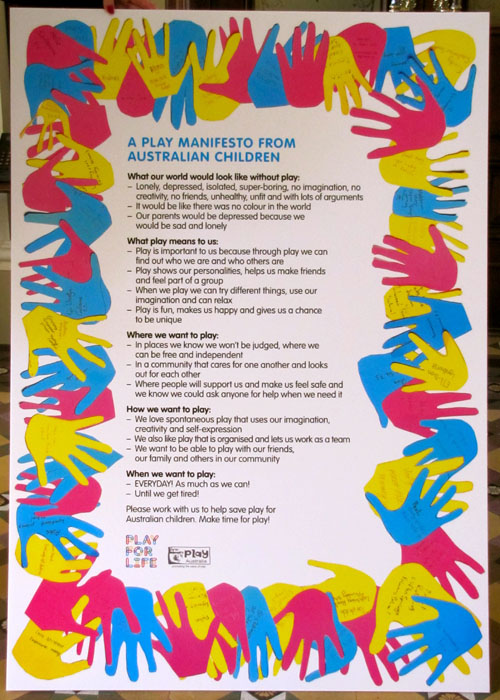
Play Based Learning in Australia is sharing a poster that captures the play manifesto of its children; how awesome!
After the overwhelming reaction to the success of the Australian Children’s Play Summit held in Melbourne on May 17th and 18th 2012 Play for Life Australia is kindly making available a copy of the Play Manifesto created BY Australian children FOR Australian children as a download. Play for Life believes that if we put the future of PLAY back into the hands of Australia’s children, then PLAY will be in very good hands!
From the blog Art Farm, a play/art therapist who offers some advice on creating spaces that encourage kids to explore, learn and play:
I really learned the importance of organizing and preparing spaces while working with youth in school settings in several public housing developments in Chicago. So often these youth would come to me (for either individual or group art therapy sessions) filled with anxieties which either manifested as acting out or withdrawn behaviors. The arrangement and presentation of the private space we used was a powerful, non-verbal message to them stating that all things are respected here – including you; everything has a place here – including you; and everything you will need to have a successful experience is here – starting with you.
[Mariah] Bruehl offers some questions to ask when designing a space for your own child:
Can your child access the materials in the play space independently? Are they organized in baskets or bins that are clearly labeled so your child knows how and where to put things away when finished with them?
Are the materials presented in an attractive manner that invites your child to use them?
Do the materials, toys, and games represent a balance between your child’s and your own preferences? Do they represent what you value and thus encourage your child to engage in activities that you feel good about?
What is your child currently interested in? If your child no longer plays with dinosaurs, but has been talking a lot about birds, make sure that the play space reflects this current passion. Rotating toys is a great way to keep your child interested in play space activities and ultimately prolongs the life of your child’s playthings. It never ceases to amaze me how excited my girls get about a toy that comes back into rotation. The nostalgia they feel toward a toy they have not seen in a while is almost more than their delight over a brand-new toy.
Is the play space a calming environment that allows one to focus on the task at hand without distracting colors, decorations, or objects?
Are you seeing things from you child’s perspective? Put yourself in your child’s shoes to determine the right height for displaying and storing materials and hanging art.
Is this a space that makes you want to make art, explore science, write stories, and more? If so, would you have everything you need to do what you want to do? What else would you add to enrich and deepen your child’s learning experience in the play space?
What other playful space researchers are out there? Any recommendations? I know about the organization Art With Heart, which focuses on creating therapeutic resources for sick kids. But I’d love to hear more about what’s out there. Let me know in the comments below.
The City’s Green Team was out shovelling dirt on Robson Street:
.
“Urban Pasture” is another trial project in amenity-making, this time in the parking lane on the south side of the 1000-block Robson – just in front of the Cafe Crepe where the sidewalk narrows. (Decades ago, the City required six-foot setbacks for any new construction, the intent being to widen the street for another traffic lane to handle vehicle growth. That ain’t gonna happen – but the setback remains so that now the sidewalks can be widened for pedestrians. This is one of the remaining choke points.)
Similar to Parallel Park off Main Street, Urban Pasture will provide a small seating space and landscaping. It isn’t even finished, and already people are filling the seats.
But there are two other aspects of note: first, this structure is in what was once the rush-hour lane, where the parking was stripped during the morning…




 Mental Flowers