environment · play · Social

City-wide public art project invites residents and visitors to talk to Austin’s street furniture | AustinTexas.gov – The Official Website of the City of Austin

Austin is a city with a strong arts culture, and is continuing to showcase that:

The hidden life of Austin’s street furniture will come to light next month with the launch of Hello Lamp Post, an international art project created by London-based designers Pan Studio which invites people to strike up conversations with familiar objects around the city using text messaging.

Hello Lamp Post is a city-wide platform for play that allows participants to talk to the city’s infrastructure and share stories using the text messaging function on any mobile phone – no smart phones required. People can interact with any object they choose, in any part of the city, because the project utilizes the thousands of pre-existing identifier codes that label items of street furniture, including (but not limited to) lamp posts, mail boxes, moontowers, utility boxes, manholes, or telephone poles

more via City-wide public art project invites residents and visitors to talk to Austin’s street furniture | AustinTexas.gov – The Official Website of the City of Austin.

If you are in or near Austin, the public is invited to a free kick-off event, complete with drinks and bites, February 12, 4-6 p.m. at Republic Square Park, 422 Guadalupe Street.

A short video about the project, starring the streets of Austin, is available now at http://www.hellolamppostaustin.com.

creativity · design · environment · happiness · health · play

15 Artists Collaborate To Make London Children’s Hospital Cozier For Kids | Bored Panda

Last year I had a stay at a local hospital. I and the people who came to visit me all found the place hard to navigate (we all got lost more than once), and I found parts of it unfriendly and slightly claustrophobic, and not very warming or healing. They had some nondescript pictures on the walls, and that was the only way I could find to navigate my way out of the maze of white and linoleum.

It doesn’t have to be this way.

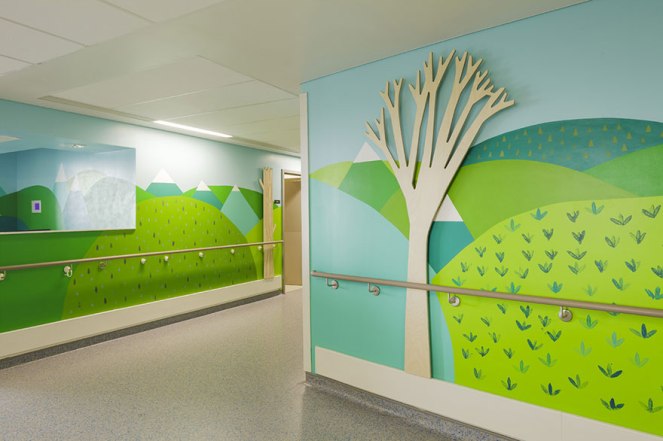
The sights, sounds and smells of a hospital can make it a terrifying place, especially for children, but it doesn’t have to be that way. Vital Arts, a British arts organization in charge of introducing art to Britain’s hospitals, had 15 artists collaborate to turn the interior of London Royal Children’s Hospital into as fun and colorful a place as a hospital can be.

Despite being limited by the fact that hospital environments need to be easy to clean, the artists were still able to use vinyl, ceramics, wood and even rugs to liven up these hospitals, each approaching the wards they decorated with their own unique style.

via 15 Artists Collaborate To Make London Children’s Hospital Cozier For Kids | Bored Panda.

The author Dovas comments that they wish it wasn’t just for kids. It really can be for everyone. Even something as simple as bright colors can be helpful in orienting patients and helping them feel better.

The nurses who helped me all commented about needing to get outside and get away from the sterile white. I think the curtain example illustrates the value of this beautifully:

“A seminal moment for me was when a three-year-old girl stopped crying the moment she saw the curtains, pointing excitedly to the hidden cats and rabbits. That’s when I knew my design had worked”

It is possible to have art and playfulness in sterile hospitals, as part of the healing process. Plus adding some joviality, like staying in the “monkey room” can make a somewhat painful situation seem less heavy.

Maintenance on some of these installations and art pieces may be higher, but if it leads to faster recovery and shorter hospitals stays, which this kind of enrichment has been found to do, then it is a worthy investment.

behavior · environment · health · mental health · play · work

Creating playful and holistic spaces for healthier employees

The Clinton Foundation recently teamed up with my employer as part of the Clinton Health Matters Initiative (CHMI) to create more healthy, and healthier, employees in a corporate environment. There were five winners chosen, and these two were my personal favorites:

  • Make Work Active
  • Concept: Gamify holistic health and wellness. Design a points based rewards program to incentivize employees for adopting a healthy lifestyle at work, with programs tailored to industry specific wellness issues.
  • Workspace Design
  • Concept: Design workplaces that require regular movement physical activity. Create “motion enhancing workplace” certification. Create certification of “Motion Enhancing Workspaces” if sufficient requirements are met (Similar to Leed Certified buildings).


While some of the other ideas were also great – have fresh food on hand, make a team goal to improve health – I love these ideas in particular because they engage with employees on an individual level, and force the employee to engage with wellness, i.e. via a game and/or their environment.

I know gamification is a super “buzz” term right now, almost to the point of being passe, but I have found it to be a surprisingly powerful tool. A few years ago I organized a walking challenge at work, and bought cheap pedometers for everyone who wanted to participate. The winner ended up being the facilities manager, which surprised everyone but totally made sense since he was on his feet all day, and was a great example of how a lot of little walks add up.

Where have you seen either of these types of initiatives in action, whether at work, school, or in your neighborhood? Do you know of any group working on creating certifications for “healthy workspaces”? Share them in the comments below.


architecture · community · creativity · culture · environment · Social

We Asked 10 of Our Favorite Artists to Create Love Letters to Their Cities. Here’s What They Came Up With | GOOD Magazine 

Good Magazine Asked 10 of Their Favorite Artists to Create Love Letters to Their Cities. Here’s What They Came Up With… (click either the link below or the picture to see them all.)

via GOOD Magazine Cities Project .

architecture · design · environment · health · mental health · Nature

In Redesigned Room, Hospital Patients May Feel Better Already – NYTimes.com

I recently had a short stay at a hospital (just some minor surgery), and as I lay in my hospital bed I recall looking out my window at a green canopy of trees planted two stories below. I remember how peaceful and pleasant it was to be able to look out and watch the trees. I also noticed my anxiety went down, I was distracted from my pain, and just overall felt better.

More and more research is coming out that is finding the benefits of incorporating nature and natural environments into the healing process, for everything from surgery to PTSD to dementia, and a variety of other ailments. So it’s great to see hospitals incorporating this knowledge into new building designs as well as therapies.

The University Medical Center of Princeton realized several years ago that it had outgrown its old home and needed a new one. So the management decided to design a mock patient room.Medical staff members and patients were surveyed. Nurses and doctors spent months moving Post-it notes around a model room set up in the old hospital. It was for just one patient, with a big foldout sofa for guests, a view outdoors, a novel drug dispensary and a bathroom positioned just so.

Equipment was installed, possible situations rehearsed. Then real patients were moved in from the surgical unit — hip and knee replacements, mostly — to compare old and new rooms. After months of testing, patients in the model room rated food and nursing care higher than patients in the old rooms did, although the meals and care were the same.

But the real eye-opener was this: Patients also asked for 30 percent less pain medication.

Reduced pain has a cascade effect, hastening recovery and rehabilitation, leading to shorter stays and diminishing not just costs but also the chances for accidents and infections. When the new $523 million, 636,000-square-foot hospital, on a leafy campus, opened here in 2012, the model room became real.

read more via In Redesigned Room, Hospital Patients May Feel Better Already – NYTimes.com.

architecture · behavior · community · creativity · culture · environment · family · happiness · health · play · Social

Cities’ Message to Young Families: Play and Stay – WSJ

City planners are finally starting to grok that in order to keep residents, they will need to offer the whole package, including playful spaces for everyone, kids and grown-ups alike.

About a decade ago, the so-called creative class of 20somethings fueled the revival of urban centers by settling in downtown areas mixing condos and coffee shops. Now, as millennials and other urbanites have children, their needs are changing. Cities want to hold on to them by becoming more “playable,” for both children and adults.

For decades, cities “relegated kids to the playground and said, ‘We’ve done something for you,’ ” says Darell Hammond, chief executive of Washington, D.C. nonprofit KaBOOM!, which consults with city officials on promoting and preserving play. “The whole city should be a playground, and play should happen everywhere.”

That means not only building more parks and bike paths but also incorporating the ideas of “fun” and “play” throughout a city, whether it is musical swings downtown Montreal, a hopscotch crosswalk in an arts district Baltimore or camp sites on a city lake front Chicago.

more via Cities’ Message to Young Families: Play and Stay – WSJ.

I hope that this attitude shift from city planners and designers makes it more acceptable for grown-ups to go out and play, and I mean actually physically play, not just go to bars and concerts that were traditionally classified as the only acceptable adult “play.” Seattle and Portland, and  are definitely accepting and encouraging of grown-ups playing bike polo in city parks or just going for a run. Creating an environment that welcomes play also helps change the attitude of others

children · culture · education · environment · learning · Nature · school

Students Go Whole Hog with Farm-to-Cafeteria Cooking | Civil Eats

A few schools are adopting a more hands-on way of teaching about food, animal care, and science, which is actually an older technique: farm animals.

Most recently, slow roasting pork tenderloin was part of a homework assignment for a Bend, OR, high school culinary class. And the source of their pork? Mountain View High School, less than a mile away, where FFA formerly known as Future Farmers of America students are raising pigs.

These classes are complementary components of an integrated farm to school program at Bend-LaPine School District, where 29 schools serve more than 16,000 students. Bend-LaPine has students raising animals, butchering animals, and feeding a school meal program. Neatly wrapped packages of pork move from classroom to school kitchen, where they are cooked into succulent carnitas for all 29 school cafeterias.

The program breaks the normal bounds of food in school and has created a whole new arena for students to learn. “It’s a full circle agriculture education experience,” says Katrina Wiest, the manager for the Bend farmers’ market and wellness specialist for the school district.

“Agriculture is a big part of my life,” says Wiest, who was raised on a wheat farm and is married to a farmer. “I feel it’s important that kids know where their food comes from.”

For close to ten years, Wiest has been pioneering the farm to school movement in the high desert of central Oregon: sourcing local food for schools and providing agriculture, health, and nutrition education opportunities in the cafeteria, classroom, and community.

more via Students Go Whole Hog with Farm-to-Cafeteria Cooking | Civil Eats.

I think this is an awesome idea! It’s a great hands-on learning opportunity for kids. A lot of schools have shied away from having animals on or near campus, or having kids even deal with animals, due to safety and health concerns. But how else and where else are kids going to learn about being safe around animals, or safety and caring for the animals themselves, unless they get somewhat structured guidance like this? Most kids don’t have a friendly farmer they can go visit and mess with their livestock on a regular basis.

But more importantly, it is a very hands-on, real-time way of letting kids work on something and seeing the results of their labor, whether it’s a happy pig or a delicious plate of carnitas, while also letting them experience delayed gratification (it takes hard work and a long time to grow a pig). It teaches kids how food is made, which is important when making food decisions. Plus, it can be very therapeutic to pet a pig.

Where I grew up was fairly rural, and yet the 4H/FFA program was still seen as a weird club that involved a lot of horse-showing. I am glad to see it getting integrated more into school programs.

behavior · children · community · education · environment · Nature · play

Let ‘Em Out! The Many Benefits of Outdoor Play In Kindergarten | MindShift

Another take on Free Play Learning:

For the typical American kindergartner, unstructured free play during the school day consists of 20 to 30 minutes of recess, and perhaps some time at indoor “stations” — perhaps creating with building blocks, costumes, or musical instruments. But what if there was more? What if the answer to “what did you do in school today?” was, “I climbed a tree, played in the mud, built a fire”?

That is exactly the kind of learning going on in the Swiss Waldkindergartens, or forest kindergartens, where children ages four to seven spend all of their school days playing outdoors, no matter the weather. With no explicit math or literacy taught until first grade, the Swiss have no set goals for kindergartners beyond a few measurements, like using scissors and writing one’s own name. They instead have chosen to focus on the social interaction and emotional well-being found in free play.

With many parents and educators overwhelmed by the amount of academics required for kindergartners — and the testing requirements at that age — it’s no surprise that the forest kindergarten, and the passion for bringing more free play to young children during the school day, is catching on stateside. Free play and inquiry learning are the cornerstone of Canada’s new all-day kindergarten program; forest kindergartens are popping up in Washington state, Vermont, and even Brooklyn.

At the Waldkindergarten, which takes place in the middle of the woods in Langnau am Albis, Switzerland, dotted with several handmade structures like a rudimentary wood shelter where children and teachers gather around the fire, children play, often away from teachers’ view.

These scenes are captured in “School’s Out: Lessons From a Forest Kindergarten,” a documentary directed by Lisa Molomot. In the 36-minute film, Molomot and producer Rona Richter show scenes from two public schools: the outdoor forest kindergarten in Switzerland and a more typical American kindergarten in New Haven, Connecticut.

more via Let ‘Em Out! The Many Benefits of Outdoor Play In Kindergarten | MindShift.

children · culture · education · environment · learning · play

A School That Ditches All the Rules, But Not the Rigor | MindShift

Play IS a form of learning and experimentation, so it’s nice to see a school try to incorporate this very basic, very elemental learning process into the heart of their education system.

How can we make school a joyful experience without sacrificing rigor? What’s the best way to measure true learning? What’s the purpose of school? The founders and teachers at the PlayMaker School (watch the PBS Newshour report by April Brown), an all-game based school in Los Angeles, are asking those big, abstract questions that all teachers grapple with. And they’re trying to find their own answers through their constantly morphing, complex experiment.

Here are their thoughts about these issues, in their own words, from extended answers to the PBS NewsHour report. How can teachers, parents, and administrators these ideologies to existing public schools?

Read the interview with the school’s founder Tedd Wakeman at  A School That Ditches All the Rules, But Not the Rigor | MindShift.

architecture · design · environment

Art Students Transform Ugly Electrical Towers Into Colorful Lighthouses | Bored Panda

Why has nobody thought of this before?

Three art students in Germany have come up with a novel way to beautify ordinarily ugly urban environments. They turned a common electric tower into a makeshift stained glass lighthouse.The change was simple but effective. Ail Hwang, Hae-Ryaan Jeon and Ghung Ki Park, students at Klasse Löbbert in Münster, Germany, filled the gaps in the tower’s struts with panels of colored acrylic plastic, turning it into a dazzlingly colorful structure. It’s not quite as detailed and beautiful as true stained glass, but it is nonetheless a great approach for decorating an otherwise ugly structure. The resulting work is called Leuchtturm, or “lighthouse” in German.

more, including the original source, via  Bored Panda.

It would also alert birds and other migratory animals that they might not want to hang out there. The only problem I can see with this is if the plastic acted as a prism for the grass and started a fire, but I’m sure there are ways you could engineer around that. Right?