We know children tend to be wiggly, but we’ve also seen them sit stone still when they are engaged in a good book or toy or enraptured by a movie. A hospital in the UK is tapping into that enraptured engaged stillness.
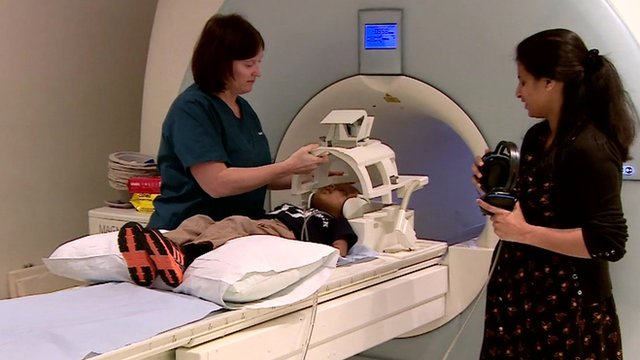
Many adults find the procedure of having a brain scan, which involves having to lie still for an hour or more while images are analysed, an unsettling experience.The process is no less daunting for young children, who are usually given a general anaesthetic when they have the procedure.
However, a pilot scheme at University College Hospital in London is helping young people have a scan without being sedated, by teaching them about it through play.
In the stuffy, little gymnasium at Richard Kluge Elementary in Milwaukee, 16 boys and girls are stretching, jumping and marching to music.
Two years ago, the school had no gym, art or music classes due to budget cuts. But now, Kluge students get a so-called “special” class three days a week.
Milwaukee Public Schools is one of several school systems across the country — including Los Angeles, San Diego and Nashville, Tenn. — that are re-investing in subjects like art and physical education. The Milwaukee school district is hiring new specialty teachers with the hope of attracting more families and boosting academic achievement.Music teacher Angie Dvorak is one of the teachers that’s been effected. Last year, Dvorak was part time and traveled between schools. This year, she’s stays at Kluge all day, teaching music upstairs from the school’s gymnasium.
Dvorak says she’s seen a different in her students: “I get to have them for class more frequently, which is awesome because their music skills are shooting through the roof this year.”
I tweeted about this short film yesterday, but I really feel like this is worth giving some space on the blog for.
The value of play is important for teaching life skills like conflict resolution and collaboration, health lessons, healing from trauma, building community and just overall survival as a child and human being, the work this organization does seems simple but is hugely important.
This short video highlights some of the incredible impact that play can have on a child, or group of children.
You can also visit the organization’s website at Right to Play.
These findings make sense to me and yet also don’t.
Image credit: Carnegie Mellon University
Few environments feature such a cacophony of decor as the elementary school classroom. Colorful bulletin boards, scientific posters, state maps, and student artwork tend to cover nearly every inch of wall space. Yet a new study on classroom design from researchers at Carnegie Mellon University suggests that all that educational flair may not be all that great for getting kids to learn.
The study, carried out over two weeks, examined 24 kindergarten students who were taught six lessons on topics they had not yet learned in school. Half the lessons were taught in a highly decorated classroom environment, with posters and art all over the walls, and the other half were taught in a classroom with no decoration.
CMU’s researchers found the kids spent more time off-task and were more distracted when the room was brightly decorated, and they tested better on subjects they learned in the sparser classroom compared to the ones they learned in the more visually stimulating environment.
Elementary school children typically stay in one room all day, so classroom decorations don’t necessarily match the subject matter they’re learning at any given time. If they’re sitting in front of a U.S. map, they’ll be looking at that all day whether the current lesson is on geography or math. This study, though very small, adds to previous research from the same psychologists showing that visual stimulation that’s irrelevant to on-going instruction can distract kids.
The study doesn’t go on to offer any ways to necessarily improve the classroom design, although the article does give other links discussing it.
Nature can be fairly visually cacophonous, so what is it about classroom designs that are so distracting? I also wonder how much of their distraction is from an unnatural learning style, and then other more engaging things to look at. That is not an attack on the teacher, I’m just skeptical whether any human is capable of sitting in one room for 6-8 hours, with a couple of lunch breaks, and concentrate the entire time, for an extended period of time. Even grown-ups have a hard time doing that, and suffer when they try to sustain that for too long.
What are your thoughts? Leave them in the comments below.
This is one of the best descriptions of the power of pretend play, especially dissecting how pretend play is hard work, and can be overwhelming, especially to someone who doesn’t have practice, which is why lots of play is important for practicing real-world feelings and situations like power, restraint, and questioning assumed priors.
Power is intoxicating.
It is also dangerous.
And it is especially dangerous when applied to four-year-olds.
Four-year-olds lack the experience to wield power responsibly. They have no idea what to do with it or how to control it.
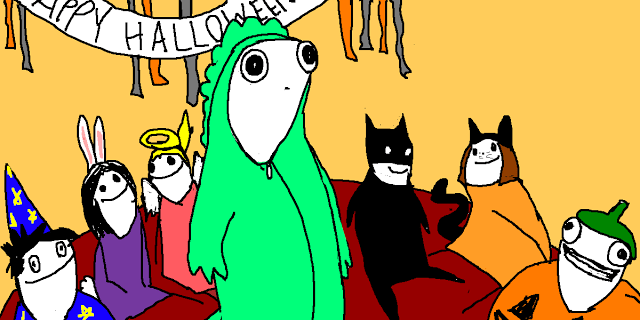
The dinosaur costume was the greatest thing that had ever happened to me.
…All I knew was that being a dinosaur felt very different from being a person, and I was doing things that I had never even dreamed of doing before. …Of course, I had always had the ability to do these things — even as a person — but I didn’t know that. I’d just assumed that I was unable. As a dinosaur, I didn’t have any of those assumptions. It felt like I could do whatever I wanted without fear of repercussions.
Now that we’re officially into fall, with the weather getting colder and wetter by the day, and all back to school or indoors,it’s important to remind ourselves of opportunities to get out and play.
Idea is Free Museum and Park Day tomorrow; September 28: over 1500 museums, and national and state parks, are opening up their doors to the public for free!
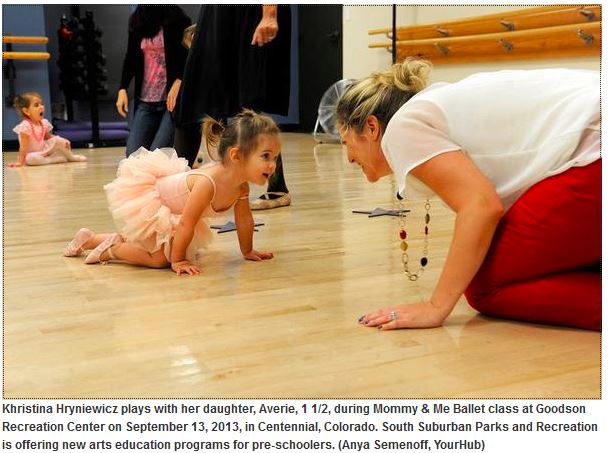
For some more structured play, there are great art, dance, and play-based programs for little and big kids. One just opened up in Colorado, and definitely understands the value of play:
The Curious About Art program is just one of many preschool arts education programs the South Suburban Parks and Recreation District offers throughout the year. It’s not so much about the final product the kids create, but the journey and experiencing sensory exploration with their parents.
“It will probably look like something you expect an 18-month-old to make, something unrecognizable but still pretty wonderful,” said Vickie Willis, culture and enrichment supervisor for South Suburban.
“Everyone needs to play,” Willis said. “It makes us feel good, it unleashes possibilities in our brain, it makes us think better.”
Aside from encouraging play, the purpose of the classes is to prepare kids for a school environment by getting them socialized to being around other children, as well as developing motor skills.
“It’s to develop the motor skills, and the little ones just want to explore their world so music and art is a good way of doing that,” said Janice Schindler, the culture and enrichment coordinator at Goodson Recreation Center
Seattle has a newly-minted hip-hop program for little kids that also focuses on the value of play and silliness in education:
Mini BREAKS is the original hip-hop dance class (breakin’ or “break dance”) for toddlers and preschoolers.
In this unique class, young students will have fun while they exercise, express themselves, think creatively, build self-esteem, practice respect, learn discipline and make new friends!
Outside of a dance studio, hip-hop culture (including breakin’) is not taught through choreography or 8-counts but more intuitively through interactive demonstration. Mini BREAKS focuses on encouraging young children to be creative and courageous – to come up with their own ideas and be able to express themselves by sharing those ideas with others. All children are artists – Mini BREAKS helps them remain artists as they grow up!
For teachers, it’s time to start thinking about Back-to-School planning. Thankfully this teacher’s got an awesome plan to teach world politics:
Ask any student the following question; would you prefer to start the year with a lecture or playing a game? I’d wager the that nearly all learners would choose to spend their time with the game. As a younger student, I recall only being able to play in class once all of the curriculum was “done”, usually at the end of the school year. Of course, we know that learners of all stripes acquire, apply, synthesize, and communicate knowledge through participation in games and simulations. As a result, there’s a strong case to be made to embed complex critical thinking simulations and games right from the outset of the school year.
I’m currently putting the final touches on all of my lesson plans for the first term of both years of IB Global Politics. Here’s a partial list of the games and simulations the students and I will be playing in the first thirteen weeks:
Yippee! I loved the old Exploratorium, and it sounds like I’ll love the new one!
The new home, with all of those characteristics (and a 200-seat cabaret), is opening on Wednesday, and while it doesn’t deserve unalloyed acclaim, the achievement is remarkable. Under its executive director, Dennis Bartels, the Exploratorium has preserved and expanded what it was when the physicist Frank Oppenheimer created it. It remains the most important science museum to have opened since the mid-20th century because of the nature of its exhibits, its wide-ranging influence and its sophisticated teacher training program.
Yet the new Exploratorium remains eccentrically original. Technology is scarce. There are few video screens. There are fewer computers. There are circuits but no evident circuit boards. Woodworking and metalworking take place on the museum floor. There are more than 600 exhibits, but the emphasis remains on the laws of physics and motion, elementary principles of perception, and elegantly designed machines that conceal nothing.
You can still play with pendulums that were designed for the museum’s original opening. You can spin disks atop a whirling wheel; you can try to get a bicycle’s pedals to move using a sequence of buttons; you can gaze at the physicality of inverted reflections created by a finely polished parabolic mirror; you can position toy robots to create spinning animations.
Dr. Thom McKenzie explains why it’s so important for children to have quality Physical Education in school and how caring adults can support it. Designed especially for parents, teachers, school board members and administrators.
Doctor’s are prescribing Aderall to kids without ADHD (Photo credit: Wikipedia)
I find this article in today’s New York Times extremely disturbing:
When Dr. Michael Anderson hears about his low-income patients struggling in elementary school, he usually gives them a taste of some powerful medicine: Adderall.
The pills boost focus and impulse control in children with attention deficit hyperactivity disorder. Although A.D.H.D is the diagnosis Dr. Anderson makes, he calls the disorder “made up” and “an excuse” to prescribe the pills to treat what he considers the children’s true ill — poor academic performance in inadequate schools.
“I don’t have a whole lot of choice,” said Dr. Anderson, a pediatrician for many poor families in Cherokee County, north of Atlanta. “We’ve decided as a society that it’s too expensive to modify the kid’s environment. So we have to modify the kid.”
Sadly the doctor is correct that many schools refuse to change a child’s environment to improve academic success, namely that they are cutting out activities like recess and P.E. in order to make more time for studying.
However, P.E., recess, and just getting outside for a quick breath of fresh air have all shown to also be extremely effective ways to improve attention and academic success. Yet because these activities are getting cut out of the school day, doctor’s feel like they must prescribe these incredibly strong, brain-chemistry changing medications to growing brains, many of these drugs with strong side effects .
I have no problem with using these drugs for what they were originally intended for, but prescribing them basically as “performance-enhancing” drugs just seems unethical to me. We frown upon athletes and grown-ups in the business world from taking speed and other kinds of drugs that are supposed to improve performance (other than coffee of course, that seems pretty much like a must-have for adults), but it’s okay for students so they can do well in elementary and middle school? To put in mildly, yuck!
I hope other people will be as outraged as I am and stand up for a child’s right to recess and P.E., and actually NOT studying from time to time, rather than encouraging giving them strong medications in order to perform well on standardized tests.





 Mental Flowers