behavior · cognition · creativity · design · education · emotion · language · learning · mental health · play

How Playing With Puppets Turns New Learners into Future CEOs | GOOD

This is a very well thought out and researched article about the benefits of pretend play, specifically creating and playing with puppets.

How Playing With Puppets Turns New Learners into Future CEOs | GOOD

The [Puppet School] curriculum establishes the tenets of puppeteering education, which put educational theories about the importance of play and grit and resilience into practice.

In the beginning classes, students start to learn basic head and mouth movements, using motor skills in both hands and both arms, choreographed to pre-existing sound tracks of well-known pop songs. Students learn to articulate vowels and develop a sense of rhythm with their bodies. As the exercises advance, students learn to improvise using their own voices and hand movements, and eventually choreograph movement to material they’ve written. From motor skills, to communication and improv skills, then finally written skills, students exercise many parts of their brains at Puppet School, increasing communication between their two brain hemispheres.

According to Eric Jensen’s Teaching with the Brain in Mind, when brain signals are passed from one side to the other quickly, or when the left and right sides of bodies work simultaneously, the brain is able to function more efficiently, and the stronger the brain’s connections become—thereby improving literacy, movement coordination, processing data, and communication skills.

more via How Playing With Puppets Turns New Learners into Future CEOs | GOOD.
creativity · design · play · Social

Google Maps Easter Egg Lets Users Play Pac-Man on Real Streets – CityLab

Gamification of at least a virtual space:

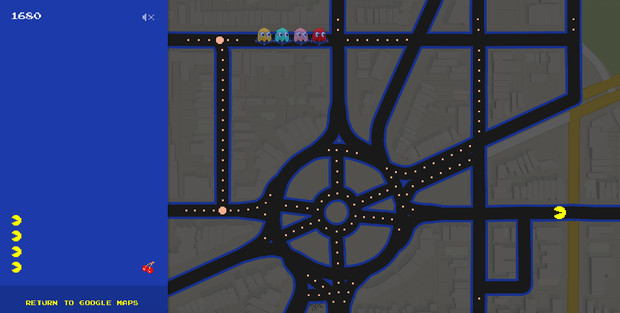
For a limited time, you can finally experience Pac-Man on your favorite (or least favorite) place to navigate IRL. One of the best navigational easter eggs ever, Google Maps is currently letting users experience the world through the eyes of a Pac-Man.

Ever wished Namco created a Pierre L’Enfant-version of the arcade game? Well, D.C.’s Logan Circle now has all the Pac-Dots your Pac-Gut can handle.

more via Google Maps Easter Egg Lets Users Play Pac-Man on Real Streets – CityLab.

architecture · children · community · design · environment · health · mental health · play · school

Changing Skyline: Redesigning playgrounds to promote ‘loose play’ – think pop-up play spaces

Great article about the evolution of the playground, as well as the next generation of playgrounds emerging in cities:

After World War II, European architects turned out custom playgrounds that challenged kids both physically and intellectually. Inspired by their work, a few American architects, including Philadelphia’s Louis Kahn, tried their hands at the form. But the movement didn’t get very far. Playgrounds were a casualty of the breakdown of American cities in the ’60s and ’70s. As maintenance was deferred, they fell into ruin. By the time cities began to recover in the ’90s, Solomon says, all that local officials wanted was equipment that was indestructible and vetted for safety.

Moore, a professor at North Carolina State University who has been studying children’s play for 50 years, sees a connection between those designs and the increase in such childhood ailments as obesity, anxiety, and attention-deficit disorder. In the simple act of scrambling up the branches of a tree, a kid learns to monitor risk and deal with fear. But on most playgrounds, the climbing frames are lower than ever.

The concern about such controlled environments has sparked any number of popular books advocating less programming: Free Range Kids, 50 Dangerous Things (you should let your children do), Last Child in the Woods. All see our culture’s fear of risk as worse than the occasional scraped knee or broken bone.

So what’s the alternative to standard-issue playgrounds? Solomon envisions multipurpose, multigenerational urban parks that incorporate spaces where kids can take charge of their own play. Instead of a fixed bridge in a plastic fort, they would have to use their imagination to decide which objects could be converted to play equipment. Such a challenging play space also would include nooks where kids could temporarily escape the nervous gaze of their caregivers. There would be no fences, plenty of trees and bushes, and good seating.

read more of their ideas for better playgrounds via Changing Skyline: Redesigning playgrounds to promote ‘loose play’ – think pop-up play spaces.

My favorite playground growing up was made of mostly huge sewer pipe pieces, a monkey cage, and random cement shapes. What was your favorite playground as a kid? Or now? Describe it in the comments below.

creativity · design · environment

Artist Spent One Year In The Woods Creating Surreal Sculptures From Organic Materials | Bored Panda

I love seeing people working WITH their environments to create art.

Sculptural artist Spencer Byles spent a year creating beautiful sculptures out of natural and found materials throughout the unmanaged forests of La Colle Sur Loup (where he lived with his family), Villeneuve Loubet and Mougins. He worked together with elements of his natural surroundings to create artwork that blends seamlessly with the environment.

Byles’ project is intentionally secretive – the only way you’ll see these work short of his photos is by going into the woods and finding them yourself. I imagine that coming upon such a fantastic structure unexpectedly in the woods is sure to be quite a magical surprise.

One of the most beautiful things about his work is its temporary nature. The pieces were not intended to last, and each sculpture will eventually be reclaimed by the natural environment that helped Byles shape it. This full circle gives the organic pieces a powerful poetic and philosophical touch.

more via Artist Spent One Year In The Woods Creating Surreal Sculptures From Organic Materials | Bored Panda.

creativity · design · environment · happiness · health · play

15 Artists Collaborate To Make London Children’s Hospital Cozier For Kids | Bored Panda

Last year I had a stay at a local hospital. I and the people who came to visit me all found the place hard to navigate (we all got lost more than once), and I found parts of it unfriendly and slightly claustrophobic, and not very warming or healing. They had some nondescript pictures on the walls, and that was the only way I could find to navigate my way out of the maze of white and linoleum.

It doesn’t have to be this way.

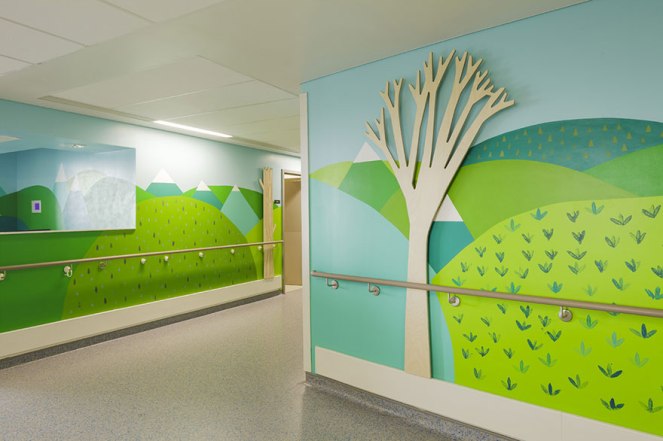
The sights, sounds and smells of a hospital can make it a terrifying place, especially for children, but it doesn’t have to be that way. Vital Arts, a British arts organization in charge of introducing art to Britain’s hospitals, had 15 artists collaborate to turn the interior of London Royal Children’s Hospital into as fun and colorful a place as a hospital can be.

Despite being limited by the fact that hospital environments need to be easy to clean, the artists were still able to use vinyl, ceramics, wood and even rugs to liven up these hospitals, each approaching the wards they decorated with their own unique style.

via 15 Artists Collaborate To Make London Children’s Hospital Cozier For Kids | Bored Panda.

The author Dovas comments that they wish it wasn’t just for kids. It really can be for everyone. Even something as simple as bright colors can be helpful in orienting patients and helping them feel better.

The nurses who helped me all commented about needing to get outside and get away from the sterile white. I think the curtain example illustrates the value of this beautifully:

“A seminal moment for me was when a three-year-old girl stopped crying the moment she saw the curtains, pointing excitedly to the hidden cats and rabbits. That’s when I knew my design had worked”

It is possible to have art and playfulness in sterile hospitals, as part of the healing process. Plus adding some joviality, like staying in the “monkey room” can make a somewhat painful situation seem less heavy.

Maintenance on some of these installations and art pieces may be higher, but if it leads to faster recovery and shorter hospitals stays, which this kind of enrichment has been found to do, then it is a worthy investment.

behavior · culture · design · emotion · happiness · technology

Daniele Quercia’s Happy maps and happier travelling

Can you map your happiness?

Mapping apps help us find the fastest route to where we’re going. But what if we’d rather wander? Researcher Daniele Quercia demos “happy maps” that take into account not only the route you want to take, but how you want to feel along the way.

watch via Daniele Quercia: Happy maps | Talk Video | TED.com.

Coincidentally, another researcher is also working on this problem, and creating maps that find the most relaxing routes based on people’s brainwaves:

MIT Media Lab’s Arlene Ducao is hoping to shed some light on which biking routes promise a more relaxing ride with her Mindreader Map. The project is a continuation of Ducao’s 2012 experiments involving a mind-controlled bicycle helmet that flashes different colors depending on the stress levels of the rider.

Using this type of data city planners could conceivably better plan bike lanes and traffic signals with an understanding of where the most stressful, and potentially dangerous, areas for cyclists are.

Have you changed your commute to be less stressful, even if it means a little longer ride or drive to work? Talk about it in the comments below.

creativity · design · happiness · health · mental health · technology · youtube

Cool Technology Allows Disabled People To Create Incredible Art With Their Minds

Art has the power to soothe, to heal, to empower, to raise awareness and to move people to action. Using technology to enable people to express themselves through art is great, whether it’s for a cause, or a brand in this case.

To raise awareness for their brand, an art supply company created this viral campaign featuring real people using technology to create beautiful abstract art. Sixteen disabled individuals in China (home to the world’s largest disabled population) were invited to participate in the project, which involved using advanced brainwave scanning technology in conjunction with detonator-equipped, paint-filled balloons. The video seems to show that by concentrating really hard, the participants were able to trigger the colorful explosions, resulting in some very unique pieces.

more via Cool Technology Allows Disabled People To Create Incredible Art With Their Minds.

architecture · design · family · health

Beauty in sadness: reflecting on hospice | @offbeatfamilies

Dying is tough stuff. No question. So it is wonderful to see how facilities are making it easier on the dying and their families to feel comfortable via the design, look, and layout of a space, with everything from the hues on the wall to the view from their window. Amy Marquez shared her observations about her mother’s hospice space a couple of years ago on Offbeat Families (now retired, but visit the sister sites for Pete’s Sake before they meet a similar fate!), and it is a wonderful ode to both her mom and people who cared for her and her family during her last days, but also the importance of creating a great, peaceful, and sometimes playful space.

At first I was impressed with how sensitive and involved the staff was. They made sure she was comfortable, asked us how we were doing and offered to help us if we needed anything. And although my mother had lost the ability to communicate verbally by the third day that she was there, they spoke to her as though she was able to answer and talked her through everything they were doing to assist her.

I spent enough days there to really start looking around. This facility was, at first glance, a very nice, tranquil place that was inviting and welcoming to family and friends of loved ones in residence there. Then I really started looking and I was amazed at the amount of thought that had to go in to building this hospice.

read the entire breakdown at Beauty in sadness: reflecting on the hospice in which my mother passed away | @offbeatfamilies.

Patient's room

architecture · children · design

This large-scale building kit helps kids learn about engineering, architecture, and design through play : TreeHugger

“Rigamajig is not about a finished product. It’s the playful process. The collaborating. The tinkering. The soft and hard skills that are learned while kids are engaged in play. This is what learning can look like!” – Cas HolmanInstead of coming with an instruction booklet that outlines how to build specific contraptions, the guide booklet for teachers, parents, and educators gives tips on how to best utilize Rigamajig for their situation, as well as offering “Play Prompts” to spur children’s imagination.

via This large-scale building kit helps kids learn about engineering, architecture, and design through play : TreeHugger.

architecture · design · environment · health · mental health · Nature

In Redesigned Room, Hospital Patients May Feel Better Already – NYTimes.com

I recently had a short stay at a hospital (just some minor surgery), and as I lay in my hospital bed I recall looking out my window at a green canopy of trees planted two stories below. I remember how peaceful and pleasant it was to be able to look out and watch the trees. I also noticed my anxiety went down, I was distracted from my pain, and just overall felt better.

More and more research is coming out that is finding the benefits of incorporating nature and natural environments into the healing process, for everything from surgery to PTSD to dementia, and a variety of other ailments. So it’s great to see hospitals incorporating this knowledge into new building designs as well as therapies.

The University Medical Center of Princeton realized several years ago that it had outgrown its old home and needed a new one. So the management decided to design a mock patient room.Medical staff members and patients were surveyed. Nurses and doctors spent months moving Post-it notes around a model room set up in the old hospital. It was for just one patient, with a big foldout sofa for guests, a view outdoors, a novel drug dispensary and a bathroom positioned just so.

Equipment was installed, possible situations rehearsed. Then real patients were moved in from the surgical unit — hip and knee replacements, mostly — to compare old and new rooms. After months of testing, patients in the model room rated food and nursing care higher than patients in the old rooms did, although the meals and care were the same.

But the real eye-opener was this: Patients also asked for 30 percent less pain medication.

Reduced pain has a cascade effect, hastening recovery and rehabilitation, leading to shorter stays and diminishing not just costs but also the chances for accidents and infections. When the new $523 million, 636,000-square-foot hospital, on a leafy campus, opened here in 2012, the model room became real.

read more via In Redesigned Room, Hospital Patients May Feel Better Already – NYTimes.com.