architecture · behavior · culture · design · environment · happiness · Nature

Seattle has too many bleak public spaces | Crosscut.com

Seattle Skyline view from Queen Anne Hill.
View of Seattle's city skyline. In such a gorgeous part of the U.S., Seattle itself is lacking in pretty public spaces. Image via Wikipedia

In case y’all hadn’t noticed yet, I’m a huge proponent of utilizing public space for community use and creating an overall aesthetically pleasing environment for people. Cities have one of the greatest opportunities to provide that for their citizens. So I was thrilled when I read this article in Crosscut Magazine arguing the same thing, specifically for my hometown of Seattle.

Our landscape-oriented mindset should have been good preparation for what we need in the densifying city now, which is more design intelligence given to the open spaces between buildings — plazas, parklets, and awkward leftovers like the places under freeway overpasses. The more the air space around us becomes stuffed with architecture, the more acutely we need the relief of thoughtfully landscaped open spaces on the ground. Arguably, these spaces are more important in the built environment than most buildings because they’re public — people use them.

Or if they’re emotionally cold, dreary, or austere, people don’t use them, which is the case with a number of Seattle’s precious open spaces. On one of our desperately rare sunny spring days this month, I visited about a dozen open spaces in the dense city and found — no surprise — the bleak ones practically unused and the beautiful ones full of life. What is surprising is that we’re not demanding more graceful, humane, imaginative design — and raising hell over trends such as Seattle Parks and Rec’s inexplicable new fascination with concrete and gravel.

The article goes on to provide examples and suggest different fixes for a couple of spaces. More via Why does Seattle have so many bleak public spaces? | Crosscut.com.

behavior · children · creativity · design · play

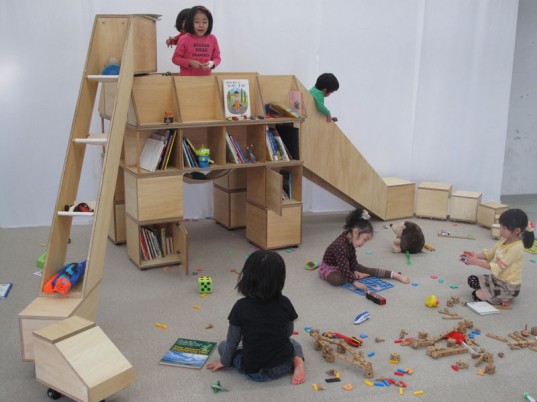
Bookshelf/Playground combo makes putting your toys away fun

Casasaurus

My mom always told me not to climb up my bookshelves when I was a kid; now I wish I was little again and could beg her to get me one of these. This is actually a great tool for learning, because it allows kids to think three dimensionally, in a playful way. Trying to decide which cubbies hold what items, and climbing, sliding, and thinking of an object as two things at once (a bookshelf AND a dinosaur) are great exercises for the brain at any age.

Casaurus, the senior thesis project of student designer Koichiro Hoshino from Tokyo University of the Arts. The designer’s dinosaur-shaped bookshelf includes plenty of space for a bookworm’s library, a tail-like slide for kids to whiz down, shelves made for climbing and small boxes that add length to the dino’s tail. Kids can also find a reading nook underneath the dino’s belly.

more via Koichiro Hoshino’s Casaurus is a Bookshelf and a Playground | Inhabitots.

creativity · culture · design · play

Crochet Vandals Do Graffiti Like Your Grandma : NPR

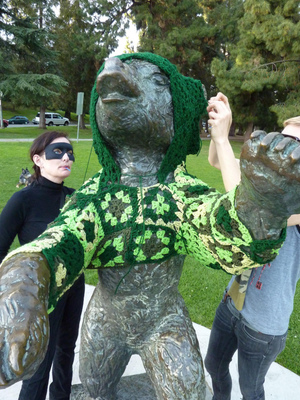
Captain Hook with bear shrug

I love this kind of public art! There was a tree in town that got a sweater a couple of years ago, and I’m so excited to see this is now becoming a “movement.”

“Captain Hook” is part of an international movement of so-called yarn bombers taking an old-school approach to street art. Unlike most street artists who travel with spray paint or markers, Captain Hook — as she asked NPR to call her — works with a crochet hook and yarn.

Her “walls” are public fixtures, like the bronze bear statue in L.A.’s Griffith Park that stands zombie-like with its paws out. “This is crochet on a statue,” she says, sitting in her Los Angeles apartment, a pile of granny squares in her lap. “This could be happening in 1725.”

more via Crochet Vandals Do Graffiti … Like Your Grandma : NPR.

architecture · behavior · brain · design · emotion · environment · happiness · health · mental health · Nature · psychology

Using Nature Therapy in Prisons and Hospitals

I’m seeing lots of different examples of people using nature to help heal, from the physically injured to those with aggression issues cut off from the rest of the world.

For example, I was just listening to a program this weekend on the local NPR station about a biologist at Evergreen State College who is greenifying a local prison, as well as working with inmates to grow new prairie grass and frogs (I can’t find the original story but here’s some similar coverage):

The frog rearing program here pairs inmates with scientists from the Evergreen State College as part of the Sustainable Prisons Project. So far, the frogs grown at Cedar Creek Correctional Center are doing better than those grown by professional zoologists.

LIESL PLOMSKI, graduate student, The Evergreen State College says, “They have a lot more time here to care for the frogs that a zoo wouldn’t have. I mean they’re here all day with them, so they change the water frequently. They feed them more frequently than a zoo could ever do.”

And then this morning stumbled upon this story:

Henning Larsen Architects recently won an international design competition with their plans for the new Odense University Hospital in Denmark. Situated close to the city center amidst a scenic old-growth forest, the OUH will use the surrounding landscape as a way to heal its patients. The holistic facility features a light footprint that incorporates nature at every turn to create an environment replete with peace and serenity. Daylight floods in through the glass-lined buildings, and rainwater will be collected to feed the many ponds and surrounding landscape.

more via Denmark’s New Odense Hospital is a Healing City of Glass Amid the Forest | Inhabitat – Green Design Will Save the World.

I am blown away by all the different applications of nature into therapy and recovery practices.

behavior · creativity · design · psychology · writing

How The Mundane Can Produce Creativity

I subscribe to this business blog, The 99 Percent (Success is 1% inspiration, 99% determination), that typically offers business strategies and stuff, but this article I found really interesting; the idea that having a ritual around your day actually allows your brain to focus on being creative:

You follow the same routine, sipping your coffee, browsing your email, skimming through the same blogs, the same news pages, the same social networks. As your colleagues arrive, you exchange the same greetings, the same gripes and gossip. As you drain the cup, you get the same itch for the same music, take your headphones out and plug yourself in. You open the same blank document, give it the same hard stare. The music kicks in.

Now you can begin.

If that sounds anything like your morning routine, you’re in good company. Over the years, as a coach and trainer, I’ve heard a similar story from hundreds of creative professionals. Of course, the details will vary – if you’re like me, your trip to work will be the “30 second commute” known to freelancers the world over, and you’ll be making your own coffee. You may incorporate meditation, or other exercise into your morning routine. And you may use a camera, easel, guitar or whatever instead of a computer.

But the chances are you’re living proof of one of the great paradoxes of creativity: that the most extraordinary works of imagination are often created by people working to predictable daily routines. There’s even an entire blog (sadly now on hold) devoted entirely to accounts of the Daily Routines of writers, artists, and other interesting people.

more via How Mundane Routines Produce Creative Magic :: Tips :: The 99 Percent.

It says the 3 common threads of these rituals are:

  1. Uniqueness – it should be something (or a combination of things) you don’t associate with other activities, otherwise the effect will be diluted.
  2. Emotional intensity – the kind you experience when you’re really immersed in creative work.
  3. Repetition – the more times you experience the unique trigger in association with the emotions, the stronger the association becomes.

Athletes, actors, and even accountants have these rituals, so why not creative types? What about you, what behaviors or rituals do you have to help you concentrate on being creative?

architecture · community · culture · design · environment

Creating a park that meets seattle’s needs

Alaskan Way Viaduct from Victor Steinbrueck Park
Image via Wikipedia

From Crosscut:

“This past weekend a small slice of the Alaskan Way Viaduct was bashed to the ground…The absence of the hulking, dirty superstructure with its squat legs immediately makes apparent new possibilities.

One can easily imagine a green promenade extending from the imposing facade of Qwest Field diagonally northwesterly, eventually touching down on an expansive waterfront park, perhaps outfitted with beaches and habitat for marine life. The promenade could be a splendid setting for food carts and festivals, art, and interpretive signs that explain the colorful history of the area previously known as the mud flats. The diminutive and delicate-looking triangle building would be a modest but distinctive landmark — now freed from lying in the shadow of the viaduct.

But still, as one looks along that alignment stretching towards Elliott Bay, the forest of dark gray columns is a dismal reminder of how much there is to be done before we reclaim the waterfront as attractive and accommodating public space.”

More

I’m really excited by the prospects of reclaiming urban spaces for pedestrian use!

architecture · behavior · children · community · creativity · design · education · environment

Green learning and sustainable knowledge

Kids learn the best by what they see and experience, not just what they are told. What better way to teach about environmental and sustainable practices then by demonstrating that at school?! Two projects in the Pacific Northwest are combining creative alternative designs and technologies to create an ideal environment for learning and minimizing impact on the environment.

I always wanted to live in a tree house or a hobbit hole. But going to school in a “living building” would be a pretty close second. From KUOW:

LEED–certified buildings are meant to be environmentally friendly and highly energy efficient. But now, there is a new standard that goes well beyond that. It’s called the “living building” and there are only three of them in the world. In Seattle, one elementary school is building what could be the first living building in the state.

The kids got to offer ideas for the school, and with its grand opening last friday, will hopefully make a splash (it does have it’s own little stream, after all).

In a related project, a school in Poulsbo is putting in Washington State’s fifth largest solar array:

“Next month, Lander, 56, will flip the switch on his first full-size community solar project atop Poulsbo Middle School, the largest of its kind in Washington and the fifth-largest solar system in the state.”

I also love the fact that both of these projects are community-based, in that the kids got to provide input on the school, and the solar panels are also community-driven.

community · creativity · design · happiness

From: DesignSponge » paul price’s signs of affection

Just in time to get into the Valentine’s Day mood: enriching signs that spread joy and cheer to everyone, not just your favorite sweety!

Colorful “Signs of Affection” from graphic designer Paul Price. Wandering by one of these on a cold afternoon sure would be a cheerful surprise. I’m hoping Paul’s work somehow makes it over to the gray Brooklyn streets in my area, so I can stumble upon “Your Hair Looks Dashing.” That would totally make any bad day feel like it was taking a turn for the better. Click below to check out more of Paul’s work online.


more via DesignSponge » Blog Archive » paul price: signs of affection.

community · design · family · health

Granny Pods Keep Elderly Close, At Safe Distance : NPR

His idea might seem strange, but “granny pods” are catching on.The granny pods real name is the MEDCottage, and its basically a mini mobile home that rents for about $2,000 a month. You park one in the backyard, hook it up to your water and electricity, and it becomes a free-standing spare room for Grandma and Grandpa.The concept is catching on all over the country, but nowhere more so than Virginia, where the state government has eased zoning restrictions on these high-tech hideaways, which go on the market early next year.The MEDCottage is homey on the outside, with taupe vinyl siding and white trim around French doors. Inside, it looks like a nice hotel suite, complete with kitchen and bathroom — and security cameras.

more via Granny Pods Keep Elderly Close, At Safe Distance : NPR.

anthropology · architecture · community · creativity · culture · design · environment · happiness

The Most Colorful Cities In The World

Living in the Pacific Northwest I can definitely appreciate the idea of adding more color to one’s life! Interestingly, it tends to be warmer climates that have the more colorful buildings, although Denmark and Finland has some of the most colorful interiors (and now exteriors) I’ve seen. Color has an amazing effect on human mental health and mood. People often talk about getting back into nature to see all the colors. Now, the colors can come to you (unless you live in a community with a rule against bright colors).

Urban life doesn’t have to be bleak and gray — in fact, many of the world’s cities pride themselves upon the bright palettes used to liven up their architecture. From the garish blue-walled buildings of Jodhpur, India, to the gentler pastels of Charleston, S.C., these cities are far from monotonous.

Charleston, SC
Charleston, SC
Nyhavn, Denmark
Buenos Aires, Argentina

More of The Most Colorful Cities In The World: Pics, Videos, Links, News.