View of Seattle's city skyline. In such a gorgeous part of the U.S., Seattle itself is lacking in pretty public spaces. Image via Wikipedia
In case y’all hadn’t noticed yet, I’m a huge proponent of utilizing public space for community use and creating an overall aesthetically pleasing environment for people. Cities have one of the greatest opportunities to provide that for their citizens. So I was thrilled when I read this article in Crosscut Magazine arguing the same thing, specifically for my hometown of Seattle.
Our landscape-oriented mindset should have been good preparation for what we need in the densifying city now, which is more design intelligence given to the open spaces between buildings — plazas, parklets, and awkward leftovers like the places under freeway overpasses. The more the air space around us becomes stuffed with architecture, the more acutely we need the relief of thoughtfully landscaped open spaces on the ground. Arguably, these spaces are more important in the built environment than most buildings because they’re public — people use them.
Or if they’re emotionally cold, dreary, or austere, people don’t use them, which is the case with a number of Seattle’s precious open spaces. On one of our desperately rare sunny spring days this month, I visited about a dozen open spaces in the dense city and found — no surprise — the bleak ones practically unused and the beautiful ones full of life. What is surprising is that we’re not demanding more graceful, humane, imaginative design — and raising hell over trends such as Seattle Parks and Rec’s inexplicable new fascination with concrete and gravel.
Helena Norberg-Hodge, director of "The Economics of Happiness" and founder of ISEC. Image via Wikipedia
I am a huge fan of buying local (although I could be a lot better at it). This film makes an interesting argument that buying local is not only good for the environment and the local economy, but also connects us back to our spiritual sense of community.
Economic globalization has led to a massive expansion in the scale and power of big business and banking. It has also worsened nearly every problem we face: fundamentalism and ethnic conflict; climate chaos and species extinction; financial instability and unemployment. There are personal costs too. For the majority of people on the planet, life is becoming increasingly stressful. We have less time for friends and family and we face mounting pressures at work.
The Economics of Happiness describes a world moving simultaneously in two opposing directions. On the one hand, an unholy alliance of governments and big business continues to promote globalization and the consolidation of corporate power. At the same time, people all over the world are resisting those policies, demanding a re-regulation of trade and finance—and, far from the old institutions of power, they’re starting to forge a very different future. Communities are coming together to re-build more human scale, ecological economies based on a new paradigm – an economics of localization.
I have seen this same community/spirituality argument proposed as well with farmers in Hawaii trying to preserve traditional knowledge of taro planting, as well as other indigenous groups in South and Central America, and all over the world, so it is interesting to see this documentary maker make the argument on a larger scale, saying it can benefit all of us. I tend to agree.
I also like the idea of “grandmother universities,” which fit in well with the current trend of DIYers.
The role of children has changed significantly over the past 100 years. Image via Wikipedia
This call for paper submissions from the The Society for the Study of Childhood in the Past got me thinking about how actively children used to participate in the daily household and economic life of families, from general maintenance like sweeping the kitchen to vital income by helping during harvest time. Children used to have to help out on the farm, and later work in factories, in order to help their families make ends meet. While some of the work was dangerous and unhealthy, some of the work was beneficial to both the kid and the family. Kids felt like they contributed to their family, and learned skills from farming to general entrepreneurship. I wonder what kids are missing out on by not having as many daily chores to do, or summer jobs like mowing lawns and lemonade stands, and how children fit into our idea of work now.
In 2011, the themed session will be on children and work. The aim of the themed papers will be to bring together scholars from a wide range of academic disciplines who are studying any aspect of children and work in the past – children as economic contributors, children as slaves, elite children taking on adult roles, children as carers, children as consumers, the impact of working in childhood on children and society. The aim will be to advance cross-cultural knowledge and understanding of childhood and children in the past, and in particular to evaluate the varying nature and impact – social, economic, cultural, medical – of work performed by or for children in the past. Archaeology, history, literature and other sources will be explored.
In providing this opportunity for scholars of childhood to present their work to an international, interdisciplinary audience, the SSCIP International Conference aims to generate new perspectives on existing knowledge and to stimulate new avenues of research for the future.
I’d be interested to hear what jobs you had growing up, before the age of 18. Did your parents encourage you to work? Did you get an allowance or did you get paid by the job, or were you just expected to “earn your keep”? How is it different with your own kids, or nieces and nephews?
Salvation Army's presence throughout the world. Image via Wikipedia
My work was having a bake sale today for the tsunami victims of Japan when we heard the news about the major tornado in Alabama (one of the managers’ first thoughts: “maybe we should have another bake sale for Alabama.”). For my birthday we made crafts to donate to a local children’s hospital.
While it seems like the last couple of years have been filled with horrible natural disasters (or man-made; thanks BP!), and a bake sale isn’t going to fix much in the large scheme of things, what struck me is that despite our nation’s economic woes and our disaster-weary national psyche, we are still interested in reaching out to help each other, whether across the nation or across the Pacific.
As organizations and first responders offer emergency relief, food and shelter, many people across the country are looking for ways to help storm victims.
Follow The Salvation Army’s blog for updates, visit its website or text “GIVE” to 80888 to make a $10 donation to the organization’s relief efforts. It will show up on your next mobile phone bill.
Samaritan’s Purse has dispatched experts and two disaster relief units, tractor trailers stocked with emergency supplies and tools, to assess the needs in Tuscaloosa, Birmingham and Cullman, Alabama.
There are lots of different ways to help both nations. Post here for different ways you have seen your community reach out, either for these disasters or others.
I love this kind of public art! There was a tree in town that got a sweater a couple of years ago, and I’m so excited to see this is now becoming a “movement.”
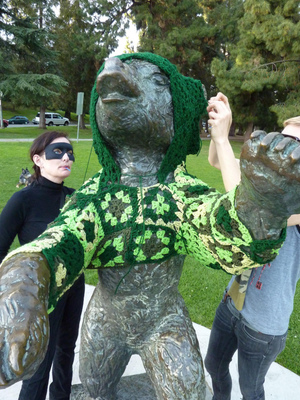
“Captain Hook” is part of an international movement of so-called yarn bombers taking an old-school approach to street art. Unlike most street artists who travel with spray paint or markers, Captain Hook — as she asked NPR to call her — works with a crochet hook and yarn.
Her “walls” are public fixtures, like the bronze bear statue in L.A.’s Griffith Park that stands zombie-like with its paws out. “This is crochet on a statue,” she says, sitting in her Los Angeles apartment, a pile of granny squares in her lap. “This could be happening in 1725.”
Oh, all right, but only because you asked soooo nicely; for Earth Day, an example of how communities in the Puget Sound are coming together to protect the Earth and improve their own personal environments as well.
Researchers have pointed the finger at stormwater runoff as the top source of pollution that’s getting into Puget Sound and other Northwest waterways. And because runoff comes from just about everywhere — roofs, roadways, parking lots, farms, and lawns — the solution has to be just as widespread.
Enter 12,000 Rain Gardens.
This week Washington State University and Stewardship Partners, a nonprofit working on land preservation, announced a campaign to promote the installing of 12,000 rain gardens around Puget Sound by 2016. The website even has a counter tracking the number of gardens and encourages folks to enter their rain garden into the database.
Flash mob pillow fight in Switzerland (neutral, yeah right!). Image via Wikipedia
Thanks again to the Seattle PI for bringing us great stories of spreading joy and happiness (see posts from earlier this week)!
If you were out and about in Seattle Sunday, you might have encountered more dancing and music than expected.
You can thank the TV show “Glee” and Seattle’s propensity for flash-mob participation for that.
“Glee” flash mobs broke out in several spots around the city Sunday afternoon. Here’s video of one of the best performances I’ve seen out of a bunch posted on YouTube.
This is such an awesome trend of seeing flash mobs of people performing public dancing and performance, from Michael Jackson’s Thriller to Glee to improv and beyond.
From NYT: Ms. Bosco, 95, spends much of her time at Seaside with Delores Brown, 73.
This New York Times article about budget cuts in New York State affecting senior community centers struck a nerve with me. In a good way. I am a strong advocate for promoting quality of life even into old age, especially into old age, and I think we youngsters forget just how important these community spaces can be for old folks.
In these places seniors can get a cheap meal, planned activities like games or fitness classes (we’re talking more Tai Chi than Tai Bo) but also companionship, and opportunities to do new things and learn. They also get experiences they never would have gotten to do otherwise; they realize they love to dance, or simply fall in love again.
However, with states and cities as cash strapped as they are, these places are in jeopardy of closing.
Last year, [New York] state and city budget cuts threatened 75 of the centers… and 29 were ultimately closed. The centers are intended to serve New Yorkers over age 60. This January, the dance began again: Gov. Andrew M. Cuomo proposed redirecting $25 million from the centers to child welfare; that, said the city’s Department for the Aging, would mean closing about a third of its centers; on March 15, the centers got a reprieve, with the Assembly and the State Senate voting to restore the money.
In a country where we are already isolating generations away from each other, it seems all the more important to at least offer a place for this demographic of people to meet and have some kind of community.
My grandparents belonged to a retirement home that practically forced them to go out and socialize with each other, be involved in community efforts, and participate in outreach to youth. I was thrilled to see new activities and challenges thrust upon my grandparents; learning new skills and taking on new responsibilities at 80 plus was revitalizing for them. However, that retirement home also ate up a lot of money, money that most folks don’t have, and soon-to-be-old folks are in worse shape as far as savings go due to the economy.
Some people may argue that it’s not worth investing in a demographic that isn’t giving back to our society. Besides the argument that they already GAVE to our society for 50 or more years, I’d argue that many of them could give back if we gave them the opportunity. There are lots of volunteer and time-bank programs where retired folks can donate their skills, from fixing leaky faucets to knitting to mentoring.
One of the programs my grandfather was in was a mentor for “troubled kids” as he’d call them who were bussed into the retirement home every other week or so to sit for an hour to talk to an old person. It was community service that a lot of them probably didn’t like the idea of at first, and to their friends they probably didn’t get all that excited about it. But when you actually saw the kids interact with the older folks, these kids opened up and really enjoyed their time with him. This was the first time in a long time that a lot of these kids got to say what was on their minds, and were really listened to. My grandfather also just happened to be a guidance counselor for many, many years, so for him this was also a treat to brush up on his old guidance counseling skills and feel like he was helping kids along the path “to the straight and narrow.” But even without that training, the older mentors felt like they were contributing to society, and so did the kids, as well as both getting something in return.
So before we look to cutting budgets on senior community centers, I argue we should look at these as possible hubs for other community activities, or community focal points. Just like lots of groups rent out the church basement for meetings or choir rehearsals, city planners should be looking at these spaces as community centers, not just senior centers. These centers offer a chance for a human being, of any age, to feel like a party of a community again, to feel human.
This is a very cool study that was featured on NPR; it is in fact a follow-up study done back in the 1950’s on the habits of successful kids, almost 1,500 of them. These new researchers picked up on the study and tried to track down the kids to see how they were doing.
They found some interesting patterns appear in the kids who live the longest and healthiest:
"The most cheerful, optimistic kids grew up to take more risks," explains Martin. "By virtue of expecting good things to happen and feeling like nothing bad ever would, they predisposed themselves to be heavier drinkers, they tended to be smokers, and their hobbies were riskier."
So, she concludes, "some degree of worrying actually is good." And, in fact, adds Friedman, "the prudent, persistent, planful people — both in childhood … and then in young adulthood we measured that — that was the strongest individual difference, or personality predictor, of long life."
Friedman and Martin also found that the conventional wisdom on fitness isn’t quite right. If we try too hard to push ourselves into exercise regimens, it can backfire. Physical activity is important, they found, but it’s more about doing what you love than adhering to a certain fitness program.
“This past weekend a small slice of the Alaskan Way Viaduct was bashed to the ground…The absence of the hulking, dirty superstructure with its squat legs immediately makes apparent new possibilities.
One can easily imagine a green promenade extending from the imposing facade of Qwest Field diagonally northwesterly, eventually touching down on an expansive waterfront park, perhaps outfitted with beaches and habitat for marine life. The promenade could be a splendid setting for food carts and festivals, art, and interpretive signs that explain the colorful history of the area previously known as the mud flats. The diminutive and delicate-looking triangle building would be a modest but distinctive landmark — now freed from lying in the shadow of the viaduct.
But still, as one looks along that alignment stretching towards Elliott Bay, the forest of dark gray columns is a dismal reminder of how much there is to be done before we reclaim the waterfront as attractive and accommodating public space.”




 Mental Flowers