Ritner Creek Covered Bridge near Pedee, Oregon, used as a rest stop during the Watermelon Rides organized by the Salem Bicycle Club (Photo credit: Wikipedia)
Happy Friday. I hope you get a chance to go outside this weekend. Not just because it’s good for you, but because it also helps the economy. No really, at least according to one study, and anecdotally, Oregon is seeing ahuge economic benefit by encouraging outdoor recreation, specifically bikeways and bike tourism:
During a special hearing on bicycle tourism at the House Transportation and Economic Development Committee in Salem, OR, on May 9th, representatives from Travel Oregon released a major new report on the economic impact of bicycle-related travel. The Travel Oregon study, The Economic Significance of Bicycle-Related Travel in Oregon Detailed State and Travel Region Estimates, 2012 (PDF), looked at bike tourism’s impact throughout the state during 2012. The big number — which garnered a headline in The Oregonian and has been adjusted up since our story in March — is $400 million. That’s how much people “involved in bicycle-related activities” spent in Oregon last year.
One key reason for the ascension of bike tourism in Oregon are initiatives like the nation’s first State Scenic Bikeway program.
The Oregon Parks and Recreation Department named two new Scenic Bikeways that same day. They’ve got the right idea about increasing revenue by making their state fun to hang out in!
You can read more about the economic impacts, but it’s so far a pretty effective strategy to promote tourism.
I read an article yesterday about “the next big thing” in office space. According to Uday Dandavate, the CEO of SonicRim, the next “megatrend” is going to be no office space:
Large working complexes will be pyramids for dead people. I’m not making a judgment. I am just observing. They are fading symbols of an era that is soon going to be a bygone era.The ideal environment is where people don’t have to go to a workplace. The workplace is distributed in the community.
Companies won’t be building offices; they will be building communities and nice places to work in those communities. It’s a fallacy that people want to stay at home to work. In a given moment they want to work where they would be most productive, or relaxed, in the kind of mindset they need to be in. We need to get away from constructing buildings that have flexibility to creating work environments that can evolve.
There needs to be a complex assessment of different moments at work. Recently we finished a global study on auto interiors for Johnson Controls. When you sit inside your car there are different moments that have different states of mind, going to work or coming home. Sometimes people want to feel their car is their home. At times people want the car to feel like a workplace. Take the same concept and apply it to architecture and work places. For any productive activity, not just working but cooking, reading, writing a letter, there is always a most conducive environment.
While Dandavate believes that the workers will be dispersed throughout the community, I’m not sure I entirely buy the idea that the central office space or main corporate headquarters is going to disappear. The emphasis on having everyone in one space my diminish, but there are a lot of reasons why having a central space sanctioned as “for work” is important.
To name a few:
Working parents who need a space away from family distractions, like screaming children and biting puppies. Or heck, noisy roommates for that matter.
People for whom going to the local library or coffee shop every day. This isn’t an option for a lot of people, even those living in big cities.
People who work very collaboratively and need real-time input, and face time in order to accomplish their work.
People who need more space to work than the kitchen table or their tiny apartment walls can provide.
Those who just need the peer pressure of others working around them to push through a hard deadline.
Extraverts!
Dandavate mentions a sense of identity for workers with the company that doesn’t require a tangible, geographical locale. I agree with his assessment that people don’t need a geographic place to congregate at to form a bond with coworkers or identify with a company, but they sure want one. Microsoft has a huge annual gathering of its employees in or near their homebase in Redmond, that most employees working from afar get really excited about. Traceurs (people who train parkour) will make pilgrimages to a small park outside of Paris simply because one of the sport’s founders filmed a video there. Elvis fans have Graceland.
Workers are also becoming more vocal about work vs. home life, and for many it is unappealing to have your work at home or not be able to leave it somewhere else (even places like Office Nomads you have to bring most of your stuff home with you).
Maybe I’m totally off-base, but while I think the workplace will become more flexible, we will always have the “homebase/headquarters” office buildings.
Disagree? Leave your thoughts in the comments below.
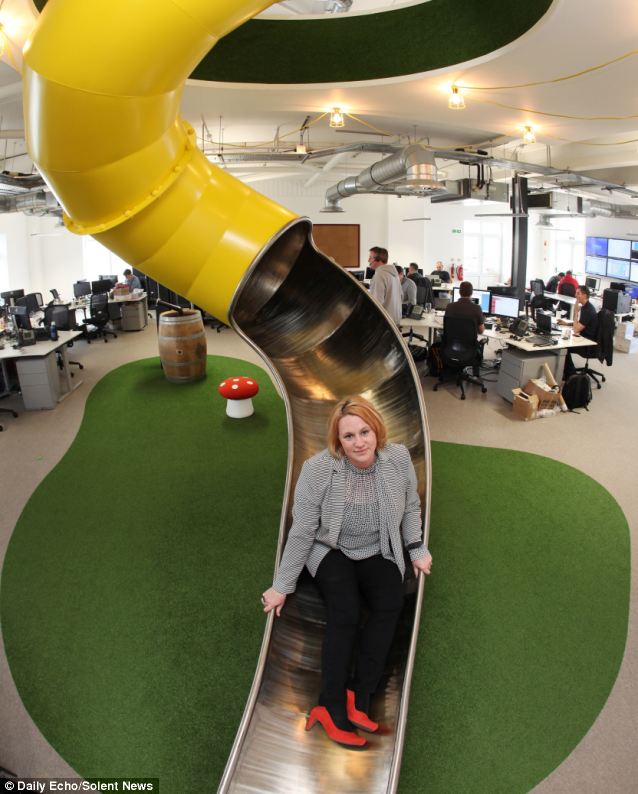
More and more office spaces are trying to become more playful, offering employees a way to destress and/or get more creative. Usually that takes the form of having ping pong tables or video game consoles set up for breaks, but more and more offices are adding slides, swing sets, picnic tables, or other more active and engaging apparatus. They are also bringing in more greenery for workers.
This office may be the most fun in Britain as it comes kitted out with a giant helter skelter slide, a tree house and even a pub.
The unique workplace also boasts a pool table, a putting green, a giant swing and a cinema.
Office designers Space & Solutions were tasked with turning a former pub in Southampton into the home for IT company, Peer 1 Hosting.
‘If you don’t feel comfortable sitting at a desk you can sit on a picnic bench. The reality is that you can do your work from anywhere.’
The article points out that some people may find all this fun a little distracting to actually work around. Some kinds of play are probably great at cutting stress but may be more of a time suck than creativity inducer. I’m curious what readers think. Are you one of those people who does their best work sitting on a couch, or heck, a swing? Do you prefer quiet and focus without any noise? Do you have a toy or plant on your desk you fiddle with when you’re trying to think or just need to destress?
Another question; do you actually use the toys and playful apparatus in the office? The office I currently work in has a ping pong and air hockey table, but only two people ever use the ping pong table, and I have only seen the air hockey table turned on once for a promo video.
A great example of actively adding art in urban settings in order to create enrichment for its inhabitants:
Urban landscapes have always inspired art, and Brazil is no exception. A new crop of artists like Matos not only is taking inspiration from Sao Paulo‘s streets but also is trying to give something back.
Matos covers trees and street poles with woolen sleeves and small, colorful pompoms. Her works look like whimsical webs of rainbow yarn; the effect is surprising and oddly comforting.
“I want people to have something familiar in the city. Here in Brazil we teach knitting from mother to daughter,” Matos says. “When they see my art, they suddenly feel comfortable walking these cold streets. And you can feel better.”
The newest and the biggest urban art project here is called , and it has an impressive list of corporate sponsors. The idea is to connect graffiti artists with individuals or business owners who have a wall they want covered with original art.
Artist Guilherme Matsumoto says he saw the website and signed up to say he was available to paint a space. Walter Orsati, owner of the Purple House Hostel, responded.
Happy Monday. Most of us are probably back at work now after the holidays. But for many of us, our work space has changed fairly dramatically in the past few years, in large part due to advances in technology. What used to be office-bound work can now be done at home in one’s slippers while simultaneously playing with your child (not that I’ve ever done that!). What does the future of work spaces look like? This article tackles that very question. The subject isn’t specifically related to playful environments, but creating spaces that are more conducive to creativity and productivity are incredibly intertwined with playful environment:
The company Teknion has been doing a serious amount of research into where the office is going, and what they should be designing and building to furnish it, and have published Phonebooths and Mailboxes to look at the future of the office.
Phonebooths and Mailboxes is a discussion about new technologies. Consider how quickly the cell phone replaced the pager, how quickly the fax machine was replaced by email. Mobile technology now signals one of the biggest transformations within the modern office.
As awesome as flexibility with one’s work space is, there is also value with face-to-face, tangible collaboration. Plus spaces for creative work and data analysis work, or whatever kind of work, may need very different spaces.
What are your thoughts about how technology is changing what our offices look like?
OpenIDEO asks how do we promote wellness in the workplace. (Photo credit: Wikipedia)
Wow, OpenIDEO is on a role lately with their challenges that get my creative juices rolling and my passions up, in a good way! This latest challenge is about wellness in the workplace:
Together with Bupa and the International Diabetes Federation, we’re asking our global community to help us explore how people can best be supported in the workplace to make positive changes to their health and wellness – and what skills and tools are needed to pass these positive changes onto their networks of co-workers, family and friends.
As the Chair of the Wellness Committee at my job for just under a year, we tried out a lot of different wellness incentives, some with better results than others. I feel very passionately about offices promoting and encouraging wellness; we spend the majority of our waking lives there, it’s cheaper in the long run for companies to have healthy and happy workers, and it promotes productivity and dedication from employees.
What are your ideas? Add them to the inspiration. I’ll have to share some of my ideas for this challenge on the blog, as well as my ideas from the previous OpenIDEO challenge I mentioned, which is currently in the concepting phase.
What does it take to reduce on-the-job depression and create an overall happier work environment? (Photo credit: Modern_Language_Center)
A recent study of health factors and their associated costs at seven companies, published in the journal Health Affairs, found that “depression is the most costly among 10 common risk factors linked to higher health spending on employees.”
The analysis, found that these factors — which also included obesity, high blood sugar and high blood pressure — were associated with nearly a quarter of the money spent on the health care of more than 92,000 workers.
First the employees were assessed for health risks, then researchers tracked their medical spending from 2005 through 2009.
The average medical spending for each employee was $3,961 a year. In total, $82 million, or 22 percent, of the $366 million annually spent on health care for the workers was attributed to the 10 risk factors, the study found.
The relationship between higher spending and depression was the strongest, with 48 percent more spending for workers with a propensity for that widespread problem.
Now, to be fair, this is a fairly small study of just seven companies, and the article didn’t say how many employees worked at these companies. However, this is definitely a trend that has been spotted at least anecdotally by many HR managers, so it’s nice to see that there is some “official” analysis being done on the issue.
So what can employers do about this? My fear is that employers would discriminate, unintentionally or intentionally, against people who suffer from depression. But these days many people will be diagnosed with depression due to a temporary life situation such as a death in the family, or their jobs, so being fired for temporary sadness is probably not a good idea for companies.
Instead, my hope is that companies would invest more on making people’s job satisfaction higher. As of two years ago, Americans reported the lowest job satisfaction ever recorded. That means employers can be doing A LOT more to improve their employees’ lives at work. And a lot of that has to do with feeling supported by their managers, and feel like they are heard and respected and overall a part of the team. A lot of that comes from having fun at work.
This philosophy has been spouted in several different books and magazines, and has been shown to work well in classrooms as well, referred to as the “Responsive Classroom” approach.
The Responsive Classroom approach centers on several ostensibly mundane classroom practices. Each morning students form a circle, greet one another, share bits of news, engage in a brief, fun activity and review the day’s agenda. The idea is to build trust, ensure a little fun (which adolescents crave) and confront small problems before they become big. Students might welcome one another with salutations from a foreign language. An activity might involve tossing several balls around a circle in rapid succession. Students share weekend plans or explore topics like bullying before lessons begin. (New York Times)
This approach could very easily be applied to a business setting, in fact it sounds like a team kick-off meeting one might see in a corporate environment. Taking time to connect with other coworkers and laugh a little before diving in to the day’s work has been shown to work wonders for productivity and boost morality in both school and work settings.
There is definitely a drive and expectation in many industries to work longer, faster, harder hours, and be available and working at all hours. But that drive is unsustainable, demonstrated by the low job satisfaction and high burnout rates in many industries, from high-tech to physicians. Taking time to play a little bit at work, or just connect with coworkers, is being shown as an effective way to reduce depression related to work and job burnout, increase productivity, and create a more cohesive company with more loyalty overall to the company’s mission.
So long story short: remember to bring the koosh ball to your next meeting.
This is a great idea! So many people have told me how they hate being inside the office all day, especially on nice summer days like this. We NEED exposure to the outdoors and nature in order to stay productive, mentally healthy, and physically fit. Just a 20-minute walk in the woods can have the same productivity benefits as an hour-long nap.
What’s your dream office? If you fantasize about bouldering on your lunch break–and appreciate being in a zero-waste, net zero-energy environment–you might want to take a look at the soon-to-be-completed space in the slideshow above: the new Alameda, Calif. headquarters of VF Corporation‘s outdoor and action sports coalition brands, which include The North Face, Lucy, and Jansport.
Now that VF’s outdoor brands are on good financial footing (especially The North Face), the corporation is working on a headquarters–set to be completed this summer–that was built with employee wish lists in mind. It shows.Below, some of the amenities available at the new 160,000-square-foot complex (many of them suggested by an employee task force).
A large onsite garden that will grow things like kale, tomatoes, and basil. VF expects to grow so much that employees won’t even be able to consume all of it. Leftover will be donated to a local food bank. Employees will be encouraged to help out with the garden, but local volunteers will also pitch in. A side note: Originally, VF toyed with the idea of installing a volleyball court, but employees elected to grow a garden instead.
Lots of natural light. 90% of employees will have access to direct sunlight, and in many areas of the complex, the overhead lights can often be kept off. Bonus: All the windows in the complex open (this should be a given, but it isn’t always).
Opportunities for onsite fitness, including an indoor fitness area and yoga room, an outside training area for bootcamp, an outside bouldering space, and an outdoor gear rental and repair shop.
A cafe serving the vegetables grown in the garden, among other things.
Eventually, if employees are really lucky, the ability to kayak out into the water just outside the complex (VF would need to make sure this is feasible and legal first, but employees have been asking for it).
A convenient location for almost everyone. When VF first started thinking about the new complex, it “took employee addresses and mapped out where they were” to figure out an ideal spot, according to Steve Rendle, group president of VF’s Outdoor & Action Sports Americas.
The office space is inside out: executive offices are in the middle of the room, and other employees sit by the windows.
VF is far from the only corporation to have an environmentally and outdoors-friendly campus. New Belgium Brewing Company, for example, buys clean energy, powers itself partially with methane from an on-site water treatment plant–and it offers perks like free bicycles and volleyball.
But the idea of a company keeping employees active, innovating, and considering the environment shouldn’t be a novel one. We hope, in other words, that this becomes a trend well outside the outdoor apparel industry.
The only thing I’m bummed about is that they didn’t use one of the hangars on the old Alameda Air Base, that closed down just over 12 years ago and hasn’t had much development done with it since. It would have been very “green” to recycle those old structures, but I also understand the price and space limitations. Still, very exciting overall, and I hope this trend continues with new office buildings.
Poor children in coastal India are encouraged to play games as a way to bring sportsmanship and structure into their lives.
All of these great ideas and more are captured on the Play theme page of the TED City2.0 project.
I think people often think of play as done out in the woods or on playgrounds, and often forget that cities can contain all the resources needed for play. Just look at parkour or buildering or urban mountain biking, or even yarn bombing. That said, it is absolutely crucial to allow people to play in cities and to create spaces dedicated entirely to play, as much for grown-ups as for kids.
What other projects promoting play in the city are you aware of? Let me know in the comments below.
For the past month I have been staying in a surprisingly noisy apartment. The neighborhood itself is very quiet, but just my luck to be staying over a night club and all-night grocery store. After this month the importance of being able to find quiet, peaceful places in a city rings all the more true and important to me (and it’s not just the ringing in my ears). From Inhabitat:
Cities have always been bustling environments, and with more and more of us living in them it can be difficult to find a quite place to relax or contemplate. Sound ArtistJason Sweeney‘s winning proposal for the TED Imagining the City 2.0 Prize is a crowdsourcing project that seeks to locate and map the places that provide silence in the urban din. The Stereopublic Project will be a public guide for those who crave a retreat from the crowds.
Based in Melbourn’s city center, Sweeney found himself attracted to tucked-in corners, where the city’s sound fades into the background and where the built environment is experienced as a sound environment. Inspired by his own experiences, he’s looking to create a platform where others can geo-tag and share their favorite quiet space. Sweeney is interested in helping those who are sensitive to noises, with disabilities, or just seeking respite from the constant din of the streets.
The TED City 2.0 prize will help his team develop a digital tool for crowdsourcing those places, adding a new layer of awareness to the cityscape for its occupants.
Cities are large, complex environments and the project is a unique way to understand the acoustic dynamic of city life. Stereopublic is based on active users sharing their findings, but ironically, the project’s success will likely make those quiet spaces busier, further pushing inhabitants to explore new places. The idea may become a failed experiment if it becomes too successful, but it also very well might help create new venues that improve the “sonic health” of a city — adding a vital resource to urban life.
Know of a quiet place in your city? Add it to the list, or leave it in the comments below and I’ll add it for you and if it’s in the Pacific Northwest may just try it out first. You know, for research).





 Mental Flowers