Okay, ignore that this is a granola company’s commercial.
And they may have cherry-picked to prove a point.
YET…
The fact that even these kids exist is terrifying.
Just watch the video. And cringe. Mourn. Cry. Then go do something about it!
Children are obsessed with technology, and Nature Valley wants us to be afraid. Very afraid.
That seems to be the message of this new ad for the granola bar company, which asks three generations of families: “When you were a kid, what did you do for fun?”
The elder two generations share memories of blueberry picking, sledding, fishing trips, and playing baseball as airy music plays in the background.
But then it’s the younger generation’s turn, and ominous music suggests these kids aren’t exactly frolicking in the grass and soaking in the sunshine. The kids detail that they spend five hours a day texting, emailing, tweeting, browsing the computer, or playing video games as the parents cry or lament the death of the good old days.
This is not okay people. So, so, the opposite of okay!
Go volunteer to take your niece or nephew to the park, or go hunt for cool leaves and flowers in the park. Grow a flower or even spider plant and give it to a kid! Take action!
Ah summer, which in Seattle brings out swimmers, cyclists, picnickers… and pianos!
It’s music to our ears: the pianos are back. After a successful first campaign, Pianos in the Parks will be returning for a second season on July 16. The month-long program will add to additional pianos to the roster this year, totaling 22 pianos in Puget Sound-area locations. Seattle Parks and Recreation will host 11 pianos in public parks.
The program, led by Laird Norton Wealth Management, is designed to encourage the discovery of parks through music and art by placing one-of-a-kind, artist-designed upright and grand pianos in parks and public spaces across King County including Seattle, Bellevue, Kirkland, Mercer Island and Sea-Tac, for free public use and music exploration.
All 22 previously owned pianos are procured, repaired, tuned, transported and maintained by Classic Pianos; and are painted by student, alumni and faculty artists of Gage Academy of Art.
The specific parks and public spaces which will host the pianos through Aug. 16 will be announced at a public kick-off celebration from noon to 1:30pm on Thursday, July 16 at Lake Union Park (860 Terry Avenue North) near the park’s model boat pond in downtown Seattle. At the celebration, local artists who painted the pianos will unveil their works of art – followed by a musical performance in which all 22 instruments will be played by local pianists. Also participating in the event are a number of musicians, city and county officials, and program partners. Following the unveiling, the public will have an opportunity to view all 22 pianos, meet the artists and be treated to additional musical performances. – See more at: http://parkways.seattle.gov/2015/07/08/pianos-in-the-parks-encourage-park-discovery-through-music/#sthash.vq7rBMDn.dpuf
There will be a public “opening” of the pianos from noon to 1:30pm on Thursday, July 16 at Lake Union Park (860 Terry Avenue North) near the park’s model boat pond in downtown Seattle.
The pianos will welcome park-goers in their respective locations thru Aug. 16. During this time, people of all skill levels and musical persuasions are urged to enter a Pianos in the Parks video contest for a chance to perform as part of the Seattle Center’s Concerts at the Mural presented by KEXP 90.3 FM on Friday, Aug. 21. Entrants simply need to upload a video of their performance using one of the participating pianos to the Pianos in the Parks website, http://www.pianosintheparks.com beginning July 16.
Find a piano, take a picture or video of yourself with it, and share with the world!
While it may be better for you to take a walk in the woods than on an urban block, living near trees, even in an urban environment, has been found repeatedly to improve people’s health, even making them feel younger.
In a new paper published Thursday, a team of researchers present a compelling case for why urban neighborhoods filled with trees are better for your physical health. The research appeared in the open access journal Scientific Reports.
The large study builds on a body of prior research showing the cognitive and psychological benefits of nature scenery — but also goes farther in actually beginning to quantify just how much an addition of trees in a neighborhood enhances health outcomes. The researchers, led by psychologist Omid Kardan of the University of Chicago, were able to do so because they were working with a vast dataset of public, urban trees kept by the city of Toronto — some 530,000 of them, categorized by species, location, and tree diameter — supplemented by satellite measurements of non-public green space (for instance, trees in a person’s back yard).
They also had the health records for over 30,000 Toronto residents, reporting not only individual self-perceptions of health but also heart conditions, prevalence of cancer, diabetes, mental health problems and much more.
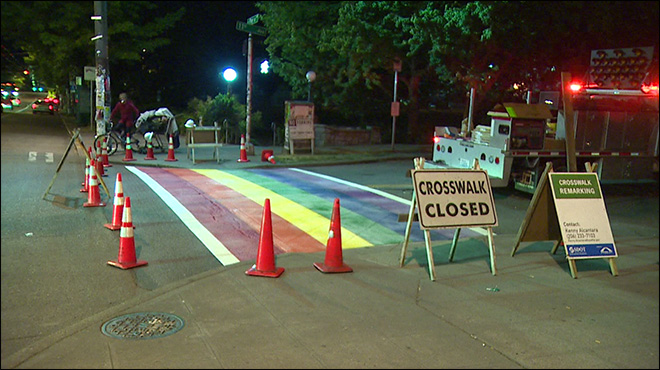
Several Seattle crosswalks are getting a new rainbow-colored coat of paint to celebrate Pride Week, and the city is planning to make them permanent.
Eleven of the rainbow crosswalks were unveiled Tuesday, including one at 10th Avenue and Pike Street on gay-friendly Capitol Hill.
Local groups have been campaigning for the crosswalks for a couple of years. They cost about $6,000 each, and are being paid for by fees for new private developers on Capitol Hill.
I love these not only because they are symbols of gay pride, they are also colorful and playful symbols of the neighbor’s character. Public art that the public engages with every time they cross the street.
A million times yes! This article focuses on one of my biggest pet peeves and challenges as a play advocate; play not being taken seriously.
The author, Hilary O’Shaughnessy, and also the producer of the Playable City Award, discusses her play competition and the usual rub of people asking whether this is really all “worth it.” I’m quoting over half of her article, but she very eloquently covers an entire blog post I was planning on writing (I will still write it, I promise):
Amongst the usual squeals of anticipation [around the competition], there are questions about the value of these ideas to the “real” world. Fun is all well and good – but surely fun is the stuff we get to when the grown up work of building hospitals and roads is done with? When we’ve fixed the economy, let’s play. Cities are full of problems, why are we not fixing them first?
Herein lies the real issue. When we see play simply as fun, a whimsy for those of us lucky enough to have the time to engage in it, we underestimate the transformative power of play and it’s role in our lives.
Fixing problems, making our living and working spaces more livable and resilient, designing better cities, starts at every level with the people that Iive in those cities. Increasingly we are realising that our cities are designed for exclusivity, so it makes sense that we don’t feel part of shaping the future. This is revealed in the language we use to describe our relationships to the services and organisations that our cites are made of. We want them to fix it, they don’t want us to have a say, they give money to them to exclude us: the language is divisive and separating, and that’s the problem. Even the descriptions of the projects fail to deliver what they promise, because a playable city is experienced, not described.
The idea of what our cities should mean, how public money is spent, what we imagine as good for us and who is involved in designing them, is only ever addressed when we have a complaint or we feel excluded. We talk to the city council when the road is road is torn up or the lights won’t come on. We complain that our voices are unheard, but we never seize opportunities to speak, fearing that if we do we will be ignored or shouted down by the loudest ones.
This feeling of separation cannot be undone overnight. We need new approaches, new tools, and new ways to talk to one another about how to live together in cities.
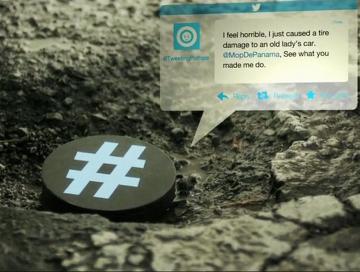
From a different article, but an example of using play as political protest: a device placed in large potholes that tweets whiny complaints when it is run over in order to publicly shame govt. into action.
Conversations about the future, about how we want to live, have to begin from a level playing field, and crucially that level playing field may not be where we expect. Play is a leveler: when we play, we play as humans, first. Traditional status markers like wealth, celebrity, or qualifications are not really much use when invited to dance with your shadow or conduct lights like a demi-god.
Addressing problems and finding solutions that work for us all begin with inviting everyone into conversation. Play as unexpected interventions in familiar places act as invitations to connect, an offer to begin to talk about those parts of our cities that we feel excluded from. To new eyes and ears, some projects can seem esoteric – but that is because we have become numbed to dull public announcements, badly designed flyers and clunky websites which act as information dumps that no-one reads, let alone takes as an invitation to work together. Yet, this is important stuff: we need to talk about the kind of future we want or it be will be decided for us while we look the other way.
Sitting on a bench at a bus stop or in the park, most people tend to focus on their smartphones or a book rather than whoever’s sitting next to them. But a new bench is designed to instantly connect strangers in a moment of play: When you sit down, the bench transforms into a makeshift merry-go-round.
After a successful year-and-a-half long pilot, we’re excited to announce that the Parklet Program is now a permanent program! This means that Seattle businesses and community groups have even more opportunities to enhance our streets with public spaces.
As part of this launch, we’re also rolling out a brand-new approach to activating our streets: the Streateries Pilot Program. What’s a “streatery” you ask? Streateries combine the best features of a parklet and a sidewalk café by allowing a restaurant, café, or bar to use a parking space to create outdoor seating for their customers during business hours (like a café) and for the public during non-business hours (like a parklet).
This is a scathing opinion piece looking at the negative influences of space and place, specifically cars and car culture. Corwin argues passionately against the takeover of cars in to the city space and how it is anything BUT enriching. It is full of examples of what NOT to do, and therefore offers suggestions on how to solve it.
Our experiences driving cars in this city are, for the most part, fleeting. We drive somewhere, we get out of the car, we close the door, and we walk away. But to think that we can escape the world that cars have created as easily as we escape the car itself is foolish. In fact, when we leave our cars, we walk into that world. We have to live in that putrid mess.
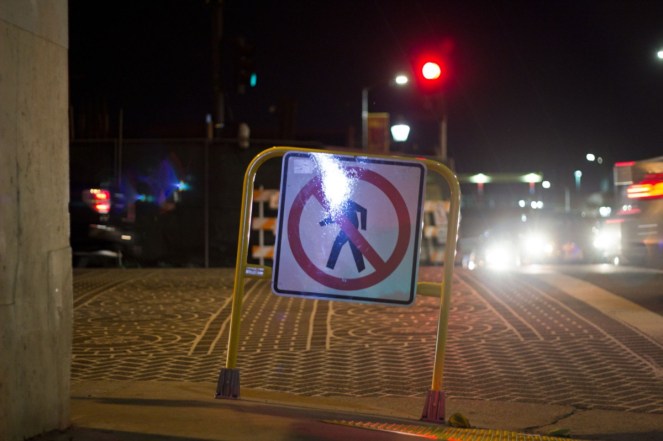
Let’s talk about how Los Angeles is a city where construction projects can fence off whole blocks, including the sidewalks, without offering people on foot an alternative. Let’s talk about how when that happens, no one even considers converting one of the two car lanes into a temporary sidewalk, because dear god, that might cause slight inconvenience to people in cars. And let’s talk about how ironic it is that inconveniencing people in cars is the end of the world, but doing the same to people on foot is a non-issue. Then let’s talk about how when frustrated walkers decide to use the car lane rather than take the ridiculous detour, the city’s totally acceptable solution to that problem is not to concede space to those people, but rather to bolt permanent, metal signs into the middle of the sidewalk to keep them from doing so. That is cancer.
Mapping apps help us find the fastest route to where we’re going. But what if we’d rather wander? Researcher Daniele Quercia demos “happy maps” that take into account not only the route you want to take, but how you want to feel along the way.
Coincidentally, another researcher is also working on this problem, and creating maps that find the most relaxing routes based on people’s brainwaves:
MIT Media Lab’s Arlene Ducao is hoping to shed some light on which biking routes promise a more relaxing ride with her Mindreader Map. The project is a continuation of Ducao’s 2012 experiments involving a mind-controlled bicycle helmet that flashes different colors depending on the stress levels of the rider.
Using this type of data city planners could conceivably better plan bike lanes and traffic signals with an understanding of where the most stressful, and potentially dangerous, areas for cyclists are.
Good Magazine Asked 10 of Their Favorite Artists to Create Love Letters to Their Cities. Here’s What They Came Up With… (click either the link below or the picture to see them all.)





 Mental Flowers