children · creativity · play

Merry Christmas

Or better yet, I will let Mila say it for me:

Hyvää joulua, Merry Christmas, God Jul, Boas Festas e Feliz Ano Novo, Joyeux Noel, Froehliche Weihnachten, Mo’adim Lesimkha. Chena tova, Buone Feste Natalizie, Shinnen omedeto. Merii Kurisumasu, Kung His Hsin Nien bing Chu Shen Tan, Sarbatori vesele, Feliz Navidad, Wesolych Swiat Bozego Narodzenia or Boze Narodzenie, Pozdrevlyayu s prazdnikom Rozhdestva is Novim Godom, Buorrit Juovllat, Noeliniz Ve Yeni Yiliniz Kutlu Olsun!

For the past year Mila’s mom Adele has taken photos of her daydreams.  She has called it her maternity leave hobby:

“While my baby is taking her nap, I create scene around her and take quick snap photos. I use only few minutes per picture, including creating idea, implementation and editing, ’cause I don’t want to disturb her sleeping.”

She has used just regular towels and toys to create some amazing photos.

So while visions of sugar plums may dance in your head, you can see what Mila’s been dreaming about all year. Mila’s mom is now branching out to other topics, but Mila still pops in now and again. Stay tuned…

anthropology · architecture · community · creativity · culture · design · environment · happiness

The Most Colorful Cities In The World

Living in the Pacific Northwest I can definitely appreciate the idea of adding more color to one’s life! Interestingly, it tends to be warmer climates that have the more colorful buildings, although Denmark and Finland has some of the most colorful interiors (and now exteriors) I’ve seen. Color has an amazing effect on human mental health and mood. People often talk about getting back into nature to see all the colors. Now, the colors can come to you (unless you live in a community with a rule against bright colors).

Urban life doesn’t have to be bleak and gray — in fact, many of the world’s cities pride themselves upon the bright palettes used to liven up their architecture. From the garish blue-walled buildings of Jodhpur, India, to the gentler pastels of Charleston, S.C., these cities are far from monotonous.

Charleston, SC
Charleston, SC
Nyhavn, Denmark
Buenos Aires, Argentina

More of The Most Colorful Cities In The World: Pics, Videos, Links, News.

brain · community · creativity · happiness · mental health · play · psychology

Grandma the superhero

Mental health is important throughout the entire human lifespan, from infancy (see previous post) to old age.

Courtesy of Boing Boing, I ran across this great story about actively pursuing good mental health, helping out a fellow human being, and using creativity and silliness to accomplish it.

“Sacha Goldberger found his 91-year-old Hungarian grandmother Frederika, a WWII survivor, feeling lonely and depressed. To cheer her up, he photographed her dressed up as a fictional superhero. To his surprise, she loved it. The photos are a bit comical, but there’s an underlying sense of hope, strength and courage in them.”

View Grandma’s Superhero Therapy (18 photos). From the blog: 

Frederika was born in Budapest 20 years before World War II. During the war, at the peril of her own life, she courageously saved the lives of ten people. When asked how, he tells us “she hid the Jewish people she knew, moving them around to different places everyday.” As a survivor of Nazism and Communism, she then immigrated away from Hungary to France, forced by the Communist regime to leave her homeland illegally or face death.

Aside from great strength, Frederika has an incredible sense of humor, one that defies time and misfortune. She is funny and cynical, always mocking people that she loves.

With the unexpected success of this series, titled “Mamika,” Goldberger created a MySpace page for his grandmother. She now has over 2,200 friends and receives messages like: “You’re the grandmother that I have dreamed of, would you adopt me?” and ” You made my day, I hope to be like you at your age.”

People often forget just how much fun, funny, and spunky people can be after living on this Earth for a few decades. My grandmas were and are unstoppable forces of nature.

There have been a few photographic projects with older folks, in retirement homes or elsewhere, but the artist in me definitely feels like this demographic is an important part of humanity to explore that has been relatively neglected.

anthropology · brain · creativity · Mental · neuroscience · psychology

The Evolving Minds Of Humans : NPR


Where do we get artistic ideas and inclinations? What is it about the brain that makes us like art? Neurologist Antonio Damasio writes about his ideas why in his new book, Self Comes to Mind.

In his new book, Self Comes To Mind, neurologist Antonio Damasio argues that consciousness gave humans an evolutionary advantage. Damasio describes the differences between self and mind, and traces the evolutionary path of the human brain.

Where do we get the ability to create works of art, to be moved by a piece of beautiful music or to feel bad when someone says something hurtful?

via The Evolving Minds Of Humans : NPR.

His main focus is on consciousness, but touches on the idea of creativity, new thinking, and artistic desires as part of our evolution as humans.

brain · creativity · design · music

10 Ways to Boost Creativity

This list was compiled by the very talented Lori McNee (@lorimcneeartist) for The Top 10 Blog.

Lori is an internationally recognized professional artist who specializes in still life and landscape oil paintings. She shares valuable fine art tips, art business tips and social media advice on her superb blog FineArtTips.com.

Lori writes: Artists, writers, musicians and even bloggers have a common need to create. But, sometimes we hit a mind block and often find ourselves stressed, overwhelmed and unable to produce original ideas. This happens to me from time to time, so I decided share my top ten ways to boost your creativity.

1. Set aside a time and place.
2. Give yourself a break from technology. (um, but continue reading this blog for more ideas before you take a break!)
3. Try something new.

Read all of her ten tips and why here: http://www.thetop10blog.com/top-10-ways-to-boost-your-creativity/

behavior · brain · children · community · creativity · education · environment · health · learning · mental health · technology

Let’s hear it for being a kid

I’ve been reading some very depressing stuff today – about one school that doesn’t allow anyone over the age of 6 to have recess, kids not feeling protected from their tormentors, and so on – so I needed a pep talk.

Adora Svitak’s TED talk did just the trick.


anthropology · behavior · community · creativity · environment · play · Social

Games in Real Life

Drawing of ancient Indian board game with piec...
Game board from India; looks kind of like a city grid. Image via Wikipedia

An article featured on the O’Reilly Radar last month that interviews Kevin Slavin, managing director of Area/Code, who is currently working with Frank Lantz to integrate gameplay into the fabric of reality, or what he calls “Big Games.”

Big games are “games that take place using some elements from the game system and some elements of the real world. Something Frank Lantz had worked on with Katie Salen and Nick Fortugno was called the Big Urban Game. It involved transforming the city of Minneapolis into a game board. They did that by using huge inflatable game pieces, about 25-feet high. The players, among other things, were moving these huge pieces around the city.”

“There’s a few of us who have been thinking about how “play” and the “city” were going to combine. We’ve been drinking the same Kool-Aid from the same cooler for quite a while.”

The way Slavin’s describing his vision reminds me a lot of parkour. Interesting ideas.

Read the full interview (highly recommended).

behavior · brain · creativity · culture · happiness · health · mental health · play · Social

Playing is good for work productivity

Editor’s Note: Hi! I just wanted to take a minute to acknowledge that this post is VERY similar to a  post this week on the blog of digital agency Plexipixel. That’s because they were BOTH written by me, but I didn’t want to plagiarize my own work. For the original version of this post, check out their site.

The title of this blog post sums up the entire concept. There’s no other way to say it: you need to play to be a productive member of society.

However, this idea doesn’t seem to be sticking. 

The perception in America is that the harder and longer you work, the more productive you’ll be. Especially now when jobs are scarce and companies are holding on by the skin of their teeth, people sacrifice play, exercise, and good old legitimate downtime, not to mention sleep (September 30th was National Coffee Day!), to get more work done.

But it turns out we weren’t built to work that way. We need breaks, we need downtime, and we most certainly need to cut loose and be a little silly every once in awhile. As biology professor Robert Sapolsky pointed out in his book “Why Zebras Don’t Get Ulcers,” occasional stress is good – it makes sure we get that report in on time and we are aware of our surroundings in a new city. But constant stress just wears us down.

Several studies have found that play increases new ideas and overall productivity at work. Germans, and other European countries, have more vacation time than Americans, and yet have overall higher productivity, according to data presented in an article in Open Forum. The O.E.C.D. put Americans at 1,804 work hours a year on average and the Germans at 1,436 hours in 2006.Author Thomas Geoghegan believes that Americans weren’t always this overworked. In an interview, Geoghegan explains that in the 1960’s, Americans spent more vacation time than they do now, and many people in their 50s or 60s will tell you that they take less vacation time than their parents did. In the same New York Times article, another commenter noted that Americans view time as a currency in the workplace, as opposed to output, whereas Germans view results as the biggest indicator of results.

And it’s not just time away from work that’s rejuvenating. Repeated research has found that play increases new ideas and overall productivity at work. Psychology Today reports that telling stories and jokes makes us better writers. It also reports that even a little bit of physical play or just boring old exercise – a brisk walk around the block three times a week – fights depression. 

New business, products, and companies stem from play. The t-shirt company Threadless, for example, started off 10 years ago as a hobby. The company has since grown to employ 80 workers, but Jake Nickell, founder and chief strategy officer, “has made sure playtime remains a part of company culture. Shooting a potato gun at plastic parachute guys is a way to relieve stress.”

 Pamela Meyer, author of “From Workspace to Playspace: Innovating, Learning and Changing through Dynamic Engagement,” agrees that taking time out for fun is a good workplace practice.

“This idea of play space is very much a key part of business success” because it fosters dynamic employee engagement, said Meyer in an interview with the Chicago Tribune. “Companies that engage their workers by giving them space to create, try new roles or test new ideas benefit from higher employee retention, greater productivity and better financial returns.”

So, to re-re-emphasize my point: Go play, it’s good for your work.

architecture · creativity · Mental · psychology

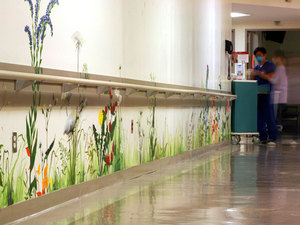
Rx Art For Hospitals: Just What The Curator Ordered : NPR

Being able to relax during medical treatments makes treatments more effective, as well as making better patients. Diane Brown is working to add a little art and light to a scary place: hospitals.

“While hospitals have become more physically welcoming in recent years, with new buildings designed by famous architects and lobbies filled with art, those changes rarely find their way to some of the hospital’s most difficult spaces — the rooms filled with machinery where treatment actually happens.

Diane Brown is trying to change that. She’s the founder of Rx Art, a nonprofit group dedicated to bringing art into the examination room and giving patients a way to escape their bodies’ sickness through their minds’ imagination.”

more via Rx Art For Hospitals: Just What The Curator Ordered : NPR.

cognition · creativity

Technology: old and new

Where does the time go? Not into sleeping, I’ll tell you that much. Here are a few of the lovely tidbits I’ve picked up in the past month, all with a technology/innovation theme:

First pair of ice skates discovered.

A 2300-year-old shipwreck carrying wine cargo was also discovered.

The Lemelson center for the study of innovation and invention. Makes the argument that science, technology, innovation, invention, and play are all connected (we’ve established this already, but for all the slow-learning, non-innovators out there, there is this). I actually found a whole bunch of groups that were working on this same idea – a collection of sci tech museums, conferences, and several academic groups. There is definitely a trend to combine computer science studies with creativity.