behavior · creativity · happiness · writing

Finding time to do what you love is harder than it sounds

creativity
Image by Sean MacEntee via Flickr

Shared by Orangette and What The Cool Kids Are Reading, an article by Anne Lamott about finding time to do the activities that truly fulfill you:

…creative expression, whether that means writing, dancing, bird-watching, or cooking, can give a person almost everything that he or she has been searching for: enlivenment, peace, meaning, and the incalculable wealth of time spent quietly in beauty.

…the bad news: You have to make time to do this.

This means you have to grasp that your manic forms of connectivity—cell phone, email, text, Twitter—steal most chances of lasting connection or amazement. That multitasking can argue a wasted life. That a close friendship is worth more than material success.

more via Finding time – Sunset.com.

It’s harder than it sounds theoretically (I can certainly testify to that), but I also agree with Lamott that it is sooo worth carving out time for.

What are you willing to give up in order to achieve your creativity goals? So far I have given up what little TV I already watched and this week living off the giant roast and yams I made on Sunday (it’s now Thursday), rather than attempting to create a brand new gourmet meal every night.

What are you willing to sacrifice in order to get the creative need filled?

community · creativity · design · play

The Design Your Own Park Competition | American Journal of Play

Mitsuike Park03
How would you design the perfect park? Image via Wikipedia

The City of Binghamton, New York has a great solution for the empty lots and spaces in its area: parks! As David Sloan Wilson describes in his journal article published in the American Journal of Play:

“the thinking behind and the implementation of the Design Your Own Park (DYOP) Competition, a collaborative project of a university, a city, and a fund-raising organization to empower neighborhoods and restore outdoor play citywide in Binghamton, New York. The city makes vacant lots and other neglected spaces available for neighborhoods to turn into parks that residents design and build with the assistance of faculty and students from Binghamton University’s Binghamton Neighborhood Project.

The Design Your Own Park Competition (DYOP), launched in 2010, is a collaborative effort … to enhance opportunities for unstructured play on a citywide scale by empowering neighborhoods to create parks of their own design.

Neighborhoods typically are not well suited for collective action. From the richest gated communities to the poorest ghettos, most people scarcely know their neighbors. But there is nothing like a common goal such as creating a neighborhood park to bring people together.

more via The Design Your Own Park Competition | American Journal of Play.

The city of Seattle, WA, proposed a similar project, although it fizzled out somewhat after initial interest from various organizations (does anybody remember the name of that project? If so, leave it in the comments below, thanks!).

Check out some of the other articles published in the Spring edition of the American Journal of Play. They deal with some really interesting issues of play, child devleopment, and overall health.

anthropology · behavior · creativity · happiness · health · mental health · play

The Shape of Enrichment – ICEE conference taking place this weekend in Portland, Oregon

There are people who get paid to come up with games and toys for animals. Just like people, animals need something to do all day to keep themselves fit and healthy, both mentally and physically. This has been dubbed “enrichment” by people who study this kind of thing, but it basically is just looking at ways to encourage animals to play.

This weekend enrichment experts are all getting together to discuss different ways to provide better enrichment (i.e. toys, games, crossword puzzles) for animals that live in zoos, aquariums, research centers, and so on.

I am sorry I am missing this conference; it sounds amazing!

The mission of the ICEE is to improve the wellbeing of captive animals by providing a venue for the exchange of information among the many diverse groups that participate in environmental enrichment. A key feature of the ICEE is the participation and interaction of animal welfare scientists and all those responsible for the care of captive animals. To further this mission, the ICEE Committee organizes a biennial conference, with published proceedings, in locations around the globe.

more via The Shape of Enrichment – ICEE.

I wish I could go, but I’m doing a little bit of self-enrichment this weekend so am otherwise engaged (plus $400 is a bit steep for me), so I will just lurk on the website for awhile and see what updates pop up. OR, if you’re going you could post in the comments and let me know what I missed? Or, even better, if you know of other events coming up soon, share them here! Thanks!

architecture · behavior · community · creativity · environment · happiness · play

Slide into work with the subway slide in Holland

Thanks to the blog Cup of Jo for finding this:

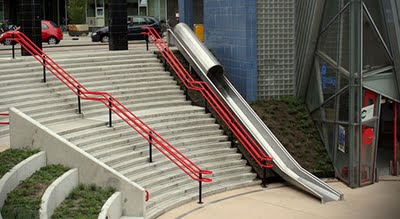
Leave it to the Dutch to install a slide in a subway station. Commuters are encouraged to use it if they’re running late, and the official name is a “transfer accelerator.” At night they play Bach. How rad is that?!

more via A CUP OF JO: Dutch subway slide.

I love the idea of putting a little fun in your commute, in the community, and just keeping your environment fun in general.

Where else have you seen a little fun put into everyday surroundings? I’ve posted about the musical stairs before, but what else is out there? Some silly graffiti? Colorful cars? Share in the comments below.

autism · behavior · children · cognition · creativity · mental health · psychology · technology

Using Play and Technology for Therapy

Griffin Wajda and Juan Pablo Hourcade in Iowa City, IA, play a collaborative-storytelling app.

I truly think technology (and play) are underutilized when it comes to all kinds of therapy, partially because it’s expensive, and partially because people don’t know how to implement it. This article in the Wall Street Journal offers a great example of how people are integrating play AND technology into therapy.

Multitouch technology—which turned smartphones, iPads and other tablet computers into consumer sensations—has a new function: therapy for cerebral palsy and autism spectrum disorders, as well as a range of developmental disabilities. Researchers from at least three North American universities, including Iowa, are developing therapeutic applications for multitouch devices. Games developed by the Scientists’ Discovery Room Lab at Harvard University, and by University of Alberta researcher Michelle Annett, encourage children with cerebral palsy and stroke victims to stretch their range of upper arm and wrist motion.

“It’s a very motivating tool for the patients. It’s visual, the feedback is instant and it’s fun,” said Isabel Henderson, vice president of Glenrose Rehabilitation Hospital in Edmonton, Canada, where games on a touch-screen table are part of stroke victims’ physical rehabilitation.

The new apps offer patients engaging ways to address their medical conditions over the long term, said Quentin Ranson, an occupational therapist at the Alberta hospital. They also could help reduce the time patients need to spend in expensive traditional therapy, Mr. Ranson said.

Children with cerebral palsy—a group of disorders caused by brain damage before or shortly after birth—work to improve their motor skills and coordination through repetitive exercises like wiping a cloth across a table, stringing beads on a pipe cleaner or throwing a ball back and forth. Patients recovering from stroke do much of the same, stacking cones and flipping cards to help them lift their arms against gravity.

more via the Wall Street Journal.

This is just one example of how using play and the right tools can encourage development and healing.

architecture · community · creativity · design

6 Awesome Parks Made From Rehabilitated Urban Structures | Inhabitat

It’s starting to be State Fair time around the U.S., so what better time to talk about interesting parks, particularly those made from rehabbed structures?

Over the past few years we’ve seen some very creative minds transform urban ruins into spectacular parks for us to enjoy. If you can brave an abandoned nuclear plant turned into an amusement park, head to Germany – or see how old train tracks can be transformed into beautiful and fun parks in New York City and Lima.

see all of the 6 Awesome Parks Made From Rehabilitated Urban Structures | Inhabitat – Green Design Will Save the World.

anthropology · behavior · community · creativity · design · Social

Lucerne’s Clever Street Decals Make Taking Out the Trash Fun | Inhabitat – Green Design Will Save the World

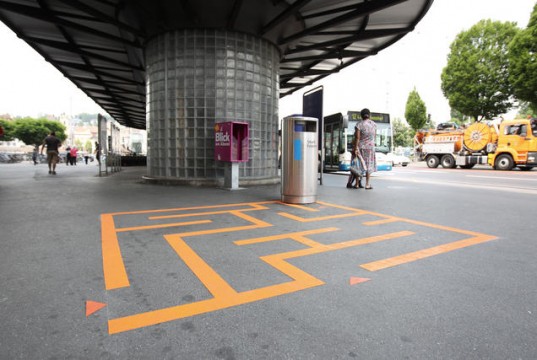
More ways to make social responsibility fun! I love the idea of turning the act of throwing away your trash into a game.

To discourage residents tossing their empty cups and wrappers on the streets and sidewalks, the city of Lucerne launched its “Lucerne Shines” program, which rolled out mazes, hopscotch boxes, and three point lines to make the act of trash disposal more fun. The project appeals to kids and is a great nostalgic throwback for adults alike — kudos to the Swiss town for this creative idea!

check out more games, like hop-scotch and puzzles, via Lucerne’s Clever Street Decals Make Taking Out the Trash Fun | Inhabitat – Green Design Will Save the World.

brain · cognition · creativity · music · neuroscience

How the brain reacts to music, improv

As a follow-up to my previous post about brain reactions to improv, creativity, and problem-solving, check out my post on my other blog, Art of Science, to see the TED talk by Charles Limb discussing how the brain works on music.

How the brain reacts to music, improv.

behavior · brain · creativity · learning · psychology

The Body Odd – Watching Jon Stewart might make you more creative

Jon Stewart
Watching sarcastic comedians like Jon Stewart exercise your creativity. Image via Wikipedia

Both my parents were fairly sarcastic, and even got chided for it by their parents since it “set a bad example” for us kids. According to this study, however, they were actually doing us a favor!

Israeli researchers found that when people overheard anger conveyed in a sarcastic way, they were better able to solve creative problems, according to a recent report in the Journal of Applied Psychology.

In one experiment, researchers recruited 184 Israeli undergrads, all engineering students, and had them listen to one of three versions of a fake customer service center phone call. In each conversation, a customer called to complain about cell phone service problems — the “customer’s” speech was either angry, sarcastic, or neutral.

After eavesdropping on these pretend exchanges, the participants were asked to solve a series of problems — some creative, some analytic.

“Observing anger enhanced analytic problem solving, but hindered the solving of creative problems,” write Dorit Efrat-Treister, Anat Rafaeli and Orit Scwarz-Cohen, all of Technion-Israel Institute of Technology, along with Ella Miron-Spektor of Bar-Ilan University.  They add that “observing sarcasm improved the solving of creative problems.”

more via The Body Odd – Watching Jon Stewart might make you more creative.

Having to decipher sarcasm, interpreting the emotion behind the words, apparently helped the undergrads get into a creative problem-solving mode. The group didn’t speculate why this might be the case, but it is interesting to think about humor and how it can affect the brain.

This is also one reason why I feel email and writing aren’t always the best form of communication; it’s hard to indicate sarcasm in writing.

behavior · brain · cognition · creativity · learning · play

Why we need play and relaxation to think

Recreated :File:Neuron-no labels2.png in Inksc...
These little guys need a break just like your muscles. Image via Wikipedia

The brain is an amazing thing. It allows us to problem solve, combine ideas, and create out of seemingly thin air. But only if we let it.

As a play advocate, I run into a lot of people grumbling that play takes away from learning; but the fact of the matter is, play is ESSENTIAL to the learning process. More and more science is showing that the brain needs that down time to process what it’s learned, digest it a little bit, in order for us to use it for any useful purpose.

People who study creativity and innovation are aware of this all too well:

Current neuroscience research confirms what creatives intuitively know about being innovative: that it usually happens in the shower. After focusing intently on a project or problem, the brain needs to fully disengage and relax in order for a “Eureka!” moment to arise. It’s often the mundane activities like taking a shower, driving, or taking a walk that lure great ideas to the surface. Composer Steve Reich, for instance, would ride the subway around New York when he was stuck.Science journalist Jonah Lehrer, referencing a landmark neuroscience study on brain activity during innovation, writes:

“The relaxation phase is crucial. That’s why so many insights happen during warm showers. … One of the surprising lessons of this research is that trying to force an insight can actually prevent the insight.”

keep reading the Developing Your Creative Practice: Tips from Brian Eno :: Tips :: The 99 Percent to hear Brian Eno’s take on creativity and how he puts his brain to work.

It’s nice to see that science is finally taking relaxation and play seriously. I just wish the rest of the world, or at least our education system, would too. I know my work would benefit greatly if I took time to just relax and contemplate things more, to relax and let my brain explore a little bit. Hmmm, another exercise to try…