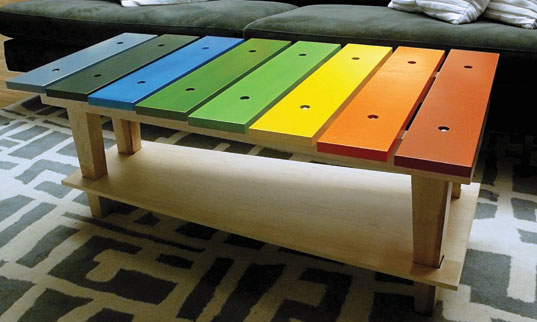
I looooved my xylophone as a kid. It was just fun to bang on every once in awhile. And I love the idea of being musical before I’ve finished my first cup of coffee:
The designers behind Manhattan based Jellio have dreamed up yet another uber-cool, kid-friendly home decor piece: a coffee table that doubles as a rainbow colored, working xylophone that is just begging to played by tots and adults alike! Jellio’s Music Table is a much larger version of the tiny xylophones we all tinkered away on as tots — and we think the designers have lived up to their mission to ‘combine childhood fun with interior design… and make you smile.’ Made of solid pine with a natural finish base, Jellio’s Music Table would not only be a lively focal point in a nursery or child’s bedroom, it would also be a unique and entertaining coffee table for the family room. We’d sure love to tap away to a spirited rendition of ‘Twinkle Twinkle Little Star’ on this beauty.
Install public art to create community, sense of place
Install public murals and other public art to create a sense of place and add beauty to urban spaces, which leads to more interest in and conservation of the environment as a whole, including the natural environment.
Yarnbombed tree
Public art creates a sense of place and space, and makes people more aware of their environments, more invested in the space, and more interested in preserving other things in their environment.
From a Grist article: “dozens of painted plazas, dubbed Intersection Repairs, pepper the map not just of Portland but also of Los Angeles, New York, St. Paul, and Seattle.
“In Seattle, a City Repair chapter formed and facilitated several intersection painting projects, including a ladybug in the Wallingford neighborhood. Residents meet annually to repaint the mural and hold a block party. “Our goal is to cut down traffic and bring the community together and create a sense of neighborhood,” Eric Higbee, who led the ladybug painting, told the Seattle Times.
“It’s not about the paint,” says professor Jan Semenza, a professor of public health at Portland State University who lives near the Sunnyside Piazza and has researched intersection repairs. “It’s about neighbors creating something bigger than themselves.” As an everyday intersection becomes someplace special, residents begin to experience the value of community.”
There are other examples of public art and murals being installed that have created a renaissance in a neighborhood, from New York to Brazil.
Guerilla street art has also started to appear over the last couple of years, creating awareness and interest in preserving the community. In Seattle, when a woman knit a sweater for a tree, it created interest in the tree and a desire to preserve it. Even something as simple as “repairing” walls and buildings with colorful Legos, such as the work that Jan Vormann has been doing for the last couple of years, has made people more invested in repairing and preserving their community.
While it is not a direct impact on the natural environment, it is a positive impact on the built environment, and does create a sense of place and overall higher investment in the neighborhood and local environment.
I have been on vacation in California this week, playing with deer, ground squirrels, sea otters, sea lions, harbor seals, pelicans, sparrows, sheep, dogs, cats, persimmons, pomegranates, oak trees, poplars, and other assorted flora and fauna. It also means I haven’t been feeding and tending to this blog as much as I would like. So, to hold you over until I am back into my usual swing of things, I am providing a link to a collection of 10 TED talks on Creativity.
Why TED?
I like to think of TED talks as little mental snacks, so this smattering of talks about creativity, both as a blessing and a curse, when it flows and when it doesn’t, and what you can do about it if anything, are a great collection of videos for you to snack on.
Why creativity?
Because I see creativity as merely a facet of play, so any research or discussion of creativity is also beneficial for talking about play. People need creativity in order to play. Creativity is also a key element to a playful space. Writers and artists often need specific environments to create (or at least think they do). And, for some reason, I find it’s easier for academics and business types to talk about creativity than play, when in many regards they are talking about the same thing. You say tom-A-to, I say tom-au-to…
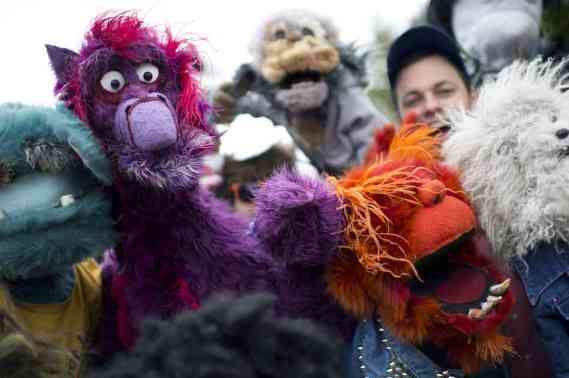
Puppets at the Million Muppet March protest this past weekend.
When presidential hopeful Mitt Romney threatened a childhood icon with funding cuts during a debate last month, people took to the streets and protested…with puppets. In what was deemed the Million Muppet March, people used puppets, marionettes, and other toys to show their unhappiness with the idea of funding for public broadcasting being cut:
Organizers say at least 600 people signed up to attend the march in person, with a few thousand more participating virtually on Facebook, Twitter and their own marches around the country. So far, the pictures on the group’s Facebook page show the marchers bundled in puppet-like hats with animal ears, carrying coffee, placards with statements like “Grouches of the World, Unite!” and, yes, more than a few puppets.
This protest is not only about supporting Public Broadcasting, but is also about play on several different levels. First, Big bird and other Sesame Street characters are a big part of many Americans’ childhoods. While imaginary, to many people these Muppets were very real and very important play characters during the formative years of their lives.
Second, the use of puppets and toys to protest politics is an age-old tradition. People in countries ranging from the England to Venezuela to Thailand have used puppets and epitaphs during protests to get a laugh out of people as well as get their attention. Even the court jester in days of old could get away with some nasty political commentary because it was said “in jest.”
Full disclosure, I am a huge Muppet fan, and am happy to see that others agree with me that Big Bird and PBS are worth funding, and I’m especially happy that people showed their support using puppets.
I read about this street performer on Mashable. Based in Manhattan, he sounds like a guy with the same passion and vision for a play-filled world that I have, so I just had to share:
Silver, “The Great Performer,” can be seen throughout Manhattan using dance, song and oversized props to ease the tension of everyday life — because, as he says on his website, “it’s OK to be silly from time to time.”
Matthew describes his work on his website as an antidote to seriousness:
My role as a clown, trickster and village idiot is to parody excessive seriousness by playing with taboos, rules, and social norms. My inspiration comes from my heart. I perform for smiles and laughter, loosening people’s armor, and opening up a portal for imagination, creativity and love.
Silver reaching out to his audience, literally. Photo from his website.
Glad there is somebody out there who spends his time encouraging people to be silly.
Kids in Halloween Costumes (Photo credit: epSos.de)
Ah, Halloween, originally considered the betwixt and between time of year when ghosts and souls past could pass over into our world and scare the crud out of their relatives.
But these days, Halloween is really a celebration of play. No, really! When else is it perfectly acceptable to dress up in funny costumes, stay up late on a week night running around banging on peoples doors, play tricks on people, and create food that looks spooky or gross but is really just lots of sugar?
The tradition of dressing up and playing for Halloween is alive and well in the tradition of Dia de los Muertos, for example. To deal with and make light of mortality, grown-ups and kids will put on make-up and costumes that represent death and the dead. They’ll make and eat sugary confections, parade down the street, play music, sing songs, and overall try to make a party out of a normally scary and sad phenomenon. Yes, there is some sadness involved, such as visiting relatives’ graves and setting up alters to reflect their passing, but for some even the act of creating the alter, i.e. being creative, is cathartic and helps with the loss of a loved one.
In the play deprived United States, Halloween has become one big kid’s night out for adults as well as kids. Children and grown-ups alike look forward to dressing up, pretending to be a character, and be silly with friends. Often the costume is a parody or commentary on something political, but that’s just as playful as covering yourself as marshmallows, although potentially socially sticky instead of just physically sticky.
That’s why it makes me sad that so many K – 12 schools have banned Halloween for fear of these socially sticky situations or fear of kids bringing weapons to school as part of their costumes, plus some religious groups find Halloween offensive. While I understand and respect all of these concerns, I disagree with the idea that we should just get rid of it outright. How are we going to learn to get along and get over differences if we just avoid them? Play and school are both supposed to be about learning, so why not turn Halloween into a learning opportunity?
As a proponent of play, I feel like Halloween is an important holiday, not because of what it originally stood for, but for what it stands for now. Being socially allowed to play and pretend, even for one day, is important for humans’ mental health. It also creates bonds between people who share in the activity, not just from sharing the experience but learning more about each other through their costumes.
I will definitely be buying candy and supporting Halloween this year, not for the sweet tooth but for the costumes. Play on!
Playful design in an urban environment? My favorite!
Clever and talented Danish artist Jeppe Hein has been custom-making his “Modified Social Benches” for museums, arts festivals, and plazas since the mid-2000s. Most recently, he created a unique set of art you can sit on for Beaufort04, the fourth Triennial of Contemporary Art by the Sea this summer in Belgium. Kids, cool kids, and adults all seem to love playing with these.
Hein says his powder-coated aluminium “social benches” borrow their basic form from the standard park bench, but are altered to make the “act of sitting on them a conscious physical endeavor.” As they mutate, the benches become spaces to “inhabit,” rather than just places to park it and relax for a moment.
The pieces may seem like fun one-offs, but something then happens between the work and the community: “As is the case with much of Hein’s work, the Modified Social Benches on the dyke in De Haan seem to hide behind a disguise of fun and entertainment. But what they actually evoke is a process of interaction and communication that works on different levels.”
Visualization and daydreaming are useful tools. Above: the painting Rêverie (Daydream) (Photo credit: Wikipedia)
I’ve been reading about visualization a lot lately. It can seem kind of hokey or too touchy-feely for some, and I’m usually not one to buy into “if you build it, they will come” kinds of ideas. However, studies are finding that visualization has a lot of positive benefits; usually articles and research focus on the relaxation and pain reduction aspects of visualization, but it also helps formalize one’s ideas, missions, and goals, and how to achieve them.
When most people visualize something for relaxation purposes, they think of outdoor spaces, whether it’s the beach, the woods, or a mountain top. Something wide open. Very few people think of cityscapes when trying to visualize a relaxing place. Women in labor or people using visualization for pain reduction will visualize things opening and releasing, usually a flower or something else natural.
For goal setting, visualization is definitely more personal, but it also often involves the person visualizing themselves doing something they enjoy, whatever it is that makes them feel happy and alive, energized and inspired to go after their goals. Scoring the game-winning goal, building the perfect dream house, nailing the presentation at work. The object of the exercise in all of these cases is imagining themselves in a specific scenario, seeing, tasting, smelling exactly what that’s like, being happy and successful.
Scientists and strategists often describe how sitting with a problem, thinking through its complexities and possible scenarios to solve the challenge.
What’s also interesting to me is that all of these scenarios for visualization could also be described as slightly more focused daydreaming.
Daydreaming, which is considered a type of play, is often dismissed as a waste of time. But it has been shown to be extremely useful for both children and adults in problem-solving, understanding mathematical or biological concepts, or just coming up with new ideas, whether it’s understanding energy or butterfly wings. It’s also good training for more focused practices like visualization, meditation, or focused brainstorming practiced in many professions.
My advice is to take some time this weekend and daydream on a topic of interest or a problem you’ve been having, or move up a step in complexity and try visualization or brainstorming on it.
There’s really no one way to daydream or visualize, although there are lots of suggested techniques out there.
What do you find yourself daydreaming about? Do you have a goal, dream, passion? Think about what that might look like? What are you doing, how are you doing it?
Do you have a problem or challenge that has been creeping into your mind without your consent? Instead of pushing it away, let it come in and think about it? Why is it bothering you? What are some ways to fix it?
Wishing you all a happy Friday, and a visualization-filled weekend.







 Mental Flowers