community · creativity · play

Artist Creates Water-Activated Street Art To Make People Smile On A Rainy Day | Bored Panda

It makes sense that this would be developed in Seattle, where it is wet a good portion of the year.

Like a new modern version of invisible ink, superhydrophobic coatings can also be used to create hidden street art that stays invisible until it gets wet. Peregrine Chuch, a Seattle-based street artist, created a series of public works of street art called Rainworks using the same sort of hydrophobic coatings that we saw being used in Germany to combat public urination.

Church creates the artwork spontaneously because he has been assured by the city authorities that what he is doing is legal – the coating is non-toxic, non-permanent, only sometimes visible, and his works don’t advertise anything. He says that, depending on how much the sidewalk in question is used, his pieces may last between 4 months and a year, but are most vivid within the first few weeks of application.

His works are diverse, and range from artistic drawings to fun and motivational messages to a hop-scotch game that can only be played when it’s wet.

more via Artist Creates Water-Activated Street Art To Make People Smile On A Rainy Day | Bored Panda.

community · culture · environment · happiness

Seattle Department of Transportation: Seattle Parklet Program & Streatery Pilot Program

Way to go Seattle!

After a successful year-and-a-half long pilot, we’re excited to announce that the Parklet Program is now a permanent program! This means that Seattle businesses and community groups have even more opportunities to enhance our streets with public spaces.

As part of this launch, we’re also rolling out a brand-new approach to activating our streets: the Streateries Pilot Program. What’s a “streatery” you ask? Streateries combine the best features of a parklet and a sidewalk café by allowing a restaurant, café, or bar to use a parking space to create outdoor seating for their customers during business hours (like a café) and for the public during non-business hours (like a parklet).

there is still time to sign up your company if you’re interested via Seattle Department of Transportation: Seattle Parklet Program & Streatery Pilot Program.

I look forward to seeing lots of little Parklets spring up around the city as we start to emerge from the winter wet and dark.

architecture · children · community · design · environment · health · mental health · play · school

Changing Skyline: Redesigning playgrounds to promote ‘loose play’ – think pop-up play spaces

Great article about the evolution of the playground, as well as the next generation of playgrounds emerging in cities:

After World War II, European architects turned out custom playgrounds that challenged kids both physically and intellectually. Inspired by their work, a few American architects, including Philadelphia’s Louis Kahn, tried their hands at the form. But the movement didn’t get very far. Playgrounds were a casualty of the breakdown of American cities in the ’60s and ’70s. As maintenance was deferred, they fell into ruin. By the time cities began to recover in the ’90s, Solomon says, all that local officials wanted was equipment that was indestructible and vetted for safety.

Moore, a professor at North Carolina State University who has been studying children’s play for 50 years, sees a connection between those designs and the increase in such childhood ailments as obesity, anxiety, and attention-deficit disorder. In the simple act of scrambling up the branches of a tree, a kid learns to monitor risk and deal with fear. But on most playgrounds, the climbing frames are lower than ever.

The concern about such controlled environments has sparked any number of popular books advocating less programming: Free Range Kids, 50 Dangerous Things (you should let your children do), Last Child in the Woods. All see our culture’s fear of risk as worse than the occasional scraped knee or broken bone.

So what’s the alternative to standard-issue playgrounds? Solomon envisions multipurpose, multigenerational urban parks that incorporate spaces where kids can take charge of their own play. Instead of a fixed bridge in a plastic fort, they would have to use their imagination to decide which objects could be converted to play equipment. Such a challenging play space also would include nooks where kids could temporarily escape the nervous gaze of their caregivers. There would be no fences, plenty of trees and bushes, and good seating.

read more of their ideas for better playgrounds via Changing Skyline: Redesigning playgrounds to promote ‘loose play’ – think pop-up play spaces.

My favorite playground growing up was made of mostly huge sewer pipe pieces, a monkey cage, and random cement shapes. What was your favorite playground as a kid? Or now? Describe it in the comments below.

anthropology · behavior · community · culture · environment · happiness · health

Los Angeles has Cancer — Stephen Corwin on Medium

This is a scathing opinion piece looking at the negative influences of space and place, specifically cars and car culture. Corwin argues passionately against the takeover of cars in to the city space and how it is anything BUT enriching. It is full of examples of what NOT to do, and therefore offers suggestions on how to solve it.

Our experiences driving cars in this city are, for the most part, fleeting. We drive somewhere, we get out of the car, we close the door, and we walk away. But to think that we can escape the world that cars have created as easily as we escape the car itself is foolish. In fact, when we leave our cars, we walk into that world. We have to live in that putrid mess.

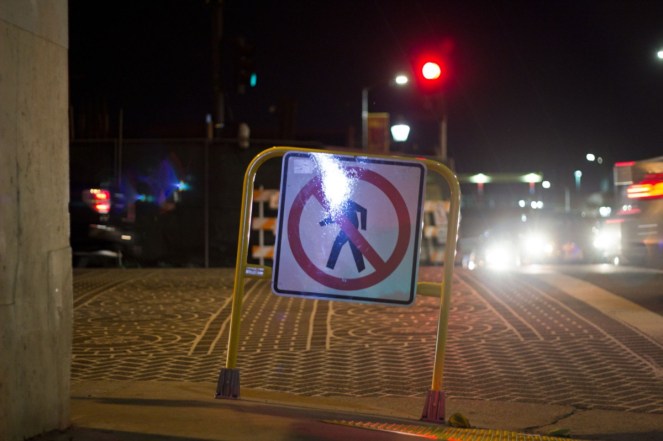
Let’s talk about how Los Angeles is a city where construction projects can fence off whole blocks, including the sidewalks, without offering people on foot an alternative. Let’s talk about how when that happens, no one even considers converting one of the two car lanes into a temporary sidewalk, because dear god, that might cause slight inconvenience to people in cars. And let’s talk about how ironic it is that inconveniencing people in cars is the end of the world, but doing the same to people on foot is a non-issue. Then let’s talk about how when frustrated walkers decide to use the car lane rather than take the ridiculous detour, the city’s totally acceptable solution to that problem is not to concede space to those people, but rather to bolt permanent, metal signs into the middle of the sidewalk to keep them from doing so. That is cancer.

read the whole thing via Los Angeles has Cancer — Medium.

It is worth a read.

community · creativity · play · youtube

City of Play Director Adam Nelson on Designing Play for a City

I have run into the same challenges or questions as Adam Nelson in my play research, so I am glad to hear it expressed by someone else. It’s from a year ago, but still good stuff.

City of Play Director Adam Nelson discusses City of Play’s philosophy on using play to make cities better places to live and work.

via City of Play – Ignite Pittsburgh – YouTube.

behavior · community · happiness · hugs · play · Social

McDonald’s will be accepting hugs, calls to mom, and dance moves as payment

OK, so YES it is being sponsored by a huge megacorporation. YES it is a total gimmick. But it is such a COOL gimmick.

“That will be five hugs, please.”

Randomly selected McDonald’s customers will have the opportunity to pay for their meals with various tasks — such as doing a dance or calling their mom — between Feb. 2 and Feb. 14. The deal is outlined in a Super Bowl ad from the company, above, which will air on Sunday but is already posted on its YouTube page.

So, for example, breakfast might cost a fist bump to a McDonald’s crew member; lunch could be paid for with a call to a loved one; and dinner could go for a hug to a family member. But there will only be 100 winners at each store.

more via McDonald’s will be accepting hugs and dance moves as payment. (Mashable)

Last week I also posted about a major paint company that promoted their paint via enabling the handicapped in China to blow up paint balloons onto a canvas.

While to some it may feel “icky” to have mega-sized companies counting this kind of self-congratulating promotion as “spreading the love” or even “charity work,” frankly I am just happy that anyone, either an individual or a giant corporation, is taking steps to making their spaces a little bit happier and more enriching. Companies spend millions of dollars to make their customers happy, so why not spend a little bit of that on a smile?

When has a corporation made your day better, either through a promotion or just because an employee took some time to acknowledge you? Leave it in the comments below.

behavior · community · happiness · music · youtube

The Gift of Music In A Nursing Home. – LittleThings.com

Give a little kindness and playfulness in an otherwise stale, quiet, and sometimes depressing space, and see how far it goes!

The Piano Guys is a group of amazingly talented musicians, who are all about putting on a spectacular show and as you’ll see in this video, it was way better than any of the old timers ever expected. The group showed up at Stirling Court in St. George, Utah and surprised the residents with a truly incredible Charlie Brown medley.

As you’ll see, the senior citizens were delighted by the classic “Peanuts” tune on piano and couldn’t stop moving their feet. This video is undeniable proof that music is good for the soul. Just look at how the performance lifted their spirits!

video via She Heard Music In The Nursing Home. Her Reaction? HEART MELTING!! – LittleThings.com.

behavior · community · hugs

A Simple Idea that Can Change All The Grumpy People You Live Around : Free Range Kids

A Simple Idea that Can Change All The Grumpy People You Live Around : Free Range Kids

First, get out your hankies. Then, consider what would happen if everyone in town could thank and encourage each other via a public message board. That’s what one anonymous Canadian wondered, and so he or she started a website (and Facebook account) called “Spotted in Windsor,” in Ontario.

It was inspired by a similar site the local university created, according to metronews.ca.

Most of the posts are positive, but not all.

Editor’s note: Some are downright heart-wrenching.

read some here via A Simple Idea that Can Change All The Grumpy People You Live Around : Free Range Kids.

architecture · community · creativity · culture · environment · Social

We Asked 10 of Our Favorite Artists to Create Love Letters to Their Cities. Here’s What They Came Up With | GOOD Magazine 

Good Magazine Asked 10 of Their Favorite Artists to Create Love Letters to Their Cities. Here’s What They Came Up With… (click either the link below or the picture to see them all.)

via GOOD Magazine Cities Project .

architecture · behavior · community · creativity · culture · environment · family · happiness · health · play · Social

Cities’ Message to Young Families: Play and Stay – WSJ

City planners are finally starting to grok that in order to keep residents, they will need to offer the whole package, including playful spaces for everyone, kids and grown-ups alike.

About a decade ago, the so-called creative class of 20somethings fueled the revival of urban centers by settling in downtown areas mixing condos and coffee shops. Now, as millennials and other urbanites have children, their needs are changing. Cities want to hold on to them by becoming more “playable,” for both children and adults.

For decades, cities “relegated kids to the playground and said, ‘We’ve done something for you,’ ” says Darell Hammond, chief executive of Washington, D.C. nonprofit KaBOOM!, which consults with city officials on promoting and preserving play. “The whole city should be a playground, and play should happen everywhere.”

That means not only building more parks and bike paths but also incorporating the ideas of “fun” and “play” throughout a city, whether it is musical swings downtown Montreal, a hopscotch crosswalk in an arts district Baltimore or camp sites on a city lake front Chicago.

more via Cities’ Message to Young Families: Play and Stay – WSJ.

I hope that this attitude shift from city planners and designers makes it more acceptable for grown-ups to go out and play, and I mean actually physically play, not just go to bars and concerts that were traditionally classified as the only acceptable adult “play.” Seattle and Portland, and  are definitely accepting and encouraging of grown-ups playing bike polo in city parks or just going for a run. Creating an environment that welcomes play also helps change the attitude of others