community · environment · play

It’s PARK(ing) Day!

Park(ing) Day in Indianapolis
Park(ing) Day in Indianapolis. Image by DanO'Connor via Flickr

Today in Seattle, S.F., and other major cities, activists are taking over one or several parking spaces and turning them into parks!

PARK(ing) Day is an annual, worldwide event that invites city dwellers to transform metered parking spots into parks for the day. PARK(ing) Day in Seattle happens to fall on the first day of the [Seattle Design] Festival.

We’ll be partnering with the Seattle Art Museum (SAM) at their impromptu “park.” Drop by and join us in a Festival photo/design activity open to everyone.

SAM will also be offering an all-ages, hands-on artmaking activity; an artist-designed Cornhole game (bean bag toss); and a noon concert by James Whetzel, classically trained on the sarod and tabla.

More via the Seattle Design Festival, which is going on from the 16th until the 25th!   The festival is also pretty relevant since its goal is to explore our environments, how we use them, and how to make them better.

I was able to go see the Seattle exhibit last year, but unfortunately am parked at work today, so go see it and report back. Last year they had lots of games and give aways, and maps featuring the many parks that are scattered around the Seattle metro area.

behavior · community · psychology

How Reading Fiction Boosts Empathy – Culture – GOOD

Complete set of the seven books of the "H...
Reading fiction can improve empathy. Image via Wikipedia

I had a great vacation – I got out into nature, I slept in (some mornings when I wasn’t out looking for wildlife), and I even read a little bit. Turns out the reading was good for me in more ways than one; reading is not only relaxing, some studies find it improves empathy:

Shira Gabriel and Ariana Young, both from the psychology department at the University of Buffalo, gave 140 undergraduate students passages to read from either the Harry Potter series or the Twilight series. Afterward, the students were asked how much they related to the characters in the novels. Gabriel and Young found that despite the fact that both the stories rely heavily on otherworldly magic and mysticism, the undergrads felt a real affinity for the characters. “[T]he study found that participants who read the Harry Potter chapters self-identified as wizards, whereas participants who read the Twilight chapter self-identified as vampires,” they wrote. ”

And “belonging” to these fictional communities actually provided the same mood and life satisfaction people get from affiliations with real-life groups. Books provide the opportunity for social connection and the blissful calm that comes from becoming a part of something larger than oneself for a precious, fleeting moment.”

Raymond Mar, a professor at York University, has also noticed the link between reading and empathy. In a study of children, Mar found that the more a child reads, the likelier she is to be able to understand the emotions of others.

more via How Reading Fiction Boosts Empathy – Culture – GOOD.

Some of my reading wasn’t very empathy inducing, although that may be because I was reading the news rather than fiction.

What books do you recommend that may help with empathy? They don’t have to be empathic necessarily, just tell a good story about someone.

architecture · community · environment · happiness · health

Seattle Neighbors Fight Stormwater Pollution by Building Rain Gardens · Oregon Public Broadcasting

This post is a total plug on my part of an activity meant to encourage people to go out and get their hands dirty, improve their environment, and help nature at the same time: Rain gardens!

Gardening season is coming to an end for most of us, but it’s not too late to plant a rain garden for this winter’s torrents.

Rain gardens are becoming more popular, especially in places like Seattle with significant rain and run-off, and I suspect also because they’re very low maintenance; you simply plant, water them until they’re established, and let nature to the rest. They also make the neighborhood look nicer than just having a strip of grass between your car and the sidewalk.

The West Seattle neighborhood is actively encouraging residents to plant rain gardens:

The gardens are part of a campaign by Washington State University and the non-profit Stewardship Partners. Their goal is to install 12,000 rain gardens in Puget Sound communities by 2016. So far, more than 700 gardens have been installed (see a map of them) and more are being added every week.

“Twelve thousand gardens will absorb approximately 160 million gallons of stormwater each year,” said Stacey Gianas, who is with Stewardship Partners.

That much water would fill 250 Olympic swimming pools. And its stormwater, which washes over roofs and streets, picking up all kinds of pollution. Usually that contaminant-filled water runs into storm drains that empty into waterways and rivers.

more via Neighbors Fight Stormwater Pollution by Building Rain Gardens · Oregon Public Broadcasting · EarthFix.

Rain gardens can be as small as a couple of feet, or take up the entire yard. They also promote wildlife (the good kind!) to stop and visit.

community · creativity · design · play

The Design Your Own Park Competition | American Journal of Play

Mitsuike Park03
How would you design the perfect park? Image via Wikipedia

The City of Binghamton, New York has a great solution for the empty lots and spaces in its area: parks! As David Sloan Wilson describes in his journal article published in the American Journal of Play:

“the thinking behind and the implementation of the Design Your Own Park (DYOP) Competition, a collaborative project of a university, a city, and a fund-raising organization to empower neighborhoods and restore outdoor play citywide in Binghamton, New York. The city makes vacant lots and other neglected spaces available for neighborhoods to turn into parks that residents design and build with the assistance of faculty and students from Binghamton University’s Binghamton Neighborhood Project.

The Design Your Own Park Competition (DYOP), launched in 2010, is a collaborative effort … to enhance opportunities for unstructured play on a citywide scale by empowering neighborhoods to create parks of their own design.

Neighborhoods typically are not well suited for collective action. From the richest gated communities to the poorest ghettos, most people scarcely know their neighbors. But there is nothing like a common goal such as creating a neighborhood park to bring people together.

more via The Design Your Own Park Competition | American Journal of Play.

The city of Seattle, WA, proposed a similar project, although it fizzled out somewhat after initial interest from various organizations (does anybody remember the name of that project? If so, leave it in the comments below, thanks!).

Check out some of the other articles published in the Spring edition of the American Journal of Play. They deal with some really interesting issues of play, child devleopment, and overall health.

children · community · design

Kids paint South Seattle mural for safety | Seattle Times

Hajiyeva Aysha, a volunteer from Harborview Medical Center, foreground, and Keith Harrison help paint a whale mural near Graham Hill Elementary School on Sunday. The mural is meant to improve walking conditions for child pedestrians in the Graham Hill Community. Photo credit Ellen Banner. Seattle Times.

Flashing lights or a “Slow Children” sign are common sights around schools, but now a local school has put in a “a huge, round, sea-themed mural right smack in the middle of South Graham Street in South Seattle,” to alert drivers to pint-sized pedestrians:

Some of the kids who had helped earlier talked about what the painting was supposed to accomplish.”It’s there so people will notice it and think they should really, really slow down so they don’t get into accidents,” said Maya Garcia, 8, one of the students the mural is meant to protect at nearby Graham Elementary School.Her friend Lilly King, 9, had another concern. “I hope they don’t crash into each other when they’re slowing down.”

The mural, part of the Safe Kids Seattle project installed this weekend in the 5100 block, is thought to be the fourth in the city and the first south of Interstate 90, according to Graham Elementary Principal Christina Morningstar. Each year, according to officials, more than 244 children under the age of 14 are killed in pedestrian accidents in the nation. All the Safe Kids projects are designed to alert drivers to the presence of children in school zones.

In addition to the mural, which features a whale and several fish, organizers installed speed bumps and school-warning signs using $35,000 in grant money from FedEx and the Seattle Department of Transportation.

via Local News | Kids paint South Seattle mural for safety | Seattle Times Newspaper.

I read this story in the office lounge while I was waiting for my leftovers to warm up in the microwave, and immediately thought this was a good idea not just for schools, but for any place that pedestrians frequent. Often cities will put in colored bricks or tiles at busy crosswalks, but for areas with less options and/or funds to renovate, this is a great solution!


community · culture · design · technology

Smashing the Cubicles – Technology Review

Typical rolltop desk
The workplace is changing. Image via Wikipedia

I just wanted to share a nice article from Technology Review discussing some of the different ways that people are adapting the typical work environment. The way we work is changing, so why not the way our workplace looks? I used to work in a cube with poor lighting and no view of the sun, so BOY let me tell you how important a good work environment can be.

The quick expansion of social and mobile technologies is creating a widely distributed workforce. To better suit employees who come into offices more sporadically, some companies and design firms are testing radically new—and more efficient—configurations for physical offices, and betting that improved technology will make the experiment more successful than similar ones in the 1990s.

A project at the headquarters of Cisco Systems in San Jose, California, for example, overthrows decades-old conventions about office space. Called Connected Workplace, it replaces individual cubicles with open clusters of wheeled desks that belong to groups, not individuals; personal belongings are largely confined to lockers.

There are no PCs at the desks, because the employees who use the space use mobile technologies, including the Cius tablet, which Cisco recently began selling to businesses. Rick Hutley, a Cisco vice president, chooses his desk according to which colleagues are present and what’s on the day’s agenda. Then he docks his Cius to a port on the desk that includes a phone handset. The tablet handles voice and video calls whether it’s docked or mobile, and it can be used to share documents at meetings.

more via Smashing the Cubicles – Technology Review.

behavior · brain · community · emotion · happiness · mental health · Social

Yes, you can now be addicted to social media

Illustration of Facebook mobile interface
Social media keeps us connected with friends, but for some can be detrimental to everyday life. Image via Wikipedia

I love being able to connect to old friends, classmates, and coworkers via social media, as well as share thoughts, ideas, and new developments. But some people can take it too far, and while I have my weaknesses as much as the next gal, I don’t think I’d consider myself addicted as they describe it. Apparently people can receive intense highs from the social interactions and feel like they need a “fix” if they go on too long without checking in to one of their social media networks.

When you hear the word ‘addiction’ perhaps you think of alcohol, drugs and sex. But what about social media? Over recent years there’s been an emergence of studies into social media as a new form of addiction.

Research by Retrevo Gadgetology looked into how people use social networking sites. Out of those asked, 45% said they check Facebook or Twitter after getting into bed. People under the age of 25 were the more extreme with 19% saying they log on any time they wake up during the night, 27% said they sometimes check when they wake up during the night and 32% check in first thing in a morning.

via Social Media: The Pursuit of Happiness.

To me this indicates just how detached and isolated many of us are, that instead of going to a local gathering or even a bar or club when we’re feeling lonely, we go online. It’s been shown that Americans feel more isolated and alone than at any other time in our history (or at least history of checking for this kind of thing), and I would hypothesize we’re turning to these social media networks as some way to retain communities we’ve established in other physical locales, or create new ones that are entirely virtual. I also wonder if the meta-interaction makes people feel less fulfilled than dealing with people in real, physical life and make them anxious to get more. I believe social media networks are useful, no doubt, but I do wonder if we are using them as a crutch rather than actually meeting people in person. Granted a lot of social media sites encourage actual in-person meetings, from online dating sites to the new GrubwithUs startup that acts as matchmaker for hungry social types in various cities across the U.S.

What are your thoughts about social media networks and people who can’t seem to unplug from them? Leave your thoughts and/or experiences in the comments below.

architecture · behavior · community · creativity · environment · happiness · play

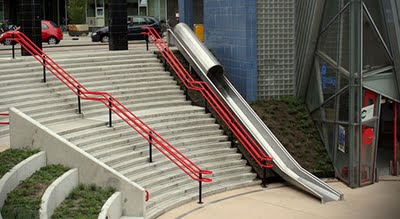
Slide into work with the subway slide in Holland

Thanks to the blog Cup of Jo for finding this:

Leave it to the Dutch to install a slide in a subway station. Commuters are encouraged to use it if they’re running late, and the official name is a “transfer accelerator.” At night they play Bach. How rad is that?!

more via A CUP OF JO: Dutch subway slide.

I love the idea of putting a little fun in your commute, in the community, and just keeping your environment fun in general.

Where else have you seen a little fun put into everyday surroundings? I’ve posted about the musical stairs before, but what else is out there? Some silly graffiti? Colorful cars? Share in the comments below.

architecture · community · creativity · design

6 Awesome Parks Made From Rehabilitated Urban Structures | Inhabitat

It’s starting to be State Fair time around the U.S., so what better time to talk about interesting parks, particularly those made from rehabbed structures?

Over the past few years we’ve seen some very creative minds transform urban ruins into spectacular parks for us to enjoy. If you can brave an abandoned nuclear plant turned into an amusement park, head to Germany – or see how old train tracks can be transformed into beautiful and fun parks in New York City and Lima.

see all of the 6 Awesome Parks Made From Rehabilitated Urban Structures | Inhabitat – Green Design Will Save the World.

community · design · technology

Summary of National Building Museum’s “Intelligent Cities” symposium: Change Observer: Design Observer

Red, yellow and green (unlit) LEDs used in a t...
LED traffic lights in Sweden. Image via Wikipedia

What does it take to make a city “smart”? Not intellectual, but make traffic lights respond to traffic, have buses alert people if they’re running a few minutes behind, and large corporate buildings comfortable for all its occupants. Journalist Phil Patton offers a nice review of the takeaways from National Building Museum‘s “Intelligent Cities” symposium which looked at these questions and more in order to design a better, smarter future city; among the many takeways:

What is critical in making cities “smart” is not just data, it seems, but clear, accessible data that is often used for purposes government may never have dreamed of. Early in the symposium, Judith Rodin, president of the Rockefeller Foundation, said that information to make cities smart was about “making it easier to do the right thing.”

Once-utopian ideas are now feasible, such as notions dreamed up at the MIT Smart Cities program, formerly headed by the late William Mitchell, author of City of Bits. “Smart parking places” that are RF-tagged could cut the energy wasted by circling vehicles. And systems that allow for hailing taxis and jitneys by mobile phone can provide “infill” transportation between private car and mass transit.

At the same time, there is concern about data that can make cities smart: fear of information used to justify policies imposed in a top-down way, and fear of loss of privacy.

more takeaways via Summary of National Building Museum’s “Intelligent Cities” symposium: Change Observer: Design Observer.

I’ve covered smart meters and “smart” monitoring of bridges and in cars before, so I’ve always thought of this kind of municipal monitoring exclusive to roadways or utilities.That last takeaway brought up a tough question for me: What data are you comfortable sharing with a municipality in order get a better experience navigating through and functioning in your community?