Another great story about public artwork and interactive public space. This time courtesy of Design*Sponge:
Mike Perry (who was part of Design by the Book four years ago) is launching a new project via Kickstarter called Wondering Around Wandering. It’s a three-month FREE community exhibition and event space where Mike will teach workshops and host screenings, discussions and more. The space will welcome artists and art appreciators alike and, because of the time span, would be a great way for visiting artists and design enthusiasts to learn and experience on a more intimate level.
Holiday Zine, one example of what you’d get as part of your support via Kickstarter
Thaisa Way, a UW associate professor of landscape architecture, and several of her design students have curated “Experimenting in Public Space,” on exhibit May 9 to June 24 at the American Institute of Architecture design gallery in downtown Seattle. The exhibit explores Gas Works and 11 subsequent parks and public spaces in a series of sketches, photographs and architectural renderings.
In 1962, a parcel at the northern tip of Lake Union was a toxic waste dump, the result of an industrial plant that turned coal to natural gas. By 1976, however, it was Gas Works Park, the result of a gutsy experiment in landscape architecture led by Richard Haag, a University of Washington emeritus professor of architecture.
Gas Works and subsequent projects established Seattle as one of the first American cities willing to recast industrial sites into places to celebrate.
“Gas Works was a radical move, especially since Rachel Carson’s book, ‘Silent Spring,’ had just been published, and people were alerted about environmental pollution,” Way said.
Haag convinced the city that not only could unusual and sometimes polluted land be reclaimed but that it should be. Instead of the wide, rolling vistas of trees and flowers created across the country by the Olmsted brothers in the late 19th and early 20th centuries, however, Haag celebrated the city and all its right angles. The gas works boiler house eventually sheltered grills and picnic tables, and the gas compressor became a play barn, all with a water’s edge view of Lake Union and the downtown Seattle skyline.
I’m excited to see a celebration of open public park spaces, especially those reclaimed from formerly unappealing and otherwise unusable spaces. I find myself at Gas Works Park a lot in the summer, and love having so much green open space in the city I live in!
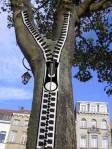
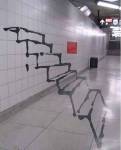
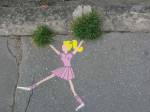
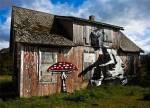
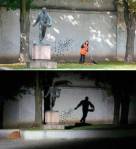
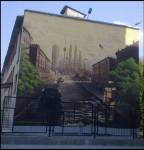
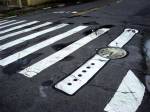
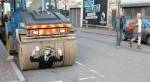
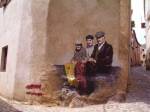
Happy Friday! I was forwarded one of those massive emails with a lot of great street graffiti and art, all of them commenting on their environment, as well as adding beauty and interest. I will add credits and attribute authors as soon as I find out who everyone is (if you know any of the artists please let me know in the comments below), but for now just some nice eye candy to get you ready for the weekend. Enjoy!
Can humans be happy in cities? Ann Arbor as seen from the University of Michigan Stadium. (Photo credit: Wikipedia)
A nice article from The Atlantic about how urban designers can do things to make living in the city a truly happier place to live:
I’ve been looking at some research reports, and confirming that some of the qualities associated with great urbanism – good public transit; easy access to cultural activities, recreation and shops; connectedness – are associated positively with human happiness. I first reported on a study reaching just those conclusions back in early February. Others found the study as well, concluding that residents of “beautiful, well-designed cities” are happier than those living in suburbs.
[Some research] points out, however, that other research contradicts those conclusions, or at least muddies them significantly.
Still another study – this one involving a bit of self-selection, since its data were generated by use of an iPhone app – finds that none of the above is true, since nature is what really produces a good mood.
There are definitely positive elements to living the city: more social contact with others, social and cultural events, potential access to a variety of fresh fruits and veggies, and more. There is also the flip side to all of those positives.
Read the entire article, and write back with your own opinion: do you believe that people can be happier in the city?
Babies are born social scientists. (Photo credit: Wikipedia)
Happy Friday! I read this article in the New York Times about Dr. Liz Spelke, at Harvard University, who studies the neuroscience of babies.
Dr. Spelke is a pioneer in the use of the infant gaze as a key to the infant mind — that is, identifying the inherent expectations of babies as young as a week or two by measuring how long they stare at a scene in which those presumptions are upended or unmet.
While the article primarily focused on what we can glean from babies about human cognition and knowledge, I couldn’t help but pick up on the author’s observations that the main thing the baby test subjects want to do, and the main thing that is enriching to them, is engage with the people around them (and how enriching it is for the grown-ups involved too):
The 15-pound research subject … tracked conversations, stared at newcomers and burned off adult corneas with the brilliance of her smile. Dr. Spelke, who first came to prominence by delineating how infants learn about objects, numbers, the lay of the land, shook her head in self-mocking astonishment.
“Why did it take me 30 years to start studying this?” she said. “All this time I’ve been giving infants objects to hold, or spinning them around in a room to see how they navigate, when what they really wanted to do was engage with other people!”
Babies are born with a desire to learn and engage in their world. They are pretty helpless, and so the only thing they have to defend themselves, as well as learn, is to engage with others and beg for help. As soon as they figure out who’s safe, they look for more people like that:
Katherine D. Kinzler, now of the University of Chicago, and Kristin Shutts, now at the University of Wisconsin, have found that infants just a few weeks old show a clear liking for people who use speech patterns the babies have already been exposed to, and that includes the regional accents, twangs, and R’s or lack thereof. And in guiding early social leanings, accent trumps race.
But, babies are also fascinated with the unknown, and will stare at new concepts and objects for much longer than the known items and individuals.
To me the really interesting thing is that what most interests the baby subjects is getting to know the researchers. As grown-ups we don’t have to lose that sense of wonder. Many people grow up to be researchers (like Dr. Spelke). We can continue to be fascinated by our surroundings and new people and always seek knowledge about what’s around us.
P.S.: Also, just if you’re curious, according to the Spelke lab here are some of the things that babies know, generally before the age of 1:
They know what an object is. They know that objects can’t go through solid boundaries or occupy the same position as other objects, and that objects generally travel through space in a continuous trajectory.
Babies can estimate quantities and distinguish between more and less. They also can perform a kind of addition and subtraction, anticipating the relative abundance of groups of dots that are being pushed together or pulled apart.
Infants and toddlers use geometric clues to orient themselves in three-dimensional space, navigate through rooms and locate hidden treasures.
Jeff Ragsdale, the instigator for "One Lonely Guy" (Photo credit: Wikipedia)
More and more studies are coming out about how Americans feel more isolated than ever, and that we have less “close” friends despite being more connected to people via social media and technology.
One book was recently released that explores that idea of loneliness and the need for humans to connect with each other through the case of one man’s ad and the voicemails he received in response. From University of Washington News:
In October 2011, former University of Washington student Jeff Ragsdale, living in New York, had hit a low point — his stand-up comedy and acting career had stalled, he had been through a bad breakup and he was living in a cheap rented room. Despondent, Ragsdale posted a flyer around the city that said, “If anyone wants to talk about anything, call me. (347) 469-3173.”
To his surprise he got about 100 calls and texts the first day alone, and they kept on coming, finally numbering in the thousands. In time he brought the messages to the attention of his former teacher, UW English Professor David Shields. From that came the book “Jeff, One Lonely Guy,” edited by Ragdsale, Shields and Michael Logan of Seattle.
“I had kept in touch with Jeff over the years; I knew he was always up to interesting projects,” said Shields. “Jeff kept sending me the most amazing transcriptions of phone calls and texts that he had received. At a certain point, I just couldn’t say no. The material was simply too interesting; it spoke too deeply to the culture.
“What I love about the book (and I can say this because it’s less anything any of us did, and it’s more the voices that came in on Jeff’s cell phone) is what it tells us about what it’s like to live in America right now. I can’t think of a book that evokes more specifically how people talk now (the new words and phrases and sayings are extraordinary — it’s a virtual Roget’s of contemporary slang); how much they/we hunger for connection to themselves/ourselves, to each other, to a larger community; how energized and enervated they are/we are by Big Media and digital culture; how confusing love is in a 24/7 porn environment; and how baffling transcendence is — how fame or brief flickers of fame seem to beckon out of every internet portal. This book is a remarkable document of contemporary existence.”
The explorations of loneliness and connectedness sparked by one simple ad is pretty incredible. The book itself is also pretty powerful in that it truly is a collaborative effort, not only edited by three guys, but the content of the book is created from the voicemails of 100’s of individuals who were looking to connect with another individual in some way.
In Seattle we talk about the “Seattle Freeze,” this phenomenon where it’s hard for newcomers to make friends, but it sounds like it’s a problem all over the U.S. Would you say you have a close friend, or close friends? Would you say you feel connected to where you live, to your community? Why do you think we feel so disconnected from our neighbors compared to 30 years ago? Leave your thoughts in the comments below.
Great story from TreeHugger about self-proclaimed “Urban Hacktivist” Florian Riviere and some of the various “hacks” he’s done:
When it comes to redefining public space and objects, Florian Rivière is a master. The self-described “urban hacktivist” transforms parking spots into hockey rinks, sidewalk barriers into tables, and uncomfortable benches into lounge chairs for the homeless.
I absolutely agree with TreeHugger when they say:
I love it when people re-imagine how urban space is used; it’s a fantastic way to make cities more liveable, practical and fun, without needing major construction projects or the hassle of red tape.
This is just one example of “hacking” public space in a fun creative way. I still remember the yarn-bombing movement that really took off a couple of years ago but seems to have died down for now.
There was also the Swing at the bus stop.
What other examples of urban “hacktivism” have you seen? Share them in the comments below.
I love the fact that playgrounds are incorporating the stuff that kids love to play with the most – dirt, rocks, and sticks!
Children won’t find new monkey bars and bright plastic play structures at the upgraded Donnan Park.
Instead, the aging playground at 9105 80th Ave. will become Edmonton’s first “natural playground,” part of a growing trend in playground design.
Children in the redesigned Donnan Park will entertain themselves with such timehonoured playthings as rocks, sticks, sand and dirt. The overhauled space will feature a slide built into a hill, a sideways-growing tree, a boulder spiral, a hand pump to pour water into a small stream and plenty of plants, trees and greenery.
It will be “a beautiful garden that everyone plays in,” says Kory Baker-Henderson, co-chair of the neighbourhood committee that worked on the preliminary playground design with expertise from Ontario-based Bienenstock Natural Playgrounds.
“Around us there are already some typical playground structures, so we wanted to have something different that blends in with the (Mill Creek) ravine,” Baker-Henderson says.
“Studies have shown imaginative play is much more stimulated (in natural settings) and children actually will play longer and become much more involved than on a typical red, plastic slide structure. Their games will just get much more imaginative. There’s that connection with nature. We have plans for a community garden, so it’s a learning and teaching tool, too.”
The playground at Donnan Park currently has swings and a slide that will remain for now, but won’t be replaced, she says.
With gas prices going through the roof, many people are taking to walking more. But after being car-focused in our navigation for decades, it can be unusual for people to know how to get around by walking and how long it will take them. One student from Raleigh, North Carolina, has an idea:
On a rainy night in January, urban planning student Matt Tomasulo and two fellow schemers positioned 27 signs in three strategic locations across central Raleigh. In bold, authoritative letters, each sign indicates the number of minutes it would take for a pedestrian to reach a particular, popular destination.
And for the directionally challenged, the otherwise spartan signs are equipped with a high-tech surprise. By scanning the signs with a smartphone, pedestrians can receive a specially tailored Google Map that will keep them on the right path.
Tomasulo and his colleagues at City Fabric have dubbed their effort Walk Raleigh, and have submitted the project to the Spontaneous Interventions competition, a contest sponsored by the Institute for Urban Design. In terms of impressing judges, the group is off to a good start: far from being displeased by Tomasulo’s guerrilla antics, the city of Raleigh has expressed interest in permanently incorporating Walk Raleigh’s signs into the city’s landscape.
I’m glad the city of Raleigh is encouraging this, and I hope it catches on in other places. I think it’s great to share our knowledge of neighborhoods with others and let them get to know their cities and environments a little bit better. Plus it’s just fun.
Have you seen similar signs in other cities? Tell me about it in the comments below.
Simple: I saw some inspirational work, and had some immensely rewarding conversations.
We took a meandering and surprisingly green route across most of the NDC area to Radnor Street Gardens.
This is one of London’s best examples of a ‘playable space’ – in other
words, a space where offering opportunities for play is only one of the
jobs that has to be done. My work for the GLA
[pdf link] helped to embed this idea in London’s planning system. In my
view, it is fundamental to the success of public play facilities in
almost any urban area.
What struck me was how the programme combined park, amenity space and
play projects, along with streetscape and highways initiatives, so that
the whole far exceeded the sum of its parts. The ingredients we saw
included [*deep breath*]: new play spaces and toilet blocks in parks and
estates, new public squares from reclaimed street space and car parks, ‘home zone’-style
shared road surfaces, landscaped road closures, greening up an adventure playground, estate-based allotment projects, cycle lanes,
shared use ball game areas, pushchair-friendly pavements, even (on one
estate) new refuse bin sheds with green roofs. Her approach to
engagement was revealing. Local people were closely involved at all
levels, right up to the NDC board. However, they were seen not simply as
‘stakeholders’ or ‘consumers’, but as people who needed to be inspired,
debated with, and (hopefully) won over.
I think this is a great idea; just as we have garden tours, we should have playground tours! Areas that introduce parents and officials alike to playful, fun spaces to take their kids.
This blog actually has some great conversations about play and the need for children to get outside and play more.
























 Mental Flowers